
Quick answer
Clogged gutters and short downspouts are among the least expensive causes of basement water intrusion to fix. Clean gutters twice a year, confirm they slope toward the downspouts, and extend every downspout at least four to six feet from the foundation. Soil should fall roughly six inches over the first ten feet away from the house. Call (888) 840-6512 to reach a certified water damage restoration company in your area; the line is answered 24/7.
Written & reviewed by Marcus ReedIICRC WRT
Reviewed July 1, 2026· Next review Jan 2027
Gutters & Downspouts: How to Prevent Water Damage
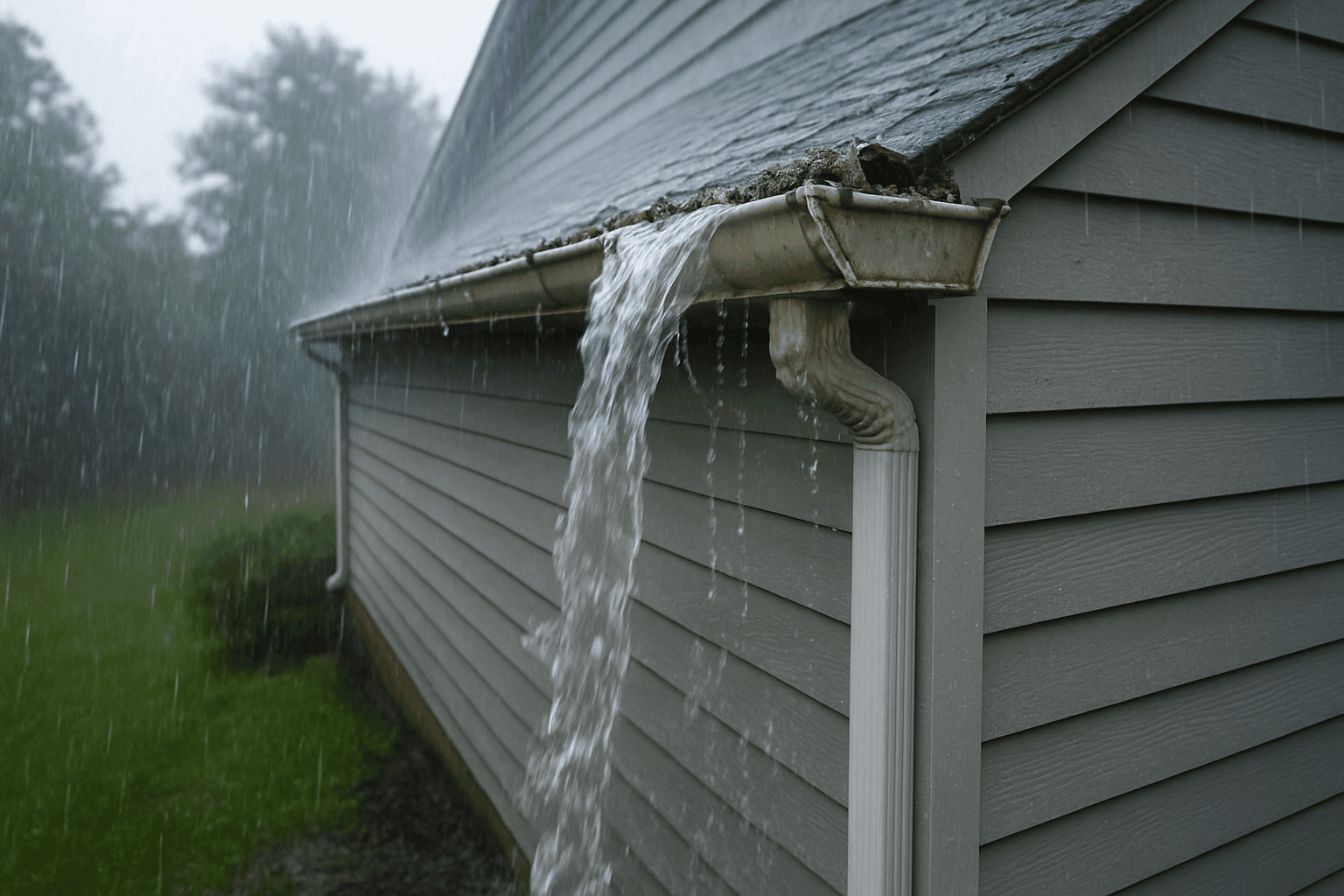
Clogged gutters and misdirected downspouts are among the most preventable causes of serious water damage. A properly functioning gutter system directs all roof runoff away from your foundation — a failed system concentrates that water at the worst possible location.
How Gutters Cause Water Damage
When gutters clog, water has nowhere to go but over the edge. Overflow typically falls directly along the foundation, saturating the adjacent soil and creating hydrostatic pressure against basement walls. Over time, this is a primary driver of:
- Basement flooding — saturated soil hydrostatic pressure forces water through cracks and the floor-wall joint
- Foundation damage — chronic hydrostatic pressure slowly cracks and bows foundation walls
- Fascia rot — water running behind the gutter saturates the wood fascia board, leading to rot and allowing water into the roof edge
- Soffit and attic damage — a pulled-away or overflowing gutter allows water to reach soffit vents and the attic
- Ice dams — clogged gutters full of ice and snow backup water under shingles in winter
How Downspouts Cause Water Damage
A downspout that terminates at the foundation wall or within 2 feet effectively delivers all roof runoff directly against the most vulnerable perimeter of your home. A 1,500 sq ft roof in a 1-inch rain event generates approximately 900 gallons of water — all of which a short downspout pours against your foundation.
Maintenance Schedule
Twice per year: Clean gutters in late spring (after seeds and spring growth) and late fall (after all leaves have fallen). Homes under heavy pine or oak tree cover may need 3–4 cleanings annually.
At each cleaning:
- Remove all debris from the gutter channel
- Flush gutters with a hose to verify slope toward downspouts
- Clear the downspout opening — a clogged downspout outlet is as problematic as a clogged gutter
- Inspect all joints, seams, and end caps for gaps — reseal with gutter caulk where needed
- Check that gutters are attached firmly to the fascia — a gap indicates pulling away from the wood, allowing water behind
Annually:
- Inspect fascia boards for soft spots or discoloration (rot)
- Verify all downspouts discharge at least 6 feet from the foundation
- Check gutter slope — gutters should pitch 1/4 inch per 10 feet toward the downspout outlet; standing water after rain indicates incorrect slope
Downspout Extensions: The Highest-ROI Prevention Step
Extending downspouts costs $10–$30 per downspout. This single action — directing roof runoff away from the foundation — is one of the highest return-on-investment flood prevention measures a homeowner can take.
Rigid aluminum extensions are preferable to flexible accordion-style extensions. Flexible extensions collect debris, kink, disconnect from the downspout, and often end up directing water sideways rather than away from the house.
Underground discharge via a buried corrugated pipe running to a daylight exit 10–20 feet from the foundation is the most permanent solution. Cost: $200–$600 per downspout installed by a landscaper.
Do Gutter Guards Eliminate Cleaning?
No — but they significantly reduce frequency. Gutter guards prevent large debris but allow small particles, pine needles, and roof grit to pass through. Plan for annual inspection even with guards installed.
The bigger risk with gutter guards: homeowners assume they never need attention, go years without inspection, and find a completely failed or debris-blocked gutter when they finally look. Annual inspection prevents this.
Signs Your Gutters Are Causing Water Damage Right Now
- After heavy rain: water at the base of your foundation, wet soil along the house perimeter
- Basement seepage occurring during or immediately after rain events
- Paint peeling on fascia boards behind gutters
- Mold or efflorescence on basement walls on the side of the house under a downspout
- Erosion in the soil directly below a downspout that terminates too close to the house
Talk to a water damage pro now
Answered 24/7 · Toll-free · answered 24/7 · no obligation
(888) 840-6512- Describe the damage & give your ZIP
- You're routed to the on-call local crew
- They quote — you decide, no obligation
Reading to confirm what you already suspect?
Confirm it in two minutes instead — the pro on this line answers questions about YOUR situation all day: what it is, what it should cost, whether you even need service. If you want, they'll set the appointment on the same call.
Toll-free · no obligation · asking costs nothing
Frequently Asked Questions
- 1Rigid underground discharge pipes ($200–$600 installed) carry gutter water 6–10 feet from the foundation and daylight at grade — no above-ground tripping hazard and highly effective
- 2Pop-up emitters release water when hydrostatic pressure builds during rain and seal when not in use, preventing pest and debris entry
- 3Grade correction — if soil within 6 feet of the foundation is flat or slopes toward the house, regrading costs $500–$1,500 and may have more waterproofing impact than any gutter modification alone. Gutters and downspouts also need cleaning — a clogged gutter causes overflow at the foundation line, exactly where you do not want water concentrating. Clean gutters twice per year (spring and fall) and after any major storm with significant leaf fall. Install gutter guards if debris accumulation is chronic.
How often should I clean my gutters?
Most homes need gutter cleaning twice per year: once in late spring (after seed pods and spring growth) and once in late fall (after leaves are done falling). Homes under heavy tree cover — especially pine trees — may need cleaning 3–4 times per year.
If your gutters overflow during rain, they're clogged. Gutters full of debris become heavy, pulling away from the fascia and creating a gap where water can flow behind the gutter directly onto the fascia board and into the wall.
How far should downspouts discharge from the foundation?
The minimum recommended discharge distance is 6 feet from the foundation. The further the better — 10 feet is ideal. Downspout extensions (flexible plastic or rigid aluminum) are available at any hardware store for $10–$30.
A downspout that terminates at the foundation wall or within 2 feet effectively channels all roof water directly against the most vulnerable point of your home's water barrier. This is one of the highest-ROI preventive measures a homeowner can take.
Can gutters cause basement flooding?
YesDirectly. Overflowing gutters discharge water along the foundation perimeter, saturating the soil directly adjacent to basement walls.
This creates hydrostatic pressure that forces water through foundation cracks and the floor-wall joint. A properly functioning gutter system directs all roof runoff away from the foundation — a clogged gutter system concentrates that water in the worst possible location.
Do gutter guards eliminate the need for cleaning?
NoGutter guards significantly reduce the frequency of cleaning but do not eliminate it. Gutter guards still allow debris accumulation on top of the guard, small particles to pass through into the gutter, and pine needles to pass through most guard types.
The biggest risk with gutter guards: homeowners assume they never need cleaning, go years without inspection, and find a completely debris-clogged gutter when they finally look. Plan for annual inspection even with guards installed.
How far from the foundation do downspouts need to discharge water to actually protect my basement?
Industry standard: downspout discharge extensions should direct water at least 4–6 feet away from the foundation — but this is a minimum, not an optimal target. The goal is to prevent water from pooling in the soil immediately adjacent to the foundation wall, which increases hydrostatic pressure and basement seepage. More effective approaches:
Who do I call right now for water damage?
Call (888) 840-6512. The line is answered 24 hours a day, seven days a week, and connects you with an IICRC-certified water damage restoration company that serves your area. Describe what you can see — where the water is coming from, how long it has been there, and whether it smells — the more specific you are, the faster the right company is on the line.
If the source is a pipe or an appliance, shut the main water valve first. Have four things ready and the call goes quickly: the address, when the water started, what is wet now, and whether you have filed an insurance claim.
Still not sure which of these is your situation? (888) 840-6512 · toll-free · answered 24/7
Sources
- IICRC S500 — Water Damage Restoration(retrieved 2026-07-02)
- EPA — Mold and Water Cleanup Guidance(retrieved 2026-07-02)
Methodology: How we source and verify data · Report an error
Disclaimer: HearthDry is an independent educational resource. This article is for informational purposes only and does not constitute professional, legal, or insurance advice. Consult licensed professionals before making decisions about your property or insurance claims.
Professional Equipment
If Water Gets In Despite Prevention — Dry It Fast
Even well-maintained gutters fail during heavy rain events. A compact dehumidifier in your basement or crawl space provides an early warning system — rising runtime signals elevated moisture before you see visible damage.
Affiliate link — HearthDry earns a commission from Sylvane via CJ at no extra cost to you
Watch
Source: This Old House — YouTube
Free 2-day shipping
Amazon Prime members pay no shipping on restoration equipment
Dehumidifiers, air movers, and moisture meters qualify for free Prime delivery — bulk items that otherwise cost $15–$40 to ship.
Affiliate link — HearthDry earns a bounty if you sign up; costs you nothing extra.
Equipment
What each machine actually does
Removes the moisture the structure is still giving off — the machine that decides how long drying takes
See the picks →Moves air across wet surfaces so the dehumidifier has something to take out of the air
See the picks →Finds water behind walls and under floors, and tells you when a material is actually dry
See the picks →Alerts you the moment a leak starts — the cheapest thing on this list and the only preventive one
See the picks →Those pages carry affiliate links. As an Amazon Associate, HearthDry earns from qualifying purchases; it costs you nothing extra.
Our Amazon storefront →Advertisement
