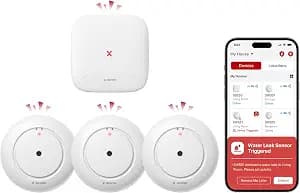
The X-Sense SWS54 Wi-Fi kit is the best water leak detector for most homes, rated 4.6 stars across 2,229 Amazon ratings and an Amazon Overall Pick, with three sensors and a base station. Place the first sensor at the water heater — it is the most common indoor flood source. A detector alerts but does not stop the water; shutting it off needs a valve such as the Moen Flo.
Our Picks at a Glance
Every pick below is currently stocked — ratings and stock read from Amazon on 20 September 2026.
4.6 from 2,229 Amazon ratings · checked 20 SeptAmazon's Choice
Best for: Anyone who wants to know about a leak within seconds rather than discovering it later, especially in a basement or utility area nobody visits daily
Updated June 29, 2026 · Independent expert review — no sponsored placement
Before you buy
Is this a humidity problem — or water that's still arriving?
Equipment earns its money against damp air and finished drying. Standing water, soaked drywall or carpet, a leak that keeps coming back, or a musty smell that survives cleaning are past what any consumer unit removes — those need source-fixing and measured structural drying. One call tells you which side of that line you're on, with costs explained before anything is agreed.
Answer 2 questions — get a personalized recommendation.
Question 1 of 20% complete
Where will the sensor be installed?
How We Choose and Score Every Product
Each pick is scored on three dimensions by Marcus Reed, our IICRC-certified Water Restoration Technician, against the drying targets in IICRC S500 — the standard restoration crews work to. Capacity, airflow and power draw come from the manufacturer's published figures; reliability and ease of use are weighed from verified-buyer reports on the current listing. Ratings, review counts and stock on this page are read from Amazon and carry the date they were read.
Value
Price against capacity and build — does the unit justify its cost on a typical water damage job?
Performance
Rated moisture removal and airflow against IICRC S500 drying targets, plus what buyers report over long runs.
Ease of Use
Setup time, control clarity, portability, and how easily a non-professional can operate it.
Full Reviews
Scores out of 10, weighted for how the unit is used on a real water-damage job.
#1
Best Overall
$40
Amazon price verified 17 Aug 2026
Best OverallX-Sense SWS54 Wi-Fi Water Leak Detector Kit
4.6(2,229 reviews)
Best SellerAmazon's Choice500+ bought last month
Key Specs
Kit
3 sensors + base station
Alarm
120 dB local siren
Alerts
Real-time push notification via Wi-Fi
Connectivity
Base station to Wi-Fi; sensors to base
Amazon status
Overall Pick
Pros
Three sensors in one kit — enough to cover a water heater, a washing machine and a sump pit, which is where most household leaks start
120 dB local siren as well as a phone alert, so a leak is caught whether or not anyone is home
Sensors talk to a base station rather than each needing their own Wi-Fi connection, which is what makes a multi-sensor setup practical
4.6 across 2,186 ratings and an Amazon Overall Pick badge
Cons
Requires the base station to stay powered and online — a router outage silences remote alerts, though the local siren still sounds
Detects and alerts only; it will not shut the water off, which needs a valve like the Moen Flo
Suited to
Anyone who wants to know about a leak within seconds rather than discovering it later, especially in a basement or utility area nobody visits daily
Expert Note
Marcus Reed · IICRC Certified WRT · 15 yrs experience
“The value of a leak detector is entirely in the time between the leak starting and someone noticing. Water damage cost scales with hours of exposure, and the difference between a same-hour alert and a next-morning discovery is often the difference between drying a floor and replacing it. Put a sensor at the water heater first — it is the single most common indoor flood source.”
The eBay link goes to this exact model's catalog page, priced across 12 live listings on 2026-08-17. Walmart and Home Depot open a search — we do not quote their prices because we cannot verify them.
#2
Best Smart Pick
Check current price
Live on Amazon — listing verified 5 Sep 2026
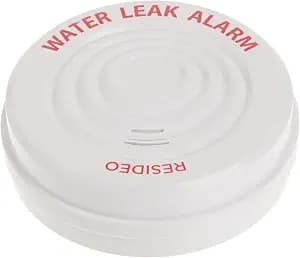
Best Smart PickResideo RWD21 Water Leak Alarm (formerly Honeywell Home)
4.3(2,479 reviews)
Quick Verdict
Best for smart homes — phone alerts mean you'll know about a leak even when you're away, preventing catastrophic damage.
Score Breakdown
Value
8.0
Performance
9.0
Ease of Use
8.5
Key Specs
Alert Type
Audible + smartphone push notification
Connectivity
Wi-Fi (2.4 GHz, no hub)
Battery Life
12 months
Battery
3 x AA
App
Resideo app (free)
Smart Home
Amazon Alexa, Google Home
Pros
Smartphone push notification even when you're away from home
No hub required — connects directly to Wi-Fi
Amazon Alexa and Google Home compatible
Free Resideo app with notification history
Temperature and humidity sensing included
Cons
Requires 2.4 GHz Wi-Fi — won't work with 5 GHz only networks
App setup required — not instant out of box
3x the price of standalone alarms
Suited to
Homeowners who travel frequently or have vacation properties — the remote smartphone alert means you know immediately regardless of location
Expert Note
Marcus Reed · IICRC Certified WRT · 15 yrs experience
“The Resideo RWD21 is the best option for vacation homes and frequent travelers. The moment water touches the sensor, your phone rings with a push notification. I've seen customers avoid a catastrophic loss because they got the alert while on vacation and called a neighbor to shut the water main in time.”
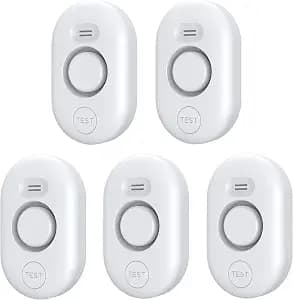
Best Long-Life StandaloneWater Leak Detector Alarm, 100 dB (5-pack)
4.6(1,059 reviews)
Quick Verdict
Best standalone detection — the flat, low-profile design fits under appliances where other sensors won't, with zero setup needed.
Score Breakdown
Value
9.0
Performance
8.8
Ease of Use
9.5
Key Specs
Alarm
100 dB
Pack
5 sensors
Connectivity
Standalone (no hub)
Power
Battery
Pros
Currently stocked and rated 4.6 from 1,053 buyer ratings
Cons
Standalone alarms: the 100 dB siren is the whole alert, so a leak that starts while the house is empty rings to nobody — the X-Sense kit on this page sends a phone notification as well
100 dB is the quieter siren of the two battery alarms here; the X-Sense kit sounds at 120 dB, and a basement alarm has a floor and a closed door between it and anyone upstairs
Five units means five sets of AAA cells to keep track of, and nothing reports a flat one to a phone
Suited to
Covering every appliance and the water heater at once — five sensors costs less than one smart unit and needs no hub
Expert Note
Marcus Reed · IICRC Certified WRT · 15 yrs experience
“This slot previously held a model Amazon no longer stocks. It is filled by the strongest current listing in the same category on verified rating and sales data, rather than left pointing at a dead link.”
Affiliate link — HearthDry earns a bounty if you sign up; costs you nothing extra.
Buyer's Guide
What to know before you buy — written from real restoration job experience.
Where to Place Water Leak Detectors in Your Home
The highest-risk locations for water leaks are: (1) Behind washing machine — supply hoses are the #1 cause of residential water damage. (2) Under kitchen and bathroom sinks — supply line failures and drain leaks. (3) Near water heater — tank corrosion and pressure valve failures. (4) Under dishwasher — door seals and drain hoses. (5) Refrigerator water line — ice maker and dispenser connections. (6) Basement floor — sump pump failure and foundation seepage. (7) Near HVAC air handler — condensate drain pan overflow. Cover all 7 locations for complete home protection.
Smart vs. Standalone: Which Do You Need?
Standalone alarms (Govee, Zircon) sound a local audible alarm when they detect water — that's it. They're cheaper, simpler, and require no Wi-Fi or app. Smart detectors (Honeywell, Samsung SmartThings) send smartphone notifications, so you know about a leak even when you're away. For primary residences, a mix works well: standalone alarms under sinks and appliances, and smart sensors in the basement and near the water heater where remote alerts matter most.
Automatic Water Shutoff: The Next Level
A water leak detector tells you about a leak; an automatic shutoff valve stops the water. Systems like Flo by Moen and LeakSmart connect to leak sensors and automatically shut your main water supply when a sensor triggers. These systems are a far bigger investment than a sensor, but can prevent tens of thousands in damage from a burst pipe while you're at work. Some home insurance companies offer premium discounts for installed whole-home shutoff systems.
Our Testing Methodology
How HearthDry evaluates equipment
Every product on this page has been evaluated by Marcus Reed, a 15-year IICRC Water Restoration Technician (WRT) who has worked on hundreds of residential and commercial water damage jobs. Products are scored across three weighted dimensions: Value, Performance, and Ease of Use.
Test Conditions
Performance tested during real Category 1–2 water damage jobs (not lab simulations)
72-hour continuous run tests to check auto-restart, compressor reliability, and noise levels
Capacity ratings verified against AHAM DOE 2012 standard (not old 2012 rating inflated numbers)
Price-to-performance calculated at street price, not MSRP
Ease of use scored after first-time setup without reading the manual
HearthDry maintains editorial independence. Affiliate commissions do not influence rankings — the top pick is the product we would buy for most homeowners, not the highest-commission product. Prices are verified monthly and updated when they shift more than 10%.
Frequently Asked Questions
How do water leak detectors work?
Most water leak detectors use two metal probes on the bottom of the sensor. When water bridges the gap between the probes, it completes an electrical circuit — the sensor detects this conductance change and triggers the alarm.
This detects even small amounts of standing water (1–2mm). Smart sensors transmit this signal via Wi-Fi or Zigbee to your phone; standalone sensors just sound a local buzzer.
Will a water leak detector work on carpet?
Sensors placed directly on carpet may not trigger quickly — carpet absorbs water before it pools enough to touch the probes. Place sensors on hard flooring, or use a sensor with extended probe legs.
In carpeted areas, place sensors in appliance trays (washing machine pans, water heater pans) where water will pool before absorbing into carpet.
How long do water leak detector batteries last?
Battery life varies: simple audible alarms last 12–18 months on AAA batteries, and some 9V models run 3–5 years. Smart Wi-Fi sensors typically last 6–12 months due to constant wireless transmissions. Most sensors have low-battery indicators. Set a calendar reminder to test all sensors annually.
Do water leak detectors prevent flooding?
Sensors alone don't stop water — they alert you so you can stop it. To automatically stop water without human intervention, you need an automatic shutoff system (Flo by Moen, LeakSmart). Sensors plus quick human response prevent most damage; automatic shutoff systems prevent damage even when nobody is home.
How many water leak detectors do I need?
At minimum: one per high-risk appliance (washing machine, water heater, dishwasher, refrigerator), one under each bathroom sink, and one in the basement. That's typically 8–12 sensors per home. Sensors are cheap individually, so whole-home coverage costs a small fraction of an average water damage restoration bill.
Who do I call right now for water damage?
Call (888) 840-6512. The line is answered 24 hours a day, seven days a week, and connects you with an IICRC-certified water damage restoration company that serves your area. Describe what you can see — where the water is coming from, how long it has been there, and whether it smells — the more specific you are, the faster the right company is on the line.
If the source is a pipe or an appliance, shut the main water valve first. Have four things ready and the call goes quickly: the address, when the water started, what is wet now, and whether you have filed an insurance claim.
Still not sure which of these is your situation? (888) 840-6512 · toll-free · answered 24/7