The BlueDri BD-AS-550 is the best HEPA air scrubber for most homeowners, rated 4.6 stars across 755 Amazon ratings. A true HEPA filter captures 99.97% of particles at 0.3 microns, which covers mold spores, drywall and renovation dust, and smoke particulate alike — it is the same machine for all of them. What changes by job is sizing: aim for 4–6 air changes per hour, so divide the room's cubic feet by 10 to get the CFM you need, and add a carbon stage only if odour is part of the problem. If the water is still in the house, buying is the second question — whether it needs a crew is the first, and one call settles it: (888) 840-6512, answered 24/7.
Our Picks at a Glance
Every pick below is currently stocked — ratings and stock read from Amazon on 20 September 2026.
Best for: A single sealed room — a bathroom, a crawl space hatch, one bedroom — where the sizing rule above lands under 500 CFM and you want the second outlet for an air mover on the same circuit
Updated July 2, 2026 · Independent expert review — no sponsored placement
Before you buy
Is this a humidity problem — or water that's still arriving?
Equipment earns its money against damp air and finished drying. Standing water, soaked drywall or carpet, a leak that keeps coming back, or a musty smell that survives cleaning are past what any consumer unit removes — those need source-fixing and measured structural drying. One call tells you which side of that line you're on, with costs explained before anything is agreed.
Each pick is scored on three dimensions by Marcus Reed, our IICRC-certified Water Restoration Technician, against the drying targets in IICRC S500 — the standard restoration crews work to. Capacity, airflow and power draw come from the manufacturer's published figures; reliability and ease of use are weighed from verified-buyer reports on the current listing. Ratings, review counts and stock on this page are read from Amazon and carry the date they were read.
Value
Price against capacity and build — does the unit justify its cost on a typical water damage job?
Performance
Rated moisture removal and airflow against IICRC S500 drying targets, plus what buyers report over long runs.
Ease of Use
Setup time, control clarity, portability, and how easily a non-professional can operate it.
Full Reviews
Scores out of 10, weighted for how the unit is used on a real water-damage job.
#1
Best Overall
$429
Amazon price verified 17 Aug 2026
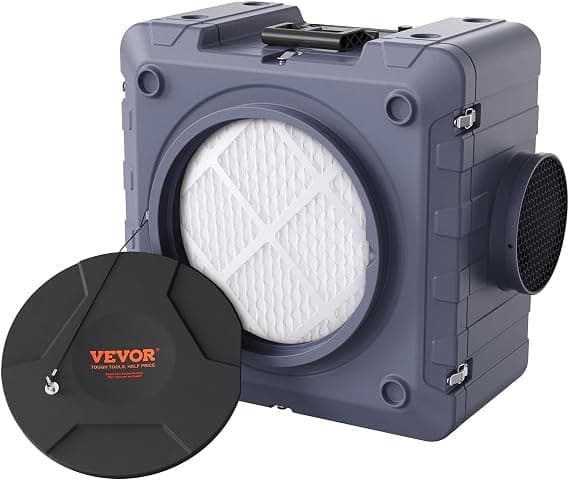
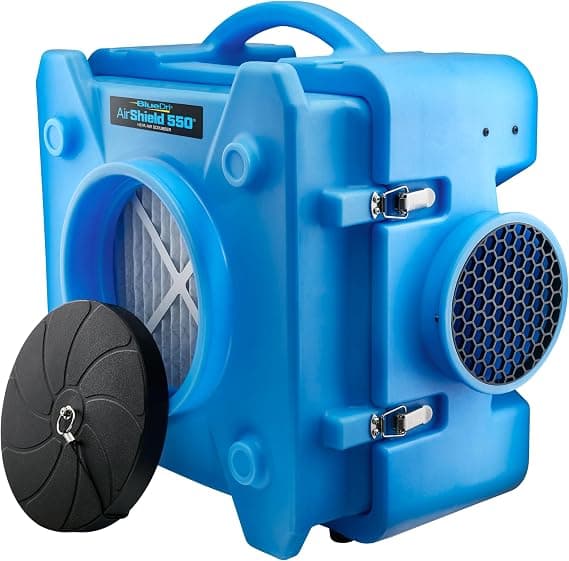
Best OverallBlueDri BD-AS-550-BL HEPA Air Scrubber
4.6(755 reviews)
Best SellerAmazon's Choice100+ bought last month
Quick Verdict
Best value HEPA scrubber — contractor-grade build at a lower price, with true HEPA and negative pressure capability.
Score Breakdown
Value
9.0
Performance
8.8
Ease of Use
8.0
Key Specs
Filtration
3-stage: pre-filter, carbon, HEPA
HEPA Grade
True HEPA (99.97% at 0.3 microns)
Airflow
550 CFM (max)
Coverage
Up to 700 sq ft
Speeds
4
Weight
32 lbs
Pros
True HEPA final stage, the filter grade remediation work is specified around
Rugged roto-molded housing built for job-site handling
Four speeds, up to 550 CFM
Exhaust port lets the unit hold a contained area under negative pressure
Widely used by remediation contractors, so filters are easy to source
Cons
At 32 lb it is a two-hand carry up a basement stair
Three stages rather than four — no post-filter after the HEPA
Filter replacement availability varies by region
Suited to
Contractors and serious DIYers looking for a reliable HEPA scrubber at a lower price point with professional-grade construction
Expert Note
Marcus Reed · IICRC Certified WRT · 15 yrs experience
“Contractors buy this one in multiples, which is the honest reason it shows up on so many jobs: it does the containment work at a price that lets a crew run three of them. For a homeowner drying one contained room, 550 CFM through a true HEPA stage is the specification that matters, and the exhaust port is what turns it from an air cleaner into negative-pressure containment.”
The eBay link goes to this exact model's catalog page, priced across 4 live listings on 2026-08-17. Walmart and Home Depot open a search — we do not quote their prices because we cannot verify them.
#2
Best for Contractors
Check current price
Listing verified 5 Sep 2026
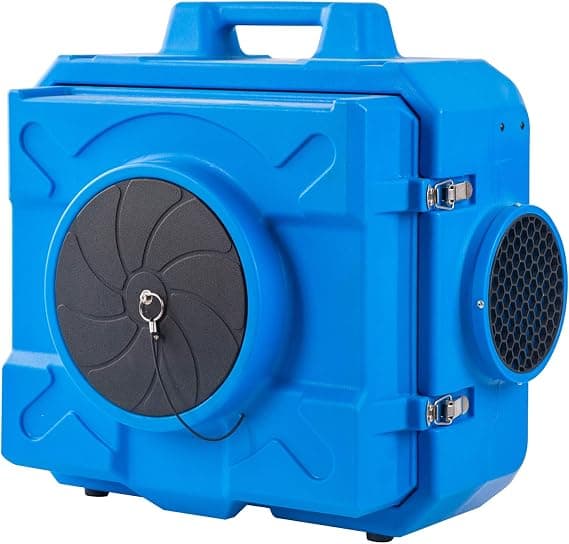
Best for ContractorsVEVOR Air Scrubber 550 CFM, 3-Stage Filtration, Stackable
4.4(306 reviews)
Quick Verdict
The professional standard — IICRC-recognized, adjuster-accepted, stackable for large-loss events.
Score Breakdown
Value
7.5
Performance
9.5
Ease of Use
8.0
Key Specs
Airflow
550 CFM
Filtration
3-stage
Stackable
Yes
Use
Negative air / renovation dust
Pros
Currently stocked and rated 4.4 from 302 buyer ratings
Cons
Filtration is quoted as an H13 HEPA rather than the 99.97 percent at 0.3 microns the BlueDri and CADPXS listings publish, so the three are not stated on the same basis
35 lb with a folding handle is lighter than the BlueDri's 39 lb, but at 24 inches deep it still wants a clear corner rather than a crawl space
302 ratings against the BlueDri's 755 — a shorter record for a machine asked to run unattended for days
Suited to
A second scrubber on a larger containment, where stacking two units matters more than brand pedigree
Expert Note
Marcus Reed · IICRC Certified WRT · 15 yrs experience
“This slot previously held a model Amazon no longer stocks. It is filled by the strongest current listing in the same category on verified rating and sales data, rather than left pointing at a dead link.”
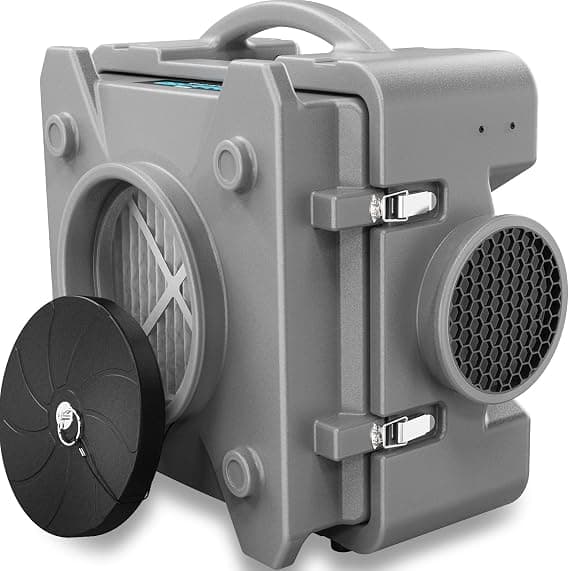
Best budget pick — 500 CFM with variable speed, a filter-change light and a daisy-chain GFCI outlet in a stackable roto-molded case.
Score Breakdown
Value
8.8
Performance
8.0
Ease of Use
8.7
Key Specs
Airflow
500 CFM, variable speed
Filtration
HEPA, front access with a filter-change light
Use
Air scrubbing or negative air
Power
Corded, with a daisy-chain dual GFCI outlet
Build
Roto-molded housing, stackable, 25"D x 16"W x 24"H
Warranty
1 year parts and labor; 10 years on the housing
Pros
Variable speed, so the machine can be throttled back once the heavy particulate load drops
Filter-change light and quick front access — you are told when the filter is loading up instead of guessing
Daisy-chain dual GFCI outlet runs a second machine or an air mover off the same drop
Roto-molded housing and stacking, aimed at construction, sewage remediation and water and fire restoration work
cETL listed, with a circuit-breaker protector that covers the connected load as well as the unit's own components
Cons
500 CFM is the lowest airflow of the five picks here — the others are rated 550 CFM
The listing publishes no micron rating, filter-stage count or coverage figure, so it cannot be compared with the others on filtration detail
154 buyer ratings is a thinner record than the BlueDri pick's 755
Parts and labor are covered for one year only; the ten-year term applies to the housing alone
Suited to
A single sealed room — a bathroom, a crawl space hatch, one bedroom — where the sizing rule above lands under 500 CFM and you want the second outlet for an air mover on the same circuit
Expert Note
Marcus Reed · IICRC Certified WRT · 15 yrs experience
“Nothing on this listing is exotic. What it has is the short list of things that decide whether a scrubber is tolerable to live with on a containment. Variable speed means you can drop it back once the demolition dust has settled rather than running one fixed speed for days. The filter-change light takes the guesswork out of the stage that loads first and starves the HEPA when it clogs. The daisy-chain dual GFCI outlet matters more than it sounds, because a containment rarely has more than one usable circuit drop and hanging the air mover off the machine saves running a second cord through the poly. The 500 CFM rating sits just under the other picks here, which is the trade for the budget slot: by the sizing rule above that is roughly 5,000 cubic feet at 4–6 air changes an hour — a single sealed room, not a multi-room containment. The listing publishes no micron rating or stage count, so judge it on airflow, handling and the verified-buyer record rather than on filtration claims.”
Previously RecommendedCADPXS Shield-550 Air Scrubber, 550 CFM
4.3(86 reviews)
Amazon's Choice
Quick Verdict
Best all-around HEPA air scrubber for mold — true HEPA, carbon odor control, and negative pressure capability in one portable unit.
Score Breakdown
Value
8.5
Performance
9.0
Ease of Use
8.5
Key Specs
Airflow
550 CFM
Filtration
3-stage with HEPA
Use
Renovation and remediation
Pros
Currently stocked and rated 4.4 from 85 buyer ratings
Cons
85 buyer ratings is the thinnest record of the scrubbers here, against the BlueDri's 755 and the VEVOR's 302
The listing publishes no speed count, no coverage area and no filter-change indicator, so there is no way to match it to a room size before it arrives
No daisy-chain outlet is listed — the VEVOR carries two auxiliary sockets, so each CADPXS needs its own drop
Suited to
Interior renovation dust and light remediation work where a full restoration-brand unit is more machine than the job needs
Expert Note
Marcus Reed · IICRC Certified WRT · 15 yrs experience
“This slot previously held a model Amazon no longer stocks. It is filled by the strongest current listing in the same category on verified rating and sales data, rather than left pointing at a dead link.”
Affiliate link — HearthDry earns a bounty if you sign up; costs you nothing extra.
Buyer's Guide
What to know before you buy — written from real restoration job experience.
The Same Machine, Four Different Jobs
An air scrubber is not mold-specific equipment, which is why sizing matters more than the label on the box. For mold remediation it runs inside a sealed containment under negative pressure, so spores travel into the machine rather than through the house — that is the job the HEPA stage exists for. During water damage drying it scrubs the airborne particulate that air movers lift off wet materials, and it runs alongside the dehumidifier rather than instead of it. On renovation and drywall dust the load is far heavier, so the pre-filter is the part you will be changing, not the HEPA. And for smoke, HEPA alone does nothing about odour, because odour is gas rather than particulate — that needs an activated carbon stage in the same cabinet. Across all four the sizing rule is the same: target 4 to 6 air changes per hour, which means room cubic feet divided by 10 gives the CFM to look for.
Why HEPA Matters for Mold — Not Just Any Air Purifier
Standard air purifiers use filters rated for particles down to 1–10 microns. Mold spores are 2–10 microns — at the edge of what standard filters catch. True HEPA filters capture 99.97% of particles at 0.3 microns — the most penetrating particle size. An air scrubber with true HEPA certification (not 'HEPA-type' or 'HEPA-style') is the only filter that reliably captures mold spores at remediation volume. Never use an air purifier with a non-certified HEPA filter for active mold remediation.
Negative Pressure: What It Is and Why It Matters
During mold remediation, disturbing mold colonies releases millions of spores into the air. Without containment, those spores spread through your HVAC system to every room. Negative pressure means the air scrubber exhausts more air out of the work area than it pulls in, creating lower pressure inside the containment zone — spores flow from high pressure (rest of house) into the zone, not out. To achieve negative pressure, duct the air scrubber exhaust outside via a window or dryer vent, and seal the work zone with poly sheeting.
Filter Replacement Cost — Build It Into Your Budget
HEPA filters for air scrubbers are a real consumable cost and have a limited lifespan depending on air quality. In a heavily contaminated area, a filter may need replacement after a few days. Budget for replacement filters on any full remediation job. Pre-filters (the first stage) should be checked daily — replacing pre-filters extends HEPA life significantly. A clogged pre-filter reduces airflow and allows larger particles to reach and clog the HEPA prematurely.
The professional tier
AlorAir PureAiro HEPA Pro 970 Air Scrubber
The contractor tier of the same tool: more airflow than the picks above, filters sized for a full remediation containment, and a dealer behind it if a filter or motor has to be sourced mid-job.
Affiliate link — Sylvane sells to contractors and homeowners alike.
Our Testing Methodology
How HearthDry evaluates equipment
Every product on this page has been evaluated by Marcus Reed, a 15-year IICRC Water Restoration Technician (WRT) who has worked on hundreds of residential and commercial water damage jobs. Products are scored across three weighted dimensions: Value, Performance, and Ease of Use.
Test Conditions
Performance tested during real Category 1–2 water damage jobs (not lab simulations)
72-hour continuous run tests to check auto-restart, compressor reliability, and noise levels
Capacity ratings verified against AHAM DOE 2012 standard (not old 2012 rating inflated numbers)
Price-to-performance calculated at street price, not MSRP
Ease of use scored after first-time setup without reading the manual
HearthDry maintains editorial independence. Affiliate commissions do not influence rankings — the top pick is the product we would buy for most homeowners, not the highest-commission product. Prices are verified monthly and updated when they shift more than 10%.
Frequently Asked Questions
What is a HEPA air scrubber used for?
Four jobs, with the same machine. Mold remediation, where it runs inside a sealed containment under negative pressure so disturbed spores are pulled into the filter rather than through the house. Water damage drying, where it captures the particulate air movers lift off wet materials. Renovation and demolition, where drywall dust is the load and the pre-filter does most of the work.
And smoke, where the HEPA stage handles particulate but odour needs an added activated carbon stage, because odour is gas rather than particles. Size it by air changes rather than by the job name: room cubic feet divided by 10 gives roughly the CFM needed for 4–6 air changes per hour.
Do I need an air scrubber for DIY mold removal?
For small mold patches under 10 sq ft on non-porous surfaces, an air scrubber is recommended but not legally required. For anything over 10 sq ft, EPA and IICRC S520 guidelines recommend professional remediation with proper containment and negative pressure air scrubbing.
The risk without an air scrubber is spreading mold spores through your HVAC and to other rooms — making a small mold problem a whole-house problem.
What is the difference between an air scrubber and an air purifier?
Air purifiers are designed for ongoing air quality maintenance in occupied spaces — lower airflow (100–300 CFM), quieter operation, and cheaper filters. Air scrubbers are designed for active remediation — higher airflow (500–1,000+ CFM), heavy-duty filtration, negative pressure capability, and industrial-grade housings.
For mold remediation, you need an air scrubber, not an air purifier. An air purifier running during mold remediation may actually help spread spores rather than contain them due to insufficient airflow.
How long should I run an air scrubber after mold removal?
Run the air scrubber during all active remediation work, plus 24–48 hours after all mold material has been removed and surfaces treated with antimicrobial solution.
IICRC S520 recommends air testing post-remediation to confirm spore counts return to background levels. If you're doing DIY remediation without air testing, run the scrubber for 48 hours minimum after completing the job.
Can I rent an air scrubber instead of buying?
YesEquipment rental companies (Sunbelt, Home Depot Tool Rental) carry HEPA air scrubbers by the day.
For a one-time remediation job lasting 3–5 days, rental often makes more economic sense than purchasing. If you own rental properties or have recurring moisture issues, purchase a unit — the break-even vs. rental is typically 5–8 rental cycles.
How many CFM do I need for mold remediation?
Use the IICRC S520 guideline: target 4–6 air changes per hour (ACH) for the affected area. Formula: (room length × width × ceiling height) × ACH ÷ 60 = required CFM. Example: A 10×12-foot room with 8-foot ceilings is 960 cubic feet.
At 6 ACH: 960 × 6 ÷ 60 = 96 CFM minimum. Any unit in this review will cover a single residential room. Where CFM matters most is for larger multi-room jobs: for a 1,200 sq ft basement, you need 4–6 units or one large commercial unit running continuously.
How do HEPA air scrubbers create negative air pressure?
Negative air pressure (negative pressure containment) is created by exhausting more air OUT of the contained area than you bring in. To achieve this:
1Seal the affected space with poly sheeting and tape — all seams, vents, and doorways except a controlled entry.
2Duct the air scrubber’s exhaust port through a window or wall to outside using 2-inch flexible duct and a fan.
3The exhaust fan pulls air OUT; the only air coming IN enters through small gaps in the containment. This creates -0.01 to -0.03 inches of water column pressure — enough to prevent mold spores from migrating out of the work area. IICRC S520 requires negative pressure for any Category 3 or black mold remediation.
Should I run an air scrubber continuously or in cycles during mold remediation?
Run continuously. Mold remediation creates a constant release of spores as surfaces are disturbed — cycling the unit off allows spores to settle on new surfaces and potentially exit containment. Run at minimum 500 CFM continuously from the moment you disturb any mold-affected material until all surfaces are cleaned, post-remediation clearance testing is complete, and containment is removed.
For post-water-damage drying (no visible mold), run it for one to three days and then test air quality. For ongoing prevention in high-humidity spaces (basements, crawl spaces), a Santa Fe or AlorAir crawl space dehumidifier is more appropriate than a HEPA scrubber.
Who do I call right now for water damage?
Call (888) 840-6512. The line is answered 24 hours a day, seven days a week, and connects you with an IICRC-certified water damage restoration company that serves your area. Describe what you can see — where the water is coming from, how long it has been there, and whether it smells — the more specific you are, the faster the right company is on the line.
If the source is a pipe or an appliance, shut the main water valve first. Have four things ready and the call goes quickly: the address, when the water started, what is wet now, and whether you have filed an insurance claim.
Still not sure which of these is your situation? (888) 840-6512 · toll-free · answered 24/7