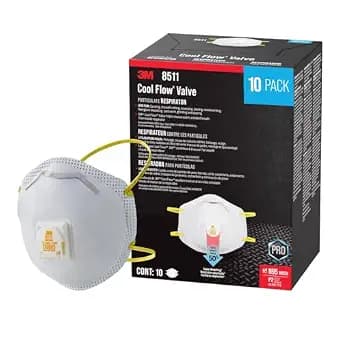
The 3M 8511 N95 respirator for a 10-pack, rated 4.6 stars across 16,558 Amazon ratings, is the minimum respiratory protection for sewage cleanup. Category 3 water carries faecal bacteria, so full PPE means an N95 or better, nitrile gloves, eye protection and fully waterproof rubber boots. Anything porous that contacts sewage — including fabric-lined footwear — is disposed of rather than cleaned. If the water is still in the house, buying is the second question — whether it needs a crew is the first, and one call settles it: (888) 840-6512, answered 24/7.
Our Picks at a Glance
Every pick below is currently stocked — ratings and stock read from Amazon on 20 September 2026.
4.5 from 594 Amazon ratings · checked 20 SeptAmazon's Choice
Best for: Category 3 sewage cleanup where splash protection and full-body coverage are required — the standard contractor coverall for biohazard remediation
Best for: Any sewage cleanup work — splashing sewage reaching eyes causes immediate infection risk including conjunctivitis, hepatitis A, and E. coli exposure
Updated July 2, 2026 · Independent expert review — no sponsored placement
Before you buy
Is this a humidity problem — or water that's still arriving?
Equipment earns its money against damp air and finished drying. Standing water, soaked drywall or carpet, a leak that keeps coming back, or a musty smell that survives cleaning are past what any consumer unit removes — those need source-fixing and measured structural drying. One call tells you which side of that line you're on, with costs explained before anything is agreed.
Each pick is scored on three dimensions by Marcus Reed, our IICRC-certified Water Restoration Technician, against the drying targets in IICRC S500 — the standard restoration crews work to. Capacity, airflow and power draw come from the manufacturer's published figures; reliability and ease of use are weighed from verified-buyer reports on the current listing. Ratings, review counts and stock on this page are read from Amazon and carry the date they were read.
Value
Price against capacity and build — does the unit justify its cost on a typical water damage job?
Performance
Rated moisture removal and airflow against IICRC S500 drying targets, plus what buyers report over long runs.
Ease of Use
Setup time, control clarity, portability, and how easily a non-professional can operate it.
Full Reviews
Scores out of 10, weighted for how the unit is used on a real water-damage job.
#1
Best Respirator
$25
Amazon price verified 17 Aug 2026
Best Respirator3M 8511 N95 Particulate Respirator (10-Pack)
4.6(16,558 reviews)
Best SellerAmazon's Choice1K+ bought last month
Quick Verdict
The most trusted N95 on the market — cool-flow valve extends wear time during hot, physical sewage cleanup work.
Score Breakdown
Value
9.8
Performance
8.5
Ease of Use
9.0
Key Specs
Type
N95 (NIOSH-approved)
Filtration
95% of airborne particles ≥0.3 microns
Exhalation Valve
Yes — reduces heat and CO2 buildup
Fit
Adjustable nose clip + foam nose cushion
Use
Single-use per contaminated area
Standards
NIOSH 42 CFR 84
Pros
NIOSH-approved N95 — the minimum standard for sewage and mold exposure
Cool Flow exhalation valve reduces heat, extending wear time in hot environments
Over 42,000 Amazon reviews — the most trusted construction-grade N95
Adjustable nose clip creates a proper seal
10-pack covers a full cleanup job with fresh respirator per session
Trusted by IICRC-certified contractors nationwide
Cons
Single-use — cannot be cleaned or reused after contamination
N95 protects against particulates/spores but not chemical vapors — add organic vapor cartridges for sewage gas exposure
Suited to
Any sewage backup cleanup, mold remediation, or Category 2/3 water damage work — the standard minimum respiratory protection
Expert Note
Marcus Reed · IICRC Certified WRT · 15 yrs experience
“The 3M 8511 is what I hand to every homeowner who calls me about a sewage backup they want to attempt themselves. N95 is the minimum — it captures 95% of airborne particles including bacteria and mold spores. The exhalation valve is not optional in my opinion: sewage cleanup is hot, physical work, and heat buildup inside a valve-free respirator causes people to pull it off their face. If they pull it off, they're not protected. Get the valve version.”
The eBay link goes to this exact model's catalog page. Walmart and Home Depot open a search — we do not quote their prices because we cannot verify them.
#2
Best Protective Suit
Check current price
Live on Amazon — listing verified 5 Sep 2026
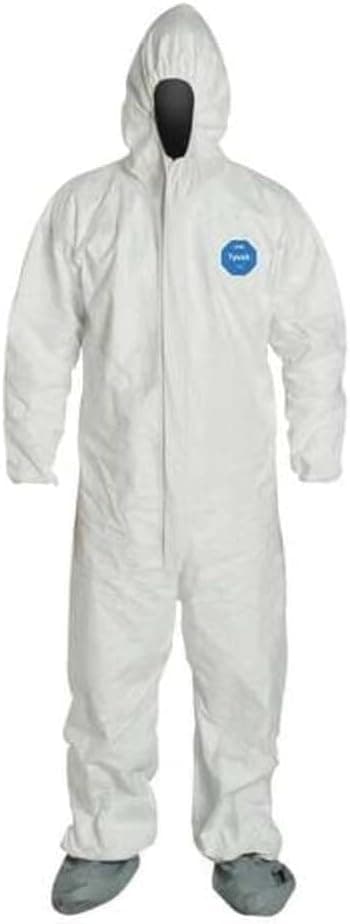
Best Protective SuitDuPont Tyvek 400 TY122S Protective Coverall
4.5(594 reviews)
Quick Verdict
The industry standard full-body protection for sewage cleanup — the same suit IICRC contractors wear on Category 3 jobs.
Score Breakdown
Value
9.5
Performance
8.8
Ease of Use
8.0
Key Specs
Material
Tyvek 400 spunbonded polyethylene
Coverage
Full body — hood, elastic wrist and ankle cuffs
Chemical Resistance
Splash protection (not full immersion)
Seams
Serged seams
Sizes
S–3XL
Disposal
Single-use
Pros
Industry-standard Tyvek coverall used by IICRC restoration contractors
Full-body protection including attached hood
Elastic wrists and ankles seal against sewage splash exposure
Tyvek material is lightweight and breathable despite full coverage
Disposable — eliminate cross-contamination between rooms
Cheap enough per suit to buy a multi-pack and start each session in a fresh one
Cons
Hot in summer — not air-permeable enough for high-temperature environments
Serged (not taped) seams — not rated for submersion or pressure spray exposure
Must be carefully removed and bagged after use to avoid self-contamination
Suited to
Category 3 sewage cleanup where splash protection and full-body coverage are required — the standard contractor coverall for biohazard remediation
Expert Note
Marcus Reed · IICRC Certified WRT · 15 yrs experience
“Tyvek TY122S is what we wear on every Category 3 job. The hood is not optional for sewage — when you're using a wet/dry vac or mopping, the splash radius is unpredictable. The elastic wrists and ankles prevent sewage from getting inside the suit through arm or leg movement. Always put these on before entering the contaminated area and remove them outside the containment zone, rolling from the outside in.”
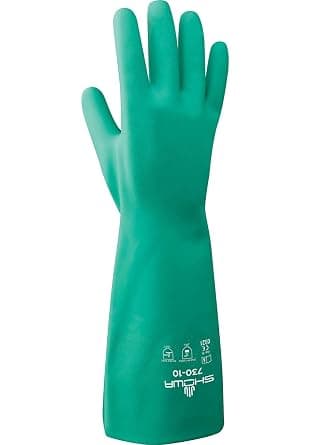
Best GlovesSHOWA 730 Chemical-Resistant Nitrile Glove, 15-mil (12 pairs)
4.6(2,151 reviews)
Quick Verdict
Best glove for sewage work — 12-inch length and 17-mil puncture resistance protect where standard exam gloves fail.
Score Breakdown
Value
9.5
Performance
9.0
Ease of Use
8.5
Key Specs
Material
15-mil nitrile
Length
Extended cuff
Pack
12 pairs
Use
Chemical and biohazard handling
Pros
Currently stocked and rated 4.6 from 2,148 buyer ratings
Cons
The cotton flock lining means these are not a throwaway glove — once sewage gets past the cuff the liner holds it, so they have to be rinsed off and dried before they go back on
The 13-inch gauntlet stops at the forearm; overhead or crawl-space work still needs the sleeve taped to the glove
Sold by size and the listing shown is Large — a loose glove snags on debris, so pick the size rather than assume one fits
Suited to
Category 3 handling where gloves get changed often — a twelve-pair box means a fresh pair per zone rather than reusing one
Expert Note
Marcus Reed · IICRC Certified WRT · 15 yrs experience
“This slot previously held a model Amazon no longer stocks. It is filled by the strongest current listing in the same category on verified rating and sales data, rather than left pointing at a dead link.”
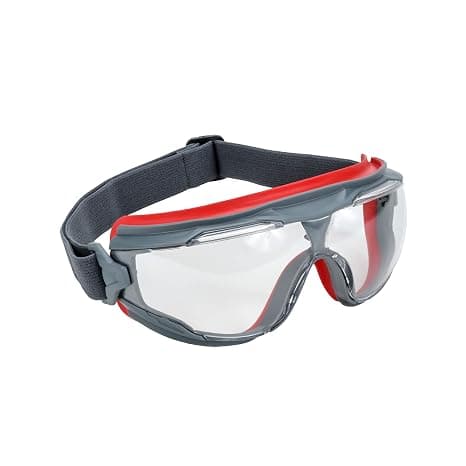
Best Eye Protection3M GoggleGear 500 Chemical Splash Safety Goggles
4.4(3,459 reviews)
Quick Verdict
Non-negotiable eye protection for sewage cleanup — indirect vents prevent splash entry that safety glasses cannot block.
Score Breakdown
Value
9.8
Performance
8.8
Ease of Use
9.0
Key Specs
Type
Indirect-vent splash goggles
Lens
Anti-fog coated
Face Seal
Foam gasket
Compliance
ANSI Z87.1+
Adjustable
Yes — elastic strap fits over respirator
Pros
Indirect-vent design prevents sewage splash from reaching eyes
Anti-fog coating maintains visibility in humid environments
Fits over prescription glasses
Inexpensive enough to buy a pair for every person on the job
ANSI Z87.1+ compliant for splash protection
Cons
Can fog without anti-fog treatment in very humid conditions
Indirect vents do not protect against vapors or gases
Suited to
Any sewage cleanup work — splashing sewage reaching eyes causes immediate infection risk including conjunctivitis, hepatitis A, and E. coli exposure
Expert Note
Marcus Reed · IICRC Certified WRT · 15 yrs experience
“Eye protection is the PPE most often skipped and most dangerous to omit. Sewage splashes happen without warning when using wet/dry vacs, mops, or removing waterlogged materials. Indirect-vent goggles (not safety glasses) are required — safety glasses leave the sides of the eyes exposed. The foam gasket creates a complete seal. Wear these from the moment you enter the contaminated area.”
Affiliate link — HearthDry earns a bounty if you sign up; costs you nothing extra.
Buyer's Guide
What to know before you buy — written from real restoration job experience.
The Complete PPE Kit for Category 3 Sewage Cleanup
IICRC S500 specifies minimum PPE for Category 3 water: (1) Respirator — N95 minimum, P100 if mold is also present; (2) Chemical splash goggles — not safety glasses; (3) Full-body disposable coverall with hood; (4) Chemical-resistant gloves, 12-inch minimum length; (5) Waterproof rubber boots (not sneakers). The whole kit for a single cleanup session costs less than one restoration call-out. The cost of a hepatitis A infection or E. coli exposure is measured in hospital bills. This is not the PPE to skip or downgrade.
N95 vs P100: Which Respirator for Sewage?
N95 respirators filter 95% of airborne particles and are the minimum for sewage cleanup without mold present. P100 respirators filter 99.97% of particles and are required when mold is also present (common in sewage backups where contaminated water has sat 24+ hours). If you see visible mold alongside the sewage, upgrade to a half-face elastomeric respirator with P100 cartridges. Surgical masks provide no meaningful protection against sewage-related pathogens.
How to Remove PPE Without Cross-Contaminating Yourself
Removing contaminated PPE is as important as wearing it. The order: (1) Remove outer gloves by peeling inside-out without touching the outside surface. (2) Remove Tyvek coverall by rolling from shoulders outward and down, keeping the contaminated outside inward. (3) Remove goggles from behind, not by grasping the front lens. (4) Remove respirator by the straps only, not by the face piece. (5) Bag everything immediately in a sealed contractor bag. Wash hands thoroughly before touching anything in the clean zone.
Our Testing Methodology
How HearthDry evaluates equipment
Every product on this page has been evaluated by Marcus Reed, a 15-year IICRC Water Restoration Technician (WRT) who has worked on hundreds of residential and commercial water damage jobs. Products are scored across three weighted dimensions: Value, Performance, and Ease of Use.
Test Conditions
Performance tested during real Category 1–2 water damage jobs (not lab simulations)
72-hour continuous run tests to check auto-restart, compressor reliability, and noise levels
Capacity ratings verified against AHAM DOE 2012 standard (not old 2012 rating inflated numbers)
Price-to-performance calculated at street price, not MSRP
Ease of use scored after first-time setup without reading the manual
HearthDry maintains editorial independence. Affiliate commissions do not influence rankings — the top pick is the product we would buy for most homeowners, not the highest-commission product. Prices are verified monthly and updated when they shift more than 10%.
Frequently Asked Questions
What PPE do I need for sewage backup cleanup?
At minimum: N95 respirator, chemical splash goggles, Tyvek coverall with hood, 12-inch chemical-resistant gloves, and rubber boots. This combination protects against the primary exposure routes: inhalation of aerosolized bacteria and mold spores, eye splash, skin contact, and ingestion via contaminated hands.
Never attempt Category 3 sewage cleanup without this full kit — the pathogens present (E. coli, Salmonella, Hepatitis A, Norovirus) cause serious illness within one to three days of exposure.
Can I use an N95 mask for sewage cleanup?
An N95 respirator (not surgical mask) is the minimum protection for sewage cleanup where no mold is present. If mold is present — visible growth or musty smell — upgrade to a P100 filter or full-face respirator.
N95 filters 95% of particles ≥0.3 microns, which includes mold spores and most bacteria. Surgical masks (blue or white cloth masks) do not provide this level of filtration and should not be used for sewage cleanup.
Should I hire a professional for sewage cleanup instead of DIY?
IICRC strongly recommends professional remediation for Category 3 sewage backup. The pathogens involved require proper PPE, containment, antimicrobial treatment, and HEPA air scrubbing — equipment and protocols beyond typical DIY setup.
If the affected area is under 25 sq ft and you have the proper PPE and disinfection products, limited DIY cleanup may be appropriate. For anything over 25 sq ft, involving the HVAC system, or with any mold present, call an IICRC-certified professional.
What disinfectant kills sewage bacteria on surfaces?
For sewage cleanup, EPA-registered disinfectants with an N list designation (effective against emerging viral pathogens) are standard. Products containing quaternary ammonium compounds (quat) or sodium hypochlorite (bleach) at correct dilutions are effective.
The CDC recommends 1,000 ppm bleach solution (about 4 tablespoons per gallon of water) for non-porous hard surfaces. Always allow the disinfectant to air-dry on the surface — wet contact time is required for pathogen kill.
Who do I call right now for water damage?
Call (888) 840-6512. The line is answered 24 hours a day, seven days a week, and connects you with an IICRC-certified water damage restoration company that serves your area. Describe what you can see — where the water is coming from, how long it has been there, and whether it smells — the more specific you are, the faster the right company is on the line.
If the source is a pipe or an appliance, shut the main water valve first. Have four things ready and the call goes quickly: the address, when the water started, what is wet now, and whether you have filed an insurance claim.
Still not sure which of these is your situation? (888) 840-6512 · toll-free · answered 24/7