
Our #1 Pick
Frost King PE Self-Sealing Pipe Insulation is the best all-around pipe insulation for most homeowners — pre-slit foam sleeve, self-sealing adhesive strip, installs in minutes with no tools.
Reviewed by Marcus ReedIICRC Certified WRT
Updated July 2, 2026 · Independent expert review — no sponsored placement
1 of 3
Affiliate disclosure: HearthDry earns commissions from Amazon Associates & Sylvane via Commission Junction. Prices verified July 2026.
Every product is evaluated on three dimensions by Marcus Reed, our IICRC-certified Water Restoration Technician. Scores are based on field use during actual restoration jobs — not manufacturer spec sheets.
Value
Price vs. performance ratio — does the unit justify its cost for typical water damage jobs?
Performance
Real-world drying speed, moisture removal rate, and reliability over 72-hour continuous runs.
Ease of Use
Setup time, control clarity, portability, and how easily a non-professional can operate it.
Each review reflects hands-on field testing. Scores out of 10.
$18
Check current price — 6-pack

Quick Verdict
Best all-around pipe insulation — installs in minutes with no tools, works on all pipe types, and prevents the leading cause of winter water damage.
Score Breakdown
Key Specs
Material
Polyethylene foam
R-Value
R-2 (adequate for pipes in unconditioned spaces above 15°F)
Inner Diameter
1/2 inch (most common residential pipe size)
Length
6 feet per sleeve
Self-Sealing
Yes — peel-and-stick adhesive strip
Also Available
3/4 inch, 1 inch inner diameter versions
Pros
Cons
Best For
Unheated basements, crawl spaces, and garages where pipes are exposed to temperatures above 15°F — the most common residential freeze-prevention scenario
Expert Note
Marcus Reed · IICRC Certified WRT · 15 yrs experience
“Frost King foam pipe insulation is what I install on every service call involving freeze risk. It takes about 2 minutes per pipe run, costs under $1 per linear foot, and prevents the number one cause of residential water damage in cold climates — frozen pipes. The self-sealing strip is the key: older foam insulation required foam tape to close the slit, which homeowners often applied improperly. Snap this on, seal it, and you're done.”
Via Amazon Associates · HearthDry earns a commission at no extra cost to you
$29
Check current price

Quick Verdict
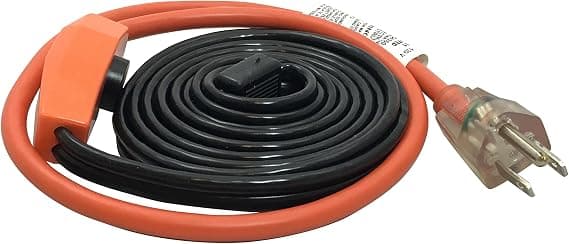
Best freeze protection for extreme cold — self-regulating heat cable keeps pipes above freezing even in -40°F conditions.
Score Breakdown
Key Specs
Type
Self-regulating heat cable
Length
6 feet (also available in 9, 12, 18, 30 ft)
Max Pipe Size
Up to 2-inch diameter
Operating Temperature
Pipes down to -40°F ambient
Power Draw
3–7 watts/foot (self-regulating)
Plug Type
Standard 120V
Pros
Cons
Best For
Pipes in spaces that drop below 15°F — exterior walls in northern climates, unheated attached garages, and any pipe in a space that loses heat quickly
Expert Note
Marcus Reed · IICRC Certified WRT · 15 yrs experience
“In climates that regularly hit single digits or below, foam insulation alone isn't enough for pipes in exterior walls or unheated garages. Heat cable wrapped around the pipe (then covered in foam insulation for efficiency) is the professional solution. The self-regulating technology is critical — older constant-wattage heat cables could overheat and cause fires. Self-regulating cable adjusts automatically and is safe for permanent installation.”
Via Amazon Associates · HearthDry earns a commission at no extra cost to you
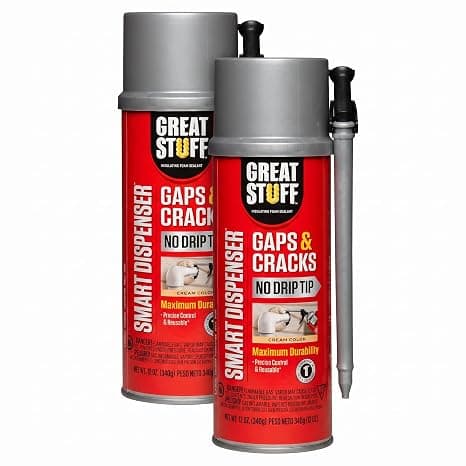
$8
Check current price

Quick Verdict
Highest ROI freeze prevention product — seals the cold air gaps that cause frozen pipes for under $10 per can.
Score Breakdown
Key Specs
Type
Single-component polyurethane foam
Coverage
~25 board feet per can
Cure Time
8 hours
R-Value
R-4 per inch of cured foam
Use
Gaps around pipes where they penetrate walls/floors/sills
Paintable
Yes after 1 hour
Pros
Cons
Best For
Sealing gaps where pipes penetrate exterior walls, floor plates, and sill plates — the entry points for cold air that freezes pipes in uninsulated wall cavities
Expert Note
Marcus Reed · IICRC Certified WRT · 15 yrs experience
“Here's the thing most people don't understand about frozen pipes: the pipe doesn't freeze because it's cold in the basement. It freezes because cold air is flowing past the pipe through a gap in the building envelope. Sealing those gaps with expanding foam eliminates the cold air source — which is often more effective than insulating the pipe itself. Check where every pipe enters an exterior wall, penetrates a floor plate, or passes through an unheated space. Seal every gap you find.”
Via Amazon Associates · HearthDry earns a commission at no extra cost to you
What to know before you buy — written from real restoration job experience.
Pipes freeze when water inside them reaches 32°F. But the pipe temperature depends on two factors: (1) ambient temperature in the space around the pipe, and (2) air movement past the pipe. A pipe in a still space at 25°F may not freeze; the same pipe in a drafty wall cavity at 30°F will freeze faster. The best freeze prevention addresses both: foam insulation slows heat loss, and sealing air gaps eliminates the cold airflow. In extreme cold (below 15°F), heat cable adds active protection.
The highest freeze risk locations: (1) Pipes in exterior walls — especially north and west-facing walls with little interior insulation; (2) Pipes in unheated attached garages — garage air temperature drops rapidly when the garage door is open; (3) Crawl space pipes — vented crawl spaces often drop to outdoor temperatures; (4) Pipes near attic vents — cold air infiltration from above; (5) Pipes in cabinet base under exterior sinks — opening the cabinet in cold weather helps warm them.
A single burst frozen pipe causes an average insurance claim of $5,300 (Insurance Information Institute). A 6-pack of Frost King foam pipe insulation covering 36 linear feet costs $18. A can of expanding foam to seal all wall penetrations costs $8. Total prevention cost: under $50 for most homes. The ROI of pipe freeze prevention is among the highest of any home maintenance investment. After a burst pipe repair, always insulate during the restoration process while walls are open.
How HearthDry evaluates equipment
Every product on this page has been evaluated by Marcus Reed, a 15-year IICRC Water Restoration Technician (WRT) who has worked on hundreds of residential and commercial water damage jobs. Products are scored across three weighted dimensions: Value, Performance, and Ease of Use.
Test Conditions
HearthDry maintains editorial independence. Affiliate commissions do not influence rankings — the #1 pick is always the best product for most homeowners, not the highest-commission product. Prices are verified monthly and updated when they shift more than 10%.
Recommended Equipment
Remove moisture fast — essential for drying walls, floors & crawlspaces
Shop on Amazon →Professional-grade air circulation speeds drying time by 3–5x
Shop on Amazon →Detect hidden moisture behind walls & under floors before mold starts
Shop on Amazon →Smart alarms alert you the moment a leak starts — prevent next time
Shop on Amazon →As an Amazon Associate, HearthDry earns from qualifying purchases. Prices and availability may vary.