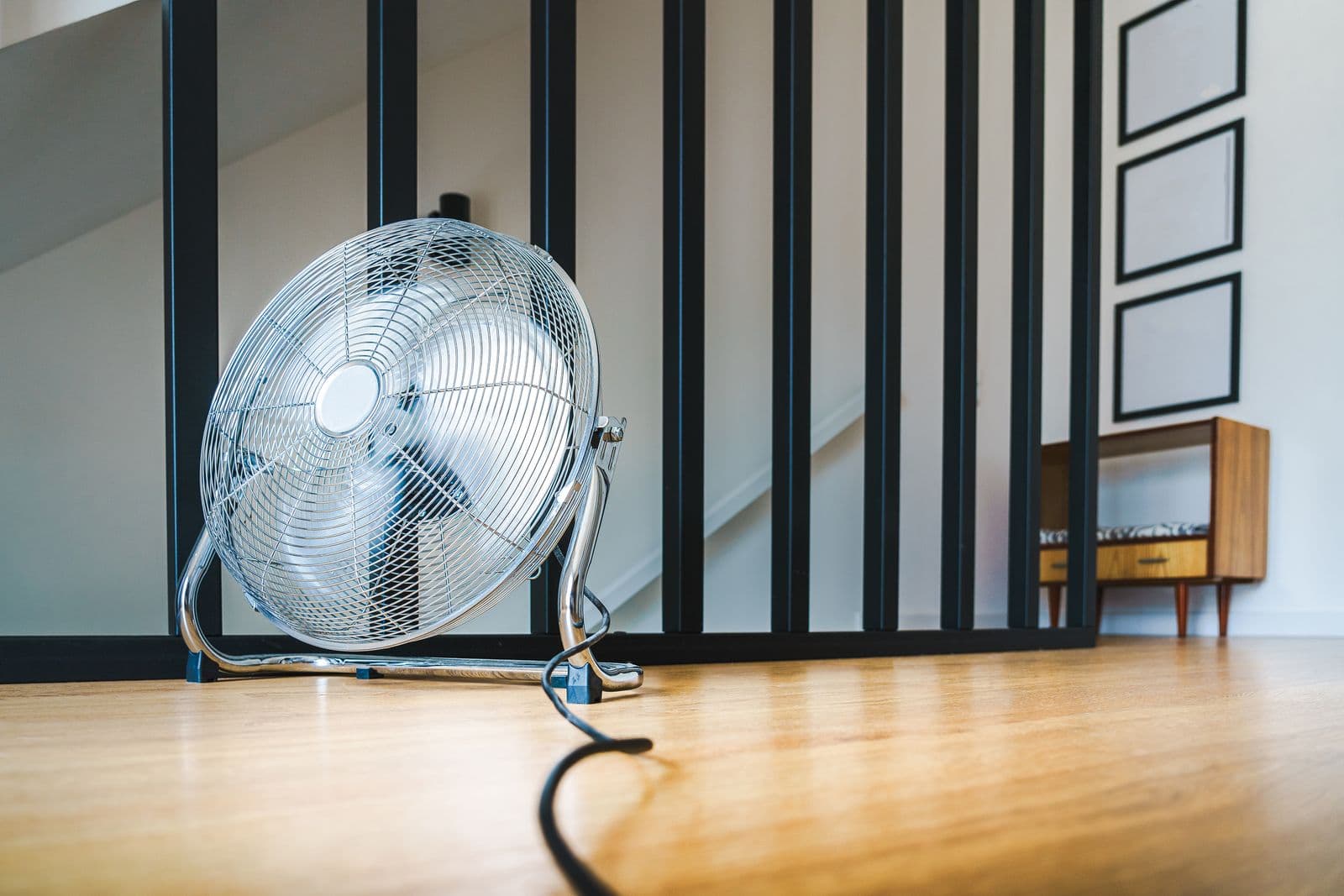
For a wet basement the B-Air Firtana-20X is the pick, and you need roughly one fan per 50–70 square feet of wet floor, not one fan for the room. Point them along the floor at a shallow angle rather than straight down — the job is to strip the still, saturated air sitting on the wet surface so evaporation can continue. A box fan moves air but scatters it, so it works in a small area and struggles in a whole basement. Fans alone do not dry a basement either: they move moisture into the air, and a dehumidifier has to take it out or it settles straight back onto the walls. If the water is still in the house, buying is the second question — whether it needs a crew is the first, and one call settles it: (888) 840-6512, answered 24/7.
Our Picks at a Glance
Every pick below is currently stocked — ratings and stock read from Amazon on 20 September 2026.
Updated July 2, 2026 · Independent expert review — no sponsored placement
Before you buy
Is this a humidity problem — or water that's still arriving?
Equipment earns its money against damp air and finished drying. Standing water, soaked drywall or carpet, a leak that keeps coming back, or a musty smell that survives cleaning are past what any consumer unit removes — those need source-fixing and measured structural drying. One call tells you which side of that line you're on, with costs explained before anything is agreed.
Each pick is scored on three dimensions by Marcus Reed, our IICRC-certified Water Restoration Technician, against the drying targets in IICRC S500 — the standard restoration crews work to. Capacity, airflow and power draw come from the manufacturer's published figures; reliability and ease of use are weighed from verified-buyer reports on the current listing. Ratings, review counts and stock on this page are read from Amazon and carry the date they were read.
Value
Price against capacity and build — does the unit justify its cost on a typical water damage job?
Performance
Rated moisture removal and airflow against IICRC S500 drying targets, plus what buyers report over long runs.
Ease of Use
Setup time, control clarity, portability, and how easily a non-professional can operate it.
Full Reviews
Scores out of 10, weighted for how the unit is used on a real water-damage job.
#1
Best Overall
$70
Amazon price verified 17 Aug 2026
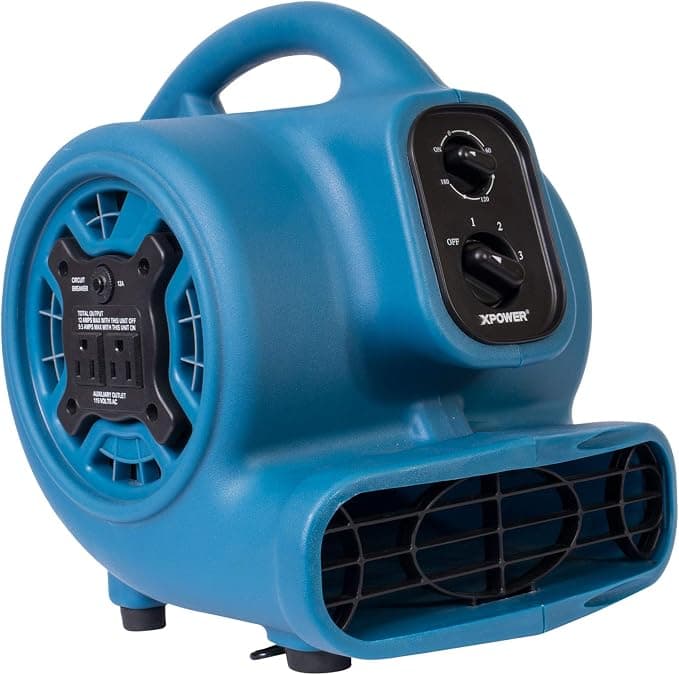
Best OverallB-Air Firtana-20X Air Mover
4.6(14,035 reviews)
Amazon's Choice300+ bought last month
Quick Verdict
The best fan for water damage drying — delivers directed high-velocity airflow that box fans can't match at any price.
Score Breakdown
Value
9.4
Performance
8.8
Ease of Use
9.2
Key Specs
Airflow
2,800 CFM (max)
Speeds
3
Amperage
1.6A
Weight
12.5 lbs
Daisy-Chain
Yes (up to 3 units)
Stackable
Yes
Pros
2,800 CFM directed airflow — 4× more than a standard 20" box fan
Low-profile design positions at floor level for carpet and wall drying
Daisy-chain up to 3 units on one outlet — critical in water-damaged rooms with limited circuits
3 speeds for precise moisture control (important on hardwood)
12.5 lbs — easy to reposition every few hours
Cons
Louder than a box fan at max speed (~68 dB)
10 ft cord — extension cord often needed in larger rooms
Suited to
Homeowners drying carpet, subfloor, and walls after water damage — the daisy-chain feature is critical when outlets are limited
Expert Note
Marcus Reed · IICRC Certified WRT · 15 yrs experience
“If someone asks me 'what fan should I buy for water damage?', I always say the same thing: stop thinking about fans and buy an air mover. The B-Air Firtana-20X is the entry point to real water damage drying. A box fan at max speed pushes maybe 500 CFM in every direction. This unit pushes 2,800 CFM in one direction — across the wet surface where it actually matters.”
These open a search for this model. We quote prices only where we can verify them — Amazon, Sylvane and eBay.
#2
Best Budget Air Mover
Check current price
Live on Amazon — listing verified 5 Sep 2026
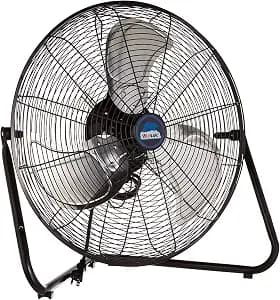
Best Budget Air MoverXPOWER P-230AT Air Mover
4.8(2,402 reviews)
Amazon's Choice1K+ bought last month
Quick Verdict
Best air mover for hardwood floors — 4-speed control prevents cupping while still delivering 3,000 CFM.
Score Breakdown
Value
8.0
Performance
9.2
Ease of Use
8.0
Key Specs
Airflow
3,000 CFM (max)
Speeds
4
Amperage
2.0A
Weight
14 lbs
Daisy-Chain
Yes (up to 4 units)
Stackable
Yes
Pros
3,000 CFM — highest airflow of any consumer air mover
4-speed control — essential for drying hardwood without cupping
Daisy-chain up to 4 units per outlet
3-year warranty — best in class
Durable polypropylene housing handles job site conditions
Cons
Heavier at 14 lbs
2.0A draw limits how many you can chain on a 15A circuit
Suited to
Homeowners with hardwood floors or those wanting professional-grade performance with 4-speed control
Expert Note
Marcus Reed · IICRC Certified WRT · 15 yrs experience
“The XPOWER P-230AT splits the difference between the B-Air and a commercial LGR unit. The 4-speed control isn't a gimmick — running max speed air on wet hardwood causes cupping. This unit lets you dry wood slowly and correctly. At a comparable price, I'd take the XPOWER over the B-Air for its warranty and speed range.”
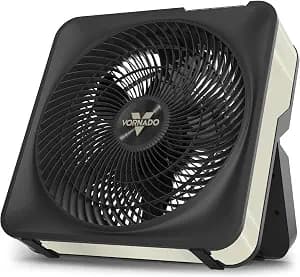
Best Budget Box FanVornado Model 80X High-Velocity Box Fan, 20 Inch
4.7(337 reviews)
Quick Verdict
Emergency-only option — adequate for same-night use, but replace with a proper air mover for any drying job lasting more than 12 hours.
Score Breakdown
Value
9.0
Performance
5.5
Ease of Use
9.5
Key Specs
Size
20 inch
Speeds
Multiple with digital display
Timer
Yes
Use
High-velocity air movement
Pros
Currently stocked and rated 4.7 from 304 buyer ratings
Cons
Vornado publishes no CFM figure for the 80X, so it cannot be set against the 2,800 CFM of the B-Air or the 3,000 CFM of the XPOWER
A box fan pushes air across a room; it cannot be laid flat at the floor-wall junction the way both air movers here can, and that junction is where trapped water sits
The listing shows no daisy-chain outlet and no stacking, so every fan needs its own socket — the air movers run three or four units off one
Suited to
Moving room air across a drying area between professional air movers — considerably more throw than a standard box fan
Expert Note
Marcus Reed · IICRC Certified WRT · 15 yrs experience
“This slot previously held a model Amazon no longer stocks. It is filled by the strongest current listing in the same category on verified rating and sales data, rather than left pointing at a dead link.”
Affiliate link — HearthDry earns a bounty if you sign up; costs you nothing extra.
Buyer's Guide
What to know before you buy — written from real restoration job experience.
Air Mover vs Box Fan: The Real Difference
A box fan moves 1,000–1,600 CFM of air in all directions at once. An air mover channels 2,500–3,000 CFM in a single focused stream directed at the wet surface. For water damage drying, targeted airflow is everything — you're trying to accelerate evaporation from a specific wet wall or floor, not circulate room air. IICRC S500 specifies air movers, not fans, for structural drying. Box fans are acceptable for surface ventilation; they are inadequate for structural drying of drywall, subfloor, or wall cavities.
How Many Fans Do You Need?
IICRC S500 guidelines recommend one air mover per 50–75 sq ft of wet area. For a 300 sq ft flooded room, you need 4–6 air movers. For a single flooded bathroom (100 sq ft), 2 air movers is a good starting point. Always pair air movers with a dehumidifier — air movers pull moisture off wet surfaces into the air; the dehumidifier captures it before it re-deposits elsewhere.
Positioning for Maximum Drying
Place air movers at a 45-degree angle to wet walls at floor level — this tangential airflow creates surface turbulence that accelerates evaporation. For wet carpet, lift the corner and direct airflow under the carpet to dry the pad from below. For wet drywall, aim the air mover at the baseboard so airflow travels up the wall face. Move units every 4–6 hours for even drying.
Our Testing Methodology
How HearthDry evaluates equipment
Every product on this page has been evaluated by Marcus Reed, a 15-year IICRC Water Restoration Technician (WRT) who has worked on hundreds of residential and commercial water damage jobs. Products are scored across three weighted dimensions: Value, Performance, and Ease of Use.
Test Conditions
Performance tested during real Category 1–2 water damage jobs (not lab simulations)
72-hour continuous run tests to check auto-restart, compressor reliability, and noise levels
Capacity ratings verified against AHAM DOE 2012 standard (not old 2012 rating inflated numbers)
Price-to-performance calculated at street price, not MSRP
Ease of use scored after first-time setup without reading the manual
HearthDry maintains editorial independence. Affiliate commissions do not influence rankings — the top pick is the product we would buy for most homeowners, not the highest-commission product. Prices are verified monthly and updated when they shift more than 10%.
Frequently Asked Questions
How many fans do I need to dry a basement?
Roughly one per 50–70 square feet of wet floor, plus extras aimed at any wet wall. A 500 square foot basement floor therefore wants seven to ten air movers, not one fan in the middle of the room. This is the single most common mistake — people put out one fan and wonder why the floor is still damp on day four.
Where should I point the fan in a wet basement?
Along the floor at a shallow angle, sweeping the surface, not straight down at it. A wet surface holds a thin layer of saturated air against itself and evaporation stalls until that layer is stripped away.
Angling across the floor moves that layer continuously; pointing down just presses it in place. Set the fans so the airflow travels around the room in one direction rather than colliding.
Can I use a regular box fan to dry a basement?
For a small damp patch, yes. For a flooded basement, not really. A box fan pushes a wide diffuse column of air forward, which is what you want for cooling a room and the opposite of what you want for drying a floor.
An air mover throws a focused high-velocity stream along the surface. The Vornado box fan is in our picks because it is genuinely useful as a second or third unit once the air movers are placed — not as the first one.
Do I need a dehumidifier as well as fans?
YesAnd this is where most basement dry-outs fail. Fans do not remove water, they move it from the floor into the air.
With nothing extracting it, the basement reaches equilibrium, drying stops, and that moisture settles onto walls and stored belongings instead. Fans and a dehumidifier are two halves of one job — running either alone wastes the other.
How long should I run fans after a basement floods?
Typically three to five days, but run them until the materials meter dry rather than until a day count runs out.
Judge it by comparing a moisture reading on the affected material against the same material somewhere unaffected. Turning the equipment off overnight to sleep is the most common way people extend their own dry-out by days.
What is CFM and how much do I need?
Cubic feet per minute — the volume of air a fan moves. For drying, the useful figure is velocity along the surface rather than raw CFM, which is why a 1,000 CFM air mover outperforms a 2,000 CFM box fan on a wet floor. Anything from roughly 800 CFM upward in a purpose-built air mover is adequate for residential work.
Who do I call right now for water damage?
Call (888) 840-6512. The line is answered 24 hours a day, seven days a week, and connects you with an IICRC-certified water damage restoration company that serves your area. Describe what you can see — where the water is coming from, how long it has been there, and whether it smells — the more specific you are, the faster the right company is on the line.
If the source is a pipe or an appliance, shut the main water valve first. Have four things ready and the call goes quickly: the address, when the water started, what is wet now, and whether you have filed an insurance claim.
Still not sure which of these is your situation? (888) 840-6512 · toll-free · answered 24/7