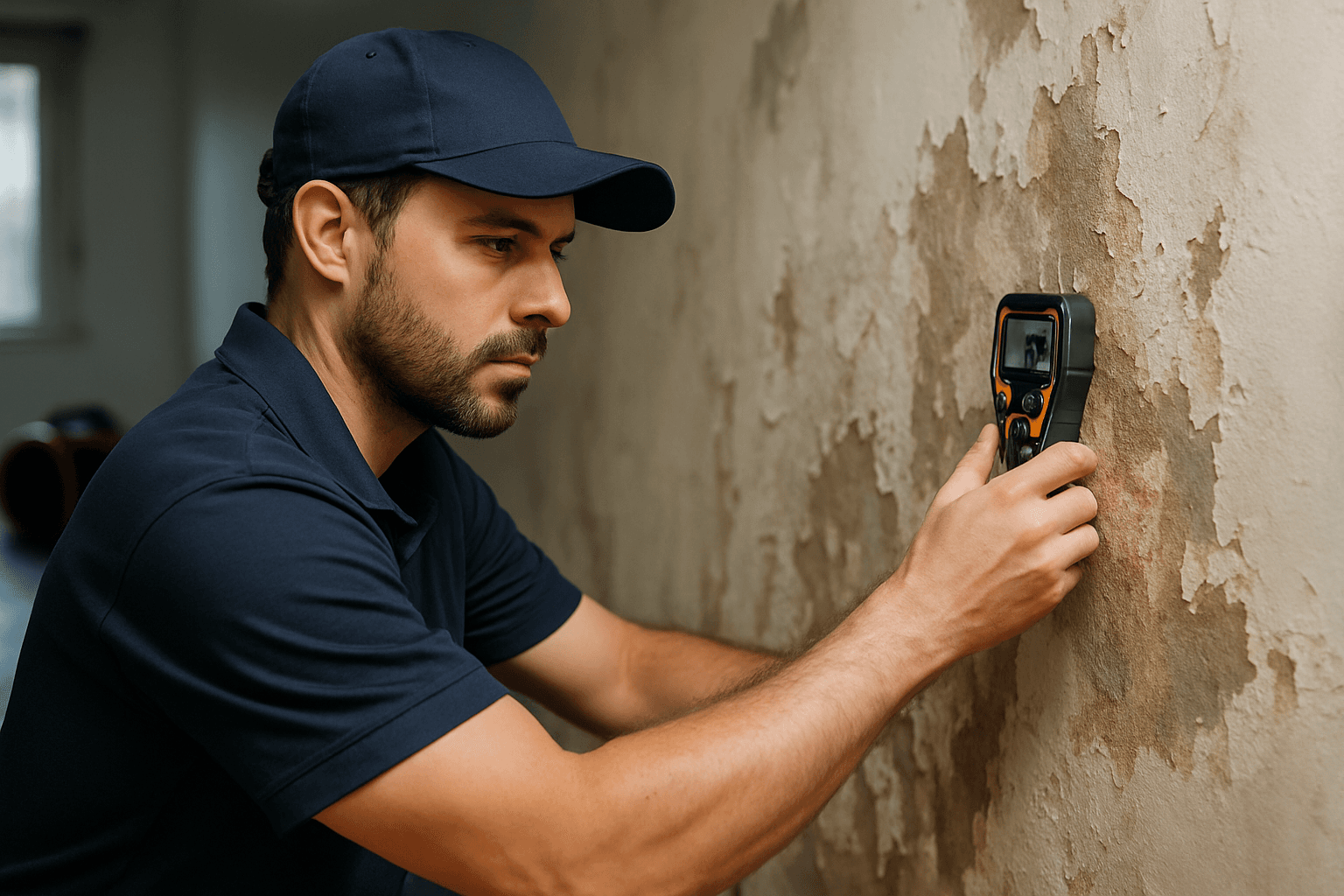
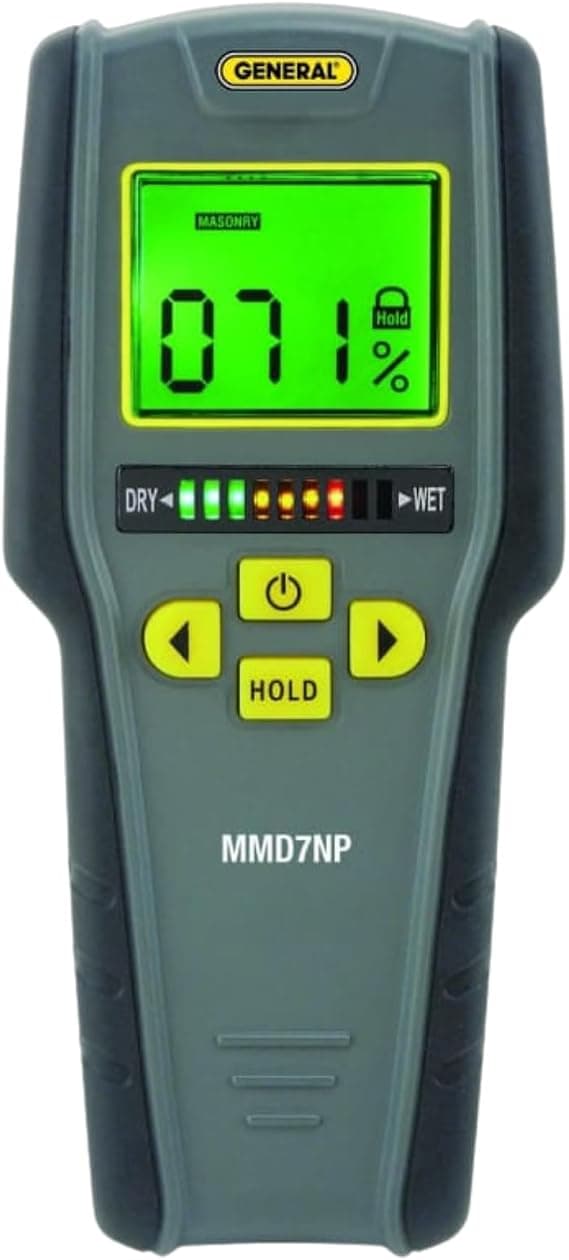
The General Tools MMD7NP is the best moisture meter for homeowners, rated 4.3 stars across 4,122 Amazon ratings. Choose pinless over pin-type for finished rooms — a pinless meter reads through drywall and flooring without leaving holes, so you can sweep a whole wall to find the edge of a wet area rather than taking a handful of readings. If the readings find water behind a finished wall or under a floor, whether it needs a crew to open and dry it is the next question, and one call settles it: (888) 840-6512, answered 24/7.
Our Picks at a Glance
Every pick below is currently stocked — ratings and stock read from Amazon on 20 September 2026.
Updated September 20, 2026 · Independent expert review — no sponsored placement
Before you buy
Is this a humidity problem — or water that's still arriving?
Equipment earns its money against damp air and finished drying. Standing water, soaked drywall or carpet, a leak that keeps coming back, or a musty smell that survives cleaning are past what any consumer unit removes — those need source-fixing and measured structural drying. One call tells you which side of that line you're on, with costs explained before anything is agreed.
Answer 3 questions — get a personalized recommendation.
Question 1 of 30% complete
What will you mainly use the meter for?
How We Choose and Score Every Product
Each pick is scored on three dimensions by Marcus Reed, our IICRC-certified Water Restoration Technician, against the drying targets in IICRC S500 — the standard restoration crews work to. Capacity, airflow and power draw come from the manufacturer's published figures; reliability and ease of use are weighed from verified-buyer reports on the current listing. Ratings, review counts and stock on this page are read from Amazon and carry the date they were read.
Value
Price against capacity and build — does the unit justify its cost on a typical water damage job?
Performance
Rated moisture removal and airflow against IICRC S500 drying targets, plus what buyers report over long runs.
Ease of Use
Setup time, control clarity, portability, and how easily a non-professional can operate it.
Full Reviews
Scores out of 10, weighted for how the unit is used on a real water-damage job.
#1
Best Overall
$49
Amazon price verified 17 Aug 2026
Best OverallGeneral Tools MMD7NP Pinless Moisture Meter
4.3(4,122 reviews)
Best SellerAmazon's Choice2K+ bought last month
Key Specs
Type
Pinless (non-invasive)
Measures
Moisture content without puncturing the surface
Display
LCD with audible alert
Brand
General Tools
Amazon status
Best Seller in its category
Pros
Pinless, so it reads through drywall and flooring without leaving holes — the difference that matters when you are surveying a finished room
Best Seller badge with 4,098 ratings at 4.4, the deepest review base of any meter in this category
Audible alert lets you sweep a wall watching the surface rather than the screen
From General Tools, the same maker as the MMD4E this page previously recommended
Cons
Pinless meters read an average over a small depth, so they locate damp areas rather than pinpointing exact moisture content
Costs about double what a basic pinless meter does
Suited to
Homeowners checking finished walls, ceilings and flooring after a leak, where puncturing the surface to take a reading is not acceptable
Expert Note
Marcus Reed · IICRC Certified WRT · 15 yrs experience
“Pinless is the right choice for a homeowner survey, and the reason is practical rather than technical: a pin meter leaves two holes at every reading, so you either take very few readings or you damage the wall you are trying to assess. Sweeping a pinless meter across a whole wall costs nothing and is how you actually find the edge of a wet area.”
The eBay link goes to this exact model's catalog page. Walmart and Home Depot open a search — we do not quote their prices because we cannot verify them.
#2
Best Pin + Pinless Combo
Check current price
Live on Amazon — listing verified 5 Sep 2026
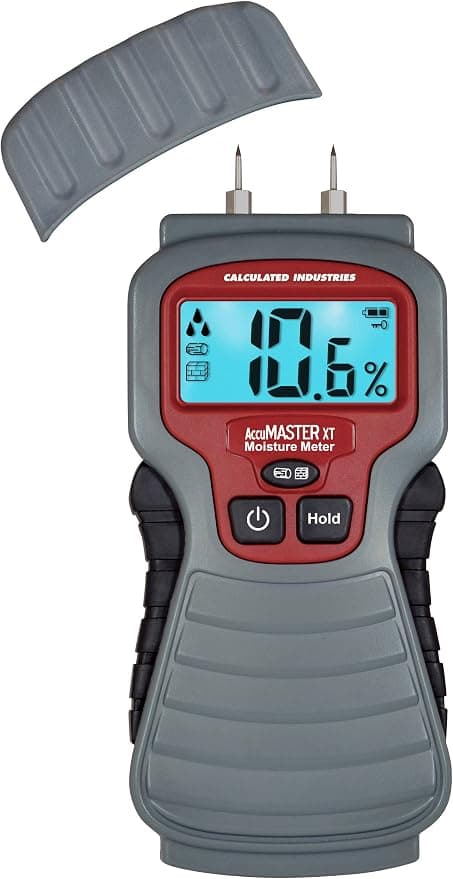
Best Pin + Pinless ComboCalculated Industries 7440 AccuMASTER XT Moisture Meter
4.4(829 reviews)
Quick Verdict
Best of both worlds — scan large areas without marking surfaces with pinless mode, then confirm readings with pin mode.
Score Breakdown
Value
8.5
Performance
9.0
Ease of Use
8.0
Key Specs
Type
Pin + Pinless
Range
6%–40% (pin), 0–100 scale (pinless)
Accuracy
±2.5%
Materials
15 reference scales
Display
LCD with mode indicator
Battery
9V included
Pros
Dual pin/pinless modes — scan without marks, then pin-verify
Ideal for large-area scanning without marking finished surfaces
Cons
More complex to operate than single-mode meters
Pinless mode less accurate than pin readings in drywall
Higher price point
Suited to
Homeowners who want to scan large areas without marking surfaces, then pin-verify any wet spots found
Expert Note
Marcus Reed · IICRC Certified WRT · 15 yrs experience
“The AccuMASTER is the best choice for homeowners with finished spaces they don't want to mark up. I use the same dual-mode approach in the field: scan first with pinless to find the wet areas, then pin-read those areas to confirm the moisture content. This saves time and protects finished surfaces.”
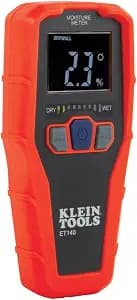
Best BudgetKlein Tools ET140 Pinless Moisture Meter
4.5(6,230 reviews)
Quick Verdict
Best for initial wet-area scanning — fast, mark-free, and cheap enough to give to a tenant or family member.
Score Breakdown
Value
9.5
Performance
7.5
Ease of Use
9.5
Key Specs
Type
Pinless
Range
0–100 relative scale
Accuracy
Relative (not absolute %)
Materials
Wood and building materials
Display
LCD
Battery
2 x AAA included
Pros
Cheapest option — excellent for initial wet/dry detection
No pins — won't mark any surface
Klein Tools brand quality
Instant scanning — fast for covering large areas
Clear LCD reading
Cons
Pinless only — readings are relative, not absolute % moisture content
Cannot give exact percentage for IICRC drying standards verification
Shallow depth penetration (~0.75 inch)
Not ideal for confirming drying completion to insurance standards
Suited to
Quick initial inspection to identify wet areas — buy this to find where to focus drying, then upgrade to a pin meter for drying confirmation
Expert Note
Marcus Reed · IICRC Certified WRT · 15 yrs experience
“The Klein pinless is fine for scanning and finding moisture hotspots, but do not use it alone to declare drying complete. Insurance adjusters and IICRC contractors use absolute percentage readings — 'below 15% WME' is a standard, and the Klein won't tell you that. Use it to find wet spots, then verify with a pin meter.”
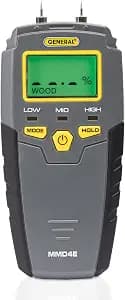
Previously RecommendedGeneral Tools MMD4E Digital Moisture Meter
4.5(15,204 reviews)
Quick Verdict
The meter I hand to every homeowner — foolproof three-color LED, accurate pin readings, and cheap enough to keep permanently.
Score Breakdown
Value
9.8
Performance
8.5
Ease of Use
9.5
Key Specs
Type
Pin-type
Range
5%–50% WME
Accuracy
±2% WME
Materials
10 wood species + reference
Display
LCD with backlight
Battery
9V included
Pros
Most popular moisture meter on Amazon — proven reliability
Pin-type for accurate structural readings in drywall and wood
Clear LCD with three-color LED scale (dry/caution/wet)
10 wood species settings for hardwood floors
Affordable enough to buy and keep permanently
Cons
Pin-type only — leaves small pin marks in finished surfaces
No pinless scanning mode — must penetrate surface
No data logging or Bluetooth
Suited to
Homeowners testing drywall, subfloor, and wood framing after water damage — the most common post-flood use case
Expert Note
Marcus Reed · IICRC Certified WRT · 15 yrs experience
“The General Tools MMD4E is what I hand to homeowners who ask what to buy before their restoration is complete. It's accurate enough for field decisions, simple enough that anyone can use it, and the three-color LED scale is foolproof — green means dry, yellow means check again, red means call your contractor and tell them it's still wet.”
Affiliate link — HearthDry earns a bounty if you sign up; costs you nothing extra.
Buyer's Guide
What to know before you buy — written from real restoration job experience.
Pin vs. Pinless: Which Type Do You Need?
Pin meters drive two small metal pins into the material and measure electrical resistance. They give absolute moisture content percentage (e.g., '18% WME'). Pinless meters use electromagnetic signals to scan moisture depth without contact. They give a relative reading on an arbitrary scale. For confirming structural drying after water damage, you need a pin meter — 'below 15% WME in drywall' is the IICRC standard, and only a pin meter gives you that absolute number. Pinless meters are useful for scanning large areas quickly to find wet spots.
What Readings Mean After Water Damage
IICRC S500 drying standards define acceptable moisture content by material type: drywall (gypsum) — dry is below 15% WME, wet is 17%+. Wood framing — dry is below 12% WME, wet is 15%+. Hardwood flooring — dry is 6–9% WME (regional), wet is above 10%. Subfloor (OSB or plywood) — dry is below 14% WME, wet is 16%+. Restoration is complete when all structural materials consistently test below these thresholds across multiple readings over 24 hours.
How to Test Drywall for Hidden Moisture
Insert pin meter probes horizontally into drywall at several heights: near the floor (6 inches from floor), at mid-height (4 ft), and near the ceiling. Water wicks up from the bottom but can also run from ceiling leaks. Map readings every 12–18 inches along wet walls. Mark wet areas with painter's tape. On days 2 and 3, re-test the same spots — if readings are declining, drying is working. If readings are steady or rising, increase air mover and dehumidifier coverage.
When to Stop Running Drying Equipment
Stop drying equipment only when all structural materials have maintained readings below their dry thresholds for two consecutive tests 24 hours apart. Document your readings — take photos of the meter on the surface with the reading visible. This documentation protects you: if mold appears later, you have proof that materials were properly dried. If you're working with an insurance claim, your adjuster will want moisture logs.
Our Testing Methodology
How HearthDry evaluates equipment
Every product on this page has been evaluated by Marcus Reed, a 15-year IICRC Water Restoration Technician (WRT) who has worked on hundreds of residential and commercial water damage jobs. Products are scored across three weighted dimensions: Value, Performance, and Ease of Use.
Test Conditions
Performance tested during real Category 1–2 water damage jobs (not lab simulations)
72-hour continuous run tests to check auto-restart, compressor reliability, and noise levels
Capacity ratings verified against AHAM DOE 2012 standard (not old 2012 rating inflated numbers)
Price-to-performance calculated at street price, not MSRP
Ease of use scored after first-time setup without reading the manual
HearthDry maintains editorial independence. Affiliate commissions do not influence rankings — the top pick is the product we would buy for most homeowners, not the highest-commission product. Prices are verified monthly and updated when they shift more than 10%.
Frequently Asked Questions
What moisture level is safe in walls after water damage?
IICRC S500 standard defines safe (dry) moisture content by material: drywall under 15% WME, wood framing under 12% WME, hardwood flooring 6–9% WME (region-dependent), and OSB subfloor under 14% WME.
Testing should show readings below these thresholds on two tests taken 24 hours apart before declaring the area dry. Mold growth begins at sustained moisture above 20% WME in drywall.
How accurate are consumer moisture meters for water damage?
Quality consumer pin meters (General Tools, Klein, Calculated Industries) are accurate to ±2–3% WME — sufficient for field decisions.
Professional IICRC technicians use the same types of pin meters; the difference is in the documentation and measurement protocols, not the meters. A basic consumer pin meter reads the same moisture as a professional-grade one in a homeowner's hands.
Can I use a moisture meter on painted drywall?
YesInsert the pins through the paint and into the gypsum — paint adds negligible thickness.
For pinless scanning of painted surfaces, note that thick or metallic paint can interfere with electromagnetic readings. When in doubt, make a small pin test in an inconspicuous area (behind a door, in a closet) for calibration.
Where should I test with a moisture meter after water damage?
Test:
1Walls — 6 inches from floor, every 12–18 inches along the wet area.
2Subfloor — through carpet or flooring in the center of the room and near walls.
3Wood framing — if walls are opened, test the studs directly.
4Around windows and doors — frames and sills.
5Any visually stained or discolored area. Map your readings and track changes daily.
What is WME (Wood Moisture Equivalent)?
WME (Wood Moisture Equivalent) is the scale used for pin moisture meters, calibrated to wood moisture behavior but used as a reference scale for all building materials including drywall.
The 15% WME threshold for drywall doesn't mean drywall holds 15% water by weight — it's a normalized reference scale that correlates with safe drying levels. Professional restorers use WME readings and compare them to IICRC material-specific thresholds.
Who do I call right now for water damage?
Call (888) 840-6512. The line is answered 24 hours a day, seven days a week, and connects you with an IICRC-certified water damage restoration company that serves your area. Describe what you can see — where the water is coming from, how long it has been there, and whether it smells — the more specific you are, the faster the right company is on the line.
If the source is a pipe or an appliance, shut the main water valve first. Have four things ready and the call goes quickly: the address, when the water started, what is wet now, and whether you have filed an insurance claim.
Still not sure which of these is your situation? (888) 840-6512 · toll-free · answered 24/7