A 10-mil polyethylene liner is the right crawl space vapor barrier for most homes, and the Crawldryer 10 × 100 ft roll is where to start. Mil thickness is the specification that matters: 6-mil meets many codes but tears during installation and on every future crawl, while 10 mil survives being laid down and entered occasionally. Rule of thumb — if anyone will be in that crawl space regularly, or an inspector has specified an ASTM E1745 Class A retarder, skip the retail rolls and order a 15–20 mil reinforced liner from an insulation supplier.
Our Picks at a Glance
Every pick below is currently stocked — ratings and stock read from Amazon on 20 September 2026.
All picks compared at a glance
Pick
Product
Rating
Best Overall
Crawldryer 10-mil Crawl Space Vapor Barrier (10 × 100 ft)
4.6 from 401 Amazon ratings · checked 20 SeptAmazon's Choice
Best for: Homeowners lining a dirt crawl space that gets entered a few times a year — a liner heavy enough to install without shredding, in the width that fits most crawl spaces
4.6 from 200 Amazon ratings · checked 20 SeptAmazon's Choice
Best for: Wide or open crawl spaces where seam count is the problem — every taped seam is a place the barrier can fail, and a 12 ft sheet gives you fewer of them
4.7 from 663 Amazon ratings · checked 20 SeptAmazon's Choice
Best for: Temporary moisture protection or very low-moisture crawl spaces where budget is the primary constraint — not recommended as a permanent encapsulation solution
Updated September 20, 2026 · Independent expert review — no sponsored placement
Before you buy
Is this a humidity problem — or water that's still arriving?
Equipment earns its money against damp air and finished drying. Standing water, soaked drywall or carpet, a leak that keeps coming back, or a musty smell that survives cleaning are past what any consumer unit removes — those need source-fixing and measured structural drying. One call tells you which side of that line you're on, with costs explained before anything is agreed.
Each pick is scored on three dimensions by Marcus Reed, our IICRC-certified Water Restoration Technician, against the drying targets in IICRC S500 — the standard restoration crews work to. Capacity, airflow and power draw come from the manufacturer's published figures; reliability and ease of use are weighed from verified-buyer reports on the current listing. Ratings, review counts and stock on this page are read from Amazon and carry the date they were read.
Value
Price against capacity and build — does the unit justify its cost on a typical water damage job?
Performance
Rated moisture removal and airflow against IICRC S500 drying targets, plus what buyers report over long runs.
Ease of Use
Setup time, control clarity, portability, and how easily a non-professional can operate it.
Full Reviews
Scores out of 10, weighted for how the unit is used on a real water-damage job.
#1
Best Overall
Check current price
Listing verified 20 Sep 2026
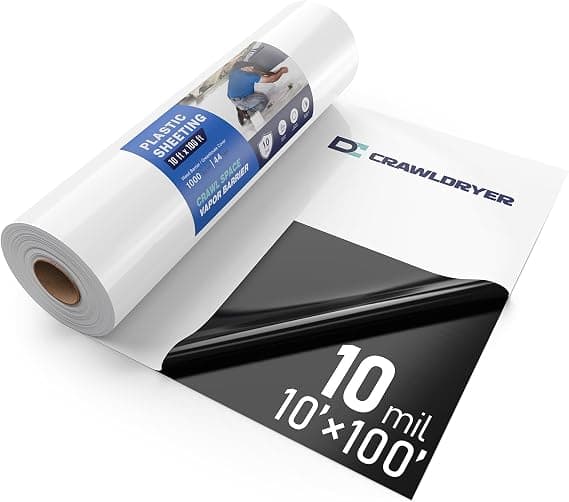
Best OverallCrawldryer 10-mil Crawl Space Vapor Barrier (10 × 100 ft)
4.6(401 reviews)
Quick Verdict
The sensible default for a dirt crawl space — 10-mil polyethylene, 1,000 sq ft to a roll, thick enough to install without tearing.
Score Breakdown
Value
9.1
Performance
8.4
Ease of Use
8.8
Key Specs
Thickness
10 mil
Material
Low-density polyethylene
Roll Size
10 ft × 100 ft
Coverage
1,000 sq ft
Finish
Black one side, white one side
Brand
Crawldryer
Pros
10 mil is thick enough to survive the install — 6-mil poly tears when you drag it over gravel and old plumbing
1,000 sq ft per roll covers most single-family crawl spaces in one buy
White face goes up; the listing puts its reflectivity above 90%, which makes a work light go further
Black face goes down and keeps light off the soil, so nothing grows under the liner
Single-ply polyethylene cuts cleanly with a utility knife and takes vapor barrier tape at the seams
Cons
10 mil, not 20 mil — this is a liner you lay down and stay off, not one you store boxes on
No published perm rating or ASTM E1745 class, so it will not satisfy an inspector who specified a Class A retarder
10 ft width means a seam every 10 feet, and every seam has to be taped
Suited to
Homeowners lining a dirt crawl space that gets entered a few times a year — a liner heavy enough to install without shredding, in the width that fits most crawl spaces
Expert Note
Marcus Reed · IICRC Certified WRT · 15 yrs experience
“10 mil is the practical floor for a crawl space you intend to leave alone. The failure I see over and over is 6-mil poly that was intact the day it went down and full of holes a year later, because someone knelt on it over a sharp rock. 10 mil takes that abuse. What it is not is a walking surface: if the crawl space stores anything, or a technician will be in there twice a year servicing a dehumidifier, buy a 15–20 mil reinforced liner from an insulation supplier — that class of product is not sold on Amazon. The listing says the film mitigates radon gas; no ASTM class is published for it, so do not treat it as a radon barrier. Whatever you buy, the seams decide the outcome: IICRC S500 practice is 12-inch overlaps sealed with vapor barrier tape, not loose overlaps.”
These open a search for this model. We quote prices only where we can verify them — Amazon, Sylvane and eBay.
#2
Best for Wide Spans
Check current price
Listing verified 20 Sep 2026
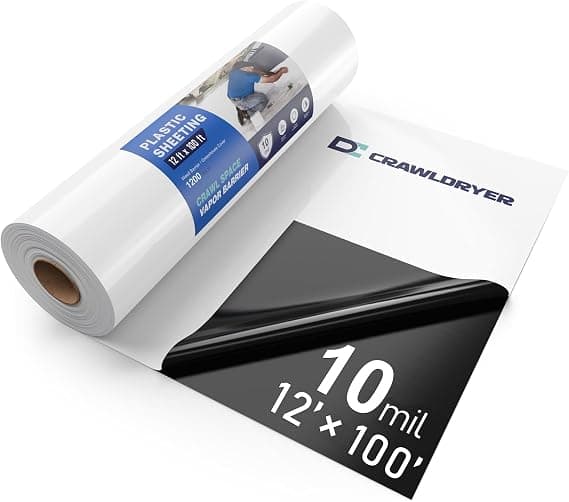
Best for Wide SpansCrawldryer 10-mil Crawl Space Vapor Barrier (12 × 100 ft)
4.6(200 reviews)
Quick Verdict
The same 10-mil film in a 12 ft width — buy it to cut the number of taped seams across a wide crawl space.
Score Breakdown
Value
8.7
Performance
8.4
Ease of Use
7.9
Key Specs
Thickness
10 mil
Material
Low-density polyethylene
Roll Size
12 ft × 100 ft
Coverage
1,200 sq ft
Roll Weight
48.6 lb
Finish
Black one side, white one side
Pros
12 ft width covers two extra feet per pass — fewer seams to tape across a wide crawl space
1,200 sq ft per roll, so a mid-size crawl space can finish on one roll
Same 10-mil polyethylene film as the 10 ft roll, in the same black-and-white construction
Wider sheet lets you run full-length passes instead of piecing the sheet around piers
Cons
The roll weighs 48.6 lb — awkward to feed through a crawl space hatch on your own
Still 10 mil, so what you gain is width, not puncture resistance
No published perm rating or ASTM E1745 class
Newer listing than the 10 ft roll, with fewer ratings behind it
Suited to
Wide or open crawl spaces where seam count is the problem — every taped seam is a place the barrier can fail, and a 12 ft sheet gives you fewer of them
Expert Note
Marcus Reed · IICRC Certified WRT · 15 yrs experience
“Pick this one on geometry, not performance — it is the same film as the 10 ft roll. Measure the short dimension of your crawl space and divide by the roll width: a 24 ft span is two clean passes of the 12 ft roll versus three of the 10 ft, which is one less seam to tape on every run. Budget a helper for the roll; at nearly 50 lb it does not go through an 18-inch hatch gracefully. And if the crawl space will be walked on regularly, the extra width does not fix that — you want a heavier liner from an insulation supplier.”
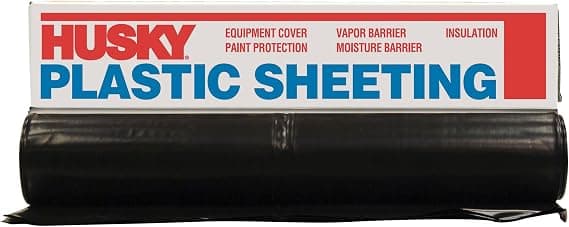
Lowest cost but not a permanent liner — 6 mil punctures during installation and lets through several times the moisture vapor of an engineered retarder.
Score Breakdown
Value
9.5
Performance
7.0
Ease of Use
8.5
Key Specs
Thickness
6 mil
Material
Polyethylene
Water Vapor Transmission
0.06 perms
Fire Rating
None listed
Use Case
General purpose / temporary
Pros
Lowest cost of the three — the cheapest way to get 1,000 sq ft of ground covered
Widely available at home improvement stores
Adequate for low-moisture crawl spaces with good drainage
Cons
6 mil punctures easily during installation — any sharp rock or screw tears through
0.06 perms allows roughly six times the water vapor transmission of an engineered Class A retarder
No fire rating — may not meet local building code for an enclosed or conditioned crawl space
Requires more careful installation and more stapling to hold flat
Suited to
Temporary moisture protection or very low-moisture crawl spaces where budget is the primary constraint — not recommended as a permanent encapsulation solution
Expert Note
Marcus Reed · IICRC Certified WRT · 15 yrs experience
“6-mil poly is what many older homes have in their crawl spaces — installed decades ago by the original builder, and it is still the code-minimum ground cover under the IRC. Code minimum and durable are different things. The 6-mil sheets I pull out are perforated wherever anyone knelt on them. If you are replacing an existing 6-mil barrier, step up to at least 10 mil; the cost difference is small relative to how much longer the liner stays intact.”
What to know before you buy — written from real restoration job experience.
Mil Rating: What Thickness Do You Actually Need?
Vapor barrier thickness is measured in mils (thousandths of an inch). The IRC sets 6 mil as the minimum ground cover for a crawl space, but moisture control professionals treat 10 mil as the practical floor, because 6-mil poly punctures during installation — a sharp rock, a nail, or a knee is enough. 10 mil survives the install and the occasional access that follows, and it is the heaviest thickness reliably stocked on Amazon. Above that, 15–20 mil reinforced liners exist for crawl spaces that get used, and they are ordered through insulation and building-supply houses rather than bought online.
When 10 mil Is Not Enough
Three situations call for a heavier liner than 10 mil. First, a crawl space anyone walks on regularly — storage, a service path to a dehumidifier or water heater, repeated trade visits. Foot traffic is what wears a liner through, and a reinforced 15–20 mil sheet is built for it. Second, a code or inspection requirement: some jurisdictions and most engineered encapsulation specs call for an ASTM E1745 Class A retarder, which is a tested product class, not a thickness. Third, a full conditioned encapsulation, where the liner is relied on as part of the building envelope. In all three cases, call an insulation supplier and ask for a Class A crawl space liner — that product class is not an Amazon purchase.
Perm Rating and What Retail Rolls Publish
Perms measure how much water vapor passes through the material; lower is better. Standard 6-mil poly is commonly rated near 0.06 perms, and engineered ASTM E1745 Class A retarders publish figures an order of magnitude lower. Most retail polyethylene rolls, including the 10-mil liners here, publish no perm rating at all — so on a retail roll, thickness is the only spec you can actually verify. If a number below 0.02 perms matters to you, on paper or to an inspector, you need a product that publishes its ASTM test data, which means buying through a supplier.
Seaming and Installation: Where Most DIY Jobs Fail
Vapor barrier effectiveness depends entirely on seam integrity. IICRC S500 practice is 12-inch overlaps at all seams, sealed with vapor barrier tape — not duct tape, which fails in humid conditions. Run the barrier 6 inches up foundation walls and seal with compatible tape or hydraulic cement. Any unsealed gap — around pipes, posts, or wall transitions — defeats the purpose of the barrier. This is also why roll width matters: a wider sheet means fewer seams, and fewer seams means fewer places to fail. Most DIY vapor barriers fail at the seams, not in the middle of the sheet.
Vapor Barrier vs. Full Encapsulation
A vapor barrier covers only the crawl space floor, controlling ground moisture. Full encapsulation covers the floor AND walls, seals all vents, and includes a dehumidifier to control both ground moisture and humid outside air. Encapsulation runs several thousand dollars professionally installed. If your crawl space humidity exceeds 70% regularly (especially in the Southeast and Gulf Coast), encapsulation is typically worth it — it prevents the mold, wood rot, and insulation damage that cost far more. Encapsulation is also the job where a heavier Class A liner is worth specifying, since the liner becomes part of the conditioned envelope.
Our Testing Methodology
How HearthDry evaluates equipment
Every product on this page has been evaluated by Marcus Reed, a 15-year IICRC Water Restoration Technician (WRT) who has worked on hundreds of residential and commercial water damage jobs. Products are scored across three weighted dimensions: Value, Performance, and Ease of Use.
Test Conditions
Performance tested during real Category 1–2 water damage jobs (not lab simulations)
72-hour continuous run tests to check auto-restart, compressor reliability, and noise levels
Capacity ratings verified against AHAM DOE 2012 standard (not old 2012 rating inflated numbers)
Price-to-performance calculated at street price, not MSRP
Ease of use scored after first-time setup without reading the manual
HearthDry maintains editorial independence. Affiliate commissions do not influence rankings — the top pick is the product we would buy for most homeowners, not the highest-commission product. Prices are verified monthly and updated when they shift more than 10%.
Frequently Asked Questions
What thickness vapor barrier do I need for a crawl space?
For most crawl spaces, 10 mil is the thickness to buy. 6-mil poly is the code-minimum ground cover in many areas but punctures easily during installation and any future access — one crawl over a sharp rock and it is holed. 10 mil survives the install and occasional entry, and it is the heaviest liner reliably stocked on Amazon.
Go heavier — 15 to 20 mil reinforced — if the crawl space is walked on regularly, used for storage, or if an inspector or engineer has specified an ASTM E1745 Class A retarder. Those heavier liners are ordered through insulation and building suppliers rather than bought online.
Quicker than reading — ask the pro directly: (888) 840-6512 · toll-free · no obligation
Is a 10-mil liner the same as a Class A vapor retarder?
NoClass A refers to ASTM E1745, a tested product class covering water vapor transmission, tensile strength, and puncture resistance — not a thickness.
A retail 10-mil polyethylene roll can be a perfectly good crawl space ground cover while publishing no ASTM class and no perm rating at all. If your plans, your inspector, or your contractor call for a Class A retarder, a 10-mil roll will not satisfy that, however it performs in the ground. Buy a product that publishes its E1745 test data, and expect to order it from an insulation supplier.
Quicker than reading — ask the pro directly: (888) 840-6512 · toll-free · no obligation
Should I encapsulate my crawl space or just add a vapor barrier?
A vapor barrier covers only the ground (dirt floor). Crawl space encapsulation covers the ground AND the walls, seals all vents, and typically includes a dehumidifier and sump pump. Encapsulation costs several times what a ground cover does, but it controls humidity more completely and can qualify the crawl space as conditioned space.
A basic vapor barrier controls ground moisture but not the humid outside air entering through the vents. If your crawl space humidity exceeds 70% regularly (especially in humid climates), encapsulation is typically worth the investment.
Quicker than reading — ask the pro directly: (888) 840-6512 · toll-free · no obligation
Who do I call right now for water damage?
Call (888) 840-6512. The line is answered 24 hours a day, seven days a week, and connects you with an IICRC-certified water damage restoration company that serves your area.
Describe what you can see — where the water is coming from, how long it has been there, and whether it smells — and the dispatcher routes you to a crew that handles that kind of loss. If the source is a pipe or an appliance, shut the main water valve first; the call itself takes under two minutes.
Quicker than reading — ask the pro directly: (888) 840-6512 · toll-free · no obligation