
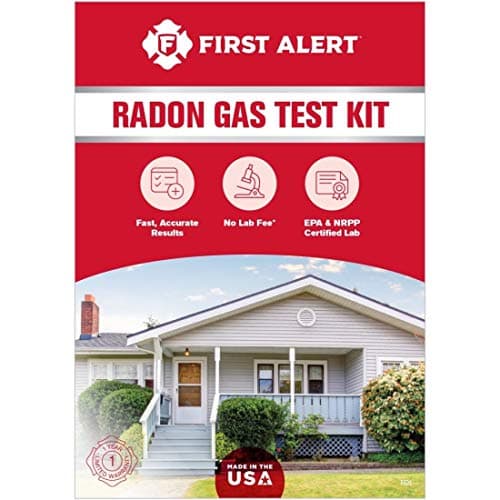
Best for: A first radon screen in a home that has never been tested
- Kit type:
- Mail-in radon test, read by a lab
- Lab fee (stated):
- Included, excluding New Jersey state fees
Listing verified 13 Oct 2026

Mail-In Kits Compared on Lab Fees and Test Length, and the Follow-Up Test Before Mitigation
4 picks compared · prices, ratings and stock checked October 12, 2026
Our Top Pick
For a first radon screen, the First Alert RD1 Radon Gas Test Kit: the lab fee is included outside New Jersey, and results are emailed within 72 hours of the lab receiving it, per its listing. If you want the method and test length spelled out, the Leaping Lynx 48-Hour Short-Term Radon Gas Test Kit names both: activated charcoal, 48 hours.
4.3 on Amazon · 10,310 ratings
Quick answer
For a first radon test, buy a short-term mail-in kit with the lab fee included, and for most homes that is the First Alert RD1 Radon Gas Test Kit, rated 4.3 stars across 10,310 Amazon ratings. Place it in the lowest lived-in level with windows and outside doors closed, then mail it to the lab right away. EPA recommends fixing your home at 4 pCi/L or higher and says to consider fixing between 2 and 4 pCi/L. Treat one kit as a screen: if it reads 4 pCi/L or more, run a follow-up test before you pay for mitigation.
Available picks first — 3 of 4 in stock at our last check — ratings and stock read from Amazon on 12 October 2026.
Best for: A first radon screen in a home that has never been tested
Listing verified 13 Oct 2026
Best for: A quick screen when you want to know exactly what is in the box and how long it runs
Listing verified 13 Oct 2026
Out of stock at our last check — the link still works if it returns.
Best for: Someone who wants status messages while the kit is in the mail and at the lab
Listing verified 12 Oct 2026
Best for: Anyone who wants one purchase to cover the kit, the lab and the trip back
Listing verified 13 Oct 2026
How this page was made: we compare the current Amazon listings, the makers' published specs and what verified buyers report, then rank by fit for the job. Ratings, review counts and stock are read from Amazon and dated. We earn a commission on purchases through our links; it does not change the order. Reviewed by Marcus Reed, IICRC-certified Water Restoration Technician.
Full Reviews
Each pick in detail: what the listing states, what buyers report, and where it falls short.
Check price
on Amazon ↗
Listing verified 13 Oct 2026
See it on Amazon ↗Best Overall
Quick Verdict
First Alert RD1 Radon Gas Test Kit: lab fee included outside New Jersey and results by email, though the bullets leave out test length and postage.
Key Specs
Kit type
Mail-in radon test, read by a lab
Lab fee (stated)
Included, excluding New Jersey state fees
Results (stated)
Emailed within 72 hours of lab receipt
Program named (stated)
Listed under the EPA radon gas measurement proficiency program
Test length and detector type
Not stated in the listing bullets; follow the instructions in the box
Return postage
Not stated on the listing
Pros
Cons
Suited to
A first radon screen in a home that has never been tested
Our take
Two lines on this listing matter most: the lab fee and the turnaround. Lab analysis is included outside New Jersey, so the box price is close to the full cost, apart from postage, which the bullets never mention. Results arrive by email within 72 hours of the lab receiving the kit, but that clock starts at the lab, not when you seal the package, so mail it the day the test ends. Test length and detector type are left to the instructions inside, and EPA's guidance is to leave a kit out for as long as the package says. The listing names the EPA radon gas measurement proficiency program; EPA's current page names NRPP and NRSB as the recognized national programs, so ask First Alert which lab reads the kit if that matters to you.
Affiliate link — commission at no extra cost to you
Compare elsewhere
These open a search for this model. We quote prices only where we can verify them — Amazon, Sylvane and eBay.
Check price
on Amazon ↗
Listing verified 13 Oct 2026
See it on Amazon ↗Best 48-Hour Charcoal Kit
Quick Verdict
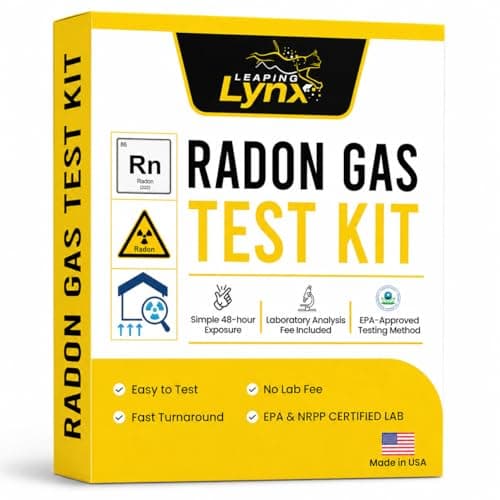
Leaping Lynx 48-Hour Short-Term Radon Gas Test Kit: a charcoal kit that states its method, length and NRPP lab, with return postage on you.
Key Specs
Method (stated)
Activated charcoal detector
Test length (stated)
48 hours
Lab (stated)
NRPP-certified lab analysis included, no separate lab fee
Results (stated)
Typically 3–5 business days after the lab receives the sample
Return postage (stated)
Not included; you pay to mail it back
Placement (stated)
Lowest livable level of the home
Pros
Cons
Suited to
A quick screen when you want to know exactly what is in the box and how long it runs
Our take
A charcoal kit works by soaking up radon from the room while it sits open, and the lab then counts what the charcoal collected. That makes a 48-hour result a snapshot of those two days and the weather in them. For a test lasting just 2 or 3 days, EPA's Citizen's Guide to Radon says windows and outside doors should be closed for at least 12 hours before it starts, and that it should not run during unusually severe storms or periods of high wind. So plan the 48 hours around the forecast, write the start and stop times on the registration sheet, and post it the same day. The NRPP-certified lab line is worth having, because it tells you who reads the charcoal and how that lab is credentialed.
Affiliate link — commission at no extra cost to you
Compare elsewhere
Check price
on Amazon ↗
Listing verified 12 Oct 2026
See it on Amazon ↗Best for Text and Email Updates
Quick Verdict
PRO-LAB Short-Term Radon Test Kit, 1 Kit: lab analysis included with text updates, but check the exact listing because other PRO-LAB packs charge a lab fee.
Key Specs
Test length (stated)
As little as 48 hours
Detectors
One short-term detector
Lab fee (stated)
Lab analysis included in the package price; no separate fees after purchase
Updates (stated)
Email and text notifications from detector receipt to results
Detector type
Not named on this listing, which describes EPA approved lab methods
Results time
Not stated on this listing
Pros
Cons
Suited to
Someone who wants status messages while the kit is in the mail and at the lab
Our take
Buy this one by its exact listing. PRO-LAB sells several radon kits on Amazon, and its two-pack short-term listing and its long-term alpha-track listing both state a separate lab analysis fee for each detector, paid after you buy. This one-kit short-term listing says the opposite: lab analysis is included and there are no separate fees to pay later. Two kits from one brand can therefore cost quite differently once the lab is paid. The listing does not name the detector type or how quickly results come back, so read the box insert for any mailing deadline before you open the pouch. The text and email updates cover the part of a mail-in test that most often goes quiet: knowing the lab actually received your kit.
Affiliate link — commission at no extra cost to you
Compare elsewhere
Check price
on Amazon ↗
Listing verified 13 Oct 2026
See it on Amazon ↗Best With Return Postage Included
Quick Verdict
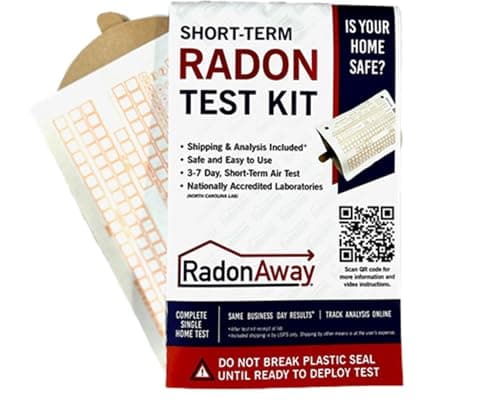
RadonAway Complete Radon Test Kit: lab fee and return USPS shipping both included with next-day results, though test length is not stated.
Key Specs
Lab (stated)
Analysis by a NELAP-approved radon lab included
Return shipping (stated)
Return USPS shipping to the lab included
Results (stated)
Next day after the lab receives the device
Report (stated)
Online and by email
Instructions (stated)
Easy to follow, with visual aids
Test length and detector type
Not stated on the listing
Pros
Cons
Suited to
Anyone who wants one purchase to cover the kit, the lab and the trip back
Our take
The cost people forget in a mail-in radon kit is the trip back to the lab, and this is the one listing on the page that says return USPS shipping is included along with the lab fee. Its next-day results after lab receipt are also the quickest turnaround stated here, which helps when a follow-up test is waiting on the first number. Two things are missing from the bullets: how long the test runs and what kind of detector it is, so read the insert before you open anything. The lab is described as NELAP-approved. NELAP is a national accreditation program for environmental labs, while EPA's page on finding radon professionals names NRPP and NRSB as the national radon proficiency programs. Whichever lab reads it, the result is judged against the same 4 pCi/L action level.
Affiliate link — commission at no extra cost to you
Compare elsewhere
What to know before you buy.
EPA's Citizen's Guide to Radon sorts tests by how long they sit in the house. Short-term tests stay two days to 90 days, depending on the device, and charcoal canisters are one of the common types. Long-term tests stay more than 90 days, usually alpha-track or electret detectors, and are more likely to reflect your year-round average, because radon rises and falls from day to day and season to season. The Leaping Lynx and PRO-LAB kits here state a 48-hour test; the First Alert and RadonAway listings leave the length to the instructions in the box. The long-term alpha-track kits read for this page did not meet its buyer-rating bar, so none made the list. For a long-term number, ask your state radon program about its kits, or use a continuous digital monitor that shows a long-term average.
A radon kit is two purchases in one: the detector and the lab that reads it. Check both lines before you buy. Per their listings, First Alert includes lab fees except New Jersey's state fee, Leaping Lynx includes the analysis but leaves return postage to you, the one-kit PRO-LAB includes lab analysis in the package price, and RadonAway covers both the lab and return USPS shipping. The trap is pack size and test type. PRO-LAB's two-pack short-term listing and its long-term alpha-track listing both state a separate lab fee for each detector, paid after purchase, so the box price there is only part of the bill. If a listing says nothing about the lab fee, assume it is extra until the box says otherwise. New Jersey residents should expect a state fee on several of these kits.
A kit can only read the air you give it. Per EPA's Citizen's Guide, close windows and outside doors at least 12 hours before a 2- or 3-day test and keep them closed as much as possible until it ends. Furnace and central air fans that recirculate indoor air can run. Fans or machines that bring in outside air should stay off, and a radon system fan or a bathroom exhaust fan used briefly is allowed. Do not start a short test during unusually severe storms or high winds. A basement dehumidifier only recirculates indoor air, so it can keep running, but set the kit well clear of its warm exhaust. Write down the exact start and stop times, reseal the kit as the package says, and send it to the lab the same day, since EPA's guide says to mail it right away.
Results come back in picocuries per liter of air, written pCi/L. EPA describes radon as a naturally occurring radioactive gas that can enter homes from the ground and build up to dangerous levels. Its action level is 4 pCi/L: at that level or above, EPA recommends fixing your home. Between 2 and 4 pCi/L, EPA's advice is to consider fixing it, and its health-risk page adds that getting radon below 2 pCi/L is difficult. For scale, EPA puts the average indoor level at about 1.3 pCi/L and outdoor air at about 0.4 pCi/L. The reason to take any of these numbers seriously is on the same page: by EPA's estimates, radon is the second leading cause of lung cancer overall and the leading cause among people who have never smoked. A result below 4 still deserves a retest someday, and a lower floor you start using needs its own test.
The follow-up in EPA's Citizen's Guide has three steps. If a first short-term test reads 4 pCi/L or higher, test again to be sure. For a better picture of your year-round level, follow up with a long-term test; if you need an answer quickly, run a second short-term test, and do it immediately if the first result was more than twice the action level, above 8 pCi/L. Then fix the home if the long-term result is 4 pCi/L or more, or consider fixing it if the average of the two short-term results is 4 or more. Averages close to 4 are the least certain. The guide gives an example: a two-test average of 4.1 pCi/L carries about a 50% chance that the year-round level is somewhat below 4. Buying two kits at the start makes the second test easy, and the mitigation cost guide linked below explains what comes next.
A kit you run yourself is for your own information, and some situations need more. If you are buying or selling a home, EPA's guide notes that buyers frequently want a test made by someone not involved in the sale, and your state radon office can point you to a qualified tester; EPA's page on finding professionals names NRPP and NRSB as the national programs that credential them. If you want to follow levels through the seasons or check a mitigation fan over the years, a continuous digital monitor fits better than one mail-in reading after another. These kits measure radon in indoor air, not in well water. And when a test comes back high, no kit can show where radon enters or which system suits your foundation. That is work for a qualified mitigation professional, and EPA's advice is to find one through your state radon program.
YesA kit used as directed gives a usable reading, but it only covers the days it was out. Radon rises and falls with weather and season, so a 48-hour result can land above or below your year-round average.
That is why EPA's guide treats a first short-term result of 4 pCi/L or more as a reason to retest rather than a final answer. The rest of the accuracy is in your hands: closed windows, the right room, prompt mailing, and a lab that is credentialed.
Plan on roughly one to two weeks from opening the kit to reading the result. The Leaping Lynx and PRO-LAB listings each state a 48-hour test, and then the kit spends a few days in the mail.
Once the lab has it, results take 72 hours for First Alert, 3–5 business days for Leaping Lynx and the next day for RadonAway, per their listings. Long-term tests are a different commitment, since EPA's guide defines them as more than 90 days.
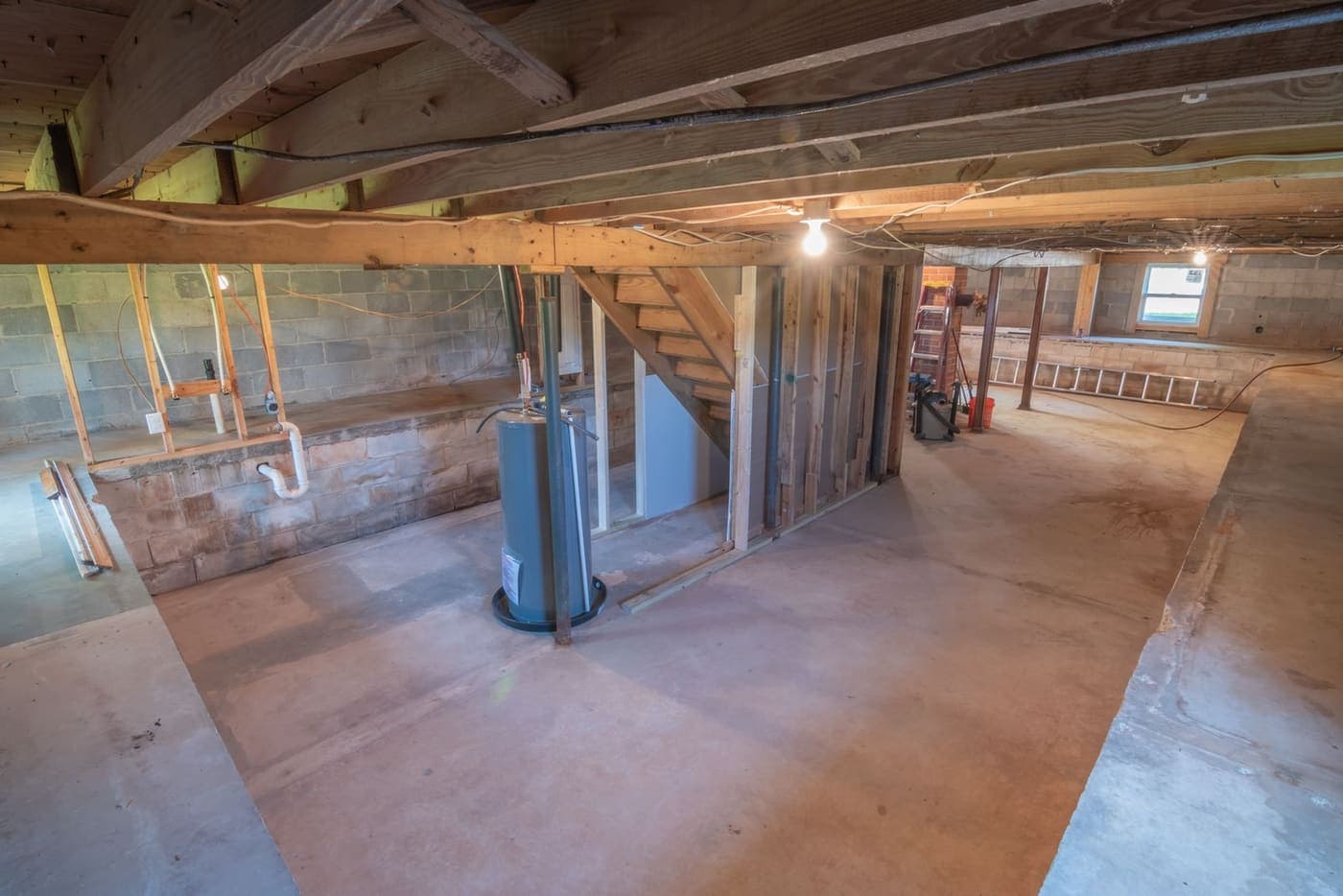
Place it in the lowest level of the home that you use regularly, in a room such as a bedroom, den or playroom. Per EPA's Citizen's Guide, that means the basement if it is frequently used and otherwise the first floor, but never a kitchen or bathroom.
Set the kit at least 20 inches above the floor where it will not be disturbed, away from drafts, high heat, high humidity and exterior walls. Also follow the placement directions on the kit's own packaging.
Use a short-term test first if you need an answer soon, and a long-term test if you want your true year-round level. Short-term kits are quick and low-cost, which is why they are the usual first screen and the usual choice during a home sale.
A long-term test smooths out the swings that can push a two-day reading up or down. A sensible path is a short-term screen, then a long-term follow-up when the first number lands near 4 pCi/L and you are not in a hurry.
SometimesThrough your state radon program rather than a store. EPA's page on finding a test kit says some states offer free or discounted kits to the public, and that the National Radon Program Services at Kansas State University sells discounted kits online.
Store-bought kits, including every kit on this page, are paid purchases, and the lab fee may or may not be included. Check your state program first; if it has nothing on offer, buy a kit whose listing states the lab fee is included.
You can, but the other side may not accept it. EPA's guide notes that buyers frequently want a test made by someone not involved in the sale, and a seller's own kit is the opposite of that.
As a buyer, ask your state radon office for a qualified tester, or one credentialed through NRPP or NRSB. As a seller, a kit run before listing is still worth it, because EPA's guide advises fixing a radon problem early so it does not complicate the sale.
Call (888) 840-6512. The line is answered 24 hours a day, seven days a week, and connects you with an IICRC-certified water damage restoration company that serves your area. A recorded menu picks up first: choose water damage or mold, key in your 5-digit ZIP code, and hold through the short silence while the call is passed to the company.
Describe what you can see — where the water is coming from, how long it has been there, and whether it smells — the more specific you are, the faster the right company is on the line. If the source is a pipe or an appliance, shut the main water valve first. Have four things ready and the call goes quickly: the address, when the water started, what is wet now, and whether you have filed an insurance claim.
Still not sure which of these is your situation? (888) 840-6512 · toll-free · answered 24/7
Methodology: How we source and verify data · Report an error
Free 2-day shipping
Amazon Prime members pay no shipping on restoration equipment
Dehumidifiers, air movers, and moisture meters qualify for free Prime delivery — bulk items that otherwise cost $15–$40 to ship.
Affiliate link — HearthDry earns a bounty if you sign up; costs you nothing extra.
A home mold test kit answers one question — is there mold here — and in almost every house the answer is yes. The kits differ in how well they answer the questions that matter, namely what kind, how much and whether it is growing, and this guide shows which kit answers which and when to skip the kit and fix the moisture instead.
Read the comparisonA properly installed vapor barrier is the most cost-effective way to keep ground moisture out of a crawl space, and most failures come from thin film and untaped seams rather than the wrong brand. This guide compares 6-mil, 10-mil and 20-mil woven liners on the specifications you can actually check, and covers the tape and overlaps that decide whether the barrier works.
Read the comparisonA damp crawl space feeds mold and wood rot in the framing above it. These four crawl space dehumidifiers are ranked on published specifications, buyer records and how honestly each states its capacity for the cool, damp conditions under a house.
Read the comparisonA hygrometer is the small, inexpensive instrument that tells you whether a room needs a dehumidifier, a humidifier or nothing at all. These picks are judged on the accuracy each listing states, how easily you can read them, and whether they can warn you about a damp basement before you smell it.
Read the comparisonA continuous radon monitor shows how radon rises and falls in your home, but its first reading is not a result, and a one-day number is not the long-term average EPA's guidance is built on. These monitors are compared on what each listing states about first reading, averages shown, power and app, with where to put one and when a qualified tester is still the right call.
Read the comparisonA radon fan is one part of a sub-slab system, and the right one is the fan whose airflow holds up at the suction your pipe and soil demand. These picks are compared on what each listing states about pipe size, airflow at pressure, power and outdoor use, alongside EPA's advice on the 4 pCi/L action level, venting above the roof and finding a qualified mitigator.
Read the comparison