Best Radon Fan in 2026 — Inline Fans for Sub-Slab Systems, Matched by Suction, Not the Biggest CFM Number

Best Radon Fan in 2026

Inline Fans for Sub-Slab Systems, Matched by Suction, Not the Biggest CFM Number

5 picks compared · prices, ratings and stock checked October 12, 2026

Our Top Pick

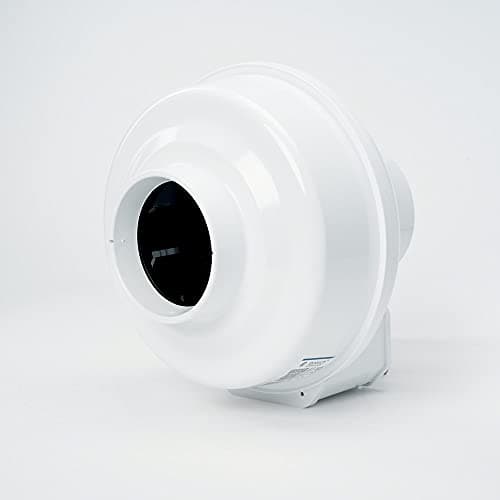
For replacing a failed fan on a 4 in system, the RadonAway RP145C Radon Fan, which its listing says is the standard RP145 under a maker's label. If you want a listing that prints airflow at a stated suction, the Fantech Rn2 (123 CFM at 0.50 in static pressure) is the alternative.

4.4 on Amazon · 1,403 ratings

Quick answer

If your radon system's fan has died, buy the same model or one whose published fan curve covers the suction your manometer showed, and for most 4 in systems that is the RadonAway RP145C, rated 4.4 stars across 1,403 Amazon ratings. Its listing says it is the standard RP145 under a different label, with 4.5 in inlet and outlet collars that join 4 in schedule 40 PVC through rubber couplings. Compare fans by airflow at a stated static pressure, not peak CFM. For a new system, EPA points you to your state radon program for qualified professionals, and advises fixing a home that tests at 4 pCi/L or more.

Our Picks at a Glance

Every pick below is currently stocked — ratings and stock read from Amazon on 12 October 2026.

Best Overall for 4 in Systems
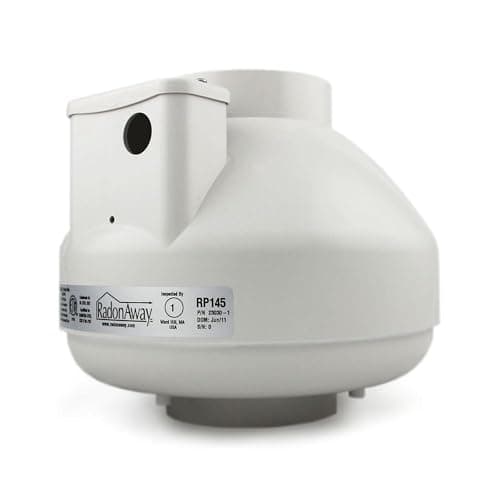
RadonAway RP145C Radon Fan (P/N 23030-1, 4.5 in Inlet and Outlet)
4.4 from 1,403 Amazon ratings · checked 12 OctAmazon's Choice

Best for: Replacing a failed RP145, or a fan of the same class, on an existing 4 in sub-slab system

Model (stated):
RP145C is the standard RP145 under the maker's label: same motor, specs and warranty
Inlet/outlet:
4.5 in diameter, the outside diameter of 4 in schedule 40 PVC

Listing verified 13 Oct 2026

How this page was made: we compare the current Amazon listings, the makers' published specs and what verified buyers report, then rank by fit for the job. Ratings, review counts and stock are read from Amazon and dated. We earn a commission on purchases through our links; it does not change the order. Reviewed by Marcus Reed, IICRC-certified Water Restoration Technician.

Full Reviews

Each pick in detail: what the listing states, what buyers report, and where it falls short.

#1
Best Overall for 4 in Systems

Check price

on Amazon ↗

Listing verified 13 Oct 2026

RadonAway RP145C Radon Fan (P/N 23030-1, 4.5 in Inlet and Outlet)See it on Amazon ↗

Best Overall for 4 in Systems

RadonAway RP145C Radon Fan (P/N 23030-1, 4.5 in Inlet and Outlet)

4.4(1,403 reviews)

Quick Verdict

RadonAway RP145C: the standard RP145 under a maker's label, a like-for-like swap for 4 in systems, though its listing prints no fan curve.

Key Specs

Model (stated)

RP145C is the standard RP145 under the maker's label: same motor, specs and warranty

Inlet/outlet

4.5 in diameter, the outside diameter of 4 in schedule 40 PVC

Housing (stated)

Seams sealed to inhibit radon leakage

Motor (stated)

Thermally protected, with a water-hardened motorized impeller

Use (stated)

Rated for commercial and residential use; meets electrical code requirements, per the listing

Airflow, static pressure, watts

Not stated on the listing

Pros

  • The listing confirms RP145C and RP145 are the same fan, so a failed RP145 can be swapped like for like without reworking the pipe
  • Housing seams are sealed against radon leakage, which matters because the outlet side of the fan runs under positive pressure
  • Thermally protected motor and a water-hardened impeller suit a fan that runs around the clock in a pipe that carries condensation
  • The maker's listing says slab cracks and openings must be sealed, an honest note most fan listings leave out

Cons

  • No airflow, static pressure or wattage figures on the listing; you have to pull RadonAway's own spec sheet to see the fan curve
  • Outdoor mounting is not spelled out in the listing's bullets, so confirm it in the installation instructions before fitting it to an exterior wall
  • The listing names no couplings, manometer or cord in the box, so plan to buy those separately if your old ones are worn

Suited to

Replacing a failed RP145, or a fan of the same class, on an existing 4 in sub-slab system

Our take

The useful line on this listing is the one most shoppers skip: RP145C is the RP145 under a manufacturer label, with the same motor, specs and warranty. If your attic or outside wall already carries an RP145, this is a direct swap. Cut the power, loosen the two couplings, drop the new fan in, and the manometer should return to about the reading marked at install, if your installer marked one. If the old fan was a different model, do not assume this one matches. The listing gives no airflow or pressure numbers, so pull RadonAway's spec sheet and check that its curve still moves air at the suction your gauge showed. The maker's own note deserves weight here: sizing a retrofit can need diagnostics.

Check today's price on Amazon →

Affiliate link — commission at no extra cost to you

Compare elsewhere

These open a search for this model. We quote prices only where we can verify them — Amazon, Sylvane and eBay.

#2
Best Published Fan Curve

Check price

on Amazon ↗

Listing verified 13 Oct 2026

Fantech Rn2 Radon Mitigation Fan (4.5 in Duct, 123 CFM at 0.50 in Static Pressure)See it on Amazon ↗

Quick Verdict

Fantech Rn2: the only listing here with airflow at a stated suction, 123 CFM at 0.50 in, for moderate-suction 4 in systems.

Key Specs

Pipe size (stated)

Standard 4½ in

Airflow at 0.50 in static pressure

123 CFM, per the listing

Airflow at 1.75 in static pressure

20 CFM, per the listing

Housing (stated)

Vibration-welded seam for a leak-proof housing

Former model (stated)

HP2190Q

Use (stated)

Residential systems

Pros

  • The only pick here whose listing prints airflow at two stated suctions, so you can check it against your manometer reading
  • Listed as the former HP2190Q, which helps if that is the model name on the fan in your attic
  • A vibration-welded housing seam, per the listing, makes the pressurized side one sealed shell

Cons

  • Airflow falls from 123 CFM to 20 CFM as suction rises from 0.50 to 1.75 in, so it suits looser soil better than tight clay
  • Wattage, noise and outdoor rating are not stated on the listing
  • A system that has always shown a high manometer reading needs a fan built for higher suction than this curve shows

Suited to

Replacing an HP2190 or a fan of the same class where the system runs at moderate suction

Our take

Two numbers on this listing do more for you than any 260 CFM headline: 123 CFM at 0.50 in of static pressure, and 20 CFM at 1.75 in. Static pressure is the suction the fan has to hold against your pipe and the soil under the slab, and it is what the U-tube manometer on your pipe reads, in inches of water column. Read the gauge before the old fan comes out. If it sat near 0.5 in, this fan has airflow to spare at that point. If it read 1.5 in or more, the soil is tight and this fan's flow is nearly gone there, so look at fans made for higher suction. Fantech also lists this as the former HP2190Q, so an old label in the attic may already tell you it fits.

Check today's price on Amazon →

Affiliate link — commission at no extra cost to you

#3
Best Kit for 3 in Pipe Systems

Check price

on Amazon ↗

Listing verified 13 Oct 2026

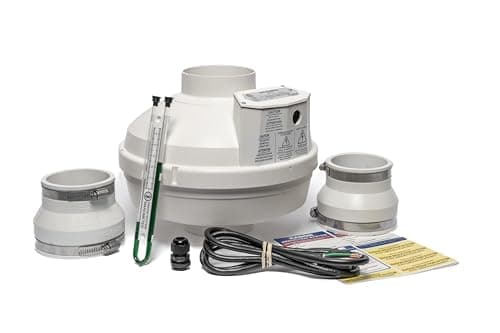
Festa AMG Maverick Radon Fan 3 in Installation Kit (4 in Fan, 4x3 Couplers, Manometer)See it on Amazon ↗

Quick Verdict

Festa AMG Maverick 3 in Installation Kit: fan, manometer, labels and 3 in couplers in one box at up to 70 watts, with no fan curve on the listing.

Key Specs

Kit contents (stated)

AMG Maverick fan, two 4x3 couplers for 3 in PVC/ABS, manometer, line cord kit and system labels

Power (stated)

Up to 70 watts

Noise (stated)

50–60 dB

Indoor/outdoor (stated)

Suitable for both

Warranty (stated)

5 years against fan failure

Airflow

Not stated on this kit listing; Festa's bare-fan listing gives 260 CFM with no static pressure

Pros

  • Comes with the manometer and labels a working system needs, plus couplers sized for 3 in pipe
  • States it suits indoor and outdoor mounting, the placement question most installs face
  • A power ceiling of 70 watts is printed on the listing, so the running cost can be worked out before you buy
  • Stated 5-year warranty against fan failure

Cons

  • No airflow figure at any static pressure, so the listing alone cannot tell you whether it matches your manometer reading
  • A stated 50–60 dB is louder than you want beside a bedroom window
  • The listing's own note, not for use in unattended areas, sits oddly with a fan that runs alone in an attic; ask Festa what it covers before mounting it there

Suited to

Fitting a fan, gauge and labels to a 3 in PVC system in one order

Our take

The kit is the reason to pick this listing. A fan swap often turns up a cracked old manometer or faded labels, and this box covers both, along with couplers that step the fan's 4 in collars down to 3 in PVC or ABS. The power figure is the other useful number: up to 70 watts, running all year, works out to about 613 kWh, so multiply that by the rate on your power bill before choosing it over a lower-draw fan. What the listing does not give is airflow at any suction. The 260 CFM on Festa's bare-fan listing has no static pressure attached, and a sub-slab fan never works against open air. The listing also says no specialist is needed; that is Festa's claim, and the retest still decides.

Check today's price on Amazon →

Affiliate link — commission at no extra cost to you

#4
Quietest Stated Noise (Two-Speed)

Check price

on Amazon ↗

Listing verified 13 Oct 2026

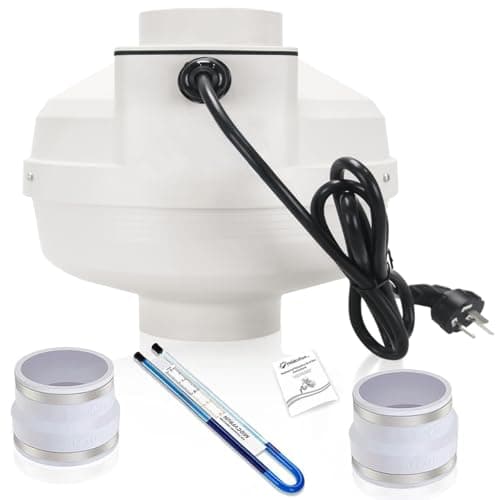
MIDCVFRUN 4 in Radon Fan Installation Kit (2-Speed, 260/188 CFM, 4x3 Couplers, Pressure Indicator)See it on Amazon ↗

Quick Verdict

MIDCVFRUN 4 in 2-Speed Kit: a stated 32 dB on low and IP67 for outdoor mounting, with no static pressure behind its CFM figures.

Key Specs

Speeds (stated)

High 260 CFM at 45 dB; low 188 CFM at 32 dB

Static pressure behind those CFM figures

Not stated on the listing

Kit contents (stated)

Fan, two 4x3 in rubber couplers and an air pressure indicator

Weather rating (stated)

IP67, for indoor and outdoor mounting

Watts

Not stated on the listing

Use named

Sub-slab depressurization in older and newer homes

Pros

  • Two speeds with a stated noise level for each, 45 dB on high and 32 dB on low, the clearest noise figures among these picks
  • An IP67 rating is stated, which covers rain on an exterior wall mount
  • Rubber couplers for 3 in pipe and a pressure indicator come in the box

Cons

  • Neither CFM figure is tied to a static pressure, and no wattage is given
  • Low speed gives up more than a quarter of the stated airflow, so read the gauge and retest before leaving it there
  • Its listing says no specialist is needed, which does not cover the slab sealing or the retest the system still needs

Suited to

A fan mounted near a bedroom or patio, where noise matters most

Our take

Noise is the complaint that sends people to the breaker panel, and a radon fan switched off is not reducing anything. This listing is the only one here to give a decibel figure for each speed: 45 dB on high and 32 dB on low. The catch is what each speed does to your system. Low cuts the stated airflow from 260 to 188 CFM, and neither number comes with a static pressure, so the only way to know low is enough is to read the pressure indicator and then retest the house. Treat it as a quiet option for a system you can check, not a shortcut. Wattage is missing from the listing too, so the running cost stays unknown until you read the motor label.

Check today's price on Amazon →

Affiliate link — commission at no extra cost to you

#5
Best for Boosting a Passive Pipe

Check price

on Amazon ↗

Listing verified 13 Oct 2026

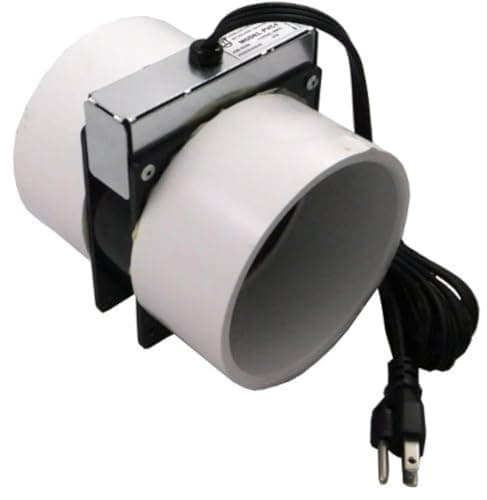
Tjernlund PVC4 Radon Mitigation Fan (Direct Fit to 4 in Schedule 40 PVC, 6 ft Cord)See it on Amazon ↗

Quick Verdict

Tjernlund PVC4: a steel-housed fan that fits 4 in schedule 40 PVC directly, for boosting a passive stack, with no fan curve on the listing.

Key Specs

Pipe fit (stated)

Connects directly to 4 in schedule 40 PVC

Power (stated)

6 ft power cord; described as minimal power consumption

Motor (stated)

Permanently lubricated ball bearing motor

Housing (stated)

Galvanized steel, backward-inclined steel impeller, custom-fitted gaskets

Size (stated)

3 lbs; 6.8 x 6.5 x 6.4 in

Airflow, static pressure, watts

Not stated on the listing

Pros

  • Fits 4 in schedule 40 PVC directly, with no rubber couplings to source
  • Galvanized steel housing and gaskets, per the listing, rather than a plastic shell
  • A plug-in 6 ft cord keeps the electrical side simple where an outlet is close

Cons

  • No airflow, pressure or wattage figures, so you cannot match it to a system from the listing
  • Outdoor or weather rating is not stated; keep it in an attic or garage unless Tjernlund's instructions say otherwise
  • The listing copy calls it a ceiling fan and a wall-mount fan in places, so take mounting directions from the instructions, not the bullets

Suited to

Adding suction to a passive radon pipe a builder already ran up through the attic

Our take

Some newer homes were built with a passive radon pipe: a vent stack from under the slab up through the roof, with no fan. If a test still comes back high, the usual next step is to put a fan on that stack, and this is the listing that speaks to that job. It says you can add it to a system for a performance boost and that it joins 4 in schedule 40 PVC directly. The weak point is the data. No airflow, pressure or wattage figure appears anywhere on the listing, so check Tjernlund's instructions for the fan's limits and whether it may be mounted outside. Fit it in the attic section of the stack, above the living space, and retest the house afterward to see whether the boost was enough.

Check today's price on Amazon →

Affiliate link — commission at no extra cost to you

Buyer's Guide

What to know before you buy.

What a Radon Fan Does, and Why It Is Only One Part of the System

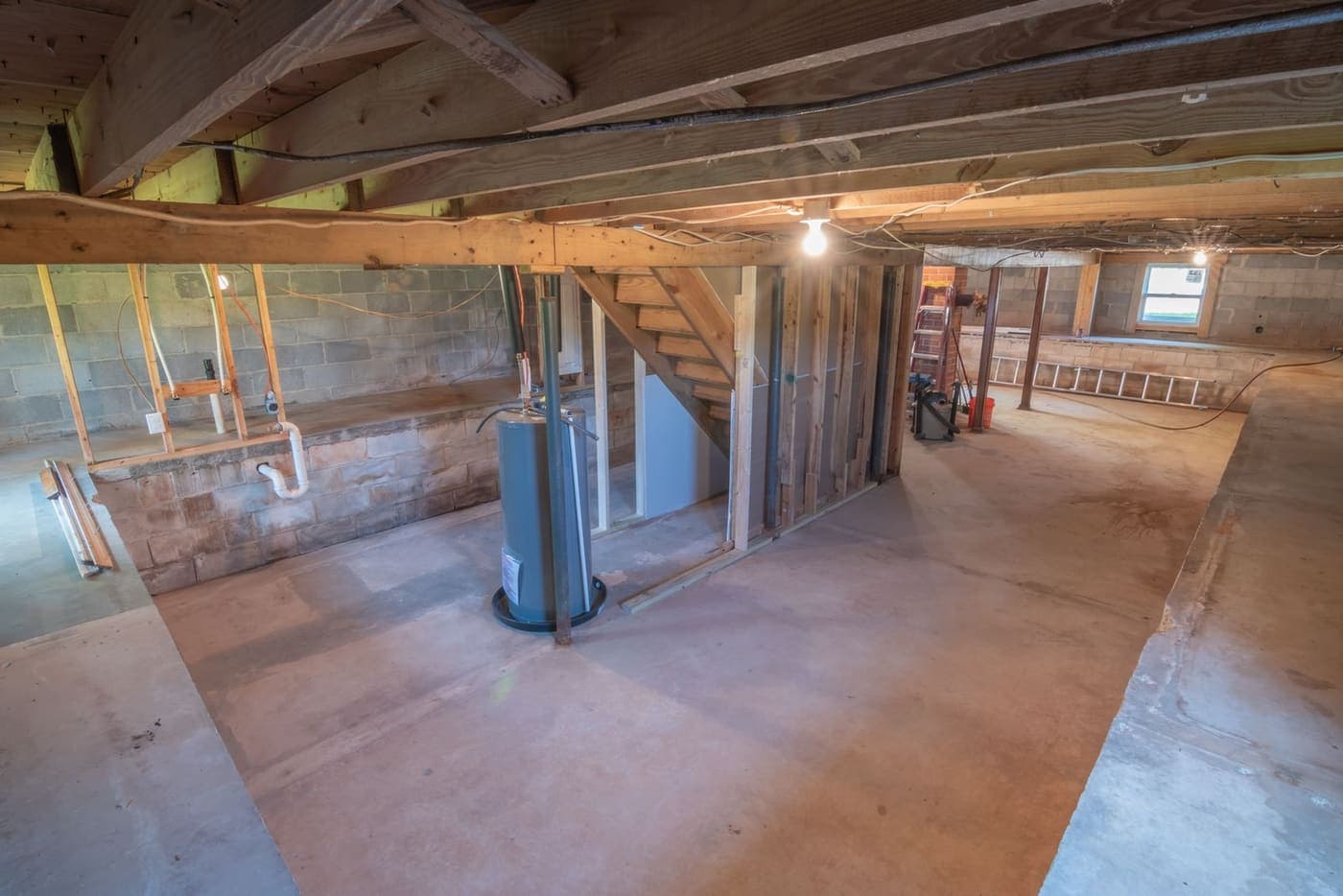
A radon fan does not filter or clean anything. In a sub-slab depressurization system, it pulls soil gas from a hole cut through the slab, up a sealed pipe and out above the roof, so the soil under your floor sits at slightly lower pressure than the air in your basement. That small suction is what keeps radon from seeping in. EPA describes soil suction the same way: radon is drawn from below the house and vented through pipe to the air above it, where it quickly dilutes. The fan only works as part of that whole. Slab cracks, sump pits and floor drains have to be sealed, or the fan pulls basement air instead of soil gas. RadonAway's own listing says as much. A bigger fan on a leaky slab mostly costs you power and heated air.

Sizing: Airflow at Your Suction, Not the Biggest CFM Number

Every radon fan trades airflow for suction. The Fantech Rn2 listing shows how steep that trade is: 123 CFM at 0.50 in of static pressure, but only 20 CFM at 1.75 in. Which point matters depends on what is under your slab. Loose gravel lets air move easily, so the system runs at low suction and needs flow. Tight clay or wet soil resists flow, so the fan has to hold high suction instead. On an existing system, the U-tube manometer on the pipe is your sizing data. Write down its reading before the old fan comes out, then choose a fan whose published curve still moves air at that number. A CFM figure with no pressure attached, like the 260 CFM on several listings here, most likely describes a fan blowing into open air, which a sub-slab fan never does.

Replacing a Failed Fan vs Designing a New System

A like-for-like swap is the job most buyers of a radon fan are doing. If the system tested low before the fan failed, the pipe, seals and suction point are already proven, and you are replacing a motor. Cut the power, loosen the couplings, fit the same model or one whose curve covers your manometer reading, and retest the house afterward. A new system is a different job. It starts with a test result, then checks under the slab to see how far suction reaches, then the suction point, sealing and pipe route. EPA's route for that work is your state radon program, which can help you find qualified professionals. States that receive EPA radon grants list providers credentialed by the state or by one of two national programs, the NRPP and the NRSB, and some states set requirements of their own.

Where the Fan Goes: Attic, Garage or Outside Wall, Never the Basement

Mount the fan outside the living space: in the attic, in an attached garage, or on an exterior wall. Everything after the fan is under positive pressure, so a cracked joint on that side pushes radon-laden air out wherever it leaks. With the fan outside the living space, that leak happens where nobody breathes it. The exhaust then has to rise above the roof. EPA explains that it disallowed ground-level discharge because the gas can be drawn back into the house and children could be exposed, and that radon falls to near background levels 3 to 4 ft from the discharge point. Outdoor mounting needs a fan stated for it, such as the IP67 MIDCVFRUN kit, and a weatherproof electrical connection. Hardwiring and any outdoor disconnect follow local electrical code, which is an electrician's call.

Checking It Works: The U-Tube Manometer, Noise and Power

The U-tube manometer on the pipe is your running check. With the fan on, the liquid sits higher on one side, and the difference, in inches of water column, is the suction. If both sides are level, the fan has stopped or the pipe has come apart, and from the living room you would not hear the difference. EPA advises looking at your system's warning device regularly and retesting the home at least every two years. It also notes that fans may last five years or more, with maker warranties that tend not to exceed five. Power is the running cost to plan for. A fan runs 8,760 hours a year, so a 70-watt draw, the ceiling on Festa's listing, comes to about 613 kWh a year. Noise varies more than people expect: listings here state anything from 32 dB to 60 dB.

Who Should Not Buy a Radon Fan Yet

Do not buy a fan before you have a test result. EPA's advice is to fix a home when radon is 4 pCi/L or more and to consider fixing between 2 and 4 pCi/L, so the number decides whether you need a system at all. By EPA's estimate, radon is the number one cause of lung cancer among non-smokers, which is why a test, not a hunch, should drive this purchase. A fan on its own does nothing in a house with no suction point or pipe; that home needs a designed system. A crawl space with a dirt floor needs a sealed membrane first, with suction drawn from under it. A dehumidifier or air purifier does not stop soil gas from entering, so neither is a radon fix. And if a retest stays high after a fan swap, call a qualified mitigator rather than buying a bigger fan.

Frequently Asked Questions

What size radon fan do I need?

You need the fan whose published curve still moves air at the suction your system runs at. On an existing system, read the U-tube manometer before removing the old fan; that number, in inches of water column, is the point to match.

Check the pipe size too, since most homes use 3 in or 4 in PVC and the couplings have to fit. For a new system, suction has to be measured under the slab first, which is why RadonAway's listing says retrofit sizing may need professional diagnostics.

Can I replace a radon fan myself?

Usually yesIf you are swapping a failed fan for the same model, or one with a matching curve, on a system that was working.

The job is cutting power, loosening two rubber couplings, fitting the new fan and restoring the wiring. Check first whether your state regulates radon mitigation work; EPA notes that some states have requirements of their own. Afterward, confirm the manometer shows suction again and retest the house, because a fan that spins is not proof the levels are down.

How long does a radon fan last?

EPA says radon fans may last five years or more and may then need repair or replacement, with manufacturer warranties that tend not to exceed five years. Some run well past that, especially when sized for the system rather than straining at high suction.

A stopped fan gives no warning sound inside the house, so glance at the manometer every few months, and retest at least every two years, which is EPA's advice for homes with a system.

Should a radon fan run all the time?

YesA sub-slab system only holds the soil under your floor at lower pressure while the fan runs, so switching it off lets radon start entering again.

Radon fans are built for continuous duty, which is why power draw matters: the fan runs 8,760 hours a year. If noise is the reason you want it off, fix the noise instead, with fresh rubber couplings, a firmer mount or a quieter fan matched to the same suction.

Where should a radon fan be installed?

Install it outside the living space: in the attic, an attached garage, or on an exterior wall, with the exhaust carried above the roof. The pipe after the fan is under positive pressure, so any leak on that side should happen outdoors or in unoccupied space.

EPA disallowed ground-level discharge because the gas can be drawn back indoors, and it notes radon falls to near background levels 3 to 4 ft from the discharge point. An outdoor fan must be stated as suitable for outdoor use.

How do I know if my radon fan is working?

Look at the U-tube manometer on the pipe: if the liquid sits at different heights on each side, the fan is pulling suction, and if both sides are level, it has stopped or the pipe has separated.

Compare the reading with the one marked at install, since a large change can mean a failing fan, a blockage or a leak. The manometer only shows the fan is moving air; a radon retest is what shows the levels are low.

Who do I call right now for water damage?

Call (888) 840-6512. The line is answered 24 hours a day, seven days a week, and connects you with an IICRC-certified water damage restoration company that serves your area. A recorded menu picks up first: choose water damage or mold, key in your 5-digit ZIP code, and hold through the short silence while the call is passed to the company.

Describe what you can see — where the water is coming from, how long it has been there, and whether it smells — the more specific you are, the faster the right company is on the line. If the source is a pipe or an appliance, shut the main water valve first. Have four things ready and the call goes quickly: the address, when the water started, what is wet now, and whether you have filed an insurance claim.

Still not sure which of these is your situation? (888) 840-6512 · toll-free · answered 24/7

Sources

  1. EPA — Health Risk of Radon
  2. EPA — Radon Frequently Asked Questions
  3. EPA — Find a Radon Test Kit or Measurement and Mitigation Professional

Methodology: How we source and verify data · Report an error

How we chose these picks

  • Every pick is a current listing. Stock, star ratings and rating counts are read from Amazon by script and carry the date they were read.
  • Nothing under 4.0 stars makes the list, and the top pick needs a large rating count, so one good week of reviews cannot put it there.
  • Specs are quoted from the listing or the maker, with the test condition behind the number where there is one, and sized against the job rather than the room on the box.
  • We do not run lab or field tests. Where a spec matters, we say what it is measured under and what it cannot tell you.

Free 2-day shipping

Amazon Prime members pay no shipping on restoration equipment

Dehumidifiers, air movers, and moisture meters qualify for free Prime delivery — bulk items that otherwise cost $15–$40 to ship.

Try Prime free →

Affiliate link — HearthDry earns a bounty if you sign up; costs you nothing extra.

Also Worth Comparing

Best Crawl Space Vapor Barrier 2026 — 6 mil vs 10 mil vs 20 mil Woven, and the Tape That Seals the Seams

A properly installed vapor barrier is the most cost-effective way to keep ground moisture out of a crawl space, and most failures come from thin film and untaped seams rather than the wrong brand. This guide compares 6-mil, 10-mil and 20-mil woven liners on the specifications you can actually check, and covers the tape and overlaps that decide whether the barrier works.

Read the comparison

Best Crawl Space Dehumidifiers in 2026 — Compared at Crawl-Space Temperatures

A damp crawl space feeds mold and wood rot in the framing above it. These four crawl space dehumidifiers are ranked on published specifications, buyer records and how honestly each states its capacity for the cool, damp conditions under a house.

Read the comparison

Best Dehumidifier for Basement Use in 2026 — Drain Hose, Built-In Pump and Honest Pint Ratings

Most basement dehumidifier disappointment comes from two numbers nobody reads properly: the pint rating, measured at warm test conditions a 60°F basement never reaches, and the drainage method. Five units are compared here on those two points first, from a garden-hose drain to a built-in pump with a stated 15 ft lift.

Read the comparison

Best Radon Test Kits in 2026 — Mail-In Kits Compared on Lab Fees and Test Length, and the Follow-Up Test Before Mitigation

A mail-in radon kit tells you whether your home needs a closer look, and what you actually pay depends on whether the lab fee and return postage are in the box. These kits are compared on what each listing states about the lab, test length and turnaround, with EPA's action level and the follow-up test that should come before any mitigation decision.

Read the comparison

Best Radon Detectors in 2026 — Continuous Home Monitors Compared on First Reading, Power and Display, and What a Monitor Cannot Replace

A continuous radon monitor shows how radon rises and falls in your home, but its first reading is not a result, and a one-day number is not the long-term average EPA's guidance is built on. These monitors are compared on what each listing states about first reading, averages shown, power and app, with where to put one and when a qualified tester is still the right call.

Read the comparison

Best Crawl Space Ventilation Fans in 2026 — Vent-Mounted Fans With Humidistats, and When Outside Air Makes the Crawl Space Wetter

A vent-mounted crawl space fan pulls damp air out through a foundation vent, and it helps only while the outside air coming in behind it is drier than the air it removes. These picks are compared on what each listing states about airflow, humidistat range, freeze cutoff and fit, alongside the dew point check that tells you whether a fan or a sealed crawl space with a dehumidifier is the right job.

Read the comparison