

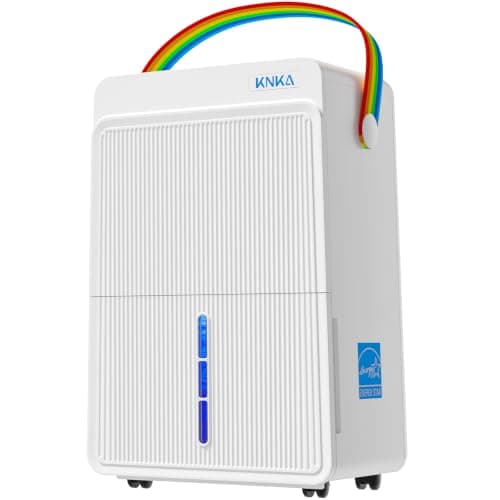
Best for: A damp, musty basement with a floor drain within a few feet of where the unit will sit
- Capacity (stated):
- 56 pints/day at 86°F, 80% RH; 80 pints/day at 95°F, 95% RH
- Coverage (claimed):
- Up to 5,500 sq ft
Listing verified 13 Oct 2026

Picked to Hold a Room Below 50%
5 picks compared · prices, ratings and stock checked October 11, 2026
Our Top Pick
For a damp or musty basement, the KNKA 80 Pint: ENERGY STAR certified, an Auto mode that holds 50% out of the box, and the longest stated drain hose on this page. For a closet with no outlet, a fragrance-free DampRid canister absorbs damp air without hiding the smell.
4.4 on Amazon · 1,203 ratings
Quick answer
Yes, a dehumidifier helps with mold, but by preventing it rather than removing it: hold a room below about 50% relative humidity and new growth cannot get started, damp surfaces dry out, and the musty smell usually fades. It does not kill mold that is already there, so clean small patches and fix the water source first. The KNKA 80 Pint is the pick for most damp basements, rated 4.4 stars across 1,203 Amazon ratings, with an Auto mode that defaults to 50% and a stated 56 pints a day at 86°F and 80% RH.
Every pick below is currently stocked — ratings and stock read from Amazon on 11 October 2026.
Best for: A damp, musty basement with a floor drain within a few feet of where the unit will sit
Listing verified 13 Oct 2026
Best for: A basement that runs cool for much of the year, where a coil that clears its own frost matters
Listing verified 13 Oct 2026
Best for: A single musty room, such as a laundry room, a finished basement bedroom or a den, rather than a whole open basement
Listing verified 13 Oct 2026
Best for: A walk-in closet, small bathroom or storage room with an outlet, where a thermoelectric mini unit would not keep up
Listing verified 13 Oct 2026
Best for: A closet, pantry or cabinet with a mild musty smell and no outlet nearby
Listing verified 13 Oct 2026
How this page was made: we compare the current Amazon listings, the makers' published specs and what verified buyers report, then rank by fit for the job. Ratings, review counts and stock are read from Amazon and dated. We earn a commission on purchases through our links; it does not change the order. Reviewed by Marcus Reed, IICRC-certified Water Restoration Technician.
Full Reviews
Each pick in detail: what the listing states, what buyers report, and where it falls short.
Check price
on Amazon ↗
Listing verified 13 Oct 2026
See it on Amazon ↗Best Overall
Quick Verdict
ENERGY STAR, set to 50% out of the box and quoted at a realistic 86°F test point — the default choice for a musty basement.
Key Specs
Capacity (stated)
56 pints/day at 86°F, 80% RH; 80 pints/day at 95°F, 95% RH
Coverage (claimed)
Up to 5,500 sq ft
Humidity control
Auto mode defaults to 50% RH; Setting mode 30%–80% RH
Drainage
1.45 gal tank with full alert and shut-off, or continuous drain through the included 6.56 ft (2 m) hose; optional 2.64 gal external tank sold separately
Efficiency
ENERGY STAR certified
Noise (claimed)
40–45 dB; display and indicator lights can be switched off
Pros
Cons
Suited to
A damp, musty basement with a floor drain within a few feet of where the unit will sit
Our take
For mold, the set point matters more than the pint rating, and this is the one listing here that ships set correctly: Auto mode holds 50% unless you change it, and Setting mode reaches down to 30% if a stubborn space needs a lower target. Read its two capacity figures together. 56 pints at 86°F and 80% RH is the honest number for a damp basement in August, and even that falls as the room cools toward 60°F. The listing is silent on defrost, which is the gap to close before relying on it through a cool spring. Because its own sensor sits at the air inlet, put an inexpensive hygrometer on the far side of the room and trust that reading.
Affiliate link — commission at no extra cost to you
Compare elsewhere
These open a search for this model. We quote prices only where we can verify them — Amazon, Sylvane and eBay.
Check price
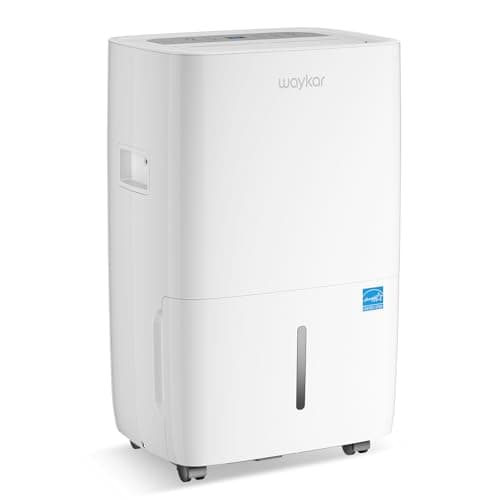
on Amazon ↗
Listing verified 13 Oct 2026
See it on Amazon ↗Best for Cool Basements
Quick Verdict
The most-rated unit here, with stated auto defrost for basements that run cool — plan on a longer garden hose.
Key Specs
Capacity (stated)
80 pints/day at 95°F, 90% RH
Coverage (claimed)
Up to 5,000 sq ft
Humidity range
30%–80% RH set point
Cold-weather handling
Automatic defrost and overload protection
Drainage
1.14 gal (4.3 L) tank, or continuous gravity drain through the included 3.3 ft hose; standard 3/4 in garden-hose connection
Efficiency
ENERGY STAR certified
Pros
Cons
Suited to
A basement that runs cool for much of the year, where a coil that clears its own frost matters
Our take
Mold-prone basements are often cool ones, and a cool coil is where compressor dehumidifiers struggle: below about 65°F frost forms on the coil and moisture removal drops. Waykar states automatic defrost, and that is the reason to choose it over the KNKA in a basement that stays in the low 60s from fall to spring. It does not publish a minimum operating temperature, so treat defrost as protection for the machine rather than a promise of full output in the cold. The 30% floor on the set point is more range than mold prevention needs. Set it to 45–50%; going lower adds running hours without making the space any safer from growth.
Affiliate link — commission at no extra cost to you
Compare elsewhere
Check price
on Amazon ↗
Listing verified 13 Oct 2026
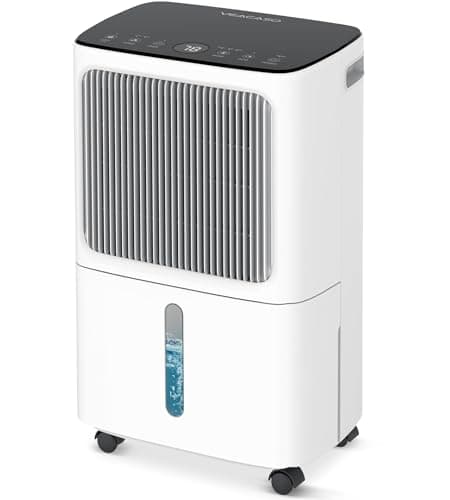
See it on Amazon ↗Best for One Damp Room
Quick Verdict
A quiet mid-size unit for one damp room, with power-failure memory — capacity test conditions not stated.
Key Specs
Capacity (stated)
34–36 pints/day (test conditions not stated on the listing)
Coverage (claimed)
Up to 2,500 sq ft
Modes
DEHU (holds a set humidity), DRY, CONT (continuous)
Drainage
0.53 gal tank with auto shut-off and full indicator, or continuous drain through the included hose
Noise (claimed)
40 dB or less on low
Controls
LED touch panel with live humidity reading; 1–24 hour timer; power-failure memory
Pros
Cons
Suited to
A single musty room, such as a laundry room, a finished basement bedroom or a den, rather than a whole open basement
Our take
Musty smells usually come from one room, not the whole house, and a mid-size unit fits that job without paying for capacity it will never use. The listing leaves out the one number that would make its capacity comparable, the test conditions behind 34–36 pints, so judge it on what it does state: a live humidity display, a DEHU mode that holds a set point, and power-failure memory, which matters more than it sounds in a room nobody visits daily. Set DEHU to 45–50%, close the door, and run the hose to a drain. The small tank is a backstop, not a plan.
Affiliate link — commission at no extra cost to you
Compare elsewhere
Check price
on Amazon ↗
Listing verified 13 Oct 2026
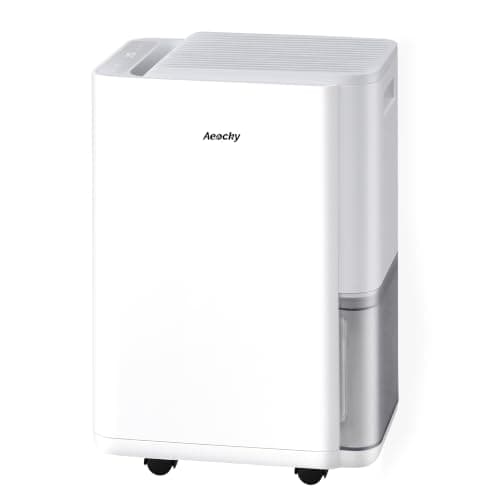
See it on Amazon ↗Most Compact Compressor
Quick Verdict
A true compressor small enough for a walk-in closet — empty the half-gallon tank often until the space dries.
Key Specs
Capacity (stated)
50 pints/day at 95°F, 95% RH
Coverage (claimed)
Up to 3,000 sq ft
Size
8.03 in D x 11.1 in W x 15.75 in H
Modes
Auto (holds 45%–55%), Constant Humidity (40%–80%), Continuous, Sleep
Drainage
0.5 gal tank with full-tank shut-off, or continuous gravity drain through the included hose
Protection
Smart defrost; float and proximity-switch water-level sensors
Pros
Cons
Suited to
A walk-in closet, small bathroom or storage room with an outlet, where a thermoelectric mini unit would not keep up
Our take
This is the honest alternative to the thermoelectric mini dehumidifiers sold for closets. Those remove ounces a day and suit a small cabinet; a compressor removes pints, and this one is small enough to tuck beneath hanging clothes. Its Auto mode targets 45–55%, which straddles the top of the EPA's range, so for a closet that has already grown mold on the back wall, switch to Constant Humidity and set 45%. The trade-off is the tank. Half a gallon goes quickly while a damp closet is first being dried, and few closets have a drain, so it works best where the hose can reach a nearby floor drain or you are willing to empty it daily at first.
Affiliate link — commission at no extra cost to you
Compare elsewhere
Check price
on Amazon ↗
Listing verified 13 Oct 2026
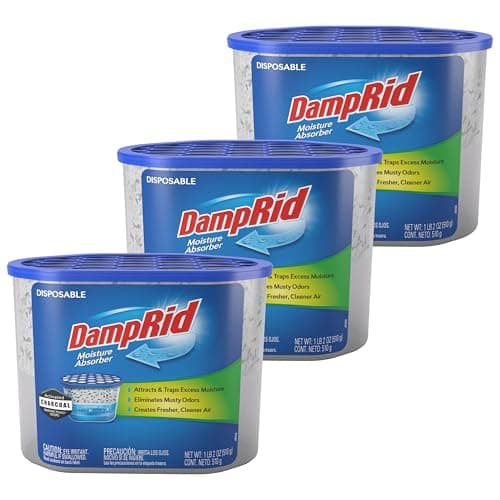
See it on Amazon ↗Best for Closets Without an Outlet
Quick Verdict
For a closet with no outlet: absorbs damp and odor without masking the smell — not a substitute for a dehumidifier.
Key Specs
Type
Disposable moisture-absorbing crystals with activated charcoal
Pack
Three 18 oz containers
Life (claimed)
Up to 60 days each, depending on temperature and humidity
Area (claimed)
About 300 sq ft per container
Power
None required
Scent
Fragrance free
Pros
Cons
Suited to
A closet, pantry or cabinet with a mild musty smell and no outlet nearby
Our take
Moisture absorbers pull water vapor into crystals that slowly dissolve into a liquid, and in a closed closet that is enough to take the edge off damp air. They run no fan and move no air, so they act only on the small volume around them and cannot keep up with a basement, which is why this is the last pick rather than the first. Choose the fragrance-free version for a mold problem: a scented bag makes the closet smell better while the cause carries on. If the smell returns within days of a fresh canister, the closet has a water source, often a cold exterior wall or a leak, and needs a dehumidifier or a repair.
Affiliate link — commission at no extra cost to you
Compare elsewhere
What to know before you buy.
Mold needs moisture, and a dehumidifier takes that away. The EPA advises keeping indoor humidity below 60%, ideally between 30% and 50%, and a unit holding a basement or room in that band stops new colonies from starting and lets damp drywall, wood and fabric dry out. That is prevention. A dehumidifier does not kill growth that is already there, and dried mold still sheds spores and allergens until it is cleaned off or cut out. The order matters: find and fix the water source, clean the affected surfaces, then run the dehumidifier to keep the problem from coming back. The EPA treats a patch under about 10 square feet as a job most homeowners can handle; beyond that, or after sewage or contaminated water, bring in professionals experienced in mold cleanup.
That musty odor is produced by mold and bacteria growing on something damp, which makes it a useful signal rather than just a nuisance. Drying the air slows the growth that produces it, so in most basements and closets the smell fades within days of humidity dropping below 50%. If it is still there with the room holding 45%, something is feeding the growth faster than the air can dry it: a slow leak, a wet wall cavity, a sweating pipe, carpet over a damp slab. That is when to look for the source instead of buying a bigger machine. Scented products and plug-in fresheners cover the odor while the cause continues, which is the opposite of what you want in a room with mold.
The capacities on this page were measured at different conditions. KNKA quotes 56 pints at 86°F and 80% RH as well as 80 at 95°F and 95%. Waykar quotes 80 at 95°F and 90%. AEOCKY's ARION quotes 50 at 95°F and 95%, and VEAGASO gives a range without conditions. Since 2019 the federal test for portable dehumidifiers has used 65°F and 60% RH, cooler than the 80°F of the older test, so the same machine now carries a smaller rated number, and the large headline figures on listings come from warmer, wetter test points. A basement at 60–65°F reaches none of them. Size for the dampness and the floor area you actually have, and lean toward more capacity in a basement that smells or shows condensation.
A dehumidifier that fills its tank shuts itself off, and the drying stops with it. In a basement, plan on continuous drainage from day one: a hose from the unit to a floor drain or sump that sits lower than the outlet. KNKA includes a 6.56 ft hose, Waykar a 3.3 ft hose with a standard garden-hose thread, and VEAGASO and the ARION include hoses without stating their length. If the only drain is a laundry sink or a window above the floor, a gravity hose cannot reach it and you need a unit with a built-in pump. Check the hose after the first day to confirm water is arriving, and keep it free of kinks and upward loops.
Two other kinds of product sit next to dehumidifiers in every search for musty smells. Thermoelectric mini dehumidifiers, the small quiet units with a light and a tank measured in ounces, remove ounces of water a day. That can help in a closet, a small bathroom or a cabinet, but it cannot lower the humidity of a basement or a bedroom with a damp wall. Moisture absorbers such as DampRid use crystals that draw water from the air and dissolve; they need no power and work in an enclosed space for weeks at a time. Neither one dries a room. Use them for closets and cabinets, and use a compressor dehumidifier anywhere mold has already appeared.
Set the humidistat to 45–50%. Lower costs electricity without adding protection, and higher leaves room for growth on cool surfaces. Do not trust the unit's own display alone: its sensor reads the air entering the machine, which near a running unit is often drier than the far corners. A separate hygrometer on the far side of the space, or near the spot where mold appeared, is the real test. Keep doors and windows closed while it runs, leave a foot or so of clearance around the intake and outlet, and clean the filter on the schedule in the manual, because a clogged filter cuts moisture removal long before anything else fails.
NoA dehumidifier removes moisture from the air, which stops mold from spreading and keeps new growth from starting, but the mold already on a wall, a joist or a closet shelf stays there until it is physically cleaned off or the material is replaced.
Clean small patches with detergent and water, let the area dry fully, and then run the dehumidifier to keep it dry. Growth that keeps coming back points to a water source the dehumidifier cannot fix.
Between 45% and 50% relative humidity. The EPA's guidance is to keep indoor humidity below 60% and ideally between 30% and 50%, and 45–50% sits safely inside that range without running the machine for hours it does not need.
Confirm the setting with a separate hygrometer placed away from the unit, because the built-in sensor reads the air entering the dehumidifier rather than the room as a whole.
Usually, if the smell comes from damp air. Once a basement or closet holds below 50% humidity, the growth producing the odor slows and the smell typically fades over several days.
If it lingers with the humidity under control, the source is a wet material, such as carpet on a slab, a leaking pipe or a wall cavity, and drying the air alone will not reach it.
For a musty basement, a dehumidifier with a continuous drain, because it removes the damp that causes the odor rather than absorbing or covering it. Odor absorbers with activated charcoal are worth having in closets and cabinets, and a fragrance-free one will not hide the warning smell.
Air fresheners and scented sprays only mask it. If the odor smells of sewage rather than must, check floor drains and the sump for a dry trap or a backup, which no dehumidifier will fix.
For a typical basement, often yes, but check how the 50 pints was measured. A rating taken at 95°F will shrink a long way in a 62°F basement, while a figure at cooler conditions holds up better.
For a large, very damp or open basement, a unit rated higher at warm conditions, such as the 80-pint KNKA, gives headroom so it can reach 50% and cycle off rather than run without stopping.
When the growth covers more than about 10 square feet, when it followed sewage or other contaminated water, or when it is inside the heating and cooling system.
Those are the cases where the EPA's homeowner guidance points to experienced professionals or its more detailed guides rather than a do-it-yourself job, and anyone with health concerns should talk to a doctor before cleanup starts. A dehumidifier is still useful afterward to keep the cleaned area dry.
Call (888) 840-6512. The line is answered 24 hours a day, seven days a week, and connects you with an IICRC-certified water damage restoration company that serves your area. A recorded menu picks up first: choose water damage or mold, key in your 5-digit ZIP code, and hold through the short silence while the call is passed to the company.
Describe what you can see — where the water is coming from, how long it has been there, and whether it smells — the more specific you are, the faster the right company is on the line. If the source is a pipe or an appliance, shut the main water valve first. Have four things ready and the call goes quickly: the address, when the water started, what is wet now, and whether you have filed an insurance claim.
Still not sure which of these is your situation? (888) 840-6512 · toll-free · answered 24/7
Methodology: How we source and verify data · Report an error
Free 2-day shipping
Amazon Prime members pay no shipping on restoration equipment
Dehumidifiers, air movers, and moisture meters qualify for free Prime delivery — bulk items that otherwise cost $15–$40 to ship.
Affiliate link — HearthDry earns a bounty if you sign up; costs you nothing extra.
After water damage, the right treatment helps keep mold from returning on framing and concrete once the cleanup is done. These are three products for water damage cleanup in 2026, compared on what each listing claims, bleach content and where each belongs in the cleanup.
Read the comparisonAn air purifier is the right tool for airborne spores and the allergy symptoms they cause, and the wrong one for the colony and the damp that feeds it. These five HEPA units are compared on the figures that decide how much air they really clean: verified CADR, the stated filter rating and the room size at about five air changes an hour.
Read the comparisonMost basement dehumidifier disappointment comes from two numbers nobody reads properly: the pint rating, measured at warm test conditions a 60°F basement never reaches, and the drainage method. Five units are compared here on those two points first, from a garden-hose drain to a built-in pump with a stated 15 ft lift.
Read the comparisonA dehumidifier and an air purifier sit side by side in every store, but they fix different things: one takes water out of the air and the other takes particles out. For damp rooms, musty smells and mold the dehumidifier comes first; for dust, pollen and allergies in air that is already dry enough, the purifier does.
Read the comparisonA home mold test kit answers one question — is there mold here — and in almost every house the answer is yes. The kits differ in how well they answer the questions that matter, namely what kind, how much and whether it is growing, and this guide shows which kit answers which and when to skip the kit and fix the moisture instead.
Read the comparisonA hygrometer is the small, inexpensive instrument that tells you whether a room needs a dehumidifier, a humidifier or nothing at all. These picks are judged on the accuracy each listing states, how easily you can read them, and whether they can warn you about a damp basement before you smell it.
Read the comparisonA moisture absorber is a no-power container of crystals or gel that draws water out of the air in a small, closed space. It is the right tool for a cabinet, a car or a boat and the wrong one for a basement or a room after a leak, so these picks are sorted by where they will sit.
Read the comparisonNo single product removes mold from a house; each one does one job, and the order you use them in matters more than the brand. This roundup picks the strongest product for each job, from killing growth on tile to sealing a cleaned ceiling, and says plainly what each one cannot do.
Read the comparison