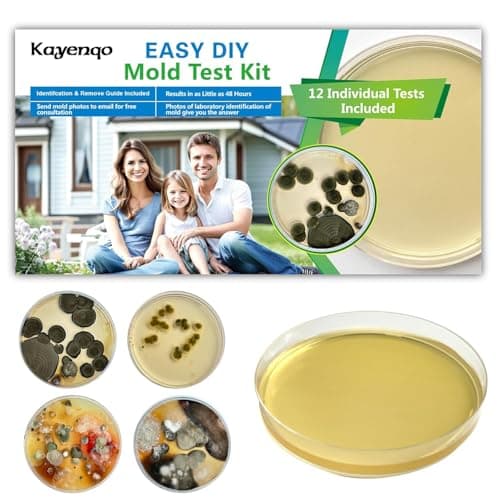
Petri-Dish, Lab, 5-Minute and Air-Pump Kits Compared
5 picks compared · prices, ratings and stock checked October 11, 2026
Our Top Pick
Comparing rooms or checking a cleanup? The KAYENQO 12-Test Mold Test Kit. Need proof on paper? PRO-LAB, with the lab fee for one sample included. A same-day answer on one dark patch? Healthful Home 5-Minute. Air sampled with a pump and reported by a lab? The GOT MOLD? 3-Room kit.
The best mold test kit for most homes is the KAYENQO 12-Test Mold Test Kit, rated 4.5 stars across 3,691 Amazon ratings: if you want to compare rooms, HVAC vents and surfaces, buy it, because 12 agar plates leave enough to expose one outdoors as a baseline. If you need a document for a landlord, insurer or buyer, the PRO-LAB kit includes the lab fee for 1 sample and reports within 7 working days. To sample air the way an inspector does, use the GOT MOLD? pump kit. If you can see mold, skip testing: EPA advises cleaning it up, since sampling is usually unnecessary.
Our Picks at a Glance
Every pick below is currently stocked — ratings and stock read from Amazon on 11 October 2026.
Linked to the current Amazon listing — price and availability change; verified 13 Oct 2026
How this page was made: we compare the current Amazon listings, the makers' published specs and what verified buyers report, then rank by fit for the job. Ratings, review counts and stock are read from Amazon and dated. We earn a commission on purchases through our links; it does not change the order. Reviewed by Marcus Reed, IICRC-certified Water Restoration Technician.
Full Reviews
Each pick in detail: what the listing states, what buyers report, and where it falls short.
Compare growth with the pictured guide, or send photos to the seller's lab staff
Incubation time
Not stated on the listing
Pros
Twelve plates is enough to run a real comparison: one outdoors as a baseline, one in each room you suspect, and a set held back to retest after cleanup
Plates come in two separate packages, so opening one set does not expose the other
Covers indoor air, HVAC vents and surfaces with the same kit, with swabs, labels and gloves included
If a colony will not match the pictured guide, photos can be sent to the seller's lab staff, per the listing
Cons
A settling plate grows whatever lands on it, so one plate with colonies proves little by itself
Identification is by eye against a picture guide or by photo, not microscope work on your sample, so species names are a best guess
The listing states no incubation time and names no accredited lab behind the photo service
Suited to
Comparing rooms against an outdoor baseline, checking HVAC vents, and confirming a cleanup worked
Our take
A petri plate on its own is a poor test, because mold spores are in every home's air and almost any plate grows something. Twelve plates change what the result can tell you. Expose one outdoors and the rest in the rooms you suspect, for the same length of time, and compare: a room plate that grows far more colonies than the outdoor baseline, or a different-looking dominant type, points to a source indoors. That is the logic professional air sampling follows with a pump, done here crudely by settling. Treat the result as a reason to look for moisture, not as a diagnosis, and keep the second set to retest the same spots after the source is fixed.
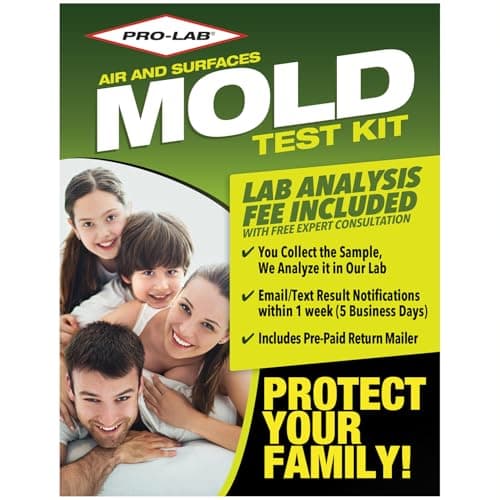
The PRO-LAB kit is the home test whose result means something to a third party — because a lab, not a petri dish, reads it.
Key Specs
Type
Sample kit + laboratory analysis
Methods
Air, surface or bulk sample, per the listing
Lab fee
Included for 1 sample, per the listing title
Turnaround
Standard report within 7 working days, by email or text through the PRO-LAB app
Return
First-class return envelope included
Result
Written report identifying mold types found
Pros
The only kind of home kit whose result a landlord, insurer or buyer will take seriously, because a laboratory reads the sample rather than you
Air, surface and bulk sampling are all possible with the one kit, per the listing
The lab fee for one sample is in the price, with a return envelope and a free consultation to explain the report
Cons
Settling-plate air samples are less rigorous than a professional's pump-and-cassette sample
One sample per kit: testing a second room means buying again, and the report can take up to 7 working days
Tells you what grew, not how much is in the air or whether it's an active colony
Suited to
Suspected hidden mold, disputes, and post-remediation checks where you need a lab's name on the result
Our take
This is the kit that gets closest to what an inspector does: a sample goes to a laboratory that can name the mold, and the report arrives with a lab's name on it. That paperwork is the reason to buy it. In a lease dispute, an insurance claim or a home sale, a lab report carries weight that a photo of a petri dish never will. Before you rely on it, ask which laboratory analyzes the samples and whether it holds AIHA accreditation, the common US program for environmental microbiology labs; the listing does not say. What the kit cannot replace is the inspector's moisture meter and flashlight: the lab tells you a mold is present, not which wall is wet.
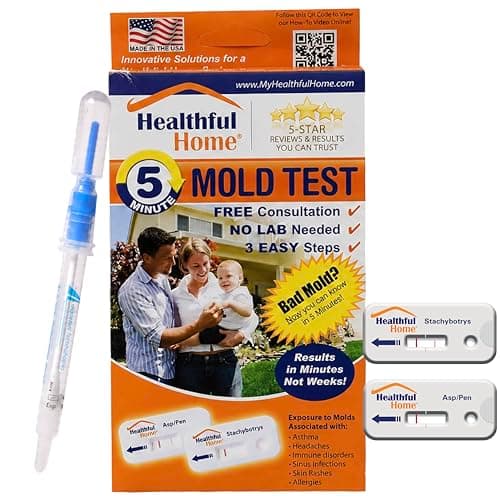
The Healthful Home 5-Minute test gives a species-group answer on the spot — narrow, but the only kit here that answers in minutes.
Key Specs
Type
Rapid immunoassay (lateral-flow) test
Detects
Aspergillus / Penicillium group and Stachybotrys
Sample
Surface swab or dust from a moist area
Time to result
About 5 minutes, no lab required
Extras
Expert consultation included per the listing
Limit
Two mold groups only; no count or air concentration
Pros
Identifies rather than grows — an answer today on whether the two most-searched mold groups are present on a surface
Useful for the 'is this dark patch Stachybotrys?' question the petri-dish kits cannot answer
No incubation, no shipping, no waiting
Cons
Detects only two mold groups; a negative does not mean no mold
It samples surfaces and settled dust; despite the indoor-air wording on the listing, it gives no airborne count or concentration
Costs more per test than a petri dish
Suited to
A fast answer on a specific spot, before deciding whether to escalate to a lab or an inspector
Our take
The honest use of this test is triage: a quick check on one suspicious spot before deciding whether to spend on a lab or an inspector. It is an immunoassay, the same lateral-flow format as a home COVID test, so it reacts to specific mold proteins rather than growing anything, which is why it answers in minutes. That also sets its limit. It looks for the Aspergillus/Penicillium group and Stachybotrys, and a negative says nothing about any other mold. Remember too that EPA and CDC treat visible growth the same way whatever the species — it gets cleaned up — so a positive here changes the urgency, not the method.
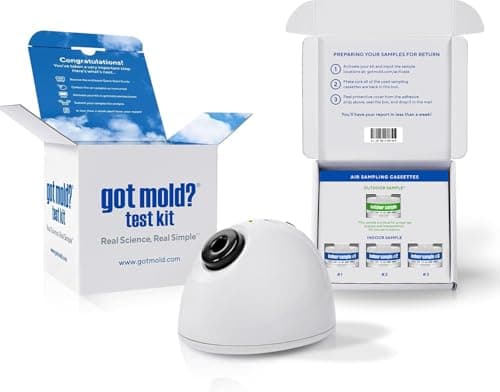
The GOT MOLD? 3-Room kit is the closest a homeowner gets to an inspector's air test: a reusable pump, spore-trap cassettes and lab-reported types and quantities.
Key Specs
Type
Pump air sampler + spore-trap cassettes + lab analysis
Sampler
Reusable BioVac air sampler, about 5 minutes per room
Rooms
3 (refill cassettes sold separately)
Lab
Lab fees included; prepaid return mailer
Result
PDF report of mold types and quantities per sample, with a color-coded interpretation
Turnaround
Within a week of the lab receiving the samples, per the listing
Pros
The only kit on this page that samples air the way an inspector does: a pump draws air through a spore-trap cassette for a set time
Reports types and quantities for each room, so one room can be compared with another instead of reading a lone plate
Lab fees and a prepaid return mailer are included, and the reusable sampler takes refill cassettes for later rounds
Cons
The listing showed a future availability date on 11 Oct 2026, so it may not ship straight away
Far fewer buyer ratings than the other kits here, and the listing names no lab accreditation
An air sample is a snapshot: spore counts swing with weather, activity and time of day
Suited to
A musty smell with no visible growth, where the question is whether the indoor air carries more spores than it should
Our take
Air sampling answers the question the other kits cannot: is there more mold in this room's air than there should be? A settling plate catches whatever happens to fall in. A pump draws air through a cassette for a set time, which lets a lab report spores per sample and compare rooms on equal terms. That is why this kit suits the musty-smell-but-nothing-visible case, where growth may be behind drywall or in ductwork. Two cautions. Professional sampling also takes an outdoor reference sample, so consider spending one of the three cassettes outside. And one round is a snapshot: a high count tells you to look for water, and the next step is still a moisture search.
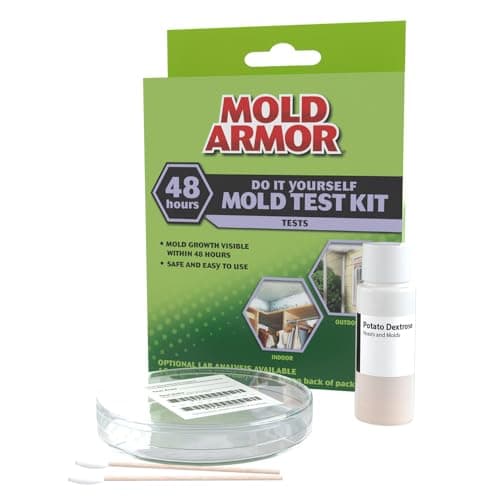
One plate and no baseline: the Mold Armor FG500 grows mold in almost every house, which is why on its own it can't tell you whether yours has a problem.
Key Specs
Type
Petri dish with growth medium + swab
Methods
Indoor air (settling), HVAC air, surface swab
Incubation
First results at 48 hours; recheck at 72 and 96 hours
Optional lab
Lab analysis for an added fee; results within about 3 weeks (manufacturer)
Result
Visible growth on the plate; species only with the lab add-on
Cost
Plate kit; lab analysis is extra
Pros
Low cost, widely stocked and simple to run
The optional lab add-on turns it into a real identification if you want one later
Fine for a before/after comparison of the same room
Cons
A settling plate grows whatever spores land on it — and spores are in every home, so most plates grow something
No way to tell 'normal background' from 'a problem' without the lab fee and a reference
Three weeks for the lab result, versus a week for PRO-LAB
Suited to
Curiosity, and side-by-side comparisons — not for deciding whether a house has a mold problem
Our take
The petri-dish kit's flaw is not that it's wrong; it's that it's always right. Every house has airborne spores, so a single plate that grows colonies has told you nothing you didn't know. What makes this one useful is the optional mail-in analysis, which turns a plate of fuzz into named molds, and a before-and-after comparison of the same room using two kits exposed the same way. Without a plate exposed outdoors at the same time, the result cannot separate an indoor problem from ordinary background, and the single plate in this box does not stretch to that.
The Question Every Kit Answers, and the One That Matters
Every home mold test answers 'is mold present?' — and in every house the answer is yes, because mold spores are part of ordinary air. The question that matters is whether there is an active colony, where it is, and what is feeding it. A single petri dish cannot answer that; a set of plates compared against an outdoor baseline can only hint at it. A lab report gets closer by naming species (Stachybotrys on a surface swab means a wet material somewhere). An inspector with a moisture meter answers it directly. Buy the kit that fits the decision you are trying to make.
Who Should Not Buy a Mold Test Kit — and What to Do Instead
EPA and CDC guidance is consistent: if you can see mold, you do not need to know what kind it is — the cleanup is the same, and sampling is generally unnecessary. Put the money toward fixing the moisture and removing the growth; EPA advises that an area larger than about 10 square feet may call for a professional. If you have symptoms you think are mold-related, a doctor is the right first call, not a kit. If a sale, a lawsuit or an insurance claim turns on the answer, hire an independent inspector who uses calibrated air sampling and writes a scope, because a kit result will not carry the same weight. Kits earn their price in the gaps: mold suspected but not visible, a room-to-room comparison, or a check after remediation.
Petri Dish vs Lab vs Immunoassay vs Air Pump
Petri-dish kits (KAYENQO, Mold Armor) grow whatever lands on the plate; read alone they cannot distinguish normal background from a problem, but several plates compared against an outdoor baseline give a rough room-by-room picture. Lab kits (PRO-LAB) send your sample to a laboratory that identifies the molds present — the most defensible home result, at the cost of a wait of up to a week. Immunoassay kits (Healthful Home) identify two specific mold groups in minutes but say nothing about anything else. Pump kits (GOT MOLD?) draw air through a spore-trap cassette for a set time, the method a professional uses, and a lab reports types and quantities. For air, a settling plate is the weakest method and a pump with a cassette the strongest.
When the Kit Says Yes
A lab report naming water-loving molds (Stachybotrys, Chaetomium) on a surface sample means a material has been wet for a long time — find the water. Elevated Aspergillus or Penicillium points to dampness and HVAC. Either way, the next step is the same as if you had never tested: locate the moisture, remove the moldy material, and dry the space. Over about 10 square feet, or inside walls or ducts, that is a remediation contractor's job, and an independent inspection is what scopes it. Once the work is done, retest with the same method and the same spots as before, so the comparison is fair.
What a Professional Inspection Adds
A moisture meter, a thermal camera, a flashlight in the crawl space, calibrated air sampling, and a written scope a remediation company can bid against. Kits find spores; inspectors find water. If the kit result is going to trigger a several-thousand-dollar decision, the inspection is worth its fee — and the company that inspects should never be the company that removes. Expect the written report to say where moisture was found, which materials are affected and how far the damage runs, so a remediation bid can be checked line by line against it.
Running a Kit So the Result Means Something
Most misleading results come from how the plates were used, not from the plates themselves. Expose every plate for the same length of time, at the same height, with windows shut and nobody vacuuming or walking through, so the only thing that changes is the room. Put one plate outdoors at the same time as a baseline, and label each plate the moment it is closed. Incubate in a dark, room-temperature spot and read at the times the instructions give, because growth slows in a cool house. For a swab, sample the suspect spot and, as a control, a clean patch of the same material nearby. Write down what you did, so the retest after cleanup can repeat it exactly.
Frequently Asked Questions
Do home mold test kits actually work?
They detect mold reliably, because mold spores are in every home, which is also their weakness. A single petri plate grows colonies in almost any house and cannot say whether that is normal background or a problem unless it is compared with a plate exposed outdoors.
Lab-analyzed kits identify the species present, which is genuinely useful when a water-loving mold shows up on a surface sample. No kit measures moisture or finds the source, which is what an inspector does.
What is the most accurate mold test kit?
A kit that sends your sample to a laboratory gives the most defensible result, because a trained analyst identifies what is there; for air, the GOT MOLD? pump kit adds quantities for each room. The Healthful Home 5-Minute test is accurate for the two mold groups it detects and silent on everything else.
Petri-dish kits are accurate about the presence of spores and uninformative about whether that presence matters, unless several plates are compared against an outdoor baseline. Whichever you use, ask whether the lab holds AIHA accreditation.
Should I test mold before removing it?
Not if you can see it. CDC and EPA guidance is that visible mold should be removed regardless of species, and that sampling is generally unnecessary. Testing earns its cost for hidden mold, for documentation in a dispute, and for clearance after remediation.
How much does a professional mold inspection cost compared to a kit?
A petri-dish kit costs least, and kits that include laboratory analysis cost several times more once the lab fee is paid.
An independent mold inspection costs considerably more again, and includes moisture readings, a physical search for the source, calibrated air sampling and a written scope. If the answer will drive a remediation decision, the inspection is the better spend.
Can you test the air for mold yourself?
YesBut how well depends on the method. A settling plate left open in a room catches whatever spores happen to fall on it, so it gives a rough picture at best.
A pump kit, such as the GOT MOLD? 3-Room kit, pulls air through a spore-trap cassette for a set time and sends it to a lab that reports mold types and quantities, which is how an inspector samples. Either way, take an outdoor sample at the same time, because indoor air is judged against the outdoor air around the house.
How long does a mold test kit take to show results?
Anywhere from 5 minutes to about a week, depending on the type. The Healthful Home immunoassay reads in about 5 minutes. Petri-dish plates need days of incubation: Mold Armor gives first results at 48 hours and suggests rechecking at 72 and 96 hours, and growth is slower in a cool house.
Lab kits take longest because the sample travels by mail: PRO-LAB states a report within 7 working days, and GOT MOLD? within a week of the lab receiving the samples.
Can a home mold test kit detect black mold?
Some can, but color alone tells you nothing about species. The Healthful Home test looks for Stachybotrys, the mold usually meant by 'black mold', and a lab kit will name it if it is in the sample.
Petri-dish guides offer only a visual match, and Stachybotrys tends to release its spores in a wet, sticky mass rather than into the air, so a settling plate can miss it. CDC and EPA treat any visible mold the same way whatever its color: clean it up and fix the moisture.
Who do I call right now for water damage?
Call (888) 840-6512. The line is answered 24 hours a day, seven days a week, and connects you with an IICRC-certified water damage restoration company that serves your area. A recorded menu picks up first: choose water damage or mold, key in your 5-digit ZIP code, and hold through the short silence while the call is passed to the company.
Describe what you can see — where the water is coming from, how long it has been there, and whether it smells — the more specific you are, the faster the right company is on the line. If the source is a pipe or an appliance, shut the main water valve first. Have four things ready and the call goes quickly: the address, when the water started, what is wet now, and whether you have filed an insurance claim.
Still not sure which of these is your situation? (888) 840-6512 · toll-free · answered 24/7
Every pick is a current listing. Stock, star ratings and rating counts are read from Amazon by script and carry the date they were read.
Nothing under 4.0 stars makes the list, and the top pick needs a large rating count, so one good week of reviews cannot put it there.
Specs are quoted from the listing or the maker, with the test condition behind the number where there is one, and sized against the job rather than the room on the box.
We do not run lab or field tests. Where a spec matters, we say what it is measured under and what it cannot tell you.
Free 2-day shipping
Amazon Prime members pay no shipping on restoration equipment
Dehumidifiers, air movers, and moisture meters qualify for free Prime delivery — bulk items that otherwise cost $15–$40 to ship.