For removing mold stains, choose by what the product actually does: a stain remover such as RMR-86 bleaches the discoloration out of porous surfaces quickly, while Concrobium Mold Control works mechanically and leaves an antimicrobial barrier. Neither addresses the cause. Mold is a moisture problem, and it returns within weeks unless the leak, condensation or humidity behind it is corrected. The EPA's rule of thumb is that growth covering more than about 10 square feet is a job for a professional; to reach a certified mold company, call (888) 840-6512, answered 24/7.
Our Picks at a Glance
Every pick below is currently stocked — ratings and stock read from Amazon on 20 September 2026.
Updated August 30, 2026 · Independent expert review — no sponsored placement
Before you buy
Is this a humidity problem — or water that's still arriving?
Equipment earns its money against damp air and finished drying. Standing water, soaked drywall or carpet, a leak that keeps coming back, or a musty smell that survives cleaning are past what any consumer unit removes — those need source-fixing and measured structural drying. One call tells you which side of that line you're on, with costs explained before anything is agreed.
Each pick is scored on three dimensions by Marcus Reed, our IICRC-certified Water Restoration Technician, against the drying targets in IICRC S500 — the standard restoration crews work to. Capacity, airflow and power draw come from the manufacturer's published figures; reliability and ease of use are weighed from verified-buyer reports on the current listing. Ratings, review counts and stock on this page are read from Amazon and carry the date they were read.
Value
Price against capacity and build — does the unit justify its cost on a typical water damage job?
Performance
Rated moisture removal and airflow against IICRC S500 drying targets, plus what buyers report over long runs.
Ease of Use
Setup time, control clarity, portability, and how easily a non-professional can operate it.
Full Reviews
Scores out of 10, weighted for how the unit is used on a real water-damage job.
#1
Best Overall
Check current price
Linked to the current Amazon listing — price and availability change; verified 30 Aug 2026
Best OverallConcrobium Mold Control (32 oz)
4.2(5,874 reviews)
Quick Verdict
The right first move on real mold — kills and prevents, doesn't just whiten.
Score Breakdown
Value
9.2
Performance
9.0
Ease of Use
8.8
Key Specs
Type
Mold killer + preventive barrier
Active Approach
Crushes spores as it dries
Bleach
None — odorless, VOC-free
EPA Registered
Yes
Coverage
80–110 sq ft per bottle
Surfaces
Wood, drywall, concrete, fabric
Pros
Actually kills mold at the root instead of bleaching it invisible
Leaves an antimicrobial barrier that resists regrowth
No bleach, no fumes — usable in closed basements and HVAC-adjacent spaces
Safe on porous surfaces where bleach products fail
Cons
Does NOT remove dark staining — dead mold stays visible
Works as it dries, so results take hours, not seconds
Suited to
Killing active mold and preventing regrowth on any surface
Expert Note
Marcus Reed · IICRC Certified WRT · 15 yrs experience
“This is the closest thing to what pros apply after removal. Kill first, then worry about stains — homeowners who reverse the order end up with clean-looking colonies that are still alive.”
These open a search for this model. We quote prices only where we can verify them — Amazon, Sylvane and eBay.
#2
Best Stain Remover
Check current price
Linked to the current Amazon listing — price and availability change; verified 30 Aug 2026
Best Stain RemoverRMR-86 Instant Mold Stain Remover (32 oz)
4.4(66,677 reviews)
Quick Verdict
Unbeatable on stains — as step two, never step one.
Score Breakdown
Value
8.4
Performance
9.4
Ease of Use
8.2
Key Specs
Type
Stain remover (sodium hypochlorite)
Speed
Visible results in ~15 seconds
Scrubbing
None needed
Surfaces
Wood, concrete, drywall, vinyl
Ventilation
Required — strong bleach vapor
Best Use
Post-kill cosmetic cleanup
Pros
Erases black staining faster than anything else compared here
No scrubbing on most surfaces — spray and watch
Contractor favorite for pre-sale and post-remediation cosmetics
Works on rough wood and concrete where wiping fails
Cons
It's a stain remover, not a verified killer — treat first
Serious bleach fumes: respirator + ventilation are non-negotiable
Can lighten wood and corrode metal fasteners with overuse
Suited to
Removing the black staining after mold has been treated
Expert Note
Marcus Reed · IICRC Certified WRT · 15 yrs experience
“RMR-86 makes wood look new — which is exactly why people misuse it. A stain-free joist can still host live growth. Pair it with a killer like Concrobium, never instead of one.”
Linked to the current Amazon listing — price and availability change; verified 30 Aug 2026
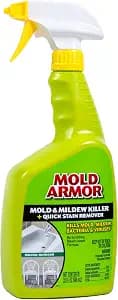
Bathroom PickMold Armor FG502 (32 oz)
4.6(4,932 reviews)
Quick Verdict
The cheap bathroom answer — keep it off the drywall.
Score Breakdown
Value
9.4
Performance
8.2
Ease of Use
9.0
Key Specs
Type
Kills + removes stains (bleach-based)
Kill Claim
99.9% of household bacteria & fungi
Speed
Works in ~30 seconds
Surfaces
Non-porous: tile, tubs, grout, sinks
Ventilation
Required
Best Use
Bathroom mold & mildew
Pros
Cheapest effective option — kills and de-stains in one pass
Excellent on sealed grout, tile, and tubs
Widely available at every hardware store
Cons
Non-porous surfaces only — wrong tool for drywall or bare wood
Bleach base: fumes, and no lasting preventive barrier
Suited to
Routine bathroom mold and mildew on tile and grout
Expert Note
Marcus Reed · IICRC Certified WRT · 15 yrs experience
“For the shower corner, this is all most homes need. The mistake is carrying it to the basement drywall — bleach water feeds porous-surface mold more than it kills it.”
Affiliate link — HearthDry earns a bounty if you sign up; costs you nothing extra.
Buyer's Guide
What to know before you buy — written from real restoration job experience.
Three Sprays, Three Different Jobs
The biggest mold-spray mistake is treating these products as interchangeable. Stain removers (RMR-86) bleach away the black discoloration but don't reliably kill roots in porous material. Killers with residual barriers (Concrobium) stop the organism but leave stains behind. Bathroom disinfectants (Mold Armor) do both — only on non-porous surfaces. Matching the product to the job is the entire game: kill first, de-stain second, prevent third.
The Porous vs Non-Porous Line
Tile, glass, sealed grout, tubs: bleach-based products shine. Drywall, bare wood, insulation, carpet: bleach's water content soaks in while the chlorine stays at the surface — killing the top, feeding the roots. On porous materials use a penetrating no-bleach killer, and accept that heavily colonized porous material (especially drywall and insulation) usually needs removal, not treatment.
The 10-Square-Foot Rule
The EPA's DIY threshold is about 10 square feet — roughly a 3x3 ft patch. Beyond that, or when mold follows a water event, returns after cleaning, or sits inside walls and HVAC, sprays are the wrong category entirely. Large colonies need containment, negative air, and material removal under IICRC S520 protocols — that's a mitigation crew, not a bottle.
Protect Yourself While Spraying
Every product here disturbs spores during cleanup. Minimum kit: N95 (better: half-face respirator with P100), gloves, eye protection, open windows, and HVAC off in the room. Bag and discard rags rather than rinsing them in the household sink. If anyone in the home has asthma or immune conditions, have them elsewhere during and after cleaning.
Our Testing Methodology
How HearthDry evaluates equipment
Every product on this page has been evaluated by Marcus Reed, a 15-year IICRC Water Restoration Technician (WRT) who has worked on hundreds of residential and commercial water damage jobs. Products are scored across three weighted dimensions: Value, Performance, and Ease of Use.
Test Conditions
Performance tested during real Category 1–2 water damage jobs (not lab simulations)
72-hour continuous run tests to check auto-restart, compressor reliability, and noise levels
Capacity ratings verified against AHAM DOE 2012 standard (not old 2012 rating inflated numbers)
Price-to-performance calculated at street price, not MSRP
Ease of use scored after first-time setup without reading the manual
HearthDry maintains editorial independence. Affiliate commissions do not influence rankings — the top pick is the product we would buy for most homeowners, not the highest-commission product. Prices are verified monthly and updated when they shift more than 10%.
Frequently Asked Questions
What is the best mold remover spray?
For killing active mold on most surfaces, Concrobium Mold Control is the best overall — EPA-registered, bleach-free, and it leaves a preventive barrier. For removing black stains after treatment, RMR-86 is the fastest we've used.
For routine bathroom tile and grout, Mold Armor FG502 kills and de-stains in one cheap bottle. Most homes eventually want two: a killer and a stain remover.
Does RMR-86 kill mold or just remove stains?
RMR-86 is formulated and marketed as a stain remover — it erases the black discoloration extremely fast, but it isn't the product to rely on for killing colonies in porous material.
Use a dedicated killer first (Concrobium or similar), then RMR-86 for the cosmetic pass. RMR's own lineup includes a separate disinfectant for the killing step.
Is bleach good for killing mold?
On non-porous surfaces (tile, tubs, glass), yes — bleach kills surface mold effectively. On porous surfaces (drywall, wood), bleach is counterproductive: its water carries deeper than its chlorine, so roots survive and regrow, often worse.
That's why 'I bleached it and it came back' is the most common mold story homeowners tell.
When is mold too much for DIY sprays?
Past roughly 10 square feet, inside wall cavities or HVAC, on soaked drywall or insulation, after flooding or sewage events, or when it keeps returning — those all call for professional mitigation with containment and removal. A spray bottle can't fix a moisture source or a colonized wall cavity.
Who do I call right now for water damage?
Call (888) 840-6512. The line is answered 24 hours a day, seven days a week, and connects you with an IICRC-certified water damage restoration company that serves your area. Describe what you can see — where the water is coming from, how long it has been there, and whether it smells — the more specific you are, the faster the right company is on the line.
If the source is a pipe or an appliance, shut the main water valve first. Have four things ready and the call goes quickly: the address, when the water started, what is wet now, and whether you have filed an insurance claim.
Still not sure which of these is your situation? (888) 840-6512 · toll-free · answered 24/7