Rent an air scrubber for a single contained room over a few days; buy one if the job runs past about a fortnight, repeats, or moves room to room. Before either, settle the question most people are really asking: a household air purifier will not do this job. A scrubber moves far more air through a true HEPA stage and, ducted out of a window, holds the work area under negative pressure so disturbed spores go into the filter rather than down the hallway — and that only works with the room sealed in poly and the machine running continuously. Size it by air changes rather than room label: cubic feet times four to six, divided by sixty, gives the CFM to look for. For rental pricing, call a tool-rental counter and a restoration supplier and ask both for the weekly rate, the deposit, filters and delivery, because regional rates vary too much to quote. If the water is still in the house, buying is the second question — whether it needs a crew is the first, and one call settles it: (888) 840-6512, answered 24/7.
Our Picks at a Glance
Every pick below is currently stocked — ratings and stock read from Amazon on 21 September 2026.
All picks compared at a glance
Pick
Product
Rating
Best Overall
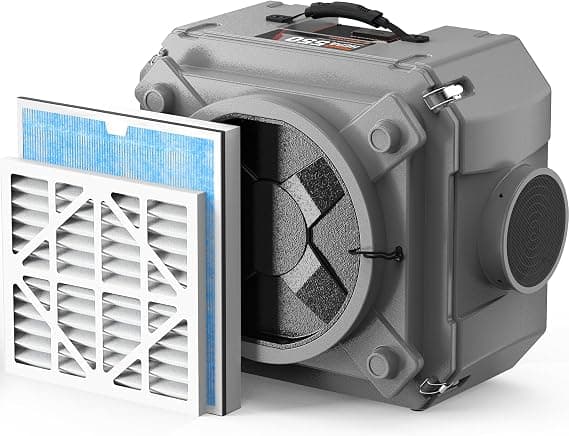
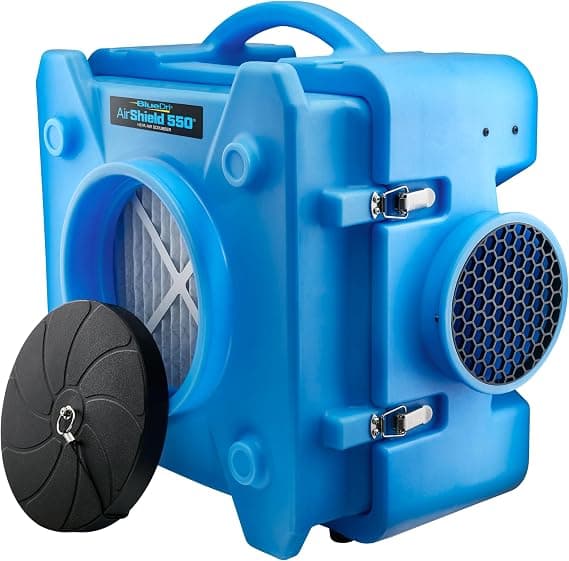
BlueDri Air Shield 550 HEPA Air Scrubber (BD-AS-550)
Best for: The default buy-instead-of-rent unit: one contained room, a job that has already run longer than planned, or a house where the same basement keeps needing it
Filtration:
3-stage: pre-filter, optional carbon, HEPA
HEPA Grade:
99.97% of particles down to 0.3 microns (per listing)
Best for: The job you expect to be short — one room, a few days — where the adjustable range means the machine is not oversized for the space and can be throttled back once demolition dust settles
Best for: A single sealed room — one bathroom, one bedroom, a crawl space hatch — where the sizing arithmetic lands under 500 CFM and the second outlet saves running another cord
Updated September 21, 2026 · Independent expert review — no sponsored placement
Before you buy
Is this a humidity problem — or water that's still arriving?
Equipment earns its money against damp air and finished drying. Standing water, soaked drywall or carpet, a leak that keeps coming back, or a musty smell that survives cleaning are past what any consumer unit removes — those need source-fixing and measured structural drying. One call tells you which side of that line you're on, with costs explained before anything is agreed.
Each pick is scored on three dimensions by Marcus Reed, our IICRC-certified Water Restoration Technician, against the drying targets in IICRC S500 — the standard restoration crews work to. Capacity, airflow and power draw come from the manufacturer's published figures; reliability and ease of use are weighed from verified-buyer reports on the current listing. Ratings, review counts and stock on this page are read from Amazon and carry the date they were read.
Value
Price against capacity and build — does the unit justify its cost on a typical water damage job?
Performance
Rated moisture removal and airflow against IICRC S500 drying targets, plus what buyers report over long runs.
Ease of Use
Setup time, control clarity, portability, and how easily a non-professional can operate it.
Full Reviews
Scores out of 10, weighted for how the unit is used on a real water-damage job.
#1
Best Overall
Check current price
Listing verified 21 Sep 2026
Best OverallBlueDri Air Shield 550 HEPA Air Scrubber (BD-AS-550)
4.6(755 reviews)
Quick Verdict
The unit to price the rental against — true HEPA, negative-pressure capable, and the longest buyer record in the category.
Score Breakdown
Value
9.0
Performance
8.8
Ease of Use
8.0
Key Specs
Filtration
3-stage: pre-filter, optional carbon, HEPA
HEPA Grade
99.97% of particles down to 0.3 microns (per listing)
Coverage
Listed at 1,400 sq ft
Daisy Chain
Yes
Warranty
1 year, 5 years on the housing
Weight
39 lbs
Pros
The listing states the HEPA stage removes 99.97% of particles down to 0.3 microns, the grade remediation work is specified around
Single-piece housing and a daisy-chain outlet, the two things that survive being moved room to room for a fortnight
755 buyer ratings at 4.6 is by far the longest record of the units here, which matters for a machine expected to run unattended
Widely carried by restoration suppliers, so replacement filters can be sourced mid-job rather than ordered and waited on
Ducted out of a window it holds a sealed room under negative pressure, which is the function a rental is usually hired for
Cons
The carbon filter is sold separately, so a job with paint or smoke odour is not covered out of the box
39 lbs is a two-hand carry, awkward on a basement stair and worse through a hatch
Parts and labour run one year; the five-year term applies to the housing only
Suited to
The default buy-instead-of-rent unit: one contained room, a job that has already run longer than planned, or a house where the same basement keeps needing it
Expert Note
Marcus Reed · IICRC Certified WRT · 15 yrs experience
“This is the machine to hold the rental quote up against. Crews buy it in multiples because it does containment work at a price that lets three of them run at once, which is also why the resale market for it is real if the job ends and the machine does not. For the rent-or-buy decision the relevant detail is the daisy-chain outlet: containments rarely offer more than one usable circuit drop, and hanging an air mover off the scrubber saves threading a second cord through the poly.”
These open a search for this model. We quote prices only where we can verify them — Amazon, Sylvane and eBay.
#2
Best for a Short Job
Check current price
Listing verified 21 Sep 2026
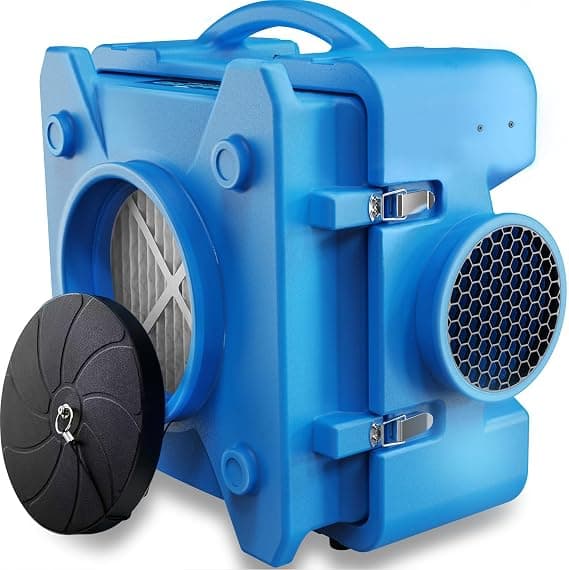
Best for a Short JobAbestorm Filteair HEPA 550 Air Scrubber
4.4(145 reviews)
Quick Verdict
Adjustable 270 to 550 CFM in a compact stackable shell — the one that sizes itself to the room instead of the other way round.
Score Breakdown
Value
8.7
Performance
8.5
Ease of Use
8.8
Key Specs
Filtration
3-stage, MERV-10 pre-filter
Airflow
Adjustable, 270 to 550 CFM
Power
Built-in GFCI connection
Dimensions
20.87"D x 24.8"W x 14.96"H
Build
Rotomolded shell, stackable
Weight
39.6 lbs
Pros
Airflow adjusts across a 270 to 550 CFM range, so one machine covers a bathroom and a bedroom rather than running flat out in both
MERV-10 pre-filter is named on the listing — the stage that loads first and the one you will actually be changing
Smaller footprint than the others here at under 15 inches high, which is the difference between fitting a stair landing and not
Stackable rotomolded shell, so a second unit goes on top rather than taking a second corner of the containment
Built-in GFCI connection, which matters on a wet job where the drop is a garage outlet
Cons
145 buyer ratings against the BlueDri's 755 — a thinner record for a machine asked to run for days
The listing names a MERV-10 pre-filter but publishes no micron figure for the HEPA stage, so it is not stated on the same basis as the BlueDri and CADPXS listings
At 39.6 lbs it is the heaviest of the four despite the smaller footprint
No carbon stage is listed, so odour from paint or smoke is not addressed
Suited to
The job you expect to be short — one room, a few days — where the adjustable range means the machine is not oversized for the space and can be throttled back once demolition dust settles
Expert Note
Marcus Reed · IICRC Certified WRT · 15 yrs experience
“The adjustable 270 to 550 CFM range is the reason this one belongs on a rent-or-buy page. A rental counter hands you whatever is on the shelf, usually a fixed-speed unit sized for a commercial loss. Sizing is the whole trick with scrubbers: too little airflow and the containment never clears, too much in a small sealed room and you are paying in noise and filter life for nothing. A machine that covers the range does the job a rental fleet needs two units to do.”
99.97% of particles at 0.3 microns and larger (per listing)
Airflow
550 CFM
Warranty
10-year limited
Dimensions
24.2"D x 22.9"W x 15.2"H
Weight
33.5 lbs
Pros
Activated carbon is included rather than optional, and carbon is the stage that addresses paint, adhesive and smoke odour — HEPA alone does nothing for gas
The listing publishes the 99.97% at 0.3 microns figure, so it can be compared with the BlueDri on the same basis
MERV-10 pre-filter is specified, so the stage protecting the HEPA is a known quantity before it arrives
33.5 lbs is the lightest of the four, a real difference carrying it up out of a basement
A 10-year limited warranty is the longest term stated on any of these listings
Cons
102 buyer ratings is the thinnest record here, against the BlueDri's 755
The listing publishes no speed count and no coverage area, so it cannot be matched to a room size before it arrives
No daisy-chain outlet is listed, so it needs its own circuit drop
The warranty is stated as limited with no parts-and-labour breakdown, unlike the BlueDri and Mounto listings
Suited to
Renovation and post-fire work where odour is part of the complaint, and any job where the carbon stage would otherwise be an extra purchase
Expert Note
Marcus Reed · IICRC Certified WRT · 15 yrs experience
“The carbon stage is why this one is worth buying rather than renting for a renovation. Odour is gas, not particulate, and a HEPA filter has nothing to say about it — machines on a rental shelf frequently ship without carbon, because the counter cannot police whether it comes back loaded. If the smell of the job is half the problem, a rented scrubber can run for a week and leave the complaint untouched.”
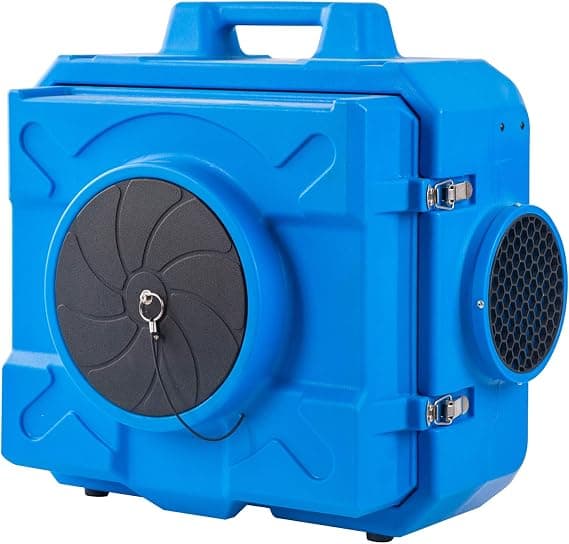
Best BudgetMounto HEPA500 Air Scrubber / Negative Air Machine (500 CFM)
4.5(154 reviews)
Quick Verdict
The lowest-cost way to own instead of rent — 500 CFM, variable speed, a filter-change light and a daisy-chain outlet.
Score Breakdown
Value
8.8
Performance
8.0
Ease of Use
8.7
Key Specs
Airflow
500 CFM, variable speed
Filtration
HEPA, front access with a filter-change light
Use
Air scrubbing or negative air
Power
Corded, daisy-chain dual GFCI outlet
Build
Roto-molded, stackable, 25"D x 16"W x 24"H
Warranty
1 year parts and labour, 10 years on the housing
Pros
Variable speed, so it can be throttled back once the heavy particulate load drops instead of running one fixed speed for days
Filter-change light and quick front access — you are told when the pre-filter is loading rather than guessing
Daisy-chain dual GFCI outlet runs a second machine or an air mover off the same drop
cETL listed with a circuit-breaker protector covering the connected load as well as the unit's own components
The listing names sewage remediation and water and fire restoration among its intended uses, so the build is aimed at job sites rather than living rooms
Cons
500 CFM is the lowest airflow of the four, which narrows the room size it suits
The listing publishes no micron rating and no filter-stage count, so it cannot be compared with the BlueDri or CADPXS on filtration detail
154 buyer ratings is a thinner record than the BlueDri's 755
Parts and labour are covered for one year only; the ten-year term applies to the housing alone
Suited to
A single sealed room — one bathroom, one bedroom, a crawl space hatch — where the sizing arithmetic lands under 500 CFM and the second outlet saves running another cord
Expert Note
Marcus Reed · IICRC Certified WRT · 15 yrs experience
“For a rent-or-buy comparison this is usually the cheapest way to stop renting. Nothing on the listing is exotic; what it has is the short list of things that decide whether a scrubber is tolerable to live beside for a fortnight — variable speed, a filter-change light and a second outlet. The 500 CFM rating is the trade: by the sizing arithmetic below, that is a single sealed room, not a multi-room containment.”
What to know before you buy — written from real restoration job experience.
Air Scrubber vs Air Purifier — The Question Behind Most of These Searches
A household air purifier and an air scrubber both pull air through a filter, and there the similarity stops. A purifier is built to sit in an occupied room and slowly improve the air in that room: modest airflow, quiet, a sealed cabinet with no way to send the clean air anywhere but back where it came from. An air scrubber is built for a room that is being taken apart. It moves several times the air, through a stack that starts with a coarse pre-filter and ends in a true HEPA stage, in a housing meant to be dragged across a job site. The difference that actually decides the question, though, is the exhaust port. A scrubber can be ducted — out of a window, through a dryer vent — so the air it takes from the work area leaves the building. That is what turns it from an air cleaner into containment, and it is the one thing no purifier does. Running a purifier during active mold work is not a smaller version of the right answer. Disturbed spores are being lifted faster than it can clear them, and nothing is stopping them drifting under the door.
What Negative Pressure Means — And How You Know It Is Working
Negative pressure is a simple idea with a fussy setup. If the machine sends more air out of the sealed room than leaks back in, the pressure inside the room sits slightly below the pressure in the rest of the house. Air then flows into the work area through every gap and never out of it, so spores and dust go into the filter rather than down the hallway. Achieving it takes three things, and missing any one of them leaves you with an expensive air cleaner and no containment: the room sealed with poly sheeting and tape across seams, vents and doorways, with one controlled entry flap; the scrubber's exhaust ducted to outside rather than back into the room; and the machine running continuously, because the moment it stops the pressure equalises. The way you know it is working is the poly itself. A sheeted doorway under negative pressure sucks inward and stays there. If it hangs slack, or billows out at you when you open the flap, the seal is leaking faster than the machine can pull, and the answer is more tape rather than more machine.
CFM and Air Changes: Sizing the Machine to the Room
Scrubbers are rated in CFM, cubic feet of air moved per minute, and the number only means something once it is set against the volume of the room. The standard restoration target, from IICRC S520, is four to six air changes per hour in the affected area. The arithmetic is short: multiply length by width by ceiling height for the room's cubic feet, multiply by the air changes you want, and divide by sixty. A ten-by-twelve room with eight-foot ceilings is 960 cubic feet, so six air changes an hour works out at 96 CFM. Every unit on this page clears that several times over, which is the honest answer to why a single residential room is not where CFM decides anything. It decides matters going the other way — a large open basement, or a containment covering several rooms, where one machine is genuinely undersized and the answer is two or three units rather than one larger one. It cuts the other way too: a very small sealed bathroom does not need a machine at full speed for a week, which is the argument for variable speed.
Filter Stages and What "True HEPA" Means
These machines are usually three stages and the order is deliberate. A coarse pre-filter takes the bulk material — drywall dust, debris — and exists mainly to stop the expensive filter behind it clogging. An optional activated carbon stage handles odour, which is gas rather than particles and which a HEPA filter cannot touch at all; if paint, smoke or adhesive smell is part of the complaint, check whether carbon is included or sold separately, because the listings differ on this. The HEPA stage is last. True HEPA is a defined standard, and listings that meet it publish the figure: 99.97 percent of particles at 0.3 microns, the size hardest to catch. Wording like HEPA-type, HEPA-style, or a plain 99 percent, is not the same claim — and on a mold job it is the claim that matters, because spores sit in a range that ordinary filter media passes. Two of the picks here publish the full figure and two do not, which is noted in their entries rather than assumed either way. Whatever the stack, the pre-filter is the consumable you will be changing most often; letting it clog starves the HEPA of airflow and shortens its life.
Rent or Buy: The Comparison to Run Before You Call the Counter
Rental counters and restoration supply houses quote air scrubbers by the day or by the week, usually with a deposit, and the daily rate is almost always worse value pro rata than the weekly one. Do not take anyone's published rate for this, including a figure read on a page like this one — rates move by region, by season, and by whether there has been a storm that week that has the local fleet out. Call two places: a general tool-rental counter and a restoration supplier, because they are different businesses with different fleets. Get four things on the same call — the weekly rate, the deposit, whether filters are included or billed on return, and whether delivery and collection are extra. Add those up, then set the total against the purchase price of one of the units above and divide to find how many weeks of hire buy the machine outright. The break-even commonly lands somewhere around a fortnight, but the honest version of the calculation is not only weeks. It is whether there is a second job. A recurring crawl space problem, a rental property, or a renovation moving room by room has already justified owning one, because the hire clock restarts from zero every time while a purchased machine keeps working. The argument for renting is equally simple: one contained room, a few days, and a machine you would otherwise store in a garage for a decade.
When the Job Is Beyond a Rented Machine
There are jobs where the right move is to stop shopping for equipment. Mold across a large area is the clearest one — EPA guidance puts the DIY ceiling at roughly ten square feet, and past that the containment, the negative pressure and the clearance testing are a trade rather than a weekend. Anything involving sewage is a different category entirely, because the hazard is biological contamination rather than airborne particulate, and protective equipment and disposal rules apply that a scrubber has nothing to do with. And mold behind walls, under a floor, or inside an HVAC system cannot be scrubbed at all, because the machine can only clean air it can reach; opening those cavities without containment already standing is how a one-room problem becomes a whole-house one. If any of those describe the job, call a remediation contractor before the demolition starts. Getting containment built correctly the first time costs less than cleaning a house that has already been cross-contaminated.
The professional tier
AlorAir PureAiro HEPA Pro 970 Air Scrubber
The contractor tier of the same tool: more airflow than the picks above, filters sized for a full remediation containment, and a dealer behind it if a filter or motor has to be sourced mid-job. On a multi-week containment, or a second and third room after the first, the hire clock restarts with every booking while a machine at this tier is bought once and keeps working.
Affiliate link — Sylvane sells to contractors and homeowners alike.
Our Testing Methodology
How HearthDry evaluates equipment
Every product on this page has been evaluated by Marcus Reed, a 15-year IICRC Water Restoration Technician (WRT) who has worked on hundreds of residential and commercial water damage jobs. Products are scored across three weighted dimensions: Value, Performance, and Ease of Use.
Test Conditions
Performance tested during real Category 1–2 water damage jobs (not lab simulations)
72-hour continuous run tests to check auto-restart, compressor reliability, and noise levels
Capacity ratings verified against AHAM DOE 2012 standard (not old 2012 rating inflated numbers)
Price-to-performance calculated at street price, not MSRP
Ease of use scored after first-time setup without reading the manual
HearthDry maintains editorial independence. Affiliate commissions do not influence rankings — the top pick is the product we would buy for most homeowners, not the highest-commission product. Prices are verified monthly and updated when they shift more than 10%.
Frequently Asked Questions
What is the difference between an air scrubber and an air purifier?
An air purifier cleans the air in the room it sits in and returns it to the same room. An air scrubber moves far more air, through a stack that ends in a true HEPA stage, and it has an exhaust port — so it can be ducted out of a window and used to hold a sealed work area at lower pressure than the rest of the house.
That last part is the whole difference. Under negative pressure, disturbed mold spores flow into the containment and into the filter instead of drifting into the hallway. A purifier cannot do this at any setting, and running one during active mold work clears the room more slowly than the work contaminates it.
Quicker than reading — ask the pro directly: (888) 840-6512 · toll-free · no obligation
Do I need an air scrubber for mold remediation?
It dependsOn the size of the job and on whether you are disturbing the mold. For a small patch on a non-porous surface — the EPA's rough line is about ten square feet — careful cleaning with the area closed off and the HVAC shut down is the usual guidance, and a scrubber is a sensible precaution rather than a requirement.
The moment you are cutting out drywall, lifting flooring or opening a cavity, spore release rises sharply and the question changes: without containment and negative pressure, those spores reach the rest of the house through doorways and ductwork. Past the small-patch threshold, EPA and IICRC S520 guidance points to professional remediation with proper containment, not a rented machine standing in an open room.
Quicker than reading — ask the pro directly: (888) 840-6512 · toll-free · no obligation
How much does it cost to rent an air scrubber?
Rental counters and restoration supply houses quote these by the day or by the week, generally with a deposit, and the weekly rate is usually better value pro rata than the daily one. Rates vary enough by region and by season that any single number published online is likely to be wrong for you — particularly after a storm, when local fleets are already out.
The way to get a real figure is to call two sources, a general tool-rental counter and a restoration supplier, and ask each for the weekly rate, the deposit, whether replacement filters are included or billed on return, and whether delivery and collection are extra. Those four numbers together are what you compare against a purchase price.
Quicker than reading — ask the pro directly: (888) 840-6512 · toll-free · no obligation
What size air scrubber do I need?
Size it by air changes rather than by room label. The restoration standard, IICRC S520, targets four to six air changes per hour in the affected area. Work out the room's cubic feet by multiplying length, width and ceiling height, multiply that by the air changes you want, and divide by sixty to get the CFM.
A ten-by-twelve room with eight-foot ceilings comes to 960 cubic feet, which needs 96 CFM at six air changes an hour — comfortably inside anything on this page. Sizing bites on larger jobs: an open basement or a multi-room containment realistically needs two or three units rather than one, and that is where the arithmetic earns its keep.
Quicker than reading — ask the pro directly: (888) 840-6512 · toll-free · no obligation
Can I use an air scrubber without containment?
You can run it, but you are no longer doing what the machine is for. Without poly sheeting sealing the work area and the exhaust ducted outside, a scrubber is simply a very large air cleaner: it will pull particulate out of the air near it, and the spores you disturb will still travel to the rest of the house through open doorways, gaps and return vents.
Negative pressure is the function that contains a mold job, and it needs all three parts — the seal, the duct to outside, and the machine running continuously so the pressure never equalises. If containment is not practical in the space, that is usually a sign the job has outgrown a DIY approach.
Quicker than reading — ask the pro directly: (888) 840-6512 · toll-free · no obligation
Is it cheaper to rent or buy an air scrubber?
For one contained room over a few days, renting almost always wins, and you avoid storing a job-site machine for years afterwards. The balance tips when the job runs long or repeats. Get the weekly rate plus deposit, filters and delivery from two local sources, then set that total against the purchase price of one of the units above — the break-even commonly lands somewhere around a fortnight of continuous hire, though it moves with local rates.
The stronger argument for buying is not the first job at all. It is the second: a recurring crawl space problem, a rental property, or a renovation working room by room means the hire clock restarts every time, while a purchased machine has already been paid for.
Quicker than reading — ask the pro directly: (888) 840-6512 · toll-free · no obligation
Who do I call right now for water damage?
Call (888) 840-6512. The line is answered 24 hours a day, seven days a week, and connects you with an IICRC-certified water damage restoration company that serves your area.
Describe what you can see — where the water is coming from, how long it has been there, and whether it smells — and the dispatcher routes you to a crew that handles that kind of loss. If the source is a pipe or an appliance, shut the main water valve first; the call itself takes under two minutes.
Quicker than reading — ask the pro directly: (888) 840-6512 · toll-free · no obligation