

Best Air Purifiers for Basements in 2026 — HEPA and Carbon Units Sized by CADR, and Why the Dehumidifier Comes First

Best Air Purifiers for Basements in 2026

HEPA and Carbon Units Sized by CADR, and Why the Dehumidifier Comes First

4 picks compared · prices, ratings and stock checked October 12, 2026

Our Top Pick

For most finished basements, the LEVOIT Vital 200S-P, with an AHAM-verified smoke CADR of 250 cfm. For a musty basement where odor matters most, the WINIX 5520 with its stated carbon filter. Run either one alongside a dehumidifier.

4.7 on Amazon · 15,451 ratings

Quick answer

The best air purifier for a basement is a HEPA unit with a CADR of about two-thirds of the floor area in square feet, run alongside a dehumidifier; for most finished basements that is the LEVOIT Vital 200S-P, rated 4.7 stars across 15,451 Amazon ratings, with an AHAM-verified smoke CADR of 250 cfm, enough for roughly 385 sq ft by EPA's sizing chart. For a larger open basement, use two units. A purifier will not dry the air or kill mold on surfaces, so hold humidity below 60 percent first.

Our Picks at a Glance

Every pick below is currently stocked — ratings and stock read from Amazon on 12 October 2026.

Best for a Basement Bedroom or Office
LEVOIT Vital 100S-P Smart Air Purifier (Carbon Filter, 4.8 Air Changes per Hour in 222 sq ft)
4.7 from 11,479 Amazon ratings · checked 12 OctAmazon's Choice

Best for: A single closed basement room such as a guest bedroom, office or gym

Air changes (AHAM verified, stated):
4.8 per hour in 222 sq ft; once per hour up to 1,073 sq ft
Filter efficiency (stated):
99.97% for particles 0.1 to 0.3 microns

Listing verified 13 Oct 2026

How this page was made: we compare the current Amazon listings, the makers' published specs and what verified buyers report, then rank by fit for the job. Ratings, review counts and stock are read from Amazon and dated. We earn a commission on purchases through our links; it does not change the order. Reviewed by Marcus Reed, IICRC-certified Water Restoration Technician.

Full Reviews

Each pick in detail: what the listing states, what buyers report, and where it falls short.

#1
Best Overall

Check price

on Amazon ↗

Listing verified 13 Oct 2026

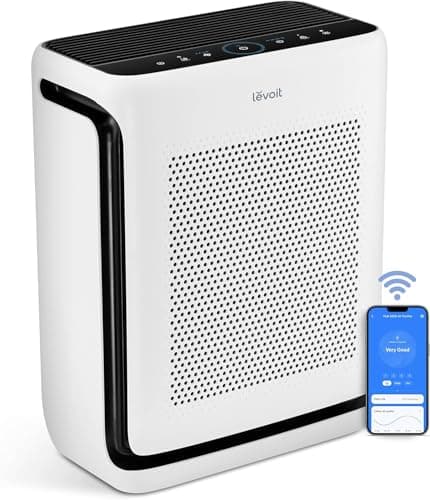
LEVOIT Vital 200S-P Smart Air Purifier (AHAM-Verified 250 CFM Smoke CADR)See it on Amazon ↗

Quick Verdict

LEVOIT Vital 200S-P: an AHAM-verified 250 cfm smoke CADR that sizes cleanly to a finished basement room.

Key Specs

CADR (AHAM verified, stated)

Smoke 250 cfm; dust 254 cfm; pollen 289 cfm

Floor area by EPA's sizing chart

About 385 sq ft for a 250 cfm smoke CADR

Headline coverage (stated)

Up to 1,875 sq ft; the listing does not give the air-change rate behind it

Intake (stated)

Standard inlet plus a U-shaped inlet for pet hair and odors

Controls

Smart, app-connected model, per the title

Carbon filter

Not described in the listing bullets

Pros

  • AHAM-verified CADR figures for smoke, dust and pollen, so sizing is arithmetic rather than guesswork
  • The listing names basements among the rooms it is meant for
  • A second U-shaped inlet draws air from more than one side
  • No ionizer or ozone feature mentioned

Cons

  • The 1,875 sq ft headline is far beyond what 250 cfm cleans at a useful rate; size by CADR instead
  • The bullets do not describe a carbon layer, so odor control is unstated
  • One unit will not cover a large open basement

Suited to

A finished basement family room or bedroom up to roughly 385 sq ft

Our take

The Vital 200S-P earns the top spot because its listing gives you the number you need. AHAM verified its smoke CADR at 250 cfm, and EPA's sizing chart puts 250 cfm at roughly 385 sq ft of floor. That suits a finished family room, a basement bedroom with an office corner, or one end of a larger open space. The 1,875 sq ft figure in the title is not a CADR-based room size, and the listing does not say how it was worked out, so a basement that big needs two or three units, not one. Carbon is not described in the bullets, so if a musty smell is your main complaint, look at the Winix below. Run it with a dehumidifier, never instead of one.

Check today's price on Amazon →

Affiliate link — commission at no extra cost to you

Compare elsewhere

These open a search for this model. We quote prices only where we can verify them — Amazon, Sylvane and eBay.

#2
Best for Musty Smells

Check price

on Amazon ↗

Listing verified 13 Oct 2026

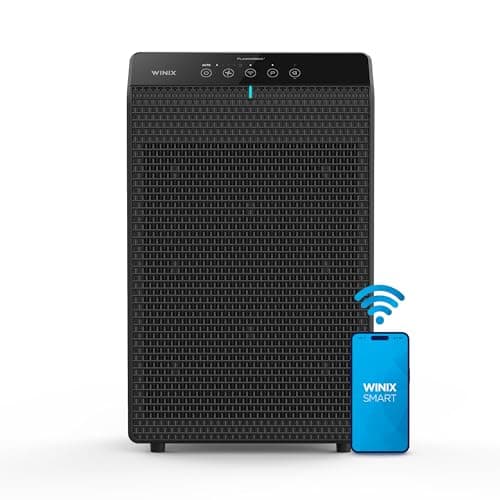
WINIX 5520 Air Purifier (True HEPA, Carbon Filter, AHAM Verified at 392 sq ft)See it on Amazon ↗

Quick Verdict

WINIX 5520: True HEPA plus a stated carbon filter, the better choice when a musty smell is the complaint.

Key Specs

AHAM-verified room size (stated)

392 sq ft

Slower coverage (stated)

941 sq ft in 30 minutes; 1,882 sq ft in 1 hour

Filters (stated)

Washable fine-mesh pre-filter, carbon filter for odors and VOCs, True HEPA

HEPA claim (stated)

99.99% of airborne allergens as small as 0.01 microns, an asterisked listing claim

Controls (stated)

Air quality sensor and auto mode; light-sensing sleep mode; Winix Smart app

Lowest-speed noise (stated)

23.5 dB

Pros

  • Names a dedicated carbon filter for odors and VOCs, the part that touches a musty smell
  • AHAM-verified room size of 392 sq ft, close to the coverage of the top pick
  • A washable pre-filter catches coarse dust that would otherwise load the HEPA filter
  • A light sensor drops it into sleep mode in a dark basement room

Cons

  • The CADR figure itself is not printed in the bullets
  • The bullets do not say whether it has an ionizer setting; check the manual and leave any such setting off
  • Carbon does nothing about the moisture or mold behind the smell

Suited to

A finished basement with a musty smell, once the humidity is under control

Our take

Winix states what the Levoit bullets leave out: a carbon filter aimed at odors and VOCs, sitting between a washable pre-filter and the True HEPA layer. In a basement that smells musty, that carbon layer is the only part of a purifier that touches the smell, since HEPA traps particles and the odor is a gas. AHAM verified it for a 392 sq ft room, roughly the same space the Levoit covers. Treat the carbon as a comfort measure while you find the source. If the smell is back within an hour of switching the unit off, the basement is still too damp or something is still growing. The bullets are silent on ionizers, so check the manual and keep any such setting off.

Check today's price on Amazon →

Affiliate link — commission at no extra cost to you

#3
Best Dual-Carbon Design

Check price

on Amazon ↗

Listing verified 13 Oct 2026

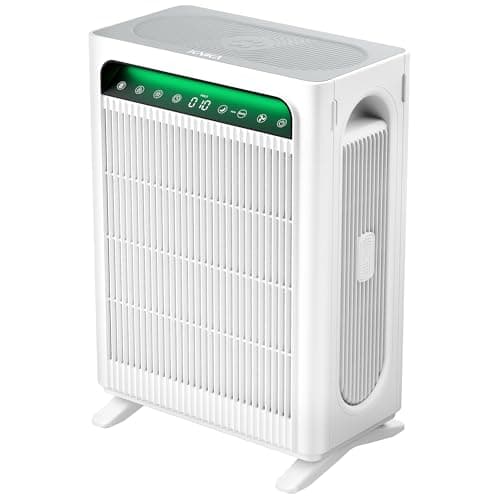
KNKA APH4000 Air Purifier (AHAM-Verified 226 CFM CADR, Carbon in Two Cartridges)See it on Amazon ↗

Quick Verdict

KNKA APH4000: carbon front and back and honest sizing data, with a filter not described as True HEPA.

Key Specs

CADR (AHAM verified, stated)

Smoke, dust and PM2.5 226 cfm; pollen 244 cfm

Air changes (stated)

4.8 per hour in rooms up to 350 sq ft; once per hour up to 1,695 sq ft

Filters (stated)

Front and back cartridges, each with a washable pre-filter, a high-efficiency filter and activated carbon

Modes (stated)

Auto, Sleep, Pet and ECO; four fan speeds

Sleep noise (stated)

22 to 24 dB

Filter change (stated)

Every 3 to 6 months

Pros

  • Carbon in both cartridges, front and back
  • Prints its AHAM-verified CADR and the air-change rate behind its room sizes
  • ECO mode idles the fan when the air reads clean and restarts on its own
  • Dual intakes and side outlets move air through the unit from two directions

Cons

  • The main filter is called high-efficiency, not True HEPA
  • Two cartridges mean two filters to buy at every change
  • A smaller CADR than the top two picks

Suited to

A basement room of up to about 350 sq ft where odor control matters as much as dust

Our take

KNKA gives the clearest sizing data on this page. Besides an AHAM-verified CADR of 226 cfm for smoke and dust, it states the air-change rate behind its room sizes: 4.8 changes an hour in 350 sq ft, falling to one an hour in 1,695 sq ft. That second figure shows why big headline numbers mislead, because one air change an hour is a slow trickle of clean air for a room that size. The design suits a musty basement, with activated carbon in both the front and back cartridges. The main filter is described as high-efficiency rather than True HEPA, so if you want the HEPA standard, choose the Levoit or the Winix. Plan on buying two filters at every change.

Check today's price on Amazon →

Affiliate link — commission at no extra cost to you

#4
Best for a Basement Bedroom or Office

Check price

on Amazon ↗

Listing verified 13 Oct 2026

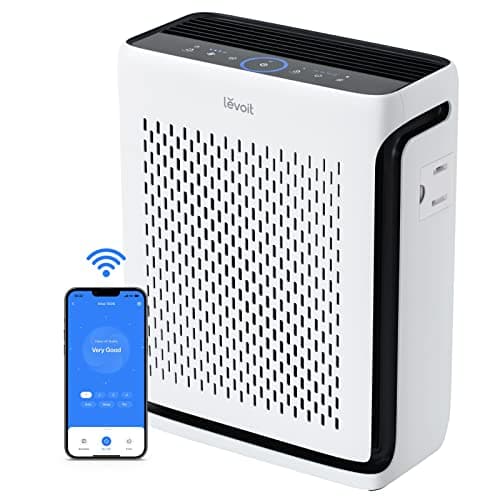
LEVOIT Vital 100S-P Smart Air Purifier (Carbon Filter, 4.8 Air Changes per Hour in 222 sq ft)See it on Amazon ↗

Quick Verdict

LEVOIT Vital 100S-P: a carbon-equipped purifier sized for one closed basement room, not an open floor.

Key Specs

Air changes (AHAM verified, stated)

4.8 per hour in 222 sq ft; once per hour up to 1,073 sq ft

Filter efficiency (stated)

99.97% for particles 0.1 to 0.3 microns

Filters (stated)

Washable pre-filter, main filter and activated carbon filter

Sleep mode (stated)

As low as 25 dB; the display dims in the dark

Smart features (stated)

VeSync app, schedules, filter-life check

Filter options (stated)

Toxin Absorber, Smoke Remover and Pet Allergy replacement filters

Pros

  • Sized for one basement bedroom, office or guest room at a stated 4.8 air changes an hour
  • An activated carbon filter is named on the listing
  • Schedules let it run hard while the room is empty and quietly while it is in use
  • A choice of replacement filters, including one aimed at VOCs

Cons

  • Too small for an open basement on its own
  • CADR is not printed in the bullets, only the room sizes

Suited to

A single closed basement room such as a guest bedroom, office or gym

Our take

Many finished basements are really a few separate rooms: a guest bedroom, an office, a gym corner. Air does not turn corners well, so one big purifier in the family room does little for the bedroom behind a closed door. The Vital 100S-P is sized for that single room, with AHAM-verified figures of 4.8 air changes an hour in 222 sq ft. It names an activated carbon filter for odors, and its replacement filters include a toxin-absorbing option for VOCs. Use the schedule to run it on high while nobody is in the room and at sleep speed when someone is. In a damp room, check the filter life in the app more often than the default reminder suggests.

Check today's price on Amazon →

Affiliate link — commission at no extra cost to you

Buyer's Guide

What to know before you buy.

What a Purifier Does Down There, and What It Cannot

A HEPA air purifier pulls air through a dense filter and catches particles: mold spores, dust, pet dander and the fine debris that drifts off stored boxes. That is all it does. It does not dry the air, it does not kill mold growing on a joist or a drywall corner, and it does not stop water coming through a wall. EPA puts it plainly: portable air cleaners do not address the cause of mold and musty odors, and while they may help reduce odors, they will not resolve a mold and moisture problem. So think of a basement purifier as the second machine. The first job is to stop the water and bring the humidity down. Once the basement is dry, a purifier cleans up the spores and dust that are already in the air.

Dry the Air First, Then Filter It

Mold needs moisture, and basements are where moisture collects: cool walls, damp slabs and summer air that turns clammy as it cools. EPA advises keeping indoor humidity below 60 percent, and ideally between 30 and 50 percent. Put a hygrometer on a shelf and read it for a week. If it sits above 60 percent, buy a dehumidifier before a purifier, and run its hose to a floor drain so it never stops on a full bucket. Running both machines together is fine and common, because they do different jobs: the dehumidifier pulls water out of the air, and the purifier strips particles out of it. Keep them a few feet apart so neither one blows straight into the other's intake.

Size It by CADR and Floor Area

CADR, the clean air delivery rate, tells you how much filtered air a purifier delivers, and it is usually measured at the top fan speed. EPA's sizing chart pairs a 100 sq ft room with a minimum CADR of 65 cfm and a 600 sq ft room with 390 cfm, which works out to about two-thirds of the floor area. Do the arithmetic for your space. A 25 ft by 30 ft open basement is 750 sq ft, so aim for a CADR near 490 cfm, or two smaller units. EPA's chart assumes an 8 ft ceiling, so the low ceilings in many basements work slightly in your favor. Be wary of the room-size headline on a box, because makers calculate it at different air-change rates. The CADR is the number to compare across brands.

Carbon Is What Touches the Smell

The musty smell is a gas, not a particle, so a HEPA filter on its own lets it through. CADR does not measure gases at all, and EPA notes that there is no widely used rating system for how well a portable purifier removes them. What helps is activated carbon, and EPA says carbon filters can be effective provided a large amount of material is used. A thin sheet of carbon-dusted fabric does far less than a deep bed of pellets. Even a good carbon filter only masks the problem if the source is still there, though. A smell that comes back every time the purifier is switched off means something in the basement is still damp, still growing mold, or both.

Skip Ozone, and Switch Off the Ionizer

EPA advises avoiding air cleaners that intentionally produce ozone, and lists ionizers, electrostatic precipitators and UV lamps without adequate coatings as devices that may give off ozone. Ozone is a lung irritant, and EPA says ozone applied to indoor air does not effectively remove mold. That matters more in a basement, where the air moves less and anything a machine emits can build up. Buy a plain HEPA and carbon purifier. If the one you choose has an ionizer or plasma setting, leave it switched off; the HEPA filter does the cleaning without it. Avoid anything sold as an ozone generator for musty smells, however strong the marketing.

Who Should Not Buy a Purifier First

A purifier is the wrong first purchase in several basements. If there is standing water, a wet carpet or water seeping through the walls, you need drying equipment and a fix for the water. EPA says you can usually handle a moldy patch under about 10 square feet yourself, so growth larger than that points to a remediation company, not a filter. A sewer smell is usually a dry floor-drain trap or a plumbing vent problem, and no filter fixes sewer gas. Radon is a gas too, so a radon concern needs a test kit, not a purifier. And a storage basement that nobody spends time in gains little from a purifier. The buyer who does well is someone with a finished, dry basement used as living space who wants the dust and spores kept down.

Frequently Asked Questions

Will an air purifier get rid of the musty smell in my basement?

Not on its own. A purifier with a deep activated carbon filter can lower the smell while it runs, but the musty odor comes from mold or mildew feeding on moisture, and EPA says air cleaners will not resolve a mold and moisture problem.

Bring the humidity under 60 percent with a dehumidifier, remove damp cardboard and mildewed items, and clean any growth you find. Then the purifier keeps what is left in check.

What size air purifier do I need for a basement?

Pick one with a CADR of about two-thirds of the floor area in square feet. EPA's estimation chart lists a minimum CADR of 325 cfm for a 500 sq ft room, and that chart assumes an 8 ft ceiling.

For a large open basement, two mid-size units placed at opposite ends often clean the air more evenly than one big machine in a corner. Compare CADR figures, not the room-size claims on the box.

Should I run a dehumidifier and an air purifier at the same time?

YesIn a damp basement the two work well together because they do different jobs.

The dehumidifier pulls moisture out of the air and keeps mold from finding the water it needs. The purifier catches the spores and dust already floating around. If you can only buy one, buy the dehumidifier first whenever your hygrometer reads above 60 percent, since a purifier does nothing about humidity.

Where should I put an air purifier in a basement?

Put it in the part of the basement where people spend time, such as the family room or home office, with clear space around every side. EPA advises keeping air cleaners away from curtains and anything else that blocks airflow.

Keep it off a damp floor and away from the dehumidifier's exhaust. In an L-shaped or divided basement, one unit cannot reach around corners well, so treat each section as its own room.

Do air purifiers with ionizers produce ozone?

Some can. EPA lists ionizers, electrostatic precipitators and UV lamps without adequate coatings among the air cleaners that may give off ozone, and it advises avoiding units that produce ozone on purpose.

Ozone is a lung irritant, and a basement with little fresh air lets it build up. If your purifier has an ionizer switch, leave it off and let the HEPA and carbon filters do the work.

Should I leave an air purifier on all the time in the basement?

Running it whenever the basement is in use, or around the clock on a low or auto setting, gives the best results. EPA notes that the longer an air cleaner runs, the more air it filters, though longer run times raise electricity use.

Check the filter more often than the box suggests, because damp basement air loads filters faster. EPA says makers typically recommend replacement every 60 to 90 days.

Who do I call right now for water damage?

Call (888) 840-6512. The line is answered 24 hours a day, seven days a week, and connects you with an IICRC-certified water damage restoration company that serves your area. A recorded menu picks up first: choose water damage or mold, key in your 5-digit ZIP code, and hold through the short silence while the call is passed to the company.

Describe what you can see — where the water is coming from, how long it has been there, and whether it smells — the more specific you are, the faster the right company is on the line. If the source is a pipe or an appliance, shut the main water valve first. Have four things ready and the call goes quickly: the address, when the water started, what is wet now, and whether you have filed an insurance claim.

Still not sure which of these is your situation? (888) 840-6512 · toll-free · answered 24/7

Sources

  1. EPA — Guide to Air Cleaners in the Home
  2. EPA — Ozone Generators That Are Sold as Air Cleaners
  3. EPA — A Brief Guide to Mold, Moisture, and Your Home

Methodology: How we source and verify data · Report an error

How we chose these picks

  • Every pick is a current listing. Stock, star ratings and rating counts are read from Amazon by script and carry the date they were read.
  • Nothing under 4.0 stars makes the list, and the top pick needs a large rating count, so one good week of reviews cannot put it there.
  • Specs are quoted from the listing or the maker, with the test condition behind the number where there is one, and sized against the job rather than the room on the box.
  • We do not run lab or field tests. Where a spec matters, we say what it is measured under and what it cannot tell you.

Free 2-day shipping

Amazon Prime members pay no shipping on restoration equipment

Dehumidifiers, air movers, and moisture meters qualify for free Prime delivery — bulk items that otherwise cost $15–$40 to ship.

Try Prime free →

Affiliate link — HearthDry earns a bounty if you sign up; costs you nothing extra.

Also Worth Comparing

Best Air Purifiers for Mold in 2026 — HEPA Units Compared on Verified Airflow

An air purifier is the right tool for airborne spores and the allergy symptoms they cause, and the wrong one for the colony and the damp that feeds it. These five HEPA units are compared on the figures that decide how much air they really clean: verified CADR, the stated filter rating and the room size at about five air changes an hour.

Read the comparison

Dehumidifier vs Air Purifier in 2026 — Which Problem Each One Solves, and Which to Buy

A dehumidifier and an air purifier sit side by side in every store, but they fix different things: one takes water out of the air and the other takes particles out. For damp rooms, musty smells and mold the dehumidifier comes first; for dust, pollen and allergies in air that is already dry enough, the purifier does.

Read the comparison

Best Dehumidifier for Basement Use in 2026 — Drain Hose, Built-In Pump and Honest Pint Ratings

Most basement dehumidifier disappointment comes from two numbers nobody reads properly: the pint rating, measured at warm test conditions a 60°F basement never reaches, and the drainage method. Five units are compared here on those two points first, from a garden-hose drain to a built-in pump with a stated 15 ft lift.

Read the comparison

Best Hygrometers for Home in 2026 — Indoor Humidity Monitors That Tell You When a Room Is Too Damp

A hygrometer is the small, inexpensive instrument that tells you whether a room needs a dehumidifier, a humidifier or nothing at all. These picks are judged on the accuracy each listing states, how easily you can read them, and whether they can warn you about a damp basement before you smell it.

Read the comparison

Best HEPA Air Scrubbers in 2026 — For Mold, Water Damage and Renovation Dust

During mold remediation, disturbed spores become airborne and spread through the HVAC system. A HEPA air scrubber captures 99.97% of particles down to 0.3 microns — including mold spores — protecting your family and containing the remediation zone.

Read the comparison