Best Hygrometers for Home in 2026 — Indoor Humidity Monitors That Tell You When a Room Is Too Damp

Best Hygrometers for Home in 2026

Indoor Humidity Monitors That Tell You When a Room Is Too Damp

5 picks compared · prices, ratings and stock checked October 11, 2026

Our Top Pick

For most rooms, the TempPro TP50: a stated accuracy of ±2–3% RH, high and low records, and a stand and magnet for placing it anywhere. For a basement or crawl space you would rather not visit, the AcuRite Wi-Fi monitor sends humidity alerts to your phone.

4.6 on Amazon · 155,791 ratings

Quick answer

The best hygrometer for most homes is a plain digital meter with a stated accuracy of ±2–3% RH, and the TempPro TP50 is the pick, rated 4.6 stars across 155,791 Amazon ratings. Use it to keep rooms between 30% and 50% relative humidity, the EPA's ideal range; a basement that sits above 60% for days is giving mold what it needs. Before trusting any meter, check it with the salt test, where a sealed container with damp salt should read about 75%. For a basement or crawl space, choose a wireless monitor so the reading reaches you upstairs.

Our Picks at a Glance

Every pick below is currently stocked — ratings and stock read from Amazon on 11 October 2026.

How this page was made: we compare the current Amazon listings, the makers' published specs and what verified buyers report, then rank by fit for the job. Ratings, review counts and stock are read from Amazon and dated. We earn a commission on purchases through our links; it does not change the order. Reviewed by Marcus Reed, IICRC-certified Water Restoration Technician.

Full Reviews

Each pick in detail: what the listing states, what buyers report, and where it falls short.

#1
Best Overall

Check price

on Amazon ↗

Listing verified 13 Oct 2026

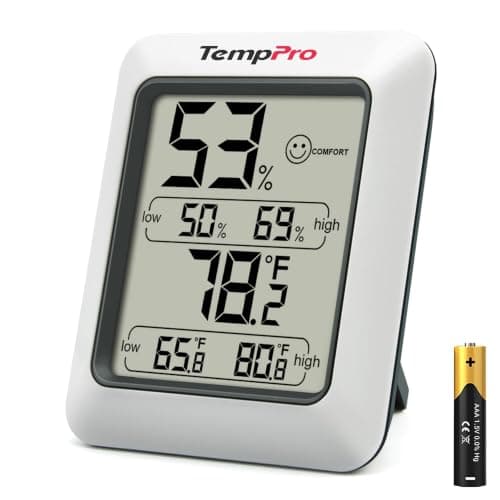
TempPro TP50 Digital Hygrometer (±2–3% RH Stated, High/Low Records)See it on Amazon ↗

Quick Verdict

A simple, widely bought display meter with a tight stated accuracy and high/low records — no app, no alerts.

Key Specs

Humidity accuracy (stated)

±2–3% RH

Temperature accuracy (stated)

±1°F

Refresh rate

Every 10 seconds

Display

Humidity, temperature, high/low records and a DRY/COMFORT/WET icon

Mounting

Tabletop stand and magnetic back

Power

1 AAA battery (included)

Pros

  • Quoted at ±2–3% RH, close enough to tell a healthy room from one drifting toward mold
  • High and low records show how damp a room got overnight or while you were out, not just the reading at the moment you look
  • The magnetic back holds it on a steel shelf or the side of an appliance, at a useful height and out of the way
  • The battery is in the box, so it works the day it arrives

Cons

  • No app and no alerts; you learn the humidity only when you walk over and look
  • The listing does not give the humidity levels behind its DRY, COMFORT and WET icons, so go by the number rather than the face
  • A backlight and a calibration setting are not mentioned on the listing

Suited to

A living room, bedroom or finished basement you pass through every day

Our take

This is the meter to buy first, and for most rooms it is the only one needed. A stated ±2–3% RH means a reading of 50% sits somewhere between about 47% and 53%, which is tight enough to act on. The high and low records are the feature that earns its keep: leave it in a basement for a week and the high mark tells you whether humidity crept past 60% on a rainy day while nobody was looking. Ignore the comfort face. Its thresholds are not published, and a WET icon is no substitute for knowing the number. Run the salt test once when it arrives and write down any offset.

Check today's price on Amazon →

Affiliate link — commission at no extra cost to you

Compare elsewhere

These open a search for this model. We quote prices only where we can verify them — Amazon, Sylvane and eBay.

#2
Best Bluetooth Monitor

Check price

on Amazon ↗

Listing verified 13 Oct 2026

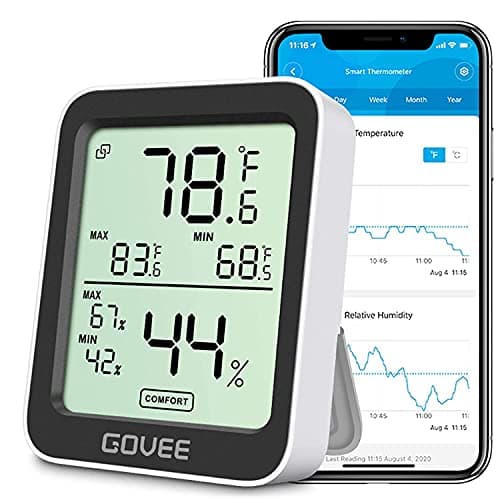
Govee H5075 Bluetooth Hygrometer (±3% RH Stated, App Alerts, 2-Year Data Export)See it on Amazon ↗

Quick Verdict

Alerts and long history for a basement one floor down — only as good as your Bluetooth range.

Key Specs

Humidity accuracy (stated)

±3% RH

Temperature accuracy (stated)

±0.54°F

Refresh rate

Up to every 2 seconds

Connectivity

Bluetooth only, 164 ft stated range; no Wi-Fi

Alerts

App notification when temperature or humidity leaves a preset range

Data

20-day graphs in the Govee Home app; export of up to 2 years as CSV

Pros

  • App alerts fire when humidity leaves the range you set, so a basement that drifts past 60% can tell you about it
  • Two years of exportable history shows whether damp spells follow rain, the season or laundry day
  • The 3 in screen still works as an ordinary meter for anyone in the house without the app
  • Readings refresh as often as every 2 seconds, handy for watching a dehumidifier or an open window take effect

Cons

  • Bluetooth only: your phone has to be within range, and floors and walls shorten the stated 164 ft
  • The listing does not say what battery it takes or how long one lasts

Suited to

A basement or utility room one floor below where you spend your time

Our take

Bluetooth is the least expensive way to get a basement reading upstairs, and for many homes it is enough: put the Govee near the spot that worries you, then check the app from the kitchen. The catch is range. The listing quotes 164 ft without saying under what conditions, and a concrete floor, ductwork and a furnace between sensor and phone will cut into it, so confirm a reading comes through from where you actually sit before relying on it. Set the alert at 60%, the ceiling in the EPA's guidance, rather than at 50%, or it will nag through every humid summer evening. The export is the underrated part: it turns a vague sense that the basement seems damp into a dated record.

Check today's price on Amazon →

Affiliate link — commission at no extra cost to you

#3
Best Wi-Fi Monitor

Check price

on Amazon ↗

Listing verified 13 Oct 2026

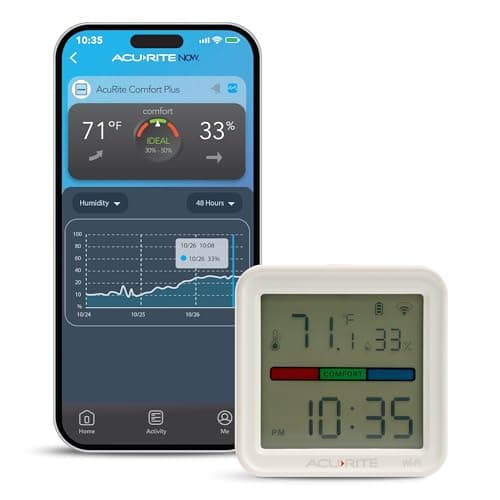
AcuRite 17017M Smart Wi-Fi Indoor Comfort Meter (App Alerts, 5-Minute Updates)See it on Amazon ↗

Quick Verdict

Wi-Fi alerts that reach you anywhere, for spaces you rarely visit — accuracy is not stated, so salt-test it.

Key Specs

Connectivity

Wi-Fi (2.4 GHz) through the AcuRite NOW app

Alerts and history

Set alerts and track history in the app

Update interval

Every 5 minutes once connected

Humidity accuracy (stated)

Not stated on the listing

Display

Temperature, humidity and a clock that sets itself once connected; momentary backlight button

Mounting

Integrated keyhole hanger for a wall

Pros

  • Wi-Fi alerts reach your phone wherever it is, which is what a crawl space, a vacation home or a basement you leave for a week needs
  • History in the app shows what humidity did while nobody was home
  • A backlight button makes the screen readable in a dark basement or closet

Cons

  • The listing does not state humidity accuracy, so run the salt test before trusting it near a decision point
  • Updates every 5 minutes, slower than the Govee; fine for a basement, less useful for watching a dehumidifier pull a room down
  • Works on 2.4 GHz Wi-Fi only, and the batteries are not included

Suited to

A crawl space, a seasonal home or any space you want watched while you are away

Our take

The difference between this and the Govee is where the alert can find you. Bluetooth needs your phone nearby; Wi-Fi sends the warning to you at work or on vacation, which is the whole point of monitoring a crawl space or a basement that can turn damp while you are gone. Five-minute updates suit that job, because humidity in a closed space changes over hours, not seconds. The gap is accuracy. AcuRite's listing does not quote a figure, so treat the first week as a trial: run the salt test, set it beside a second meter, and note any offset. Check that your 2.4 GHz network actually reaches the spot before mounting it under a floor.

Check today's price on Amazon →

Affiliate link — commission at no extra cost to you

#4
Tightest Stated Accuracy

Check price

on Amazon ↗

Listing verified 13 Oct 2026

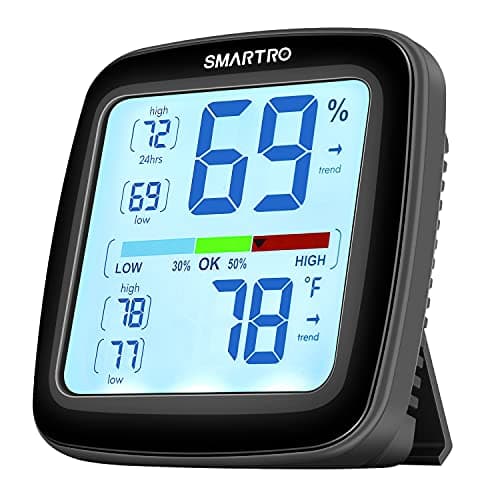
SMARTRO SC42 Digital Hygrometer (±2% RH Stated, User Calibration, 3.5 in Backlit Display)See it on Amazon ↗

Quick Verdict

The tightest stated accuracy and a calibration setting — the reference meter, with no app.

Key Specs

Humidity accuracy (stated)

±2% RH across 1%–99% RH

Temperature accuracy (stated)

Within 0.5°F (-4°F to 158°F)

Calibration

Pre-calibrated; manual calibration supported

Refresh rate

Every 10 seconds

Records

Max/min for the past 24 hours and all-time

Display

3.5 in LCD; backlight stays on 10 seconds per touch

Pros

  • The tightest humidity tolerance stated on this page, ±2% RH
  • Manual calibration lets you correct it after a salt test instead of remembering an offset
  • Separate 24-hour and all-time records show last night's peak and the worst reading since you set it out
  • The largest screen size stated on this page, 3.5 in, with a backlight for a dim basement

Cons

  • No app and no alerts
  • Batteries are not included
  • The backlight turns off after 10 seconds, so a dark corner means touching it each time

Suited to

Anyone who wants the most accurate stated reading, or one trusted meter to check the others against

Our take

For anyone searching for the most accurate hygrometer for home use, this is the listing that makes the strongest stated case: ±2% RH across nearly the whole range, Swiss sensors, and, more useful than either, a calibration setting. Every humidity sensor drifts with age and contamination, and a meter you can correct after a salt test stays trustworthy longer than one you cannot. That makes it a good reference unit. Keep it in the main living area, and once a year set your other meters beside it to see how far they have wandered. In a damp season, read the 24-hour record each morning, since cooler nights push relative humidity up in many rooms.

Check today's price on Amazon →

Affiliate link — commission at no extra cost to you

#5
Best Two-Pack

Check price

on Amazon ↗

Listing verified 13 Oct 2026

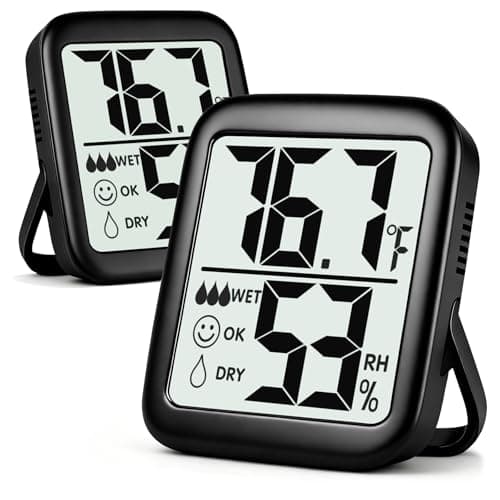
Antonki Indoor Hygrometer 2-Pack (±5% RH Stated, Kickstand and Magnets)See it on Amazon ↗

Quick Verdict

Two meters for comparing rooms — a wide ±5% tolerance, so confirm close calls with a tighter meter.

Key Specs

Humidity accuracy (stated)

±5% RH

Temperature accuracy (stated)

±2°F

Measuring range

10%–99% RH; -58°F to 158°F

Warm-up

Readings settle over 3–5 minutes after switching on

Mounting

Kickstand and magnets

Power

CR2032 coin cell (included); can be switched off

Pros

  • Two meters, so the basement and the main floor can be compared on the same day
  • The listing says a CR2032 coin cell comes with it, and an off switch saves battery between uses
  • The listing is upfront that a fresh reading needs a few minutes to settle, which avoids a false alarm right after moving it

Cons

  • ±5% RH is the widest stated tolerance on this page; a reading of 55% could really be 60%
  • The listing does not mention high/low records or a backlight

Suited to

Comparing two rooms, such as a damp basement against the floor above

Our take

A two-pack answers a question one meter cannot: is the whole house damp, or just one room? Put one in the basement and one upstairs, give both several minutes to settle, and the gap between them points to where the moisture is. The stated ±5% RH is the trade-off. That is wide enough that a reading in the mid-50s cannot be told apart from 60%, so treat these as spotters rather than judges, and confirm anything close to a decision with the salt test or a tighter meter. Leaving both side by side for an hour before separating them shows how far they disagree with each other, which is worth knowing before you compare rooms.

Check today's price on Amazon →

Affiliate link — commission at no extra cost to you

Buyer's Guide

What to know before you buy.

What a Hygrometer Tells You

A hygrometer measures relative humidity: how much water vapor the air holds compared with the most it could hold at that temperature. That single number settles questions people otherwise guess at. The EPA advises keeping indoor humidity below 60%, ideally between 30% and 50%, and notes that it can be measured with an inexpensive moisture or humidity meter from a hardware store. Above 60% for days at a time, mold and dust mites get the damp they need, and a dehumidifier is the fix. Below 30%, usually in a heated house in winter, skin and sinuses dry out and a humidifier helps, as long as the meter is watching so the room does not overshoot. Between the two, the right equipment is often none at all. Without a meter, people run a dehumidifier in a room that was already dry, or a humidifier into one that was already damp.

How Accurate Is Accurate Enough

Home hygrometers usually quote humidity accuracy somewhere between ±2% and ±5% RH, and the listings on this page span that whole range: ±2% for the SMARTRO, ±2–3% for the TempPro, ±3% for the Govee and ±5% for the Antonki two-pack, while AcuRite does not state a figure. The difference matters near the thresholds. A meter good to ±5% that reads 56% might be sitting at 61%, and one that reads 52% might already be under 50%. A ±2–3% meter narrows that to a few points, which is enough to act on. Tolerances are often quoted for the middle of the range at room temperature, and sensors drift slowly over the years, so the figure on the listing describes a new meter, not one that has spent five summers in a basement. That is the reason to check yours now and then rather than only once.

Check It With the Salt Test

Any hygrometer can be checked at home with ordinary table salt. Put a few tablespoons of salt in a bottle cap or small dish and add just enough water to make a damp paste with no free liquid. Seal the dish and the hygrometer together in a zip-top bag or an airtight food container, keep it somewhere the temperature is steady, and leave it overnight, or at least 8 hours. Air over damp salt settles at about 75% relative humidity, so a meter showing 72% is reading 3 points low, and one showing 80% is 5 points high. If the meter has a calibration setting, as the SMARTRO does, set it to 75%. If not, write the offset on a strip of tape on the back and apply it to every reading. Repeat the check every year or two, or whenever two meters disagree.

Where to Put It

A hygrometer reads the air immediately around it, so placement decides whether the number means anything. Keep it away from windows and exterior doors, out of direct sun, and well clear of supply vents and return grilles, which blow conditioned air across the sensor. Bathrooms, kitchens and laundry rooms spike with every shower, pot of pasta and dryer load, so a meter there describes that moment rather than the house. Somewhere central, at roughly tabletop height and away from outside walls, is the honest spot for a living area. In a basement, put it where you are worried: the corner that smells, the storage area, the wall that sweats in summer. Keep it away from a running dehumidifier, whose dry exhaust flatters the reading. After moving a meter, give it time to settle before believing it.

Simple Display, Bluetooth or Wi-Fi

A plain display meter suits a room you walk through every day: glance at it, adjust, move on. A wireless monitor earns its place in spaces you do not visit. A basement or crawl space is the clearest case, since the number is only useful if you see it, and nobody crawls under the house to check a screen. Bluetooth models like the Govee H5075 send readings to a phone within range, which can cover a basement one floor down. Wi-Fi models like the AcuRite send alerts anywhere, which suits a crawl space, a rental unit or a cabin. Whichever you choose, set the alert near 60% rather than at a comfort target, so it flags a real problem instead of every humid afternoon. Remember that a hygrometer watches the air, not the floor; a leaking pipe or a burst washer hose needs a water alarm.

What to Do With the Reading

Read the meter over a week, not one afternoon, because humidity swings with weather, cooking, laundry and the time of day. If a room stays under 50%, there is nothing to buy. If it sits between 50% and 60%, use bathroom and kitchen exhaust fans, make sure the clothes dryer vents outdoors, and keep watching. If it holds above 60%, or you see condensation on windows, walls or cold pipes, which the EPA treats as a sign of high humidity, look for the source first: a wet crawl space, a downspout emptying beside the foundation, a slow leak. Then run a dehumidifier set to 45–50% and keep the hygrometer on the far side of the room to confirm it is getting there. If the room drops below 30% in winter, a humidifier helps, but stop well short of 50% so cold windows do not start to sweat.

Frequently Asked Questions

What is a hygrometer used for in a house?

A hygrometer shows the relative humidity of a room, which tells you whether it needs a dehumidifier, a humidifier or nothing. In a home, that mostly means catching damp before it causes trouble: a basement creeping above 60% in summer, a closet with a musty smell, a bathroom that never dries out.

It is also the honest way to set a dehumidifier or humidifier, since their built-in readings sample only the air entering the machine. Most digital models show temperature as well.

What is the most accurate hygrometer for home use?

Among the listings reviewed here, the SMARTRO SC42 states the tightest tolerance, ±2% RH, and it is the only one that lets you calibrate it, which matters more over the years than the starting figure.

The TempPro TP50 is close behind at a stated ±2–3% RH. No home meter stays exact forever, so whichever you buy, check it with the salt test and note any offset. Two meters that agree within a few points side by side are a good sign.

What humidity level is too high in a house?

Above 60% is too high to leave alone. The EPA's guidance is to keep indoor humidity under 60% and ideally between 30% and 50%, because sustained damp lets mold grow on cool surfaces such as basement walls, closet corners and window frames.

A brief spike after a shower or on a muggy day is normal; the concern is a room that stays above 60% for days. Water beading on windows or pipes is another sign the air is holding too much moisture.

What is the best hygrometer for a basement or crawl space?

A wireless one, because a reading you have to go downstairs or under the house to see rarely gets checked. For a basement one floor below the living area, the Bluetooth Govee H5075 can do the job if your phone picks it up from upstairs; for a crawl space, or a home that sits empty, the Wi-Fi AcuRite sends alerts wherever you are.

Hang the sensor from a joist or pier rather than setting it on the ground, and confirm the signal reaches you before closing the access hatch.

Why do two hygrometers show different readings?

Because each is allowed some error, and the errors can point in opposite directions. Two meters each rated ±3% RH can disagree by 6 points and both still be within specification.

Placement adds more: a meter on an outside wall, near a vent or in sunlight reads differently from one in the middle of the room, and a meter that was just moved needs time to settle. Put both together for an hour, then run the salt test to find out which is closer.

Do I need a hygrometer if my dehumidifier shows the humidity?

It helps. A dehumidifier measures the air entering its own intake, which is often drier than the far corners of the room once the machine has been running, so its display can say 45% while a corner behind stored boxes is noticeably damper.

A separate meter placed where the problem is, such as the musty corner or the storage area, tells you whether the whole space is dry and whether the set point on the dehumidifier means what it says.

Who do I call right now for water damage?

Call (888) 840-6512. The line is answered 24 hours a day, seven days a week, and connects you with an IICRC-certified water damage restoration company that serves your area. A recorded menu picks up first: choose water damage or mold, key in your 5-digit ZIP code, and hold through the short silence while the call is passed to the company.

Describe what you can see — where the water is coming from, how long it has been there, and whether it smells — the more specific you are, the faster the right company is on the line. If the source is a pipe or an appliance, shut the main water valve first. Have four things ready and the call goes quickly: the address, when the water started, what is wet now, and whether you have filed an insurance claim.

Still not sure which of these is your situation? (888) 840-6512 · toll-free · answered 24/7

Sources

  1. EPA — A Brief Guide to Mold, Moisture, and Your Home

Methodology: How we source and verify data · Report an error

How we chose these picks

  • Every pick is a current listing. Stock, star ratings and rating counts are read from Amazon by script and carry the date they were read.
  • Nothing under 4.0 stars makes the list, and the top pick needs a large rating count, so one good week of reviews cannot put it there.
  • Specs are quoted from the listing or the maker, with the test condition behind the number where there is one, and sized against the job rather than the room on the box.
  • We do not run lab or field tests. Where a spec matters, we say what it is measured under and what it cannot tell you.

Free 2-day shipping

Amazon Prime members pay no shipping on restoration equipment

Dehumidifiers, air movers, and moisture meters qualify for free Prime delivery — bulk items that otherwise cost $15–$40 to ship.

Try Prime free →

Affiliate link — HearthDry earns a bounty if you sign up; costs you nothing extra.

Also Worth Comparing

Dehumidifier vs Humidifier in 2026 — Which One Your Air Needs, and the Ones Worth Buying

A dehumidifier and a humidifier are opposites: one pulls water out of air that is too damp, the other adds it to air that is too dry. A hygrometer reading tells you which one your home needs, and getting it wrong, such as running a humidifier in a damp room, can grow the mold you were trying to avoid.

Read the comparison

Best Dehumidifier for Home in 2026 — Sized by Room, Dampness and Drain

The right dehumidifier for a home depends on the size of the space and how damp it is, and the pint number on the box depends on which test produced it. These five picks run from a 22-pint single-room unit to an 80-pint machine for a whole basement, compared on the figures their listings actually state.

Read the comparison

Best Dehumidifier for Basement Use in 2026 — Drain Hose, Built-In Pump and Honest Pint Ratings

Most basement dehumidifier disappointment comes from two numbers nobody reads properly: the pint rating, measured at warm test conditions a 60°F basement never reaches, and the drainage method. Five units are compared here on those two points first, from a garden-hose drain to a built-in pump with a stated 15 ft lift.

Read the comparison

Best Moisture Meters for Homeowners in 2026 — Water Damage Detection

A moisture meter tells you what your eyes can't see — wet drywall, soggy subfloor, and moisture in framing. These are the four best moisture meters for homeowners dealing with water damage.

Read the comparison

Best Dehumidifier for Mold and Musty Smells in 2026 — Picked to Hold a Room Below 50%

A dehumidifier stops mold by taking away the damp it needs, and the musty smell usually leaves with the damp. It does not kill mold that is already growing, so these picks are judged on the job they can do: holding a basement, a room or a closet below 50% humidity, day after day.

Read the comparison

Best Air Quality Monitor for Home in 2026 — What Each Sensor Reads, and Why Humidity Is the Number That Warns of Mold

A home air quality monitor reads humidity, temperature and, depending on the model, CO2, fine particles, VOCs or radon, but none of them can tell you that mold is growing. These picks are compared on what each listing says its sensors measure, whether you need an app to see the numbers, and the humidity range EPA advises for keeping mold away.

Read the comparison