Quick answer
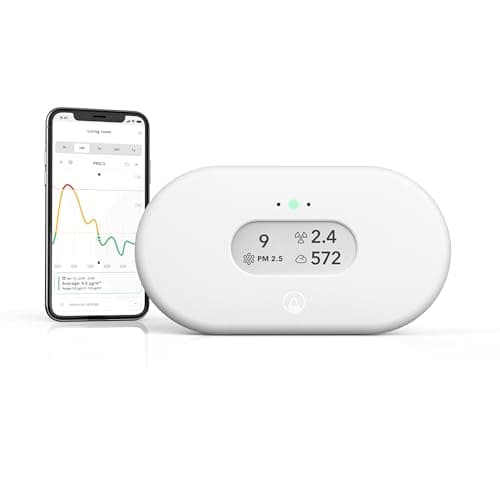
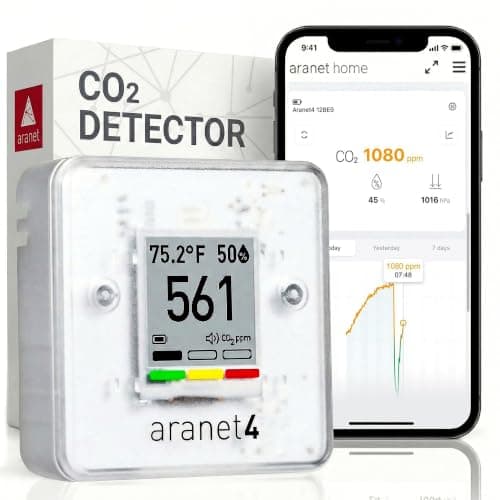
If you want one monitor that shows the numbers behind damp, stale air without opening an app, buy the Aranet4 Indoor Air Quality Monitor, rated 4.7 stars across 1,878 Amazon ratings. Its e-ink screen shows CO2, temperature and relative humidity, and the listing claims up to 4 years on its battery. No consumer monitor detects mold spores directly, so the humidity reading is your mold signal: EPA advises keeping indoor humidity below 60%, ideally 30% to 50%. For smoke and dust, add a PM2.5 model, and for a basement, consider the Airthings View Plus, which also reads radon.
Buyer's Guide
What to know before you buy.
What Each Sensor Measures, and What It Tells You
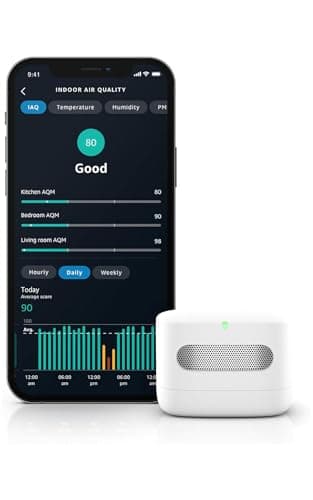
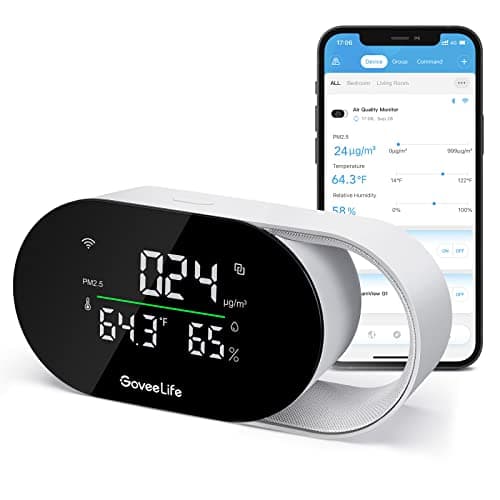
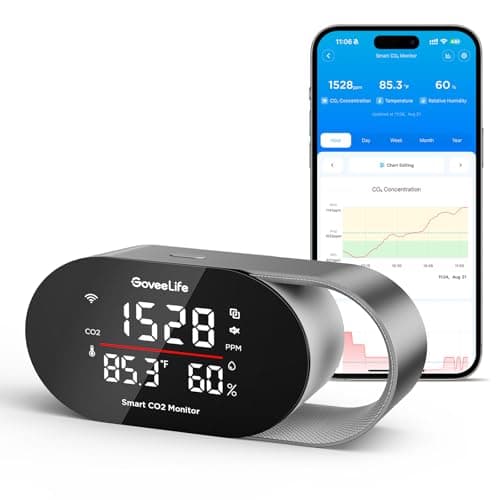
Every monitor on this page reads temperature and relative humidity. Beyond that, the sensors split. CO2 rises as people breathe in a closed room, so it works as a gauge of ventilation; the Aranet4 and GoveeLife H5140 both use NDIR sensors, per their listings. PM2.5 counts fine particles from smoke, cooking, dust and sanding, and it is the GoveeLife H5106's main reading. VOCs are gases released by products such as cleaners, paint and new flooring; EPA's list of indoor pollution sources includes household cleaning products, newly installed flooring and some pressed-wood furniture. The Amazon unit adds carbon monoxide, and the Airthings View Plus adds radon and air pressure. Pick by the question you are asking. A damp basement needs humidity first, a stuffy bedroom needs CO2, and a house near wildfire smoke or in the middle of a renovation needs PM2.5.
No Home Monitor Detects Mold; Humidity Is the Warning
None of these monitors can tell you that mold is growing, whatever an app score suggests. EPA explains that mold spores float through indoor and outdoor air and that some will always be found in a house, so a particle count would never read zero anyway. A PM2.5 sensor groups particles by size, which puts spores, drywall dust and smoke into one number. The musty smell of active mold comes from gases it releases, and a total-VOC sensor may respond to them, but it responds just as readily to a cleaning spray or a pan of onions, so a VOC rise is a prompt to look, not a finding. What a monitor does well is show the condition mold needs. EPA's advice is to keep indoor humidity below 60%, ideally between 30% and 50%, and a room that sits above 60% for days is where to look for growth.
Screen or App: How You Will Actually Read It
Decide who needs to see the numbers. The Aranet4 and Airthings View Plus use e-ink screens and run on batteries, while both GoveeLife monitors have lit screens and need power from a cable. The Amazon Smart Air Quality Monitor has no numeric screen at all: the unit shows a colored light, and the readings and score live in the Alexa app. That works for a household already built around Alexa and poorly for everyone else. Airthings goes further, since its listing says the monitor needs the app, an account and internet to function. History matters as well. To see whether a basement gets damp after rain, you need days of data, and the listings state 90 days in the Aranet4 app and up to 2 years in the GoveeLife apps.
Where to Put It, and How Many You Need
Put the monitor where the problem is, at about the height where people sit or sleep, and away from anything that skews it: a supply vent, an open window, the stove, the bathroom door, or the exhaust side of a dehumidifier. In a damp basement, set it toward the middle of the space rather than on a shelf against the foundation wall, where the air is cooler and reads wetter than the room. Most homes start with one monitor and move it. A battery unit can spend two or three days in each room, so within about a week you know which room runs the highest humidity and which bedroom goes stale overnight. If the basement turns out to be the worry, it often earns a second, permanent unit, and a plug-in model with a humidity alarm suits that job.
Who Should Not Buy an Air Quality Monitor
Skip the monitor if you can already see or smell mold. EPA says that when mold growth is visible, sampling is unnecessary in most cases, and the same logic applies to a gadget: the next step is finding the moisture source and cleaning up. EPA's do-it-yourself guidance covers patches under about 10 square feet; anything larger needs more care than a weekend scrub. If humidity is the only number you care about, a basic hygrometer reads it for far less, and our hygrometer review covers those. A monitor is also no substitute for safety alarms. The Amazon unit reads carbon monoxide, but its listing does not present it as a CO alarm, and none of these picks is a smoke alarm. And if a home sale needs a radon result, use the test the buyer, agent or state asks for.
Accuracy and Calibration: What the Listings Actually Claim
Accuracy claims vary more than sensor lists do. The GoveeLife H5106 states ±15 µg/m³ for PM2.5, ±0.54°F for temperature and ±3% RH for humidity. The GoveeLife H5140 states ±(40 ppm + 5%) for CO2 and says to calibrate outdoors in the app if required. The Aranet4 names its NDIR sensor but prints no accuracy figure, and the Amazon and Airthings bullets give none. Read every home monitor as a trend tool. A humidity reading that is 3 points off still shows clearly when a basement climbs from 45% to 70% after a storm. To check a unit, set it beside a second hygrometer in the same spot for an hour; if they disagree by more than a few points, trust the change over time rather than the exact figure.
Free 2-day shipping
Amazon Prime members pay no shipping on restoration equipment
Dehumidifiers, air movers, and moisture meters qualify for free Prime delivery — bulk items that otherwise cost $15–$40 to ship.
Affiliate link — HearthDry earns a bounty if you sign up; costs you nothing extra.