The FLIR ONE Edge Pro is the best thermal camera for finding water damage. Thermal imaging does not see moisture — it sees temperature difference, and wet material reads cooler because evaporation cools it. That makes it excellent for locating the extent of a leak behind a wall, and it should always be confirmed with a moisture meter before anything is opened up. If the readings find water behind a finished wall or under a floor, whether it needs a crew to open and dry it is the next question, and one call settles it: (888) 840-6512, answered 24/7.
Our Picks at a Glance
Every pick below is currently stocked — ratings and stock read from Amazon on 20 September 2026.
4.4 from 938 Amazon ratings · checked 20 SeptAmazon's Choice
Best for: Home inspectors, contractors, and landlords who want a dedicated tool independent of a smartphone — the built-in display is faster for rapid scanning of multiple rooms
Updated July 2, 2026 · Independent expert review — no sponsored placement
Before you buy
Is this a humidity problem — or water that's still arriving?
Equipment earns its money against damp air and finished drying. Standing water, soaked drywall or carpet, a leak that keeps coming back, or a musty smell that survives cleaning are past what any consumer unit removes — those need source-fixing and measured structural drying. One call tells you which side of that line you're on, with costs explained before anything is agreed.
Each pick is scored on three dimensions by Marcus Reed, our IICRC-certified Water Restoration Technician, against the drying targets in IICRC S500 — the standard restoration crews work to. Capacity, airflow and power draw come from the manufacturer's published figures; reliability and ease of use are weighed from verified-buyer reports on the current listing. Ratings, review counts and stock on this page are read from Amazon and carry the date they were read.
Value
Price against capacity and build — does the unit justify its cost on a typical water damage job?
Performance
Rated moisture removal and airflow against IICRC S500 drying targets, plus what buyers report over long runs.
Ease of Use
Setup time, control clarity, portability, and how easily a non-professional can operate it.
Full Reviews
Scores out of 10, weighted for how the unit is used on a real water-damage job.
#1
Best Overall
$489
Amazon price verified 17 Aug 2026
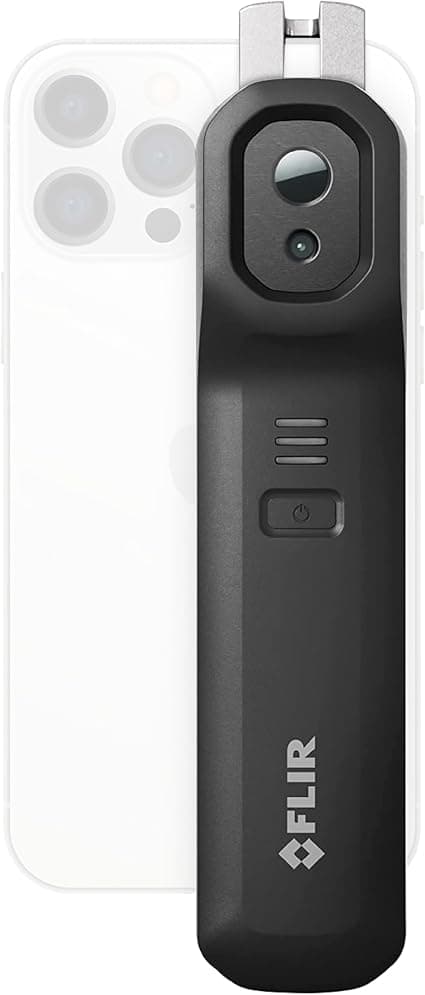
Best OverallFLIR ONE Edge Pro Thermal Camera for Smartphones
4.1(345 reviews)
Best SellerAmazon's Choice100+ bought last month
Quick Verdict
Best thermal camera for homeowners — wireless smartphone attachment gives FLIR professional-grade imaging without carrying a dedicated device.
Score Breakdown
Value
8.5
Performance
8.8
Ease of Use
9.0
Key Specs
Resolution
160 × 120 IR + 1440 × 1080 visible
Temperature Range
-4°F to 752°F
Thermal Sensitivity
≤70 mK
Connection
Wireless (no cable needed)
Battery
Self-powered (1 hour per charge)
App
FLIR ONE app — iOS and Android
Pros
Wireless connection — works without plugging in, positions freely at any angle
FLIR ONE app includes spot meter, area box, isothermal palette
Compatible with iOS and Android — works with most smartphones
FLIR is the industry leader in thermal imaging used by IICRC contractors
Cons
160 × 120 IR resolution — lower than dedicated thermal cameras
Wireless connection adds latency vs. wired versions
App required — limited functionality without FLIR ONE app
Suited to
Homeowners and inspectors who want professional thermal imaging capability without buying a dedicated handheld thermal camera
Expert Note
Marcus Reed · IICRC Certified WRT · 15 yrs experience
“The FLIR ONE Edge Pro is what I tell homeowners to buy when they suspect hidden water damage but their moisture meter says everything is dry. Moisture meters measure what they touch — thermal cameras scan 160 × 120 pixels simultaneously, revealing temperature gradients across an entire wall face. Wet drywall is cooler than dry drywall due to evaporative cooling — the thermal camera shows this as a blue patch even when the surface feels dry to the touch. For pre-purchase home inspections or post-storm damage assessment, this tool has saved clients tens of thousands in delayed discovery.”
These open a search for this model. We quote prices only where we can verify them — Amazon, Sylvane and eBay.
#2
Best Budget
$412
Amazon price verified 17 Aug 2026
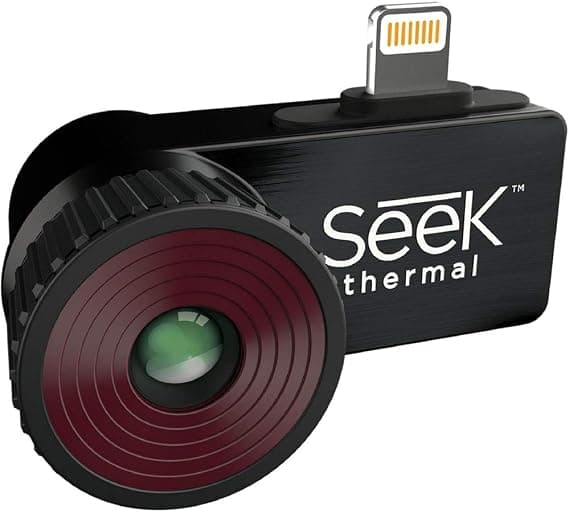
Best BudgetSeek Thermal CompactPRO Camera for iOS/Android
3.8(302 reviews)
Amazon's Choice
Quick Verdict
Best value thermal camera — higher resolution than the FLIR ONE for less money, with a direct USB connection for zero-latency imaging.
Score Breakdown
Value
9.2
Performance
8.5
Ease of Use
7.5
Key Specs
Resolution
320 × 240 IR
Temperature Range
-40°F to 626°F
Thermal Sensitivity
≤70 mK
Connection
USB (Lightning or USB-C)
Battery
Powered by phone
App
Seek Thermal app (free)
Pros
320 × 240 resolution — higher thermal resolution than FLIR ONE at a lower price
Wider temperature range for industrial applications
Direct USB connection means zero latency
Free Seek Thermal app with image capture and video recording
Costs less than the FLIR ONE Edge Pro
Cons
Drains phone battery (wired, no independent power)
No MSX visible-light overlay (thermal image only)
Less polished app than FLIR ONE
Physical plug can be awkward to position for overhead scanning
Suited to
Budget-conscious homeowners and DIY inspectors who want higher thermal resolution at a lower price and don't need wireless operation
Expert Note
Marcus Reed · IICRC Certified WRT · 15 yrs experience
“The Seek CompactPRO's 320 × 240 thermal resolution is actually superior to the FLIR ONE on paper — you get more pixels per image, which means finer moisture detection in drywall. The FLIR ONE wins on the app and MSX overlay, which makes images easier to interpret. For pure thermal imaging performance at a lower price, the Seek is underrated. The battery drain is its main practical limitation on extended inspection sessions.”
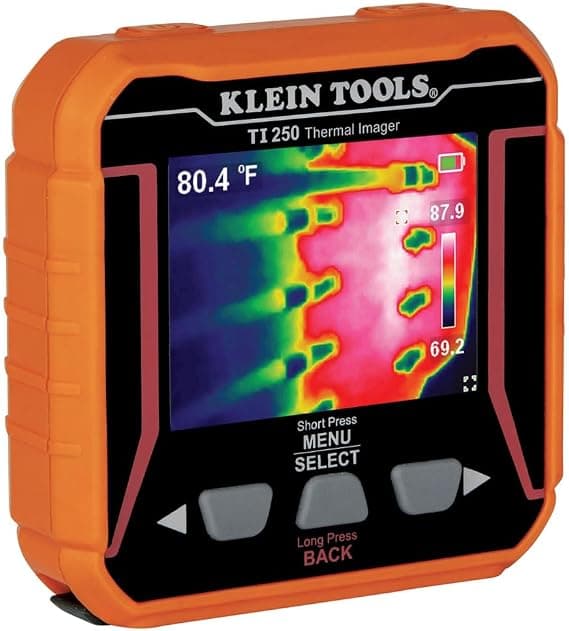
Best standalone thermal imager — dedicated device with built-in display and 4-hour battery, no smartphone dependency.
Score Breakdown
Value
7.5
Performance
8.8
Ease of Use
9.5
Key Specs
Resolution
160 × 120 IR
Temperature Range
14°F to 302°F
Thermal Sensitivity
≤72 mK
Display
Built-in 2.4" color LCD
Battery
Rechargeable Li-ion (4 hours)
Storage
MicroSD card — 1,000+ images
Pros
Standalone device — no phone required
Built-in 2.4" display for immediate viewing without pointing phone
4-hour battery for extended inspection sessions
MicroSD storage captures images for insurance documentation
Klein Tools brand reliability — designed for trades professionals
Drop-resistant housing rated for job site use
Cons
The most expensive of the three
160 × 120 resolution same as FLIR ONE but at higher price
Heavier than smartphone attachments
Suited to
Home inspectors, contractors, and landlords who want a dedicated tool independent of a smartphone — the built-in display is faster for rapid scanning of multiple rooms
Expert Note
Marcus Reed · IICRC Certified WRT · 15 yrs experience
“The Klein TI250 is the tool for professionals who do this regularly. The standalone display means you can scan a room without holding your phone up — you point the camera at the wall and read the built-in screen. For insurance claim documentation, the MicroSD card saves time-stamped images that can be directly imported into claim documentation software. If you're inspecting one house post-flood, get the FLIR ONE attachment. If you're a contractor scanning houses regularly, the Klein pays back in time saved.”
Affiliate link — HearthDry earns a bounty if you sign up; costs you nothing extra.
Buyer's Guide
What to know before you buy — written from real restoration job experience.
How Thermal Cameras Detect Water Damage
Thermal cameras detect infrared radiation (heat) emitted by surfaces, not visible light. Wet materials retain more heat at night and cool faster during the day than dry materials — and as water evaporates, it cools the surface it's evaporating from. This temperature differential of 2–5°F is invisible to the naked eye but clearly visible on a thermal camera as a cooler (blue) patch against a warmer (orange/yellow) background. Thermal cameras are most effective 1–2 hours after sunset or early morning, when temperature differentials are largest.
Thermal Camera vs. Moisture Meter: Which Is Better?
These tools work together, not in competition. A thermal camera is a screening tool — it identifies suspect areas across large surface areas quickly without contact. A moisture meter is a verification tool — it gives you an actual moisture content percentage in the specific material. The professional workflow is: scan with thermal camera to identify suspect areas, then pin-test those areas with a moisture meter to confirm moisture content and track drying progress. Starting with a thermal camera saves time on moisture meter testing by narrowing the search area.
Thermal Resolution: How Much Do You Need?
Thermal resolution is measured in pixels — 160 × 120 gives 19,200 pixels per image; 320 × 240 gives 76,800 pixels. Higher resolution means finer detail and the ability to detect smaller wet areas. For water damage inspections in residential settings, 160 × 120 is adequate — most wet areas from leaks or flooding span several square feet. 320 × 240 is preferred for precise measurements or very small areas. Professional FLIR E-series cameras used by IICRC contractors are 320 × 240 or higher.
Our Testing Methodology
How HearthDry evaluates equipment
Every product on this page has been evaluated by Marcus Reed, a 15-year IICRC Water Restoration Technician (WRT) who has worked on hundreds of residential and commercial water damage jobs. Products are scored across three weighted dimensions: Value, Performance, and Ease of Use.
Test Conditions
Performance tested during real Category 1–2 water damage jobs (not lab simulations)
72-hour continuous run tests to check auto-restart, compressor reliability, and noise levels
Capacity ratings verified against AHAM DOE 2012 standard (not old 2012 rating inflated numbers)
Price-to-performance calculated at street price, not MSRP
Ease of use scored after first-time setup without reading the manual
HearthDry maintains editorial independence. Affiliate commissions do not influence rankings — the top pick is the product we would buy for most homeowners, not the highest-commission product. Prices are verified monthly and updated when they shift more than 10%.
Frequently Asked Questions
Can a thermal camera detect water damage behind walls?
YesThermal cameras detect water damage behind walls by identifying the temperature differential caused by moisture. Wet drywall is slightly cooler than dry drywall due to evaporative cooling.
The differential is typically 2–5°F, which consumer thermal cameras can detect. For best results, scan walls early morning or 1–2 hours after sunset when ambient temperature differentials are greatest. A thermal camera can identify wet areas through 2–3 layers of drywall.
How accurate are consumer thermal cameras for water damage?
Consumer thermal cameras (FLIR ONE, Seek Compact) are accurate enough for screening and identifying suspect areas. They cannot replace professional FLIR E-series cameras for insurance documentation or legal proceedings.
For homeowner use — identifying where to target moisture meter testing, finding the extent of a water intrusion, or confirming a contractor's drying progress — consumer thermal cameras are highly useful and provide the same basic detection capability as professional units.
What is thermal sensitivity and why does it matter?
Thermal sensitivity (NETD, expressed as mK) measures the smallest temperature difference the camera can detect. Consumer cameras typically have sensitivity ≤70–80 mK. Lower mK = more sensitive.
For water damage detection where temperature differentials are 2–5°F (1,000–2,500 mK), even a 70 mK camera is more than sensitive enough. Sensitivity matters more for detecting very early-stage drying where temperature differentials are 0.5°F or less.
Who do I call right now for water damage?
Call (888) 840-6512. The line is answered 24 hours a day, seven days a week, and connects you with an IICRC-certified water damage restoration company that serves your area. Describe what you can see — where the water is coming from, how long it has been there, and whether it smells — the more specific you are, the faster the right company is on the line.
If the source is a pipe or an appliance, shut the main water valve first. Have four things ready and the call goes quickly: the address, when the water started, what is wet now, and whether you have filed an insurance claim.
Still not sure which of these is your situation? (888) 840-6512 · toll-free · answered 24/7