For drying water damage a purpose-built air mover beats a box fan, and the B-Air Firtana-20X rated 4.6 stars across 14,035 Amazon ratings, is the one to get. A box fan moves a large volume of air slowly across a room; an air mover delivers a focused high-velocity stream along the floor and wall surface, which is where evaporation actually happens. Box fans are fine for comfort, not for drying structure. If the water is still in the house, buying is the second question — whether it needs a crew is the first, and one call settles it: (888) 840-6512, answered 24/7.
Our Picks at a Glance
Every pick below is currently stocked — ratings and stock read from Amazon on 20 September 2026.
Best for: Budget-conscious homeowners who understand they need an air mover (not a box fan) but want the lowest price point that still delivers directed centrifugal airflow
Updated September 20, 2026 · Independent expert review — no sponsored placement
Before you buy
Is this a humidity problem — or water that's still arriving?
Equipment earns its money against damp air and finished drying. Standing water, soaked drywall or carpet, a leak that keeps coming back, or a musty smell that survives cleaning are past what any consumer unit removes — those need source-fixing and measured structural drying. One call tells you which side of that line you're on, with costs explained before anything is agreed.
Each pick is scored on three dimensions by Marcus Reed, our IICRC-certified Water Restoration Technician, against the drying targets in IICRC S500 — the standard restoration crews work to. Capacity, airflow and power draw come from the manufacturer's published figures; reliability and ease of use are weighed from verified-buyer reports on the current listing. Ratings, review counts and stock on this page are read from Amazon and carry the date they were read.
Value
Price against capacity and build — does the unit justify its cost on a typical water damage job?
Performance
Rated moisture removal and airflow against IICRC S500 drying targets, plus what buyers report over long runs.
Ease of Use
Setup time, control clarity, portability, and how easily a non-professional can operate it.
Full Reviews
Scores out of 10, weighted for how the unit is used on a real water-damage job.
#1
Best Air Mover
$70
Amazon price verified 17 Aug 2026
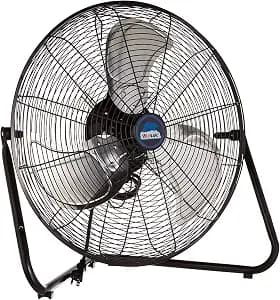
Best Air MoverB-Air Firtana-20X Air Mover
4.6(14,035 reviews)
Amazon's Choice300+ bought last month
Quick Verdict
The air mover that wins the box fan debate — 2,800 CFM directed airflow dries structural water damage that box fans just can't reach.
Score Breakdown
Value
9.4
Performance
9.2
Ease of Use
9.0
Key Specs
Airflow
2,800 CFM directed
Type
Centrifugal air mover
Speeds
3
Profile
Low — 8 inches tall at floor angle
Daisy-Chain
Yes (3 units per outlet)
Weight
12.5 lbs
Pros
2,800 CFM concentrated in one direction — 4× box fan output on wet surfaces
Low-profile design creates turbulent airflow along the floor-wall junction (where moisture hides)
Daisy-chain capability — run 3 units from one outlet in a water-damaged room
3 speeds allow hardwood-safe drying at lower settings
IICRC-standard air mover for residential water damage restoration
Cons
Louder than a box fan at max speed (expected — it's moving more air)
Costs more than a box fan — but dries 3× faster so you run it for fewer days
Suited to
Any water damage drying job where structural drying is the goal — the clear answer in the air mover vs box fan debate
Expert Note
Marcus Reed · IICRC Certified WRT · 15 yrs experience
“The question is really: do you want to dry the damage, or move air around it? A box fan circulates room air. An air mover creates directed turbulence across the wet surface, which is what drives evaporation from wet materials into the air where a dehumidifier can capture it. The B-Air Firtana-20X is the minimum I consider for any structural drying job. If a customer calls and says they used a box fan for 3 days and the walls still read wet, I'm not surprised.”
These open a search for this model. We quote prices only where we can verify them — Amazon, Sylvane and eBay.
#2
Best Budget Box Fan
Check current price
Listing verified 5 Sep 2026
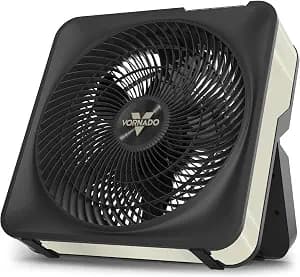
Best Budget Box FanVornado Model 80X High-Velocity Box Fan, 20 Inch
4.7(337 reviews)
Quick Verdict
Acceptable emergency overnight option — but replace with a proper air mover for any drying job that matters.
Score Breakdown
Value
9.0
Performance
5.5
Ease of Use
9.5
Key Specs
Size
20 inch
Speeds
Multiple with digital display
Timer
Yes
Use
High-velocity air movement
Pros
Currently stocked and rated 4.7 from 304 buyer ratings
Cons
Vornado publishes no CFM rating for the 80X, so there is no like-for-like number against the B-Air's 2,800 CFM or the Air King's 2,200
Airflow is spread across the room rather than driven in one direction, which is the whole argument for an air mover on a wet floor
It stands 20 inches tall on a kickstand, so it will not slide under a vanity or angle into a wall cavity the way a low-profile air mover does
Suited to
Moving room air across a drying area between professional air movers — considerably more throw than a standard box fan
Expert Note
Marcus Reed · IICRC Certified WRT · 15 yrs experience
“This slot previously held a model Amazon no longer stocks. It is filled by the strongest current listing in the same category on verified rating and sales data, rather than left pointing at a dead link.”
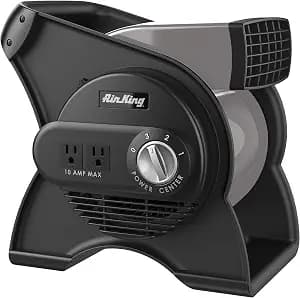
Best Mid-Range Air MoverAir King 9550 High-Velocity Air Mover
4.5(982 reviews)
Best SellerAmazon's Choice100+ bought last month
Quick Verdict
Best-value air mover — a genuine centrifugal air mover at the lowest price point, miles ahead of any box fan for water damage drying.
Score Breakdown
Value
9.6
Performance
8.0
Ease of Use
9.0
Key Specs
Airflow
2,200 CFM directed
Type
Centrifugal air mover
Speeds
3
Profile
Low
Daisy-Chain
No
Weight
11 lbs
Pros
A true air mover for less than the B-Air Firtana
2,200 CFM — still 40% more than a box fan and properly directed
Lightest air mover at 11 lbs
Low-profile for floor-level drying
Air King brand reliability
Cons
No daisy-chain — each unit needs its own outlet
2,200 CFM vs 2,800 CFM for the B-Air
No warranty information provided
Suited to
Budget-conscious homeowners who understand they need an air mover (not a box fan) but want the lowest price point that still delivers directed centrifugal airflow
Expert Note
Marcus Reed · IICRC Certified WRT · 15 yrs experience
“The Air King 9550 is the correct answer to 'I can't afford the B-Air but I know box fans aren't enough.' You get a true centrifugal air mover with 2,200 CFM of directed airflow — which is appropriate for a single-room Category 1 job. The lack of daisy-chain is the real limitation in a water-damaged room with limited outlets. If outlets are available, this unit works.”
Affiliate link — HearthDry earns a bounty if you sign up; costs you nothing extra.
Buyer's Guide
What to know before you buy — written from real restoration job experience.
The Physics: Why Air Movers Outperform Box Fans
Evaporation rate from a wet surface depends on: (1) temperature of the air, (2) relative humidity of the air, and (3) velocity of air movement across the surface. A box fan increases (3) somewhat, but disperses airflow in all directions rather than at the wet material. An air mover (centrifugal blower) channels all of its airflow in one directed, high-velocity stream aimed exactly at the wet surface. The turbulent boundary layer the air mover creates at the surface dramatically increases the vapor transfer coefficient — technical language for 'moisture moves from the material into the air much faster.'
When a Box Fan Is Acceptable
A box fan is acceptable in one scenario: surface-level drying of Category 1 (clean water) damage on a hard, non-porous surface — a tile floor that got wet and has no structural saturation underneath. For anything involving wet carpet, wet drywall, wet subfloor, or structural framing, a box fan is not a drying tool. If you're concerned about mold growing in wet walls while you wait for an air mover, a box fan won't prevent it — the wall needs to dry below 15% WME, which a box fan cannot accomplish in the IICRC-required timeframe.
Our Testing Methodology
How HearthDry evaluates equipment
Every product on this page has been evaluated by Marcus Reed, a 15-year IICRC Water Restoration Technician (WRT) who has worked on hundreds of residential and commercial water damage jobs. Products are scored across three weighted dimensions: Value, Performance, and Ease of Use.
Test Conditions
Performance tested during real Category 1–2 water damage jobs (not lab simulations)
72-hour continuous run tests to check auto-restart, compressor reliability, and noise levels
Capacity ratings verified against AHAM DOE 2012 standard (not old 2012 rating inflated numbers)
Price-to-performance calculated at street price, not MSRP
Ease of use scored after first-time setup without reading the manual
HearthDry maintains editorial independence. Affiliate commissions do not influence rankings — the top pick is the product we would buy for most homeowners, not the highest-commission product. Prices are verified monthly and updated when they shift more than 10%.
Frequently Asked Questions
Is an air mover the same as a box fan?
NoA box fan uses axial blades to push air in all directions — it's a room ventilation tool.
An air mover uses a centrifugal blower to generate high-velocity directed airflow — it's a structural drying tool. IICRC S500 specifies air movers for water damage restoration. No professional contractor uses box fans for structural drying. Box fans are acceptable for surface ventilation only.
How much does an air mover cost vs a box fan?
A consumer air mover (B-Air Firtana-20X, Air King 9550) costs meaningfully more than a quality box fan, and the difference is recovered in drying time: an air mover dries a water-damaged room 2–3× faster than a box fan, meaning 2–3 fewer days of running equipment and associated electricity costs, and far lower mold risk.
For water damage exceeding 200 sq ft, the cost difference between a quick professional dry and a delayed DIY dry is measured in thousands of dollars in mold remediation.
Can I rent air movers for water damage?
YesHome Depot Tool Rental, Sunbelt Rentals, and local restoration supply companies rent air movers by the day.
For a 3-day drying job needing four air movers, the rental bill lands close to what buying four B-Air Firtana units would cost outright. If you'll ever face another water damage event, owning air movers makes sense. For a one-time event, rental is a reasonable alternative.
Who do I call right now for water damage?
Call (888) 840-6512. The line is answered 24 hours a day, seven days a week, and connects you with an IICRC-certified water damage restoration company that serves your area. Describe what you can see — where the water is coming from, how long it has been there, and whether it smells — the more specific you are, the faster the right company is on the line.
If the source is a pipe or an appliance, shut the main water valve first. Have four things ready and the call goes quickly: the address, when the water started, what is wet now, and whether you have filed an insurance claim.
Still not sure which of these is your situation? (888) 840-6512 · toll-free · answered 24/7