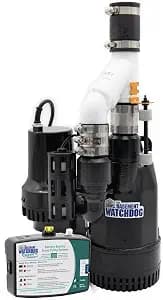
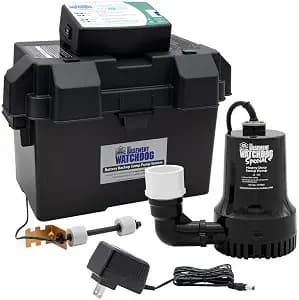
The Basement Watchdog Special CONNECT rated 4.5 stars across 321 Amazon ratings, is the best sump pump battery backup for most homes — 2,890 GPH and WiFi-capable so it tells you when it has activated. Budget for a deep-cycle battery on top, which no system on the market includes, and note that a car starter battery is the wrong type and will be damaged by the duty cycle. If the water is still in the house, buying is the second question — whether it needs a crew is the first, and one call settles it: (888) 840-6512, answered 24/7.
Our Picks at a Glance
Every pick below is currently stocked — ratings and stock read from Amazon on 20 September 2026.
Updated August 17, 2026 · Independent expert review — no sponsored placement
Before you buy
Is this a humidity problem — or water that's still arriving?
Equipment earns its money against damp air and finished drying. Standing water, soaked drywall or carpet, a leak that keeps coming back, or a musty smell that survives cleaning are past what any consumer unit removes — those need source-fixing and measured structural drying. One call tells you which side of that line you're on, with costs explained before anything is agreed.
Each pick is scored on three dimensions by Marcus Reed, our IICRC-certified Water Restoration Technician, against the drying targets in IICRC S500 — the standard restoration crews work to. Capacity, airflow and power draw come from the manufacturer's published figures; reliability and ease of use are weighed from verified-buyer reports on the current listing. Ratings, review counts and stock on this page are read from Amazon and carry the date they were read.
Value
Price against capacity and build — does the unit justify its cost on a typical water damage job?
Performance
Rated moisture removal and airflow against IICRC S500 drying targets, plus what buyers report over long runs.
Ease of Use
Setup time, control clarity, portability, and how easily a non-professional can operate it.
Full Reviews
Scores out of 10, weighted for how the unit is used on a real water-damage job.
#1
Best Overall
$279
Amazon price verified 17 Aug 2026 · battery sold separately
Best OverallBasement Watchdog Special CONNECT (BWSP)
4.5(321 reviews)
Amazon's Choice100+ bought last month
Key Specs
Backup capacity
2,890 GPH
Motor
Copper-wound
Voltage
12V DC
Monitoring
WiFi-capable with add-on module
Battery
Not included
Type
Backup pump only (keeps your existing primary)
Pros
Best rated of every system compared here, on a substantial review base
Lowest price of the four while still delivering 2,890 GPH of backup flow
Copper-wound motor rather than aluminium — the durability difference that matters on a pump that sits idle for months
WiFi-capable, so you find out it activated instead of discovering it later
Keeps your existing primary pump, so nothing working gets replaced
Cons
Battery not included — a deep-cycle unit is a separate purchase
WiFi needs a separate add-on module, it is not built in
Suited to
Any home with a working primary sump pump that needs insurance against a power cut, which is the situation most basements are actually in
Expert Note
Marcus Reed · IICRC Certified WRT · 15 yrs experience
“This is the default recommendation because it solves the real failure mode at the lowest total cost. Power cuts and sump pump demand arrive in the same storm, so a primary pump on mains power alone is a single point of failure. A backup-only system is the cheapest way to remove that, and it leaves a functioning primary in place.”
These open a search for this model. We quote prices only where we can verify them — Amazon, Sylvane and eBay.
#2
Best Combination System
$469
Amazon price verified 17 Aug 2026 · battery sold separately
Best Combination SystemBasement Watchdog Combo CITS-50 (Primary + Backup)
4.3(313 reviews)
Amazon's Choice200+ bought last month
Key Specs
Type
Preassembled primary + battery backup
Controller
Monitoring controller included
Motor
Copper-wound PSC
Monitoring
WiFi-capable with add-on module
Battery
Not included
Pros
Primary and backup arrive preassembled on one rail — far less plumbing than fitting a backup to an existing pit
Monitoring controller included rather than sold as an accessory
Copper-wound PSC motor on the primary
The obvious answer if the existing primary is old and due for replacement anyway
Cons
You are paying to replace a primary pump that may still have years left in it
Costs more than the backup-only unit, and still needs the battery
Suited to
New installations, and homes where the primary pump is already near the end of its life so both units get replaced together
Expert Note
Marcus Reed · IICRC Certified WRT · 15 yrs experience
“Only buy the combination if the primary genuinely needs replacing. If your existing pump works, the backup-only BWSP does the same protective job for less money. The combination's real advantage is installation simplicity — one preassembled unit into the pit instead of fitting a second pump and check valve around an existing one.”
Amazon price verified 17 Aug 2026 · battery sold separately
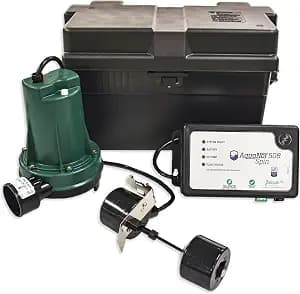
Best Build QualityZoeller 508-0005 Aquanot 508 Battery Back-Up System
4.4(192 reviews)
Best SellerAmazon's Choice50+ bought last month
Key Specs
Type
Backup system
Brand
Zoeller — cast iron pump heritage
Voltage
12V DC
Battery
Not included
Pros
Zoeller is the brand plumbers most consistently specify for pit equipment
Built for long service life in a component that spends most of its life idle
Well-supported through plumbing supply channels, so parts are findable years later
Cons
Costs more than the better-rated BWSP with no capacity advantage on paper
Smallest review base of the four compared here
Suited to
Homeowners who weight brand longevity and parts availability over price, and anyone whose plumber already works with Zoeller equipment
Expert Note
Marcus Reed · IICRC Certified WRT · 15 yrs experience
“The case for Zoeller is service life and support rather than specification. That is a legitimate reason to pay more for a device that has to work on the one night in five years it is called on — but it is a judgement about durability, not a measurable advantage over the cheaper unit, and it should be described that way.”
Amazon price verified 17 Aug 2026 · battery sold separately
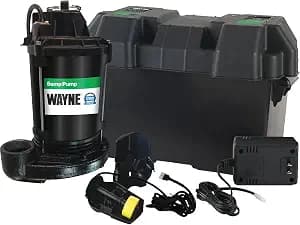
Highest CapacityWayne ESP25n (2,700 GPH, 12V)
4.4(337 reviews)
Best SellerAmazon's Choice
Key Specs
Backup capacity
Up to 2,700 GPH
Voltage
12V DC
Build
Heavy duty
Battery
Not included
Type
Backup pump
Pros
Largest review base of the four, and rated well across it
Heavy-duty construction at a mid-range price
Sits between the BWSP and the premium units on cost
Cons
2,700 GPH is marginally below the cheaper BWSP's 2,890 GPH
No integrated monitoring option comparable to the CONNECT range
Suited to
Homes wanting a heavy-duty backup from a well-established pump brand, where remote monitoring is not a priority
Expert Note
Marcus Reed · IICRC Certified WRT · 15 yrs experience
“A solid unit, but read the capacity figures side by side before paying the premium — it is rated slightly lower than the BWSP. Choose it for the build and the brand rather than for flow, and skip it if monitoring matters to you.”
Affiliate link — HearthDry earns a bounty if you sign up; costs you nothing extra.
Buyer's Guide
What to know before you buy — written from real restoration job experience.
The Battery Is Not Included — Budget For One Separately
Not one of the systems on this page ships with a battery, and it is the most common unpleasant surprise in the category. You need a deep-cycle marine or AGM battery, and the deep-cycle part is not optional: a car starter battery is built to deliver a huge current for a few seconds and is damaged by the slow deep discharge a sump pump demands. Plan on replacing the battery every three to five years as well, because a backup system with a dead battery is decoration. So the real total cost is the listed price of the system plus a battery, not the listing on its own.
Backup-Only or Combination?
A backup-only system adds a second pump beside your existing primary and takes over when mains power fails or the primary cannot keep up. A combination system replaces both as one preassembled unit. The decision is simply the age of your current primary: if it works and is not near end of life, backup-only is the cheaper route and wastes nothing. If the primary is ten years old and you would be replacing it soon anyway, the combination costs less than doing two jobs separately and is markedly easier to install — one assembly into the pit instead of fitting a second pump and check valve around a live one.
Why GPH Matters Less Than You Think
Every unit here moves between 2,700 and 2,890 gallons per hour, and that spread is not what will decide whether your basement stays dry. Two things matter more. First, head height: rated flow is quoted at a low lift, and real capacity drops as the pump has to push water higher, so a figure measured at 0 feet tells you little about a pit discharging 10 feet up and out. Second, runtime: a backup pump on a single battery typically manages several hours of intermittent cycling, and a long outage can outlast it. If your area sees multi-day outages, a second battery buys more real protection than 200 extra GPH.
What Installation Actually Costs
Fitting a backup pump is genuinely DIY-able if you are comfortable with PVC and a check valve — the pump goes into the existing pit, the discharge ties into the existing line above the primary's check valve, and the controller mounts on the wall near an outlet. Expect a few hours. A plumber will charge for a few hours of labor, more if the discharge line needs reworking or the pit is tight. Combination systems are usually easier than retrofitting a backup, because the assembly arrives ready and there is no working around a live pump. Where you should not improvise is the discharge and the check valve: get those wrong and the backup pushes water back into the pit.
Monitoring Is the Feature Worth Paying For
A backup sump pump has the same problem as a radon fan: it fails silently, and you find out when the basement floods. Systems in the CONNECT range are WiFi-capable through an add-on module and will alert you when they activate, when the battery is low, and when the water level is rising. That matters because activation is itself information — a backup that ran while you were out means the primary failed or was overwhelmed, and you want to know that before the next storm rather than after. If you buy nothing else on this page, buy an alarm.
Test It Twice a Year, or It Does Not Count
This is the part that decides whether the money was well spent. Twice a year, unplug the primary pump and pour water into the pit until the backup activates. Confirm it runs, confirm water leaves through the discharge, and confirm the alarm sounds. Then check the battery: terminals clean, fluid level correct on a serviceable type, and the controller not reporting a fault. Systems that fail on the night are almost never systems that were tested — they are systems installed once and never looked at again for six years.
Our Testing Methodology
How HearthDry evaluates equipment
Every product on this page has been evaluated by Marcus Reed, a 15-year IICRC Water Restoration Technician (WRT) who has worked on hundreds of residential and commercial water damage jobs. Products are scored across three weighted dimensions: Value, Performance, and Ease of Use.
Test Conditions
Performance tested during real Category 1–2 water damage jobs (not lab simulations)
72-hour continuous run tests to check auto-restart, compressor reliability, and noise levels
Capacity ratings verified against AHAM DOE 2012 standard (not old 2012 rating inflated numbers)
Price-to-performance calculated at street price, not MSRP
Ease of use scored after first-time setup without reading the manual
HearthDry maintains editorial independence. Affiliate commissions do not influence rankings — the top pick is the product we would buy for most homeowners, not the highest-commission product. Prices are verified monthly and updated when they shift more than 10%.
Frequently Asked Questions
How much does a sump pump battery backup cost?
Check the current listing for each system, because prices move — of the units compared here, the backup-only Basement Watchdog BWSP is the cheapest, then the Wayne ESP25n, then the Zoeller Aquanot 508, then the preassembled primary-plus-backup combination.
What matters more is what the listing leaves out. You must add a deep-cycle battery, because none of them includes one, and professional installation is a further cost if you are not fitting it yourself. Realistic all-in cost is therefore well above the sticker on any of these units.
Do I need a special battery for a sump pump backup?
YesAnd using the wrong type is a common and expensive mistake. You need a deep-cycle marine or AGM battery, not a car starter battery.
A starter battery is designed to deliver a very large current for a few seconds and is damaged by being deeply discharged, which is exactly what a sump pump does to it over an hour of pumping. Deep-cycle batteries are built for that duty. Budget for one on top of the system, and expect to replace it every three to five years — a backup system on a dead battery provides no protection at all.
How long will a battery backup sump pump run during a power outage?
On a single fully charged deep-cycle battery, most systems manage several hours of intermittent cycling — the exact figure depends on how often the pump has to run, which depends on how fast water enters the pit. Continuous pumping drains a battery far faster than a pump cycling every few minutes.
Manufacturers quote optimistic numbers based on light cycling. If your area sees outages lasting more than a day, wiring a second battery in parallel roughly doubles runtime and is better value than buying a higher-capacity pump.
Is a combination sump pump with battery backup better than adding a backup?
Only if your existing primary pump needs replacing. A combination unit puts a new primary and a new backup on one preassembled rail, which is considerably easier to install and sensible if the old pump is near end of life.
But if the primary works, a backup-only system delivers the same protection for less money and you keep a functioning pump. The genuine advantage of the combination is installation simplicity rather than performance — retrofitting a second pump around a live one is fiddlier than dropping in one assembly.
Will a battery backup sump pump work if the primary pump fails but power is on?
YesAnd this is an underappreciated benefit. The backup activates on water level, not on loss of mains power, so it takes over whether the cause is an outage, a seized primary motor, a stuck float switch, or simply more water arriving than the primary can move.
That covers considerably more failure modes than most buyers assume. It is also why activation is worth being alerted to: if the backup ran while the power was on, the primary has a problem you need to look at.
Can I install a sump pump battery backup myself?
For most people, yes. The backup pump sits in the existing pit, its discharge ties into the existing line above the primary's check valve, and the controller mounts on a wall near a power outlet. If you are comfortable cutting and cementing PVC and fitting a check valve, budget a few hours.
The two things to get right are the check valve orientation and the discharge tie-in — wrong, and the backup pushes water back down into the pit instead of out of the house. If either part makes you hesitate, a few hours of plumber time is cheap against a flooded basement.
Who do I call right now for water damage?
Call (888) 840-6512. The line is answered 24 hours a day, seven days a week, and connects you with an IICRC-certified water damage restoration company that serves your area. Describe what you can see — where the water is coming from, how long it has been there, and whether it smells — the more specific you are, the faster the right company is on the line.
If the source is a pipe or an appliance, shut the main water valve first. Have four things ready and the call goes quickly: the address, when the water started, what is wet now, and whether you have filed an insurance claim.
Still not sure which of these is your situation? (888) 840-6512 · toll-free · answered 24/7