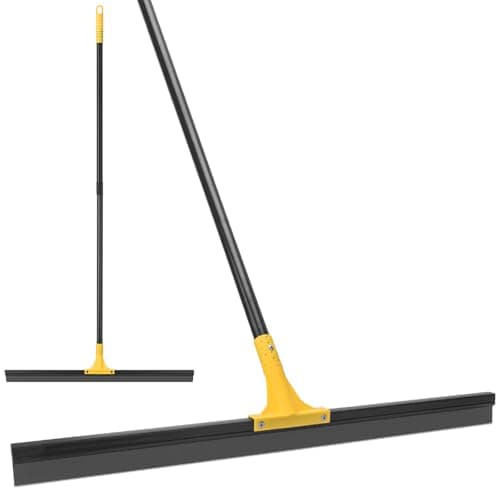
Best for: Pushing standing water across an open garage or basement slab to a floor drain, a sump or the door
- Blade width (stated):
- 30 in
- Blade (stated):
- Rubber
Listing verified 13 Oct 2026

Moving Standing Water on Concrete to a Drain, Blade Width, Rubber vs Foam, and What Comes After
5 picks compared · prices, ratings and stock checked October 12, 2026
Our Top Pick
For garages and open basement slabs, the KeFanta 30 in Rubber Floor Squeegee with its 59 in handle, wide enough to move a lot of water per stroke. For a laundry room, bathroom or narrow utility space, the CLEANHOME 17 in Rubber Floor Squeegee with its locking extendable handle.
4.4 on Amazon · 1,706 ratings
Quick answer
If you have standing water on a concrete garage or basement floor, a wide rubber floor squeegee will push it to a floor drain or out the door faster than a mop, and for most slabs the pick is the KeFanta 30 in Rubber Floor Squeegee, rated 4.4 stars across 1,706 Amazon ratings. Its 30 in blade clears a wide path on each stroke. Push toward the drain, pick up the thin film left behind with a wet/dry vac, then dry the room with fans and a dehumidifier. Never squeegee carpet; wet carpet needs extraction.
Every pick below is currently stocked — ratings and stock read from Amazon on 12 October 2026.
Best for: Pushing standing water across an open garage or basement slab to a floor drain, a sump or the door
Listing verified 13 Oct 2026
Best for: One-car garages, basements with a furnace and shelving to steer around, and wet tile floors
Listing verified 13 Oct 2026
Best for: Laundry rooms, bathrooms, utility closets and other tight floors with a drain nearby
Listing verified 13 Oct 2026
Best for: Basements with storage shelving or a workbench, where water collects underneath
Listing verified 13 Oct 2026
Best for: Wide, worn or slightly uneven concrete slabs where a firm rubber edge leaves water behind
Listing verified 13 Oct 2026
How this page was made: we compare the current Amazon listings, the makers' published specs and what verified buyers report, then rank by fit for the job. Ratings, review counts and stock are read from Amazon and dated. We earn a commission on purchases through our links; it does not change the order. Reviewed by Marcus Reed, IICRC-certified Water Restoration Technician.
Full Reviews
Each pick in detail: what the listing states, what buyers report, and where it falls short.
Check price
on Amazon ↗
Listing verified 13 Oct 2026
See it on Amazon ↗Best Overall
Quick Verdict
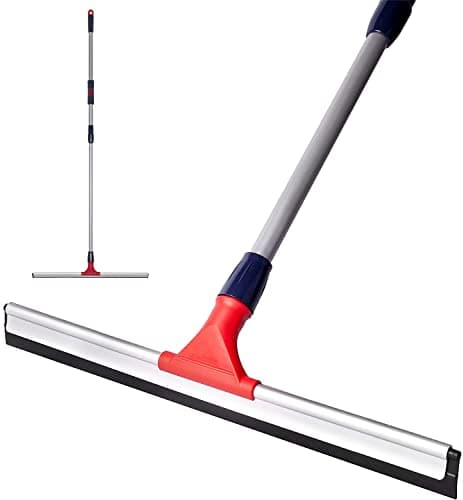
KeFanta 30 in Rubber Floor Squeegee: a wide rubber blade for open garage and basement slabs, best on smooth concrete.
Key Specs
Blade width (stated)
30 in
Blade (stated)
Rubber
Handle (stated)
59 in, joint reinforced with a plastic sleeve, hang loop for storage
Head angle (stated)
45 degrees
Surfaces (stated)
Concrete, tile and other smooth surfaces
Uses named (stated)
Garages, patios, decks, pool sides and solar panels
Pros
Cons
Suited to
Pushing standing water across an open garage or basement slab to a floor drain, a sump or the door
Our take
Width is the number that matters most on an open slab. A 30 in blade covers a strip about 1.8 times wider than a 17 in blade, so a two-car garage or an unfinished basement clears in far fewer passes. KeFanta's listing describes a rubber blade set at 45 degrees and aims it at smooth surfaces such as concrete and tile. Respect that limit: on rough, pitted or broom-finished concrete, a firm rubber edge can skip and leave lines of water. Start at the far wall and work toward the drain in overlapping strokes, keeping the water moving so it does not settle back into low spots.
Affiliate link — commission at no extra cost to you
Compare elsewhere
These open a search for this model. We quote prices only where we can verify them — Amazon, Sylvane and eBay.
Check price
on Amazon ↗
Listing verified 13 Oct 2026
See it on Amazon ↗Best Mid-Size Squeegee
Quick Verdict
DSV Standard 24 in Professional Floor Squeegee: a mid-width silicone blade on an adjustable handle, for floors with things in the way.
Key Specs
Blade width (stated)
60 cm (23.6 in), sold as 24 in
Blade (stated)
Single natural silicone rubber blade
Handle (stated)
Telescopic stainless steel and aluminum, 30–57 in
Surfaces (stated)
Concrete and tiled garage and bathroom floors, pool decks, windows and shower doors
Warranty (stated)
18 months against defects in design, materials and workmanship; 30-day money back
Pros
Cons
Suited to
One-car garages, basements with a furnace and shelving to steer around, and wet tile floors
Our take
A 24 in blade is the compromise width. It moves more water per stroke than a bathroom squeegee yet still fits between a water heater and a wall, which is where basement water likes to collect. DSV's listing describes a single natural silicone blade on a telescopic stainless and aluminum handle that runs from 30 to 57 in. The short setting is useful for shower glass and windows, the long one for a garage floor. The listing makes a bold claim about blade life that you should read as marketing. The 18-month defect warranty is the firmer promise, so keep the order details.
Affiliate link — commission at no extra cost to you
Compare elsewhere
Check price
on Amazon ↗
Listing verified 13 Oct 2026
See it on Amazon ↗Best for Small Rooms
Quick Verdict
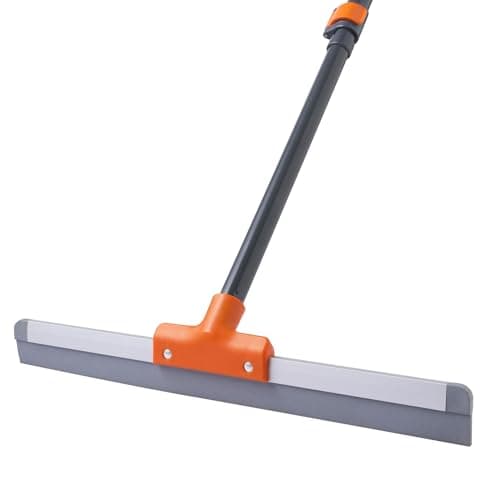
CLEANHOME 17 in Rubber Floor Squeegee: a compact rubber blade with a locking handle, sized for laundry rooms and bathrooms.
Key Specs
Blade width (stated)
17 in
Blade and base (stated)
Rubber blade on an aluminum base
Handle (stated)
Extendable 44–54 in with a locking mechanism; foam-covered grip
Head (stated)
Angled
Surfaces (stated)
Concrete, tile, shower areas, decks and garages
Pros
Cons
Suited to
Laundry rooms, bathrooms, utility closets and other tight floors with a drain nearby
Our take
Small rooms are where most household leaks end up: the laundry room after a hose lets go, the bathroom after a toilet overflow, the utility closet under a dripping water heater. A 17 in blade fits around a washer and between the tank and the wall, places a 30 in head cannot reach. CLEANHOME's listing pairs a rubber blade with an aluminum base, which it says resists rust, and a handle that locks between 44 and 54 in. Push the water to the floor drain or toward the door, then pick up the film with a wet/dry vac. If the water came from a toilet, read the safety section before you start.
Affiliate link — commission at no extra cost to you
Compare elsewhere
Check price
on Amazon ↗
Listing verified 13 Oct 2026
See it on Amazon ↗Best for Reaching Under Shelves
Quick Verdict
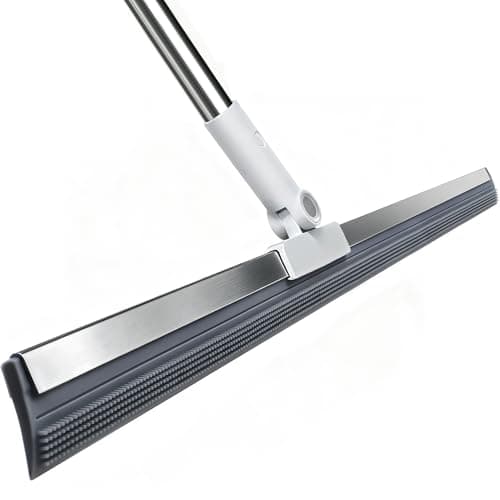
Purexa 19.7 in Floor Squeegee: a pivoting head that reaches under shelves, on a mid-width dual-sided blade.
Key Specs
Blade width (stated)
19.7 in
Blade (stated)
Flexible synthetic rubber (TPE), smooth on one side and textured on the other
Handle (stated)
Telescoping stainless steel, 51–58 in, 0.87 in (22 mm) diameter
Head (stated)
Pivots 180 degrees to lie flat under low shelves and furniture
Surfaces (stated)
Concrete, epoxy, tile and wood floors; driveways, patios and decks
Pros
Cons
Suited to
Basements with storage shelving or a workbench, where water collects underneath
Our take
Water in a basement rarely sits in the open. It pools under steel shelving, behind a workbench and beneath the lowest cabinet, where a fixed squeegee head cannot reach. Purexa's head pivots 180 degrees to lie flat, per the listing, so you can drag water out from underneath before pushing it to the drain. The blade is a flexible TPE rubber with a smooth side for water and a textured side for dirt. One caution: the listing names wood floors, but on hardwood the job is to remove water fast, not spread it around, so use a wet/dry vac there and start drying right away.
Affiliate link — commission at no extra cost to you
Compare elsewhere
Check price
on Amazon ↗
Listing verified 13 Oct 2026
See it on Amazon ↗Best Foam Blade
Quick Verdict
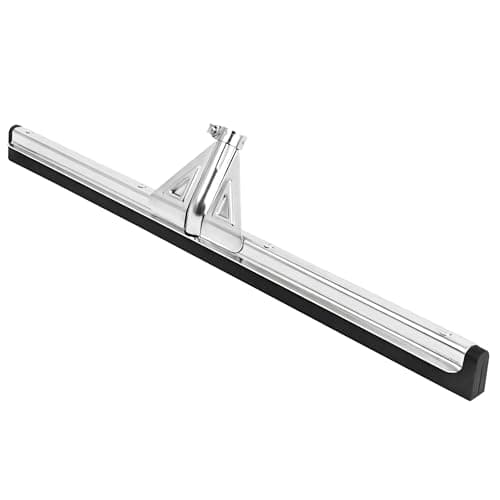
DSV Standard 30 in Heavy-Duty Floor Squeegee: a wide double foam blade for worn slabs, sold without a handle.
Key Specs
Blade width (stated)
30 in
Blade (stated)
Double foam rubber blade
Frame (stated)
Stainless steel frame with reinforced blade holders
Handle
Sold separately; fits a standard 1 in tapered handle, screw included
Surfaces (stated)
Tile, concrete, asphalt, vinyl, laminate and other smooth, sealed hard floors
Warranty (stated)
18 months against defects; 30-day money back
Pros
Cons
Suited to
Wide, worn or slightly uneven concrete slabs where a firm rubber edge leaves water behind
Our take
Foam is the answer to concrete that is no longer flat. A firm rubber blade rides over shallow dips and the rough paste of an old slab, leaving stripes of water. DSV's listing describes a double foam rubber blade that conforms to floor contours and seals against the surface, with a second blade to catch what the first leaves. The listing still pitches it at smooth, sealed floors, so expect it to help on worn concrete rather than on deeply pitted or cracked surfaces. Budget for a 1 in tapered handle, which is sold separately, and rinse the foam after any dirty water.
Affiliate link — commission at no extra cost to you
Compare elsewhere
What to know before you buy.
A floor squeegee moves water. It does not remove it and it does not dry anything. On a concrete garage floor or basement slab, it is the fastest way to send standing water to a floor drain, a sump pit or the door, much faster than mopping. What it leaves is a thin film in the pores of the concrete and in every low spot, and that film has to come up with a wet/dry vac before fans and a dehumidifier can dry the room. EPA advises drying water-damaged areas within 24 to 48 hours to prevent mold, so treat the squeegee as the first ten minutes of the job, not the whole of it. It does nothing for water already soaked into drywall, carpet or wood.
Measure the floor and the gaps on it. Across a 20 ft wide garage, a 30 in blade needs about 8 side-by-side strokes to cover each row, while a 17 in blade needs about 14, before any overlap. That difference adds up fast on a two-car garage or an open basement. Width has a cost, though. A 30 in head will not fit between a water heater and a furnace, behind a washer or between shelving uprights, and a narrow blade will. Most homes do well with one wide squeegee for the open slab, and a 17 to 24 in squeegee for utility rooms and tight corners. Check the handle too: a longer handle lets you push from your legs rather than your back.
The blade decides how much water a stroke leaves behind. Solid rubber and silicone blades, like those on the KeFanta, CLEANHOME and the 24 in DSV, give a firm, clean edge on smooth concrete, epoxy coatings and tile. On an old, rough or broom-finished slab, a firm edge can skip over shallow dips and leave stripes of water. Foam blades, like the double blade on the 30 in DSV, flex into those dips and seal better on worn surfaces, but foam generally wears faster and soaks up dirty water, so rinse it after use. A quick test: run your hand over the floor. If it feels like a sidewalk, lean toward foam; if it feels smooth and sealed, rubber or silicone will do.
Before you start, make sure no water reaches outlets, extension cords, a furnace or a water heater base; if it does, have the power cut before anyone walks in. Then clear the floor drain and check that the sump pump is running. Work from the far wall toward the drain in overlapping strokes, and never push water toward foundation walls, finished drywall or stored boxes. Push water out a garage door only if the driveway slopes away from the house. If the water came from a sewer backup or a toilet backflow from beyond the trap, IICRC S500, the restoration industry's water damage standard, treats it as Category 3 water. That means boots, gloves and eye protection at minimum, and often a restoration company.
A squeegee is the wrong tool on several floors. Carpet and carpet pad need extraction with a wet vac or a professional unit, and squeegeeing only pushes water deeper into the backing. Hardwood and laminate need the water picked up immediately, because pushing it along drives it into the seams. A finished basement with water against the drywall needs the wet material assessed, not just a dry-looking floor. Water more than an inch or two deep is faster to move with a submersible utility pump than with a blade. And if water keeps coming up through the slab or the floor drain, the squeegee treats the symptom; the cause is groundwater or a sewer line, and that is a job for a plumber or a waterproofing contractor.
Once the slab looks clear, the drying starts. Run a wet/dry vac over the whole floor to pick up the film, paying attention to cracks, low corners and the base of the walls. Lift anything stored on the floor onto shelves or move it out, since cardboard wicks water for days. Set fans to move air across the floor and run a dehumidifier with the doors and windows closed. EPA's guidance is to keep indoor humidity below 60 percent, ideally between 30 and 50 percent, and a basement holds damp long after it looks dry. Check the bottom of nearby drywall and wood framing with a moisture meter over the next few days, because that is where mold starts if drying stalls.
A wide rubber squeegee, around 24 to 30 in, is the best fit for most garage floors, such as the KeFanta 30 in Rubber Floor Squeegee.
The width clears a two-car slab in fewer strokes, and rubber gives a clean edge on smooth or epoxy-coated concrete. If your garage slab is old and rough, a foam blade such as the 30 in DSV seals better against the uneven surface.
Rubber is better for smooth, sealed or epoxy-coated concrete; foam is better for worn, uneven slabs. A firm rubber or silicone edge leaves less water on a flat surface and lasts longer.
Foam flexes into shallow dips and rough paste, so it leaves fewer stripes on old concrete, though it generally wears faster. Feel the floor with your hand: sidewalk-rough points to foam, smooth points to rubber.
NoA squeegee only pushes water along a hard surface, and on carpet it forces water down into the backing and pad.
Wet carpet needs extraction, either with a wet/dry vac fitted with a floor tool for a small area or a professional extractor for a room. The pad underneath often holds more water than the carpet, so lift a corner to check it once the surface feels drier.
Push it to the floor drain or sump pit with a squeegee, then vacuum up the film with a wet/dry vac. Make sure no water reaches outlets or appliances before you step in.
For water more than an inch or two deep, a submersible utility pump is faster. Once the floor is clear, dry the room with fans and a dehumidifier, aiming to have it dry within 24 to 48 hours as EPA advises.
Match the blade to the open floor and the tightest gap you need to reach. A 30 in blade suits two-car garages and open basement slabs. A 24 in blade suits one-car garages and basements with equipment to work around.
A 17 to 20 in blade suits laundry rooms, bathrooms and utility closets. Many homes keep one wide and one narrow squeegee rather than compromising on a single size.
YesIf the drain is clear and the water is not coming from that drain.
Clear any debris from the grate first and push water to it slowly so it can keep up. If water is bubbling up through the floor drain, pushing more water into it does nothing, because the drain or sewer line is backing up, and that water may be sewage. Call a plumber in that case.
Call (888) 840-6512. The line is answered 24 hours a day, seven days a week, and connects you with an IICRC-certified water damage restoration company that serves your area. A recorded menu picks up first: choose water damage or mold, key in your 5-digit ZIP code, and hold through the short silence while the call is passed to the company.
Describe what you can see — where the water is coming from, how long it has been there, and whether it smells — the more specific you are, the faster the right company is on the line. If the source is a pipe or an appliance, shut the main water valve first. Have four things ready and the call goes quickly: the address, when the water started, what is wet now, and whether you have filed an insurance claim.
Still not sure which of these is your situation? (888) 840-6512 · toll-free · answered 24/7
Methodology: How we source and verify data · Report an error
Free 2-day shipping
Amazon Prime members pay no shipping on restoration equipment
Dehumidifiers, air movers, and moisture meters qualify for free Prime delivery — bulk items that otherwise cost $15–$40 to ship.
Affiliate link — HearthDry earns a bounty if you sign up; costs you nothing extra.

A wet/dry vac is sized by what you can lift, not by what the label promises: water weighs about 8.3 lb a gallon, so a full 6-gallon drum is a 50 lb load. These five picks run from a cordless 2-gallon vac for the car to a 16-gallon drum with a drain port for the garage.
Read the comparisonWhen a basement floods, a submersible utility pump gets standing water out fast — before a sump pump can handle the residual moisture. These are the 3 best submersible pumps for water removal in 2026.
Read the comparisonNot all fans dry water damage equally: an air mover lays a fast, focused stream along the wet floor, while a box fan scatters its air across the room. Here are three picks, from a centrifugal air mover to a high-velocity floor fan and a 20-inch box fan.
Read the comparisonA garage is the hardest space in a house to dehumidify: it runs cold, it leaks air and it rarely has a drain. These four picks are judged on the specifications that decide whether a unit keeps working there, from a capacity stated at cool conditions and auto defrost to a desiccant option for winter and a hose that reaches a drain.
Read the comparisonA door threshold seal closes the gap between the door and the sill, which stops drafts and rain blown under the door; it cannot hold back water pooling against the house. These picks cover stick-on sweeps, a slide-on door bottom, a replacement threshold insert and a garage door threshold, compared on the gap each listing says it fills and how it attaches.
Read the comparison