
Quick answer
Drying a house properly means extract, then airflow, then dehumidify — in that order, with the windows closed so the moisture you evaporate leaves the building instead of condensing into walls. Remove saturated carpet pad and insulation rather than trying to dry them. Professionals track progress with daily moisture meter readings, not by how dry surfaces feel. Call (888) 840-6512 to reach a certified water damage restoration company in your area; the line is answered 24/7.
Written & reviewed by Marcus ReedIICRC WRT
Reviewed June 20, 2026· Next review Dec 2026
How to Dry Out a House After Flooding: The Complete Professional Process
Drying out a flooded house is not the same as making it feel dry. A surface that looks and feels dry can have moisture readings three times above safe limits inside the wall cavity behind it. That hidden moisture grows mold within 24–48 hours — without any visible warning.
Here's what professional structural drying actually involves, what equipment is used, and how to verify the job is done correctly.
Why Household Fans and Heaters Don't Work
The instinct to open windows, run fans, and turn up the heat is understandable — and wrong for anything beyond very minor surface moisture.
The problem with household drying methods:
- Ceiling fans and box fans move surface air but cannot drive moisture out of materials — they can actually spread contaminated air and disperse mold spores
- Household dehumidifiers process 30–50 pints/day; industrial units process 150–220 pints/day
- Heat without dehumidification increases evaporation rate but also increases indoor relative humidity — accelerating mold growth rather than preventing it
- Box fans on wet carpet push moisture deeper into pad and subfloor
- None of these methods create the low-RH environment required to extract moisture from building materials (drywall, framing, insulation)
For Category 2 or Category 3 water (gray water, sewage, flood): fans contaminate the air with pathogens. Do not use any airflow device.
The Professional Drying Process: Step by Step
Step 1: Assessment and Moisture Mapping (Day 0)
Before any drying equipment is placed, certified technicians perform a moisture survey of the affected area:
- Moisture meters (pin-type and non-invasive) measure moisture content of drywall, wood framing, concrete, and flooring — both visibly affected and adjacent areas
- Thermal imaging cameras detect temperature differentials that reveal wet areas behind surfaces that appear dry
- Hygrometer readings establish baseline temperature and relative humidity (RH) in each affected space
- Psychrometric calculations determine the drying capacity needed based on material types, volume, and current conditions
This produces a moisture map — a documented baseline that guides equipment placement and tracks drying progress daily.
Step 2: Water Extraction (Day 0–1)
Extraction removes the bulk of water before drying equipment is effective:
- Truck-mounted extraction units: 200–400 CFM vacuum capacity. Removes standing water and deep moisture from carpet, pad, and hard surfaces faster than portable units
- Portable extractors: For confined spaces or multi-story access
- Weighted extraction wands: Compress carpet and pad to extract deep-seated moisture
- Sub-surface extraction: Vacuum systems that draw moisture from between carpet and subfloor without removing carpet
Note: Extraction cannot dry materials to safe moisture levels — it removes bulk water only. Drying equipment must follow immediately.
Step 3: Drying System Setup (Day 1)
After extraction, technicians set up the drying system:
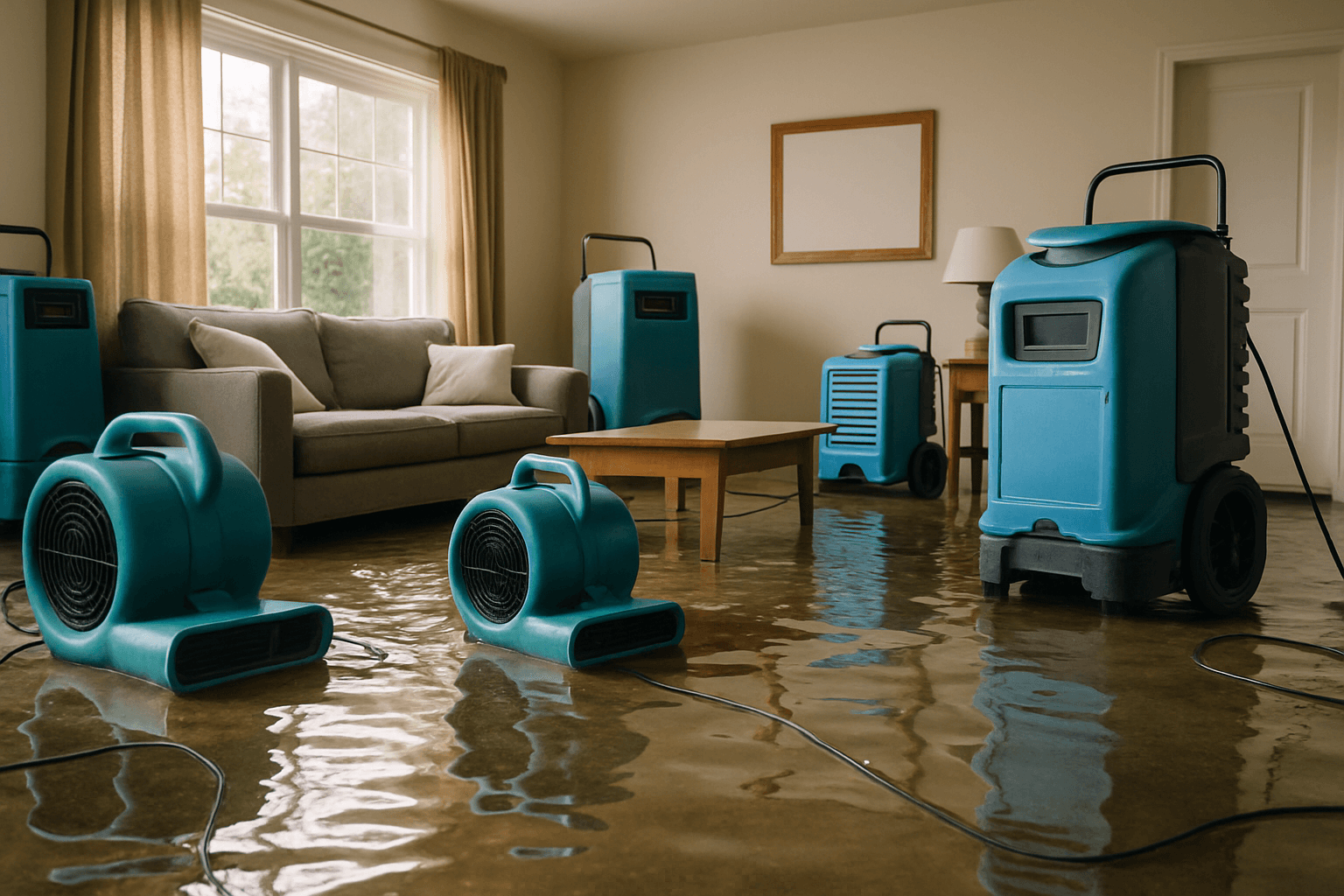
- Industrial air movers (LGR dehumidifiers + axial air movers): Create high-velocity airflow across surfaces to accelerate evaporation. Typically placed every 50–100 sq ft of affected area
- Low-grain refrigerant (LGR) dehumidifiers: Most effective for warm/humid conditions; remove 150–220 pints/day; maintain indoor RH below 40–50% to extract moisture from materials
- Desiccant dehumidifiers: For cold climates or areas where LGR units are less effective
- Air scrubbers (HEPA filtration): For Category 2/3 events — filter airborne contaminants, mold spores, and odors
Equipment quantity follows IICRC S500 formulas based on affected cubic footage, material types, and water category.
Step 4: Daily Monitoring (Days 1–5+)
A restoration technician visits daily to:
- Record moisture readings at all monitoring points
- Adjust air mover positions to address areas drying slower than expected
- Document temperature and RH readings (psychrometric tracking)
- Check for mold indicators (visual, odor)
- Determine whether materials can be preserved or need removal
Step 5: Structural Drying Completion and Clearance
Drying is complete when:
- Wood framing moisture content is ≤ 19% (IICRC standard)
- Drywall moisture content is ≤ 12–15%
- Flooring is within normal range for species/material
- Relative humidity in affected areas is ≤ 55%
- No elevated readings remain in any monitored area
Final documentation includes all moisture readings, equipment logs, and a clearance certificate — required by most insurance carriers to close a restoration claim.
How Long Does It Take to Dry a House?
Typical timelines under IICRC S500 Standard:
- Class 1 (minor): 2–3 days — limited wet area, materials with low evaporation (concrete, tile)
- Class 2 (significant): 3–5 days — significant carpet/pad saturation, wet drywall, subfloor involvement
- Class 3 (extensive): 5–10+ days — ceiling, walls, floors, insulation saturated; reconstruction often required
- Class 4 (specialty): 7–14+ days — wet hardwood, plaster, concrete block, or other specialty materials
Rushing the drying timeline is the most common mistake — and the most expensive, as it leads to secondary mold remediation.
How to Verify the Work Is Done Correctly
Ask your restoration company for:
- 1Daily drying logs with moisture readings, equipment runtime, and RH/temperature at each visit
- 2Final clearance documentation showing all monitoring points are below IICRC standards
- 3Psychrometric reports showing the drying goal was met
- 4Drying equipment manifests — what was placed, where, and for how long
If a restoration company cannot provide these documents, the work likely does not meet the standard your insurance carrier requires for claim approval.
Talk to a water damage pro now
Answered 24/7 · Toll-free · answered 24/7 · no obligation
(888) 840-6512- Describe the damage & give your ZIP
- You're routed to the on-call local crew
- They quote — you decide, no obligation
Reading to confirm what you already suspect?
Confirm it in two minutes instead — the pro on this line answers questions about YOUR situation all day: what it is, what it should cost, whether you even need service. If you want, they'll set the appointment on the same call.
Toll-free · no obligation · asking costs nothing
Frequently Asked Questions
- 1Extract all standing water with a truck-mounted extractor or wet/dry vacuum
- 2Remove saturated materials that cannot be dried -- carpet, padding, wet drywall below the flood line, insulation
- 3Set industrial air movers at 45-degree angles aimed at walls and floors
- 4Run LGR dehumidifiers (1 per 150 sq ft of wet area)
- 5Close windows and exterior doors to prevent humid outside air from entering
- 6Monitor with moisture meters daily -- target is 16% or below for drywall, 11-15% for wood
- 7Repeat until all materials reach target levels (typically 3-7 days).
How do you dry out a house after flooding?
Professional drying process in order:
How long does it take to dry out a flooded house?
Structural drying for a flooded house typically takes 3-5 days for Category 1 (clean water) with professional industrial equipment. Category 2-3 events or larger floods take 5-10 days.
The drying timeline is not negotiable -- trying to speed it up by removing equipment early is the most common cause of post-restoration mold. IICRC standards require daily moisture readings showing downward progress. Reconstruction cannot begin until all structural materials reach target moisture content.
Can I dry out my flooded house without professional help?
Small Category 1 events (single room, clean water, caught within hours) can sometimes be dried with rental equipment: a commercial 50-pint dehumidifier, two air movers, and a wet/dry vacuum.
For any Category 2-3 water, whole-floor flooding, drywall saturation, or events where water sat more than 24 hours, professional restoration is strongly recommended. The cost of failed DIY drying is almost always mold remediation ($3,000-$15,000) -- far more than the cost of professional drying upfront.
What happens if I don't fully dry my house after flooding?
Inadequate drying leads to mold growth within 24-48 hours under warm, humid conditions. Once mold colonizes wall cavities, subfloor, and framing, remediation requires cutting out and discarding all affected materials -- transforming a drying job into a full gut renovation.
Structural rot follows within weeks if moisture levels remain elevated. Building materials weakened by sustained moisture also develop long-term structural problems. The economic cost of incomplete drying is typically 3-5x the cost of doing it right initially.
Can I use fans and store-bought dehumidifiers to dry my house after flooding?
Consumer fans and dehumidifiers are insufficient for structural drying after significant flooding. The math: a typical 1,500 sq ft flooded floor area requires 8–12 commercial LGR dehumidifiers (each removing 150–250 pints/day) and 20–30 air movers creating 200+ CFM surface airflow. A store-bought dehumidifier removes 30–50 pints/day — you would need 30+ units running simultaneously for weeks, which exceeds both home electrical capacity and practical feasibility.
The real problem is wall cavities: wet insulation, drywall, and framing in wall cavities cannot be dried by surface fans — the air cannot penetrate the wall system. Professional equipment includes desiccant injection, injectidry systems for wall cavities, and floor drying mats that force conditioned air through subfloor assemblies. Consumer equipment also produces no moisture documentation — insurance adjusters require daily calibrated meter readings to accept a restoration claim. IICRC S500 specifies equipment minimums; consumer equipment does not meet these standards.
Who do I call right now for water damage?
Call (888) 840-6512. The line is answered 24 hours a day, seven days a week, and connects you with an IICRC-certified water damage restoration company that serves your area. Describe what you can see — where the water is coming from, how long it has been there, and whether it smells — the more specific you are, the faster the right company is on the line.
If the source is a pipe or an appliance, shut the main water valve first. Have four things ready and the call goes quickly: the address, when the water started, what is wet now, and whether you have filed an insurance claim.
Still not sure which of these is your situation? (888) 840-6512 · toll-free · answered 24/7
Sources
- IICRC S500 — Water Damage Restoration(retrieved 2026-07-02)
- EPA — Mold and Water Cleanup Guidance(retrieved 2026-07-02)
Methodology: How we source and verify data · Report an error
Disclaimer: HearthDry is an independent educational resource. This article is for informational purposes only and does not constitute professional, legal, or insurance advice. Consult licensed professionals before making decisions about your property or insurance claims.
Professional Equipment
Need Professional Drying Equipment?
The equipment used by IICRC-certified restoration pros — AlorAir, Santa Fe, and Dri-Eaz — is available to homeowners and contractors on Sylvane. Free shipping on orders over $45.
Affiliate link — HearthDry earns a commission from Sylvane via CJ at no extra cost to you
Video
Video: Detroit DWSD — US municipal government, public domain license
Watch: City Flood Response: Emergency Water Removal — 1 min 30 sec
Free 2-day shipping
Amazon Prime members pay no shipping on restoration equipment
Dehumidifiers, air movers, and moisture meters qualify for free Prime delivery — bulk items that otherwise cost $15–$40 to ship.
Affiliate link — HearthDry earns a bounty if you sign up; costs you nothing extra.
Equipment
What each machine actually does
Removes the moisture the structure is still giving off — the machine that decides how long drying takes
See the picks →Moves air across wet surfaces so the dehumidifier has something to take out of the air
See the picks →Finds water behind walls and under floors, and tells you when a material is actually dry
See the picks →Alerts you the moment a leak starts — the cheapest thing on this list and the only preventive one
See the picks →Those pages carry affiliate links. As an Amazon Associate, HearthDry earns from qualifying purchases; it costs you nothing extra.
Our Amazon storefront →Advertisement
