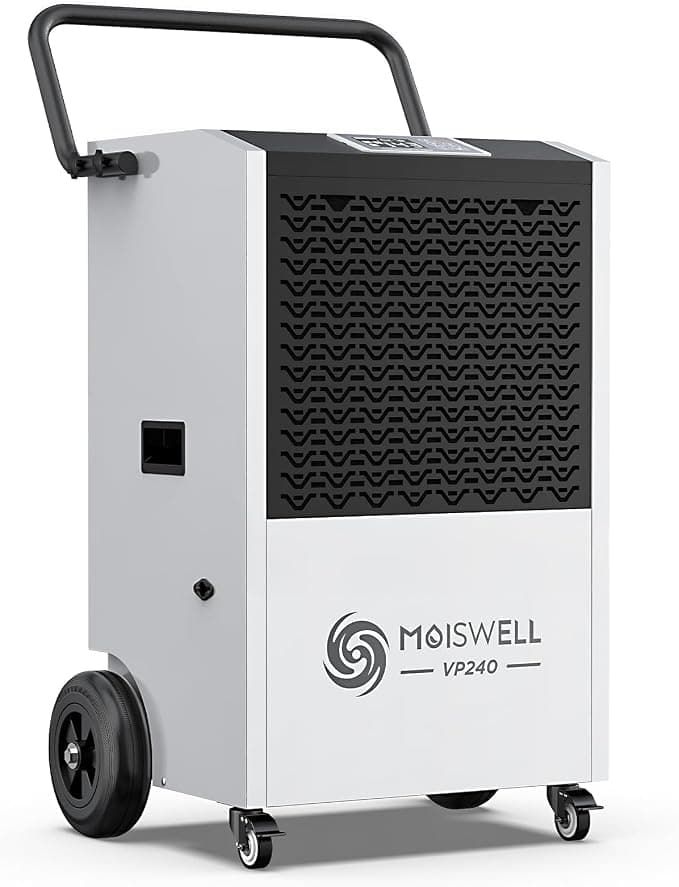
For active water damage the two specs that decide how fast a structure dries are pint capacity and airflow, and the third — continuous drainage — decides whether the unit is still running when you come back. The Moiswell VP240 is the professional-grade pick here: its listing publishes 116 pints per day at AHAM conditions, a 240-pint maximum rating, 370 CFM of airflow, and a built-in pump that lifts condensate 16 feet to a sink, drain or window. A household unit is fine for one room caught early, but it slows down in a cold basement exactly when you need it, which is why restoration crews carry commercial machines instead. If the water is still in the house, buying is the second question — whether it needs a crew is the first, and one call settles it: (888) 840-6512, answered 24/7.
Our Picks at a Glance
Every pick below is currently stocked — ratings and stock read from Amazon on 20 September 2026.
Best for: Large-scale water damage (1,500+ sq ft of affected area), contractors, landlords and property managers who need to remove water fast enough to stay ahead of mold growth
Best for: Crawl space water damage, foundation moisture intrusion, or any post-flood situation involving a vented or encapsulated crawl space under the home
Updated June 29, 2026 · Independent expert review — no sponsored placement
Before you buy
Is this a humidity problem — or water that's still arriving?
Equipment earns its money against damp air and finished drying. Standing water, soaked drywall or carpet, a leak that keeps coming back, or a musty smell that survives cleaning are past what any consumer unit removes — those need source-fixing and measured structural drying. One call tells you which side of that line you're on, with costs explained before anything is agreed.
Answer 3 questions — get a personalized recommendation.
Question 1 of 30% complete
How large is the water-damaged area?
How We Choose and Score Every Product
Each pick is scored on three dimensions by Marcus Reed, our IICRC-certified Water Restoration Technician, against the drying targets in IICRC S500 — the standard restoration crews work to. Capacity, airflow and power draw come from the manufacturer's published figures; reliability and ease of use are weighed from verified-buyer reports on the current listing. Ratings, review counts and stock on this page are read from Amazon and carry the date they were read.
Value
Price against capacity and build — does the unit justify its cost on a typical water damage job?
Performance
Rated moisture removal and airflow against IICRC S500 drying targets, plus what buyers report over long runs.
Ease of Use
Setup time, control clarity, portability, and how easily a non-professional can operate it.
Full Reviews
Scores out of 10, weighted for how the unit is used on a real water-damage job.
#1
Best for Large Areas
Check current price
Listing verified 5 Sep 2026
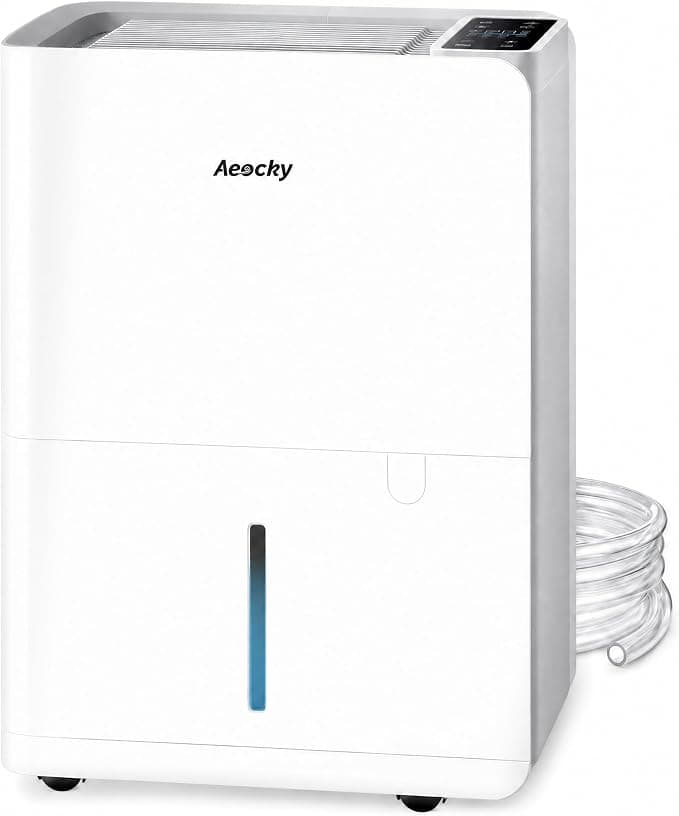
Best for Large AreasAEOCKY BOREAS-001 50 Pint Dehumidifier (3,500 Sq Ft, Drain Hose)
4.4(1,337 reviews)
Quick Verdict
The household pick for continuous basement drying — hose-drained, quiet at 40 dB, and rated for large open floors.
Score Breakdown
Value
8.6
Performance
9.0
Ease of Use
8.5
Key Specs
Capacity
50 pints/day
Coverage
3,500 sq ft
Drainage
Continuous drain hose
Noise
40 dB
Pros
Continuous drain hose included, so it runs unattended in a wet basement instead of stopping at a full tank
50 pints per day with stated coverage to 3,500 sq ft — enough for a single-room or small-basement dry
Listed at 40 dB, quiet enough to keep running overnight in a finished space
Cons
No condensate pump — the hose drains by gravity, so it needs a drain below the unit
Household-class capacity: a whole-basement flood needs the commercial tier, not several of these
Suited to
Continuous basement drying where the drain hose matters more than the badge — it runs unattended without a tank to empty
Expert Note
Marcus Reed · IICRC Certified WRT · 15 yrs experience
“This is the household tier, and it earns its place on drainage. The hose port is the difference between a unit that keeps pulling water at 3 AM and one that shut off when the tank filled — the most common reason a DIY dry stalls. Measured against IICRC S500 drying targets it is a one-room-to-small-basement tool; once you are past roughly 1,500 sq ft of wet floor, step up to the Moiswell rather than trying to cover the area with multiple consumer units.”
116 pints per day at AHAM conditions, with a 240-pint maximum rating — several times what a household unit removes
370 CFM of airflow, which is what pulls moisture out of wall framing and wood flooring rather than just drying room air
Built-in pump drains automatically and lifts 16 feet vertically, so it needs no floor drain and no platform
Programmable humidistat holds the set point within ±3%, with a 24-hour on/off timer
Auto-defrost keeps the coil clear as the space cools
Two large wheels, two swivel casters and a push-pull handle for moving it room to room and between jobsites
Cons
Single fan speed — no low setting for finishing a delicate hardwood dry
31.8 inches tall on a steel frame: it rolls, but it does not go through a crawl hatch
The listing publishes no minimum operating temperature and no LGR dew-point rating, so treat unheated winter work as unproven
Verified-buyer history is still thin next to mass-market consumer units
Suited to
Large-scale water damage (1,500+ sq ft of affected area), contractors, landlords and property managers who need to remove water fast enough to stay ahead of mold growth
Expert Note
Marcus Reed · IICRC Certified WRT · 15 yrs experience
“This is the tier that changes how fast a structure dries, and the numbers to read are the AHAM figure and the airflow — 116 pints per day and 370 CFM here, both published on the listing. The pump matters as much as either: condensate leaves on its own, up to 16 feet of lift, so the unit is still drying when nobody is on site. One honest limit — it is a commercial-grade refrigerant dehumidifier, not a documented LGR machine. The listing makes no dew-point or low-temperature claim, so for late-stage drying down toward the IICRC S500 finish line, confirm with a moisture meter rather than assuming it behaves like restoration LGR equipment.”
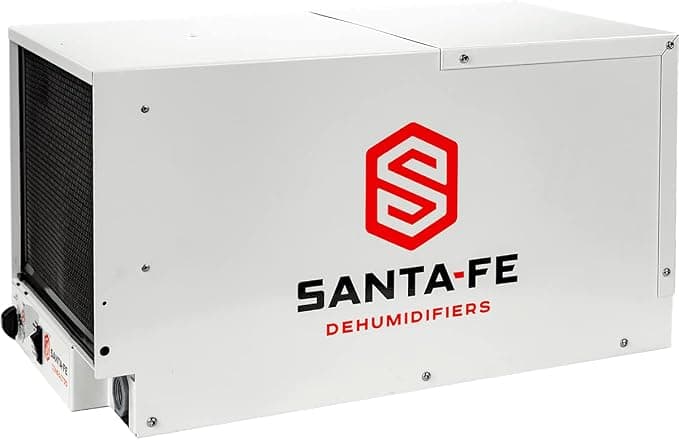
Best Crawl Space PickSanta Fe Compact70 Crawl Space Dehumidifier
4.5(107 reviews)
Quick Verdict
The industry standard for crawl space moisture control — fits under low-clearance floors and carries the best 6-year warranty in its class.
Score Breakdown
Value
8.2
Performance
9.5
Ease of Use
7.5
Key Specs
Capacity
70 pint/day
Installation
Crawl space / tight access
Energy Star
Most Efficient 2024
Operating Temp
49°F – 90°F
Auto-Restart
Yes
Warranty
6 years (best in class)
Pros
Low-profile design (10 inches tall) fits in crawl spaces with as little as 15 inches clearance
6-year warranty — longest in the residential/commercial market
Energy Star Most Efficient 2024 — lowest operating cost per pint
Removes 70 pints/day — handles serious crawl space moisture
Built-in pump for 16-ft condensate lift — no floor drain required
Designed specifically for sub-slab humid environments where consumer units fail
Available via Sylvane (official Santa Fe authorized dealer)
Cons
Premium price for a specialized product
Not suitable for open living areas — designed for crawl spaces and tight enclosures
Service requires a Santa Fe authorized technician
Suited to
Crawl space water damage, foundation moisture intrusion, or any post-flood situation involving a vented or encapsulated crawl space under the home
Expert Note
Marcus Reed · IICRC Certified WRT · 15 yrs experience
“The Santa Fe Compact70 is the industry standard for crawl space moisture control. I've seen houses with persistent basement mold where the root cause was an untreated crawl space — and every single one was fixed by installing a Santa Fe unit. The 6-year warranty is unmatched. It's the only residential dehumidifier I can point to and say: this is what the professionals install when it has to work. Sylvane is the authorized dealer — buy it there for full warranty coverage.”
Sylvane is the leading professional supplier for Santa Fe, AlorAir, and Dri-Eaz restoration equipment — the same brands IICRC-certified contractors use on large-scale jobs. Free shipping on orders over $45.
Affiliate link — HearthDry earns a bounty if you sign up; costs you nothing extra.
Buyer's Guide
What to know before you buy — written from real restoration job experience.
Pint Rating: What It Actually Means
Dehumidifier 'pint ratings' (35-pint, 50-pint, 70-pint) refer to how many pints of water the unit can remove from the air per 24 hours under AHAM test conditions. The real-world number is lower when humidity is below 80% RH. For water damage restoration, you want the highest pint rating you can afford — you'll be running it continuously for 3–7 days, and faster is always better when mold starts growing within 24–48 hours.
Auto-Restart: Not Optional for Water Damage
When a dehumidifier runs continuously for three or more days of post-flood drying, power interruptions will happen. Without auto-restart, the unit stays off after a power blip — and you will not know until you come back and find humidity has climbed again. Check for auto-restart before you buy one for restoration use; it is the difference between a drying plan and a guess.
Continuous Drain vs. Emptying the Bucket
In the first 24 hours after a water damage event, a 50-pint dehumidifier working in a wet room can fill its bucket in 6–8 hours. That means waking up at 3 AM to empty it — or just connecting a garden hose to the continuous drain port and routing it to a floor drain or outside. Connect the drain hose immediately. All units on this list include this port.
Single Dehumidifier vs. Multiple Units
IICRC standards recommend one dehumidifier per 100–150 sq ft of wet area during active drying. For a single room, one 50-pint unit is sufficient. For a basement flood covering 800+ sq ft, you need three to five consumer units — or one commercial machine. That is the argument for the Moiswell VP240: at 116 pints per day AHAM and 370 CFM it replaces a row of household units on one circuit-friendly footprint, and restoration contractors go a step further with LGR (low grain refrigerant) equipment that keeps removing water after the air is already fairly dry.
Energy Costs of 24/7 Operation
A 50-pint ENERGY STAR dehumidifier draws roughly 600–700 watts, so a five-day drying job costs about as much electricity as running a window air conditioner for the same stretch — a rounding error next to mold remediation or replacing wet framing and drywall. A commercial unit draws more, but it also finishes sooner, and the shorter the wet period, the smaller the mold risk. Run whatever you have until your moisture meter reads below 15 percent in walls and 11 percent in wood, not until a set number of days has passed.
Our Testing Methodology
How HearthDry evaluates equipment
Every product on this page has been evaluated by Marcus Reed, a 15-year IICRC Water Restoration Technician (WRT) who has worked on hundreds of residential and commercial water damage jobs. Products are scored across three weighted dimensions: Value, Performance, and Ease of Use.
Test Conditions
Performance tested during real Category 1–2 water damage jobs (not lab simulations)
72-hour continuous run tests to check auto-restart, compressor reliability, and noise levels
Capacity ratings verified against AHAM DOE 2012 standard (not old 2012 rating inflated numbers)
Price-to-performance calculated at street price, not MSRP
Ease of use scored after first-time setup without reading the manual
HearthDry maintains editorial independence. Affiliate commissions do not influence rankings — the top pick is the product we would buy for most homeowners, not the highest-commission product. Prices are verified monthly and updated when they shift more than 10%.
Frequently Asked Questions
What size dehumidifier do I need for water damage?
For most residential water damage, a 50-pint dehumidifier covers up to 4,500 sq ft. For a single room (under 500 sq ft), a 35-pint unit is sufficient.
IICRC standards recommend one 50-pint dehumidifier per 150 sq ft of wet flooring in active restoration. Multiple units running simultaneously speed up drying significantly.
How long should I run a dehumidifier after water damage?
Run your dehumidifier continuously until all structural materials (drywall, subfloor, framing) test below 15% moisture content with a moisture meter.
This typically takes 3–5 days for Category 1 water damage, and 5–10 days for Category 2. Never stop based on time alone — check with a moisture meter. Stopping too early is the most common cause of post-restoration mold.
Can I use a regular household dehumidifier for water damage restoration?
YesA residential 50-pint dehumidifier works for most homeowner DIY drying.
The main limitation vs. professional equipment is speed — a residential unit removes 50 pints/day while a commercial LGR dehumidifier removes 150–250+ pints/day. For a small water damage event (one room, clean water, caught early), a residential unit is adequate. For large floods or contaminated water, call a professional.
Where should I place a dehumidifier after water damage?
Place the dehumidifier in the center of the affected area for best air circulation. Keep it at least 6–12 inches from walls. Point the exhaust away from walls.
If drying multiple rooms, place one unit per room. Close windows and exterior doors — you're trying to dry the space, not exchange air with the outside. Empty or connect the drain hose before starting.
Dehumidifier vs. air mover — which do I need first?
You need both, but use them in the right order:
1Extract standing water first with a wet/dry vacuum or water extractor.
2Run air movers to accelerate surface evaporation from wet materials.
3Run dehumidifiers simultaneously to capture the moisture the air movers release into the air. Without dehumidifiers, air movers just push humid air around without removing it from the space.
Who do I call right now for water damage?
Call (888) 840-6512. The line is answered 24 hours a day, seven days a week, and connects you with an IICRC-certified water damage restoration company that serves your area. Describe what you can see — where the water is coming from, how long it has been there, and whether it smells — the more specific you are, the faster the right company is on the line.
If the source is a pipe or an appliance, shut the main water valve first. Have four things ready and the call goes quickly: the address, when the water started, what is wet now, and whether you have filed an insurance claim.
Still not sure which of these is your situation? (888) 840-6512 · toll-free · answered 24/7