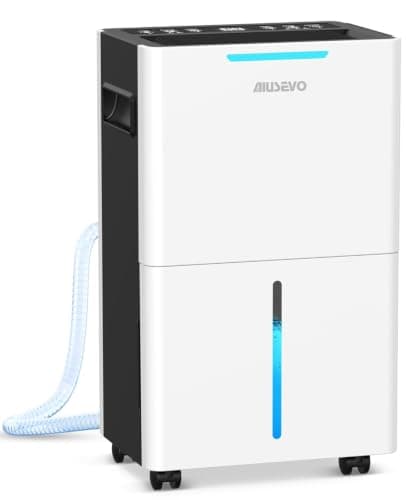
Best for: A travel trailer, fifth-wheel or motorhome lived in on shore power, with a shower that can take the drain hose
- Type:
- Compressor (refrigerant)
- Capacity (stated):
- 21 pints/day at 95°F, 90% RH
Listing verified 13 Oct 2026

Matched to Shore Power, Battery and Storage
5 picks compared · prices, ratings and stock checked October 11, 2026
Our Top Pick
For an RV lived in on shore power, the Aiusevo AS280: a real compressor that weighs 15.3 lb and comes with a drain hose, so it can stand in the shower and drain into it. On battery and inverter, the BREEZOME is the only listing here that states its draw, 48 watts.
4.3 on Amazon · 2,085 ratings
Quick answer
The best dehumidifier for a camper depends on the power you have: a compact compressor unit that drains into the shower on shore power, a low-watt thermoelectric unit on battery, and an absorber that needs no power in storage. The Aiusevo AS280 is the pick for most RVs, rated 4.3 stars across 2,085 Amazon ratings, removing up to 21 pints a day at 95°F and 90% RH at a weight of 15.3 lb. Compressor units lose capacity below about 65°F, so keep a cold camper heated while it runs, and turn on the roof fan whenever you cook or shower.
Available picks first — 4 of 5 in stock at our last check — ratings and stock read from Amazon on 11 October 2026.
Best for: A travel trailer, fifth-wheel or motorhome lived in on shore power, with a shower that can take the drain hose
Listing verified 13 Oct 2026
Best for: A van, pop-up or small trailer running off a battery bank and inverter, or a short stay on hookups
Listing verified 13 Oct 2026
Out of stock at our last check — the link still works if it returns.
Best for: Weekend campers on hookups who want a quiet unit that drains itself
Listing verified 11 Oct 2026
Best for: Wardrobes, overhead cabinets and under-bed storage, on trips or in storage
Listing verified 13 Oct 2026
Best for: A camper parked and closed up between trips or over winter
Listing verified 13 Oct 2026
How this page was made: we compare the current Amazon listings, the makers' published specs and what verified buyers report, then rank by fit for the job. Ratings, review counts and stock are read from Amazon and dated. We earn a commission on purchases through our links; it does not change the order. Reviewed by Marcus Reed, IICRC-certified Water Restoration Technician.
Full Reviews
Each pick in detail: what the listing states, what buyers report, and where it falls short.
Check price
on Amazon ↗
Listing verified 13 Oct 2026
See it on Amazon ↗Best Overall
Quick Verdict
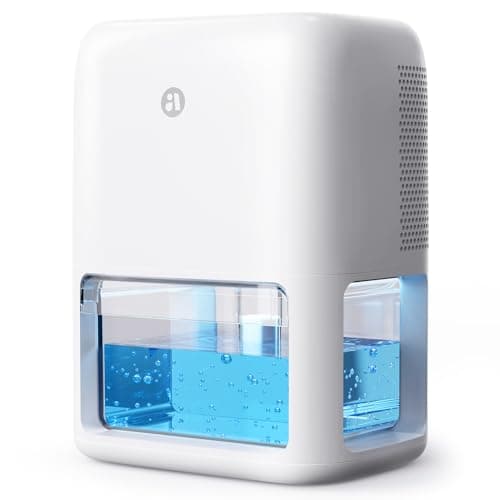
A compact compressor that drains into the shower, at 15.3 lb — wattage not stated, so check the plate before using an inverter.
Key Specs
Type
Compressor (refrigerant)
Capacity (stated)
21 pints/day at 95°F, 90% RH
Coverage (claimed)
Up to 1,600 sq ft
Modes
DEHU (30%–80% set point), DRY for wet clothes, CONT for non-stop running
Drainage
0.52 gal tank with auto shut-off, or continuous drain through the included hose (hose length not stated)
Size and weight (listing)
15.94 x 9.65 x 6.89 in; 15.3 lb
Pros
Cons
Suited to
A travel trailer, fifth-wheel or motorhome lived in on shore power, with a shower that can take the drain hose
Our take
Of the compressor units among the candidates, this is the one shaped for an RV. At 15.3 lb and under 16 in tall, it can stand in the shower stall with the hose dropped into the drain and run all week while the rig is plugged in, instead of stopping every time a half-gallon tank fills. A compressor removes pints a day rather than ounces, and on a camper's windows that difference shows by morning. Two gaps in the listing matter here: no wattage, which decides whether a campground pedestal or a small generator carries it alongside the air conditioner, and no output figure below 95°F. Read the plate, and expect less water on cold nights.
Affiliate link — commission at no extra cost to you
Compare elsewhere
These open a search for this model. We quote prices only where we can verify them — Amazon, Sylvane and eBay.
Check price
on Amazon ↗
Listing verified 13 Oct 2026
See it on Amazon ↗Best for Battery and Inverter
Quick Verdict
The one unit here that states its draw, 48 W — practical off-grid in short runs, small in capacity.
Key Specs
Type
Thermoelectric, with two semiconductor cooling modules; no compressor
Capacity (stated)
About 700 ml (roughly 24 oz) per day at 86°F and 80% RH
Power (stated)
48 W; 1.15 kWh over 24 hours of running
Tank
1.8 L (60 oz) with auto shut-off and a flashing red full light
Drainage
Tank only; the listing mentions no drain hose
Timer
12, 24, 36 or 48 hours
Pros
Cons
Suited to
A van, pop-up or small trailer running off a battery bank and inverter, or a short stay on hookups
Our take
Off-grid, the first number to know is watts, and this listing gives it: 48 W, with 1.15 kWh used over a full day. On a 12-volt bank that works out to roughly 4 amps while it runs and about 96 amp-hours over 24 hours, before inverter losses, which is a lot of battery for a small machine. So run it on the timer for a few hours after cooking or showering rather than around the clock. The trade is capacity: up to about 24 oz a day, quoted in warm, humid air. That keeps a small camper's windows clearer; it will not dry out a rig with four people living in it.
Affiliate link — commission at no extra cost to you
Compare elsewhere
Check price
on Amazon ↗
Listing verified 11 Oct 2026
See it on Amazon ↗Best Small Unit with a Drain Hose
Quick Verdict
A quiet small unit that drains itself into the shower — capacity and wattage not stated.
Key Specs
Type
Thermoelectric (dual-core semiconductor); no compressor
Capacity
Daily moisture removal not stated on the listing
Coverage (claimed)
Up to 1,000 sq ft
Drainage
98 oz tank with auto shut-off and a red full light, or continuous gravity drain through the included hose
Timer
8, 16 or 24 hours
Noise (claimed)
Below 30 dB in sleep mode
Pros
Cons
Suited to
Weekend campers on hookups who want a quiet unit that drains itself
Our take
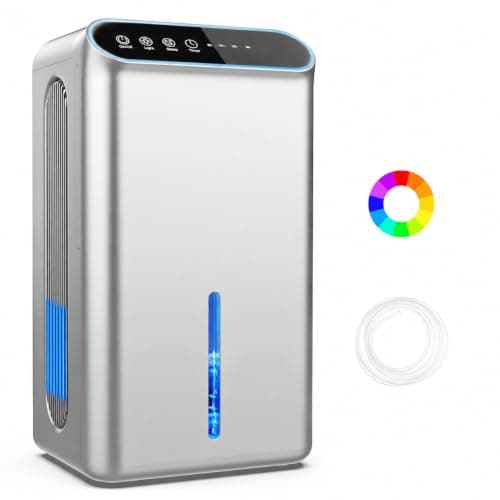
This one earns its place for the hose. A thermoelectric unit that has to be emptied by hand stops the moment its tank fills, often halfway through the night, while this one can sit in the shower stall and drain for the length of a trip. What the listing does not tell you is how much water it removes: it gives a tank size and a coverage claim but no daily figure, and a 1,000 sq ft claim on a 5.5 lb thermoelectric unit should not be read literally. Treat it as a small, quiet machine for a closed camper on hookups, and read the power draw off the plate before connecting it to a battery system.
Affiliate link — commission at no extra cost to you
Compare elsewhere
Check price
on Amazon ↗
Listing verified 13 Oct 2026
See it on Amazon ↗Best Cordless for Cabinets
Quick Verdict
A cordless, renewable absorber for cabinets and wardrobes — cabinet-sized capacity, nothing for the main cabin.
Key Specs
Type
Silica gel absorber; renewable, with no cord or batteries while in use
Absorbing capacity (stated)
Up to 6 oz before recharging
Coverage (stated)
Up to 333 cu ft
Recharge interval (stated)
About 20–30 days
Recharge method
Not described on the listing; follow the instructions
Size and weight (listing)
6.25 x 4.75 x 1.25 in; 1.45 lb
Pros
Cons
Suited to
Wardrobes, overhead cabinets and under-bed storage, on trips or in storage
Our take
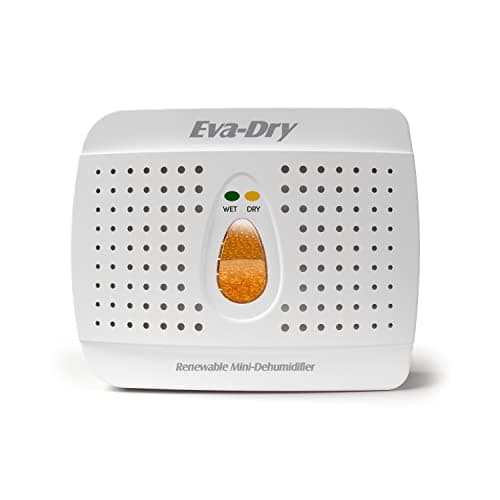
Cabinets and wardrobes on an RV's outside wall are cold, closed and still, so moisture condenses there and the musty smell usually starts there too. A room dehumidifier in the main cabin barely reaches inside a closed cabinet, which is the job this unit is made for: silica gel in a slim case, holding up to 6 oz of water before it needs renewing, sized for 333 cubic feet. Because it needs no outlet while it works, it keeps going when the rig sits unplugged. Buy one per problem space rather than one for the whole camper, and recharge them all before the RV is closed up for the season.
Affiliate link — commission at no extra cost to you
Compare elsewhere
Check price
on Amazon ↗
Listing verified 13 Oct 2026
See it on Amazon ↗Quick Verdict
A no-power bucket for a parked camper — replace it when the beads turn to gel, and secure it before driving.
Key Specs
Type
Disposable moisture-absorbing beads in a bucket
Fill (stated)
5 lb bucket
Absorption (claimed)
Up to 3 times its weight in moisture
Scent
Fragrance-free beads
Replacement
Replace when the contents turn gel-like
Power
None needed
Pros
Cons
Suited to
A camper parked and closed up between trips or over winter
Our take
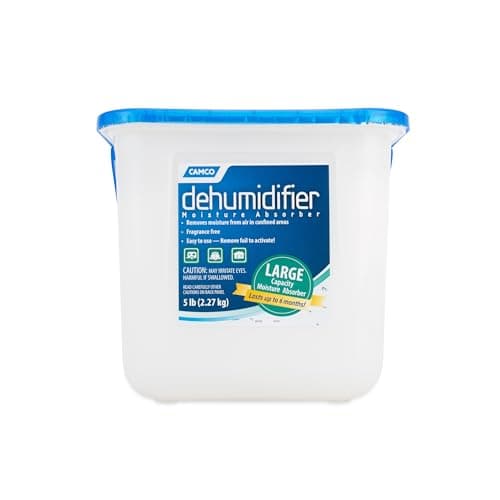
A closed, unplugged RV is close to ideal conditions for mold: the shell warms by day and cools at night, moisture condenses on the cold side, and nothing moves the air. A bucket absorber is the low-effort answer for those weeks because it needs no power, no hose and no attention beyond a look when you visit. The listing gives a 5 lb fill and claims it absorbs up to three times its weight, but no daily rate, so judge it by the contents and replace it once they turn gel-like. Pair it with an Eva-Dry in the cabinets, and check the floor beneath it when storage ends.
Affiliate link — commission at no extra cost to you
Compare elsewhere
What to know before you buy.
An RV packs a household's moisture into a few hundred square feet. Cooking puts steam into the air, and a propane burner adds more, because water vapor is one of the products of burning propane. A hot shower in a small bathroom does the same, and two people breathing in a closed rig overnight add more again. That moist air meets single-pane windows, thin walls and metal framing that sit close to the outdoor temperature, and it condenses: streaming windows in the morning, damp walls behind cushions, and musty cabinets along the outside wall. The EPA's advice for homes applies here too: keep indoor humidity below 60%, ideally between 30% and 50%, and vent moisture outdoors at its source. In a camper, that means the roof fan or range hood on every time you cook or shower, before any dehumidifier.
How the camper is powered decides the type of machine before anything else. On shore power, a compact compressor unit removes water by the pint rather than the ounce, and it is the right tool for anyone living aboard. On a battery bank and inverter, watts decide what you can run: the BREEZOME's listing states 48 W, while neither the Aiusevo nor the boglvr gives a figure, so read the rating plate before connecting either one to an inverter or a small generator. Thermoelectric units draw little but remove ounces a day. With no power at all, as in a parked rig with the batteries disconnected, only an absorber works: renewable silica gel like the Eva-Dry, or a bucket of absorbing beads like the Camco. Many owners end up with both kinds, an electric unit for trips and absorbers for storage.
A compressor dehumidifier works by chilling a coil below the dew point of the air passing over it, and the cooler the air, the harder that gets. Below about 65°F, the temperature the federal efficiency test now uses, output falls and frost starts to form on the coil; units with auto defrost, like the Aiusevo, pause drying while they melt it off. In a camper on a cool night, that means less water collected just when the windows are sweating most. Keeping the interior heated helps on both counts: the dehumidifier holds on to its capacity, and warmer walls and glass condense less of the moisture in the air. Thermoelectric units slow down in cool air as well. Absorbers keep working in the cold, if slowly, which is why they suit a camper closed up through fall and winter.
A small tank is the weak point of any camper dehumidifier, because a full tank stops the machine. The Aiusevo and boglvr both include drain hoses, and the simplest setup is to stand the unit in the shower stall or tub with the hose in the drain. That water ends up in the gray tank, so keep an eye on its level during a long stay and empty it along with the rest of your gray water. Keep the hose short and sloping downhill with no loops, since both are gravity drains. Where there is no shower to use, a unit on the counter can drain into the galley sink instead. The BREEZOME lists no hose outlet, so its 60 oz tank must be emptied by hand, which is manageable for a few hours on battery but not for a week on hookups.
A dehumidifier is a loose object in a moving vehicle, and a partly full tank is a spill waiting for the first turn. Before you pull out, switch the unit off, unplug it, empty and dry the tank, then secure the machine: strapped in place, or wedged on the floor of the shower stall where a fall does no harm. Coil the drain hose so it cannot drip onto the floor. Lift the Eva-Dry off its hook and lay it in a drawer, and stand any absorber holding collected liquid upright in the sink or tub, so a spill runs down the drain instead of soaking the carpet. Treat the Camco bucket the same way, since nothing on its listing says the liquid is sealed in. Set everything back up once you are parked and level.
A stored RV is closed, unheated and often unplugged, so moisture builds with nothing moving the air. Leave a dehumidifier running unattended only if it has shore power and a hose to a drain; a tank unit stops when it fills, and nobody is there to empty it. For most owners, storage is a job for absorbers: a bucket like the Camco on the floor of the main cabin and an Eva-Dry in the wardrobe or whichever cabinet smells first. Take out damp towels, bedding and everything in the fridge, prop the refrigerator door open, and leave cabinet doors ajar so air can reach the corners. Visit monthly if you can, check the absorbers, and look for water stains around roof vents and windows, where a slow leak often shows first.
A compressor unit sized for a small space, run on hookups and drained continuously. Living aboard means cooking, showering and sleeping inside every day, which produces more moisture than a thermoelectric unit can remove.
The Aiusevo AS280 weighs 15.3 lb, includes a drain hose and can stand in the shower draining to the gray tank. Pair it with the roof fan while cooking and showering, and an absorber in the wardrobe.
Only partly. Pop-up and tent-trailer canvas lets air through, so a dehumidifier is drying a space that keeps refilling from outside.
A small unit such as the BREEZOME can cut overnight condensation on hookups with the camper zipped shut. The bigger mildew risk is folding the camper away with damp canvas, so open it up at home and let it dry fully after a wet trip.
YesIf you know its draw and budget the battery for it.
The BREEZOME is listed at 48 W, roughly 4 amps from a 12-volt bank while it runs, plus whatever the inverter itself uses. A few hours after cooking and showering is realistic for most battery banks; running it day and night is not. The Aiusevo and boglvr listings give no wattage, so read the plate on the unit.
Two picks on this page include one. The Aiusevo AS280 is a compressor unit for a rig you live in on hookups; the boglvr is a smaller, quieter thermoelectric unit for weekend trips.
Either works from the shower floor with its hose in the drain. Keep the hose short with no loops, because neither has a pump, and watch the gray tank level on long stays.
It dependsOn the space. For a whole camper in storage, a large bucket absorber such as the Camco 44282 needs no power, can sit unattended for months and is simply thrown away once spent.
For a wardrobe or cabinet, the Eva-Dry E-333 is renewable rather than disposable and holds up to 6 oz before recharging. Neither one dries the air while people are living aboard.
Cut the moisture at its source and keep the glass warmer. Run the roof fan or range hood whenever you cook or shower, crack a window on the far side for cross-flow, and keep the camper heated on cold nights.
Then run a dehumidifier set to 50% or a little below. Wipe the glass and sills each morning, because water left sitting on the frames is where mold on window seals starts.
Call (888) 840-6512. The line is answered 24 hours a day, seven days a week, and connects you with an IICRC-certified water damage restoration company that serves your area. A recorded menu picks up first: choose water damage or mold, key in your 5-digit ZIP code, and hold through the short silence while the call is passed to the company.
Describe what you can see — where the water is coming from, how long it has been there, and whether it smells — the more specific you are, the faster the right company is on the line. If the source is a pipe or an appliance, shut the main water valve first. Have four things ready and the call goes quickly: the address, when the water started, what is wet now, and whether you have filed an insurance claim.
Still not sure which of these is your situation? (888) 840-6512 · toll-free · answered 24/7
Methodology: How we source and verify data · Report an error
Free 2-day shipping
Amazon Prime members pay no shipping on restoration equipment
Dehumidifiers, air movers, and moisture meters qualify for free Prime delivery — bulk items that otherwise cost $15–$40 to ship.
Affiliate link — HearthDry earns a bounty if you sign up; costs you nothing extra.

An exhaust fan ducted outdoors is the real fix for a steamy bathroom, and a plug-in dehumidifier is what you add when there is no fan or the one you have barely pulls. The units small enough for a bathroom remove ounces of water a day, so their job is drying the walls, ceiling and grout sooner after the steam clears, not clearing the steam.
Read the comparisonA bedroom dehumidifier has to be quiet enough to sleep beside, and five of the six picks here are thermoelectric units that remove ounces of water a day rather than pints. That is enough for a stuffy bedroom, closet or studio apartment; for a room with wet windows every morning, the sixth pick is a small compressor unit rated in pints.
Read the comparisonA garage is the hardest space in a house to dehumidify: it runs cold, it leaks air and it rarely has a drain. These four picks are judged on the specifications that decide whether a unit keeps working there, from a capacity stated at cool conditions and auto defrost to a desiccant option for winter and a hose that reaches a drain.
Read the comparisonA dehumidifier stops mold by taking away the damp it needs, and the musty smell usually leaves with the damp. It does not kill mold that is already growing, so these picks are judged on the job they can do: holding a basement, a room or a closet below 50% humidity, day after day.
Read the comparisonA compressor dehumidifier starts frosting its coils below about 65°F, which is where an unheated garage, crawl space or boat cabin sits for half the year. These picks are rotary desiccant units compared on the temperature and humidity behind each pint figure, the watts the heater draws, how fast the tank fills, and the one rechargeable silica gel bag that belongs in a car or safe instead.
Read the comparison