The Moiswell VP240 is the best commercial dehumidifier you can actually buy on Amazon, with the Kesnos 155 as the smaller pumped alternative and the Waykar 150 for a rental left sitting on a floor drain. Read the capacity rating before you compare anything: 240, 155 and 150 pints a day are all measured at 95°F and 90% relative humidity, and the only AHAM figure published across the three is the Moiswell's 116 pints a day. None of them is an LGR machine — that class is sold through restoration distributors and rented by the day, not stocked on Amazon. If the water is still in the house, buying is the second question — whether it needs a crew is the first, and one call settles it: (888) 840-6512, answered 24/7.
Our Picks at a Glance
Every pick below is currently stocked — ratings and stock read from Amazon on 20 September 2026.
All picks compared at a glance
Pick
Product
Rating
Best Overall
Moiswell VP240 240 Pint/Day Commercial Dehumidifier with Pump
Best for: Large wet spaces where the machine has to run unattended and drain itself — big basements, warehouses, gyms, indoor pool rooms and construction drying
Best for: Landlords and property managers leaving a high-capacity machine in place in a rental with a floor drain, where nobody needs to move it and a tenant may be in the room
Updated September 20, 2026 · Independent expert review — no sponsored placement
Before you buy
Is this a humidity problem — or water that's still arriving?
Equipment earns its money against damp air and finished drying. Standing water, soaked drywall or carpet, a leak that keeps coming back, or a musty smell that survives cleaning are past what any consumer unit removes — those need source-fixing and measured structural drying. One call tells you which side of that line you're on, with costs explained before anything is agreed.
Answer 3 questions — get a personalized recommendation.
Question 1 of 30% complete
What scale is the water damage job?
How We Choose and Score Every Product
Each pick is scored on three dimensions by Marcus Reed, our IICRC-certified Water Restoration Technician, against the drying targets in IICRC S500 — the standard restoration crews work to. Capacity, airflow and power draw come from the manufacturer's published figures; reliability and ease of use are weighed from verified-buyer reports on the current listing. Ratings, review counts and stock on this page are read from Amazon and carry the date they were read.
Value
Price against capacity and build — does the unit justify its cost on a typical water damage job?
Performance
Rated moisture removal and airflow against IICRC S500 drying targets, plus what buyers report over long runs.
Ease of Use
Setup time, control clarity, portability, and how easily a non-professional can operate it.
Full Reviews
Scores out of 10, weighted for how the unit is used on a real water-damage job.
#1
Best Overall
Check current price
Listing verified 20 Sep 2026
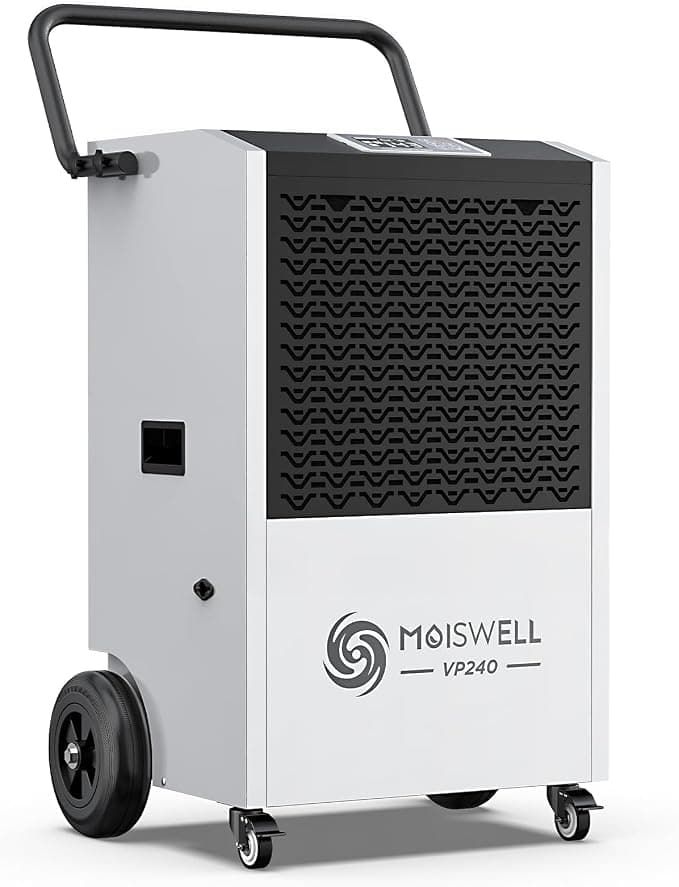
Best OverallMoiswell VP240 240 Pint/Day Commercial Dehumidifier with Pump
4.5(112 reviews)
Quick Verdict
The biggest mover here and the only one with a published AHAM rating — 370 CFM and a 16 ft pump lift make it the one to leave running unattended.
Score Breakdown
Value
8.4
Performance
9.2
Ease of Use
8.0
Key Specs
Capacity
240 pints/day; 116 pints/day at AHAM
Airflow
370 CFM
Coverage
Up to 8,500 sq ft (manufacturer claim)
Drainage
Built-in pump, 16 ft lift or run
Controls
24-hour timer, auto defrost, humidistat to ±3%
Dimensions
18.6 x 15.3 x 31.8 in
Pros
The only listing of the three that publishes an AHAM figure — 116 pints/day — next to its 240 pint headline number
370 CFM airflow, the highest of the three machines here
Built-in pump drives condensate about 16 feet vertically or horizontally, so the unit sits on the floor you are drying
Programmable humidistat holds a set point to within ±3%, with a 24-hour auto on/off timer and auto defrost
Two large wheels, two swivel casters and a push-pull handle for moving it room to room
Alloy steel housing rather than molded plastic
Cons
A refrigerant machine, not an LGR — the last stage of drying a structure goes slower than it would on rented restoration equipment
Single fan speed, so there is no quieter setting for an occupied room
The largest of the three at 18.6 x 15.3 x 31.8 in — work out the stairwell before it arrives
Suited to
Large wet spaces where the machine has to run unattended and drain itself — big basements, warehouses, gyms, indoor pool rooms and construction drying
Expert Note
Marcus Reed · IICRC Certified WRT · 15 yrs experience
“This is the closest thing on Amazon to the machine a contractor would wheel in: high airflow, a real pump, a humidistat you can set and leave, and casters that survive a jobsite. Take the two capacity numbers seriously, because they are the honest part of the listing — 240 pints a day is what it does in hot saturated air, and 116 pints a day at AHAM is what it does in conditions closer to a house. Buy it for the pump as much as the capacity: on a flooded floor, a unit that empties itself keeps working overnight, and a unit with a tank does not.”
These open a search for this model. We quote prices only where we can verify them — Amazon, Sylvane and eBay.
#2
Best Midrange
Check current price
Listing verified 20 Sep 2026
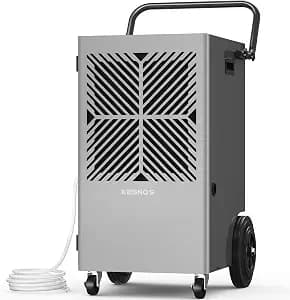
Best MidrangeKesnos 155 Pint/Day Commercial Dehumidifier with Pump, 7,500 Sq Ft
4.4(107 reviews)
Quick Verdict
A pumped commercial unit a size down from the Moiswell — both drain hoses in the box, a 10% RH floor, and it restarts itself after a power cut.
Score Breakdown
Value
8.6
Performance
8.6
Ease of Use
8.4
Key Specs
Capacity
155 pints/day at 95°F, 90% RH
Coverage
Up to 7,500 sq ft
Drainage
Built-in pump with 16.4 ft hose; 6.56 ft gravity hose also included
Humidity Range
10–90% RH
Weight
80.7 lbs
Warranty
2 years
Pros
Built-in pump with a 16.4 ft hose in the box, and it will lift water the full height of that hose
Ships a 6.56 ft gravity hose as well, so you can skip the pump where there is a floor drain
Humidity set point goes down to 10% RH — a wider band than most large portables offer
Auto-restart and power-outage memory: after a tripped breaker it resumes its settings rather than sitting idle
Large semi-pneumatic wheels and a stowable handle for rough or littered floors
Two-year warranty, washable filter, corrosion-resistant build and overload protection
Cons
155 pints a day is the figure at 95°F and 90% RH; the listing publishes no AHAM rating, so it cannot be set against the Moiswell's 116
Single fan speed — it runs flat out or not at all
At 80.7 lbs it is a two-person carry up a flight of stairs
Also a refrigerant unit, not an LGR
Suited to
Property managers and DIYers drying a large basement or a commercial unit who want automatic drainage without the Moiswell's footprint
Expert Note
Marcus Reed · IICRC Certified WRT · 15 yrs experience
“Think of this as the Moiswell's smaller sibling: less airflow and less capacity, but the same thing that matters most on a wet floor — it empties itself, and it comes with both the pump hose and a gravity hose so you can use whichever the building allows. The power-outage memory is worth more than it sounds. Drying jobs fail quietly when a breaker trips at two in the morning and the machine never restarts, and this one comes back on its own.”
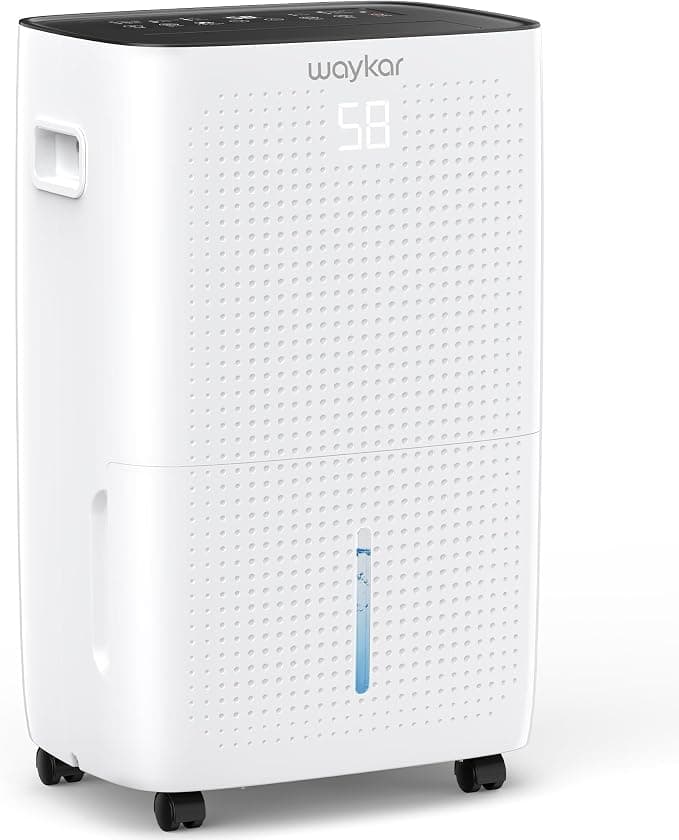
Best for Rental PropertiesWaykar 150 Pint/Day Dehumidifier, 7,000 Sq Ft, with Drain Hose
4.3(22,507 reviews)
Quick Verdict
The one to leave in a rental — gravity drain onto a standard garden hose, two fan speeds, a control lock, and small enough for one person to carry.
Score Breakdown
Value
8.8
Performance
8.2
Ease of Use
9.0
Key Specs
Capacity
150 pints/day at 95°F, 90% RH
Coverage
Up to 7,000 sq ft
Drainage
Gravity hose (3.3 ft) or 2.11 gallon tank
Humidity Range
30–80% RH
Fan Speeds
2, with control lock
Dimensions
10.83 x 14.96 x 24.29 in
Pros
Two fan speeds and a control lock — the only unit here you can turn down in a room somebody is living in, then lock so nobody changes it
90° auto swing spreads the dry air across the room instead of aiming it at one wall
Set point goes to 30% RH, below the 40% floor common on household units
Continuous, Dry and Fan modes, plus a 24-hour timer, auto defrost and overload protection
Drains continuously through the included 3.3 ft hose, and the outlet takes a standard 3/4 in garden hose; otherwise the 2.11 gallon tank has a visible level window
Smallest of the three at 10.83 x 14.96 x 24.29 in — one person can get it down a tight stairwell
Cons
No pump. It needs a drain below the machine, or somebody in the building to empty the tank
150 pints a day is the 95°F, 90% RH number, not an AHAM rating, and a cool basement is nothing like that condition
One-year warranty as shipped — the extension to two years has to be registered
Suited to
Landlords and property managers leaving a high-capacity machine in place in a rental with a floor drain, where nobody needs to move it and a tenant may be in the room
Expert Note
Marcus Reed · IICRC Certified WRT · 15 yrs experience
“This is the one you leave behind rather than the one you bring to a loss. It has no pump, so it belongs next to a floor drain or a standpipe where gravity does the work — and the outlet takes a plain garden hose, which makes that easy to arrange. What earns it the slot is that it is livable: two fan speeds, a control lock so a tenant cannot quietly switch it off, and a body small enough for one person to carry. For a chronically damp rental basement, that beats capacity you cannot site.”
Affiliate link — HearthDry earns a bounty if you sign up; costs you nothing extra.
Buyer's Guide
What to know before you buy — written from real restoration job experience.
What Amazon Stocks vs. What a Restoration Crew Rents
The machines on this page are high-capacity refrigerant dehumidifiers on jobsite wheels, and two of the three pump their own condensate. They are not LGR units, and this page will not call them that. LGR — low grain refrigerant — is a different class, built to keep pulling water after the room air is already dry, which is exactly the stage where the framing and the subfloor are still giving moisture up. That class is Dri-Eaz, AlorAir's Storm series and Phoenix, and it is sold through restoration distributors such as Sylvane, Aramsco and Jon-Don, or rented by the day from equipment rental houses and local restoration contractors. Amazon does not carry it dependably — listings surface and vanish, and warranty service runs through the distributor network rather than the marketplace. If you are drying a contaminated loss or documenting a claim, rent the LGR. If you own the building and want a machine on site before the next storm, buy from this page.
Read Which Rating You Are Comparing
240, 155 and 150 pints a day are not measured the way the 50-pint figure on a household unit is. Each of these listings states its number at 95°F and 90% relative humidity — hot, saturated air, the easiest condition a dehumidifier will ever meet. The AHAM rating is taken in cooler, drier air and lands far lower. The Moiswell listing publishes both: 240 pints at the headline condition, 116 pints at AHAM, a gap of better than two to one. The Kesnos and Waykar listings publish only the saturated figure. So a 155-pint saturated rating and a 116-pint AHAM rating are not 39 pints apart — they are results from two different tests, and setting them side by side flatters the one that never faced the harder condition. An October basement is far closer to the AHAM condition than to the headline one.
Pump or Gravity Drain
A high-capacity machine fills a tank fast, and nobody gets up every few hours overnight to empty one. The Moiswell and the Kesnos both have a built-in pump: the Moiswell drives water roughly 16 feet vertically or horizontally, the Kesnos up to 16.4 feet through the hose supplied. Either can sit on the floor you are drying and push water into a sink, a standpipe or out of a window. The Kesnos also ships a 6.56 ft hose for gravity drainage if you would rather not run the pump at all. The Waykar has no pump — it drains by gravity through a 3.3 ft hose or into a 2.11 gallon tank, so it needs a drain lower than the machine, or a person in the building. Settle this before you compare capacity. An unpumped unit that stops when its tank fills removes nothing for the rest of the night, and 150 rated pints beats 240 rated pints every time the bigger machine is switched off.
Sizing, Coverage Claims and Moving the Machine
The square-foot numbers on these listings — 8,500, 7,500, 7,000 — describe holding humidity down in an open space, not drying a flooded structure. Size restoration work by the wet area and how much material is holding water, and always run air movers alongside: a dehumidifier dries the air, and it is the moving air that pulls water out of walls and subfloor for the dehumidifier to catch. Plan the route as well as the capacity. The Moiswell stands 31.8 inches tall on an 18.6 by 15.3 inch footprint, the Kesnos weighs 80.7 pounds, and only the Waykar, at 10.83 by 14.96 by 24.29 inches, is something one person takes down a narrow stairwell without help. Wheels and casters are for flat floors; stairs are a two-person job on both pumped machines.
The professional tier
Dri-Eaz LGR 130 Dehumidifier
A true LGR machine, which none of the picks above is. Low-grain refrigerant units keep pulling water at low humidity, which is the last and slowest part of a structural dry, and they are built to run on a job site for weeks. Restoration distributors sell them; Amazon does not.
Affiliate link — Sylvane sells to contractors and homeowners alike.
Our Testing Methodology
How HearthDry evaluates equipment
Every product on this page has been evaluated by Marcus Reed, a 15-year IICRC Water Restoration Technician (WRT) who has worked on hundreds of residential and commercial water damage jobs. Products are scored across three weighted dimensions: Value, Performance, and Ease of Use.
Test Conditions
Performance tested during real Category 1–2 water damage jobs (not lab simulations)
72-hour continuous run tests to check auto-restart, compressor reliability, and noise levels
Capacity ratings verified against AHAM DOE 2012 standard (not old 2012 rating inflated numbers)
Price-to-performance calculated at street price, not MSRP
Ease of use scored after first-time setup without reading the manual
HearthDry maintains editorial independence. Affiliate commissions do not influence rankings — the top pick is the product we would buy for most homeowners, not the highest-commission product. Prices are verified monthly and updated when they shift more than 10%.
Frequently Asked Questions
How many pints per day do I need for a flooded basement?
For a 1,000–2,000 sq ft basement, start at a machine rated 150 pints a day or better — but read which rating you are buying. The 150 and 155 pint figures here are measured at 95°F and 90% relative humidity, and a cool basement will return a fraction of that; the Moiswell's 116 pints at AHAM is the more realistic kind of number.
Undersizing is the most common DIY mistake, and so is running the dehumidifier on its own. The air dries within hours while the framing and the subfloor keep releasing moisture for days, which is why professionals pair every dehumidifier with air movers aimed at the wet materials.
What is the difference between LGR, standard refrigerant and desiccant dehumidifiers?
Standard refrigerant units — including all three on this page — pull moisture well at 50–80% relative humidity and lose efficiency as the air dries below about 40% RH. LGR (low grain refrigerant) units pre-cool the incoming air before it reaches the coil, so they keep extracting down into the low range where the structure is still drying out.
Desiccant units use a moisture-absorbing wheel with heat regeneration and keep working at temperatures where a refrigerant compressor frosts up, which is why they turn up in cold-weather construction drying and cold storage. The practical difference that decides your purchase is where each is sold: refrigerant machines are ordinary retail, while LGR and desiccant equipment comes from restoration distributors and rental houses.
Can I run a commercial dehumidifier in a finished basement?
YesAll three are indoor machines and none of them needs a vent. Two things decide how well it goes. First, noise: the Moiswell and the Kesnos each have a single fan speed, so they run at full output or not at all, while the Waykar has two speeds and a control lock, which makes it the easier one to live with in an occupied room.
Second, drainage: work out where the water goes before you position the unit, because the pumped machines can stand anywhere and push water to a sink or a window, while the Waykar has to sit above its drain. Put the machine centrally, keep doors to the wet area closed, and run air movers along the walls alongside it.
How do I know when drying is complete?
Drying is finished when moisture-meter readings in the structure hold below IICRC thresholds for 24 consecutive hours — roughly under 15% WME in drywall, under 12% in wood framing and under 14% in subfloor.
Use a pin-type meter rather than a pinless scanner for the confirming reading, and take it in the same spots each time so the numbers are comparable. Dry-feeling air is not the same as a dry building: the air in a room reaches target humidity long before the materials do, which is why the meter decides and the thermostat does not.
Where do I buy or rent a commercial dehumidifier?
The three machines on this page are stocked on Amazon and ship to a home address, which is the fastest route if you need one in the building this week. True LGR restoration units — Dri-Eaz, the AlorAir Storm series, Phoenix — are not reliably sold there.
They come from restoration distributors such as Sylvane, Aramsco and Jon-Don, from equipment rental centers, and from local restoration contractors, many of whom rent gear out between jobs. For a single flood, renting LGR equipment for a few days usually makes more sense than buying it. For a building with a recurring moisture problem, owning a high-capacity unit that is already on site when water arrives is the better trade.
Who do I call right now for water damage?
Call (888) 840-6512. The line is answered 24 hours a day, seven days a week, and connects you with an IICRC-certified water damage restoration company that serves your area. Describe what you can see — where the water is coming from, how long it has been there, and whether it smells — the more specific you are, the faster the right company is on the line.
If the source is a pipe or an appliance, shut the main water valve first. Have four things ready and the call goes quickly: the address, when the water started, what is wet now, and whether you have filed an insurance claim.
Still not sure which of these is your situation? (888) 840-6512 · toll-free · answered 24/7