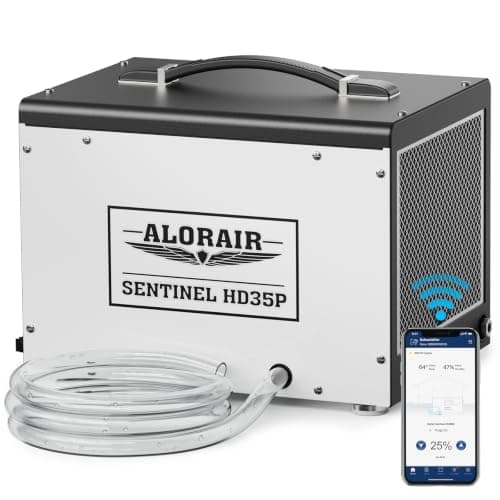
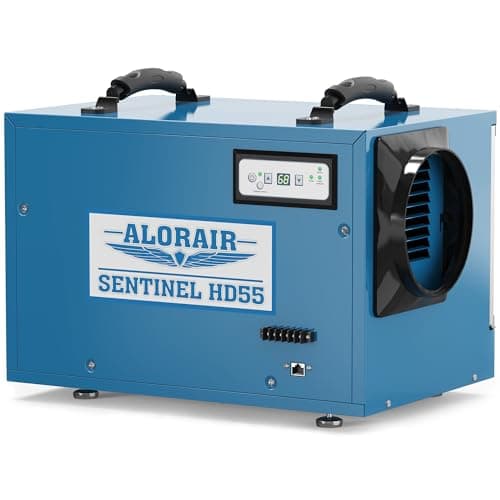
Best for: A sealed or encapsulated crawl space with a floor drain, sump pit or downhill drain route
- Capacity (stated):
- 53 pints/day at AHAM; 113 pints/day at saturation
- Coverage (claimed):
- Up to 1,200 sq ft
Listing verified 5 Nov 2026

Sentinel and Storm Models Compared for Crawl Spaces, Basements and Drying After a Leak
5 picks compared · prices, ratings and stock checked October 12, 2026
Our Top Pick
For most crawl spaces with a drain, the ALORAIR Sentinel HD55: 53 pints a day at AHAM conditions, a metal case, auto defrost and continuous drainage with no tank. Where the water has to go uphill, the ALORAIR 120 PPD ENERGY STAR Crawl Space Dehumidifier with Pump.
4.2 on Amazon · 1,223 ratings
Quick answer
For a sealed crawl space with a floor drain or a downhill drain route, buy the ALORAIR Sentinel HD55, rated 4.2 stars across 1,223 Amazon ratings: 53 pints a day at AHAM conditions (80°F, 60% RH), rated coverage up to 1,200 sq ft, a metal case, auto defrost and no tank to empty. If the water has to go up and out, the ALORAIR 120 PPD ENERGY STAR model with a built-in pump lifts it up to 19.6 ft. The Storm LGR Extreme is for drying out after a leak, not for year-round use. Every comparison here comes from the listings and published specs.
Every pick below is currently stocked — ratings and stock read from Amazon on 12 October 2026.
Best for: A sealed or encapsulated crawl space with a floor drain, sump pit or downhill drain route
Listing verified 5 Nov 2026
Best for: Owners who want the Sentinel design with ENERGY STAR certification for year-round running
Listing verified 5 Nov 2026
Best for: A crawl space or basement with no floor drain, where water must go up to a sink or out through the rim joist
Listing verified 5 Nov 2026
Best for: Drying a crawl space or basement after a leak or a wet season, before a smaller unit takes over
Listing verified 5 Nov 2026
Best for: A small, already sealed crawl space up to about 1,000 sq ft where you want humidity on your phone
Listing verified 5 Nov 2026
How this page was made: we compare the current Amazon listings, the makers' published specs and what verified buyers report, then rank by fit for the job. Ratings, review counts and stock are read from Amazon and dated. We earn a commission on purchases through our links; it does not change the order. Reviewed by Marcus Reed, IICRC-certified Water Restoration Technician.
Full Reviews
Each pick in detail: what the listing states, what buyers report, and where it falls short.
Check price
on Amazon ↗
Listing verified 5 Nov 2026
See it on Amazon ↗Best Overall
Quick Verdict
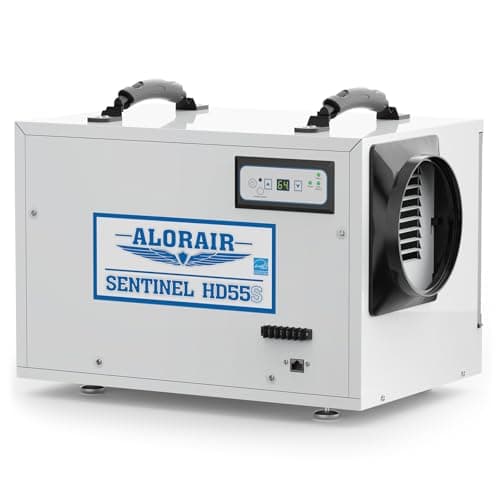
ALORAIR Sentinel HD55: 53 pints/day at AHAM in a metal case with continuous gravity drainage, the default AlorAir for a crawl space with a drain.
Key Specs
Capacity (stated)
53 pints/day at AHAM; 113 pints/day at saturation
Coverage (claimed)
Up to 1,200 sq ft
Drainage
No internal tank; drains continuously through a hose by gravity
Pump
None mentioned on this listing
Low temperature
Auto defrost: the compressor pauses while the fan keeps running
Housing
Metal outer casing with a carry handle
Pros
Cons
Suited to
A sealed or encapsulated crawl space with a floor drain, sump pit or downhill drain route
Our take
The HD55 listing is clearer than most about what its numbers mean. Fifty-three pints a day at AHAM conditions, 80°F and 60% RH, is the figure to compare with other crawl space units; the 113 pints at saturation describes hot, nearly saturated air, a condition a sealed crawl space should never reach. Because the unit has no tank, water leaves through the hose from the first minute, so plan the route before it arrives: downhill all the way to a sump pit, floor drain or daylight. Set it on blocks so the hose has fall. One limit matters more than any spec. In a vented crawl space that is still open to outdoor air, it will spend its effort drying the outdoors, so close the vents and lay a vapor barrier first.
Affiliate link — commission at no extra cost to you
Compare elsewhere
These open a search for this model. We quote prices only where we can verify them — Amazon, Sylvane and eBay.
Check price
on Amazon ↗
Listing verified 5 Nov 2026
See it on Amazon ↗Best ENERGY STAR Sentinel
Quick Verdict
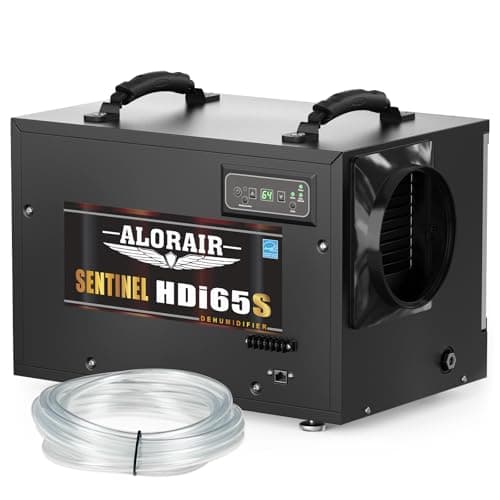
ALORAIR Sentinel HD55S: the HD55 design with an ENERGY STAR listing, 55 pints/day at AHAM and 1,300 sq ft of rated coverage.
Key Specs
Capacity (stated)
55 pints/day at AHAM; 120 pints/day at saturation
Coverage (claimed)
Up to 1,300 sq ft
Efficiency (stated)
ENERGY STAR certified
Drainage
Continuous drainage through the built-in outlet; no tank to empty
Low temperature
Low-temperature operation and auto defrost
Remote monitoring
Optional, per the listing
Pros
Cons
Suited to
Owners who want the Sentinel design with ENERGY STAR certification for year-round running
Our take
Choose the HD55S over the HD55 if the dehumidifier will run for most of the year. ENERGY STAR says certified dehumidifiers use about 20% less energy than similar conventional models, and a crawl space machine may run for months at a stretch, so the saving adds up. Otherwise the two listings sit very close: 55 versus 53 pints at AHAM, 1,300 versus 1,200 sq ft, a metal case on both, gravity drainage on both and the same defrost logic. That closeness is the useful finding. You are not choosing between two different machines, only deciding whether certified efficiency is worth the difference at checkout. If you see a gold HD55S listing, note that it lists a MERV-8 filter, while the one ranked here lists MERV-1.
Affiliate link — commission at no extra cost to you
Compare elsewhere
Check price
on Amazon ↗
Listing verified 5 Nov 2026
See it on Amazon ↗Best When the Drain Is Uphill
Quick Verdict
ALORAIR 120 PPD ENERGY STAR with Pump: 55 pints/day at AHAM with a 19.6 ft pump lift, for crawl spaces with no drain below them.
Key Specs
Capacity (stated)
55 pints/day at AHAM; 120 pints/day at saturation
Coverage (claimed)
Up to 1,300 sq ft
Pump (stated)
Built-in condensate pump, lift up to 19.6 ft
Gravity option
Drain hose to a floor drain
Efficiency (stated)
ENERGY STAR (2026), per the listing
Low temperature
Auto defrost and low-temperature operation
Pros
Cons
Suited to
A crawl space or basement with no floor drain, where water must go up to a sink or out through the rim joist
Our take
Most crawl spaces sit below the yard, so there is nowhere downhill for the water to go. That makes the pump the feature that decides the purchase, not the pints. This listing states a lift of up to 19.6 ft, which covers the usual routes: up the foundation wall and out through the rim joist, or across to a laundry sink. Horizontal distance also costs a pump some of its push, so measure the whole path, not just the height. Where the line exits outdoors, turn the end down and keep it clear of soil so it drains and cannot freeze back into the pipe, and keep the line off the vapor barrier where a kink would go unnoticed. Capacity matches the HD55S, so this is the same class of machine with a different way out for the water.
Affiliate link — commission at no extra cost to you
Compare elsewhere
Check price
on Amazon ↗
Listing verified 5 Nov 2026
See it on Amazon ↗Best for Drying After a Leak
Quick Verdict
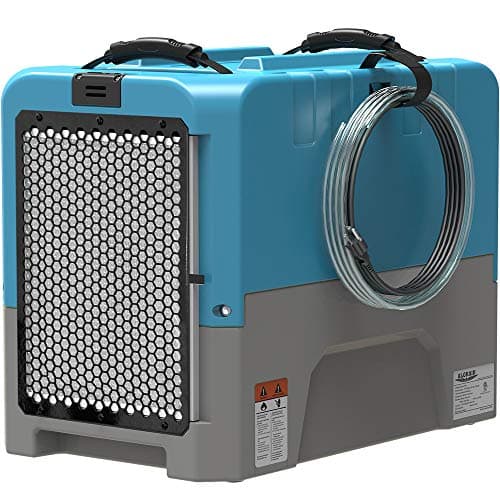
ALORAIR Storm LGR Extreme: 85 pints/day at AHAM, 210 CFM and a 14.7 ft pump lift, for drying out after a leak rather than everyday control.
Key Specs
Capacity (stated)
85 pints/day at AHAM; 180 pints/day at saturation (90°F, 90% RH)
Airflow (stated)
210 CFM
Coverage (claimed)
Up to 2,300 sq ft
Pump (stated)
Built in; 19.6 ft drain hose, 14.7 ft vertical lift
Size (stated)
22.8 x 13.7 x 17.3 in (L x W x H), two top handles
Controls
Auto on/off, memory start, auto restart after a power failure, GPP readout
Pros
Cons
Suited to
Drying a crawl space or basement after a leak or a wet season, before a smaller unit takes over
Our take
LGR stands for low grain refrigerant, a design that keeps pulling water out of air that is already fairly dry, which is what drying soaked framing and subfloor demands. AlorAir pitches it at the restoration trade, and the display reads grains per pound because GPP tracks the actual water in the air regardless of temperature. For a homeowner it makes sense after a plumbing leak or a wet spring, when a crawl space has to come down fast, with a Sentinel taking over for year-round control afterwards. Mind the two drain figures: the hose runs 19.6 ft, but the stated vertical lift is 14.7 ft. If the leak soaked insulation or subfloor rather than just the air, call a restoration firm that works to IICRC S500, the industry standard for water damage restoration, instead of relying on one machine.
Affiliate link — commission at no extra cost to you
Compare elsewhere
Check price
on Amazon ↗
Listing verified 5 Nov 2026
See it on Amazon ↗Best for Small Crawl Spaces
Quick Verdict
ALORAIR Smart Wi-Fi 70 Pint with Pump: 35 pints/day at AHAM, a 19.6 ft pump and live humidity on your phone, for small sealed crawl spaces.
Key Specs
Capacity (stated)
35 pints/day at AHAM; 70 pints/day at saturation
Coverage (claimed)
Up to 1,000 sq ft
Pump (stated)
Pushes water up to 19.6 ft; 19.6 ft line included
Gravity option
Continuous drainage by hose
Controls
Wi-Fi app with live humidity and remote settings
Low temperature
Auto defrost
Pros
Cons
Suited to
A small, already sealed crawl space up to about 1,000 sq ft where you want humidity on your phone
Our take
This unit has roughly two-thirds of the Sentinels' AHAM capacity, 35 pints a day against 53 to 55, but it pairs a pump with an app. The app matters more than it sounds. A crawl space dehumidifier fails quietly, and the first sign is often a musty smell weeks later. Seeing live humidity on a phone turns that into a number you can check over breakfast. Before buying, stand at the crawl space hatch and test the signal on your own phone, since floor framing, metal ductwork and foil-faced insulation all weaken Wi-Fi. Buy it only for a space that is already sealed and covered with a vapor barrier. An open crawl space needs sealing first and a larger machine after that.
Affiliate link — commission at no extra cost to you
Compare elsewhere
What to know before you buy.
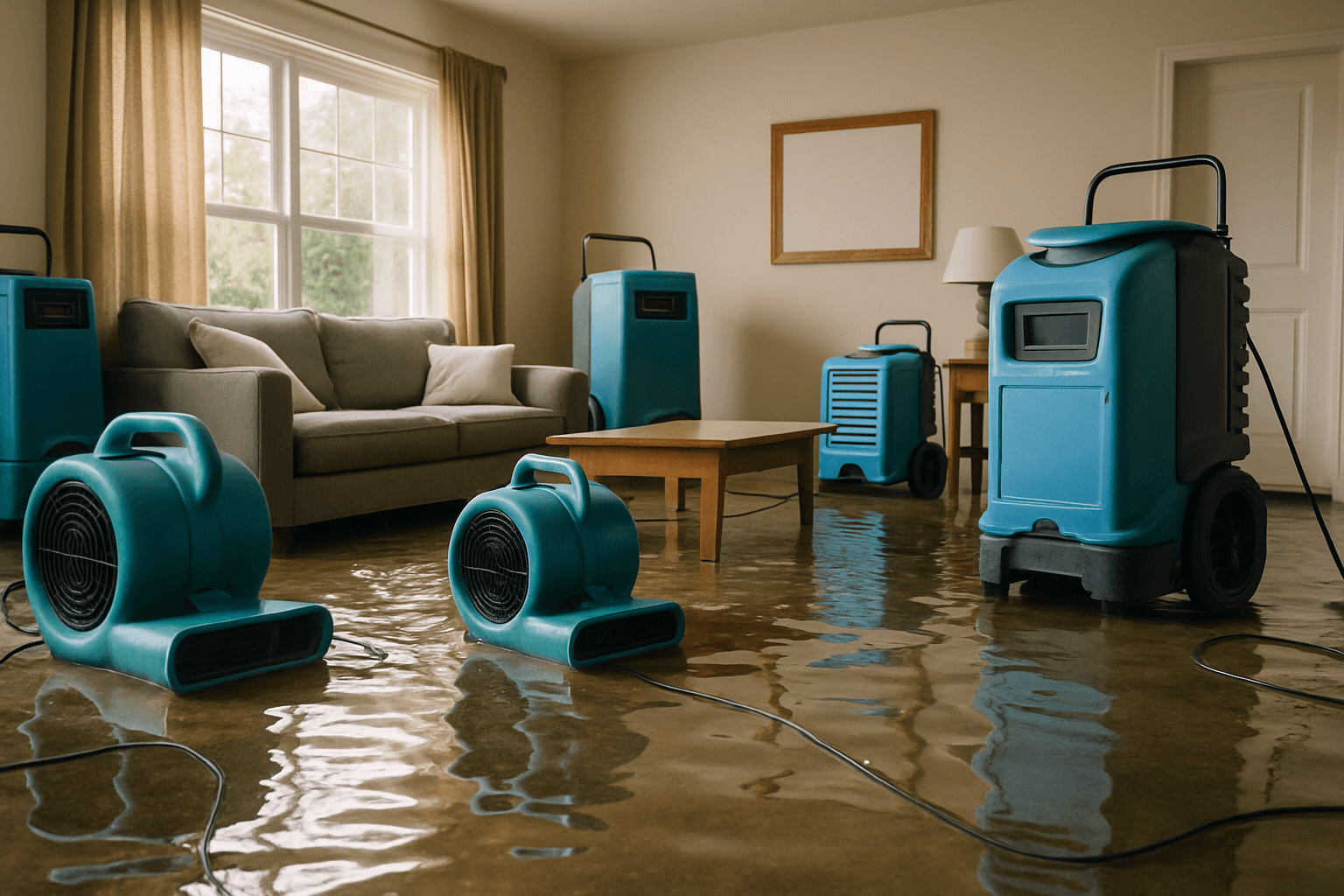
AlorAir's two main lines answer different questions. The Sentinel models, such as the HD55, HD55S and their pump versions, are built to sit in a crawl space or basement for years and hold the air at a set humidity. They have metal cases, auto defrost and no tank to empty. The Storm models are drying machines. The Storm LGR Extreme moves 210 CFM, carries a built-in pump and shows grains per pound on its display, which is how drying progress is tracked after water damage. Running a Storm year-round in a sealed crawl space is far more machine than holding a setpoint requires. Pick a Sentinel for control, and rent or buy a Storm only when something is actually wet.
Every AlorAir listing on this page prints two capacity numbers, and the gap between them is large. The AHAM figure is measured at 80°F and 60% RH, close to the conditions of a damp summer basement. The saturation figure is taken in hot, nearly saturated air; the Storm listing gives 90°F and 90% RH. The HD55 shows 53 pints at AHAM and 113 at saturation, more than double. Compare AlorAir models with each other, and with other crawl space brands, on the AHAM number. A crawl space is often cooler than 80°F, so real removal there can run below even the AHAM figure. ENERGY STAR notes that frost can form on dehumidifier coils below 65°F, which is why auto defrost appears on every Sentinel listing here: in a cool crawl space the machine has to pause, melt the ice and restart on its own.
Decide how the water leaves before choosing a model. A gravity Sentinel, the HD55 or HD55S, needs a drain point lower than its outlet the whole way: a sump pit, floor drain, or a pipe that runs downhill to daylight. If none exists, choose a pump model. The ENERGY STAR pump version and the Wi-Fi 70 pint both list up to 19.6 ft of lift, while the Storm LGR Extreme lists 14.7 ft of vertical lift on a 19.6 ft hose. Measure the full path, up the wall and across to the exit point, and leave a margin, because distance as well as height takes some of a pump's push. If you plan to discharge into a sink drain or laundry standpipe, ask a plumber about your local rules for condensate connections. Outdoors, end the line where water will run away from the foundation, not back toward it.
AlorAir's coverage claims run from 1,000 sq ft for the Wi-Fi 70 pint to 1,300 sq ft for the HD55S and the ENERGY STAR pump model, and 2,300 sq ft for the Storm. Treat those as figures for a sealed space with a vapor barrier, since an open crawl space keeps trading air with the outdoors. ENERGY STAR's advice is that it is better to oversize than undersize, so if your crawl space is close to a model's limit, or it smelled musty before you sealed it, move up a size. EPA's guidance for indoor air is below 60% RH, ideally 30% to 50%, and a setpoint around 50% in a crawl space leaves margin without running the machine constantly. Put a separate logging hygrometer at the far end of the crawl space, away from the unit, to check that the whole space is reaching the target, not just the air beside the machine.
Every listing on this page mentions a 6-year limited warranty, and AlorAir's Storm 80X listing spells out the terms it says apply to all its dehumidifiers. The first 2 years are full coverage, including parts, labor and even replacement of the unit. Years 3 through 6 cover refrigeration system parts only, meaning the compressor, condenser and evaporator, and exclude transportation and labor. In practice, a failed pump or control board in year 4 is on you, and a failed compressor in year 4 is a covered part, but the labor to fit it is not. Register the unit when it arrives, keep the receipt and serial number, and photograph the installation. Read the warranty card in the box before you mount the unit on brackets or hang it from joists, in case it sets conditions on installation.
AlorAir makes sense for crawl spaces, unfinished basements and drying jobs. It is the wrong buy for a bedroom or finished living space, where a quieter portable with a bucket and a nicer case fits better. It is also the wrong first step in a crawl space with standing water. Water on the ground calls for drainage, a sump pump or regrading, and a dehumidifier cannot keep up with a pool under the house. If the floor joists are already soft, or mold covers more than about 10 square feet, which EPA treats as beyond a routine homeowner cleanup, bring in a crawl space contractor or a remediation firm before buying equipment. And if the crawl space is still vented to the outdoors, a dehumidifier of any brand will spend most of its effort drying outside air until the vents are closed and the ground is covered.
For crawl spaces and drying jobs, AlorAir's listings are among the most specific you will find. They print AHAM and saturation capacity, coverage, pump lift and warranty terms, and the Sentinel models add metal cases and auto defrost for cold, unvisited spaces.
The 6-year limited warranty is full coverage for only the first 2 years, then refrigeration parts alone. For a bedroom or living room, a quieter portable is the better fit.
The HD55S is the ENERGY STAR certified version, with slightly more capacity and rated coverage. Per the listings, the HD55 removes 53 pints a day at AHAM conditions and covers up to 1,200 sq ft, while the HD55S removes 55 pints and covers up to 1,300 sq ft.
Both use a metal case, auto defrost, a MERV-1 filter and gravity drainage with no tank. Choose the HD55S if the unit will run most of the year.
The standard HD55 and HD55S do not; they drain by gravity through a hose. AlorAir sells pump-equipped versions, including the ENERGY STAR 120 PPD model on this page, whose listing states a lift of up to 19.6 ft, with a gravity hose option as well.
Choose a pump model whenever the only drain point is higher than the dehumidifier, which is common in crawl spaces that sit below the yard.
AHAM refers to the Association of Home Appliance Manufacturers test conditions, 80°F and 60% RH, used to rate how many pints a day a dehumidifier removes. It is the fair number for comparing crawl space units.
The saturation figure AlorAir prints alongside it is measured in hot, nearly saturated air and runs about twice as high on these listings, so it overstates what the machine will do in a cool crawl space.
Keep a crawl space below 60% relative humidity, EPA's ceiling for indoor air, and aim for around 50% to leave a margin. EPA gives that range as part of its advice for limiting mold, and a drier crawl space also keeps the musty smell out of the floor above.
Check it with a hygrometer placed away from the dehumidifier, and recheck after heavy rain, when crawl spaces tend to run highest.
YesIn most cases, if the crawl space is already sealed and has an outlet.
Set the unit level on blocks or a stand, route the drain hose downhill or run the pump line out through the rim joist, and plug it into a GFCI-protected outlet, which electrical codes generally require in crawl spaces. If there is no outlet, hire an electrician. If the space is not yet sealed, have that done first.
Call (888) 840-6512. The line is answered 24 hours a day, seven days a week, and connects you with an IICRC-certified water damage restoration company that serves your area. A recorded menu picks up first: choose water damage or mold, key in your 5-digit ZIP code, and hold through the short silence while the call is passed to the company.
Describe what you can see — where the water is coming from, how long it has been there, and whether it smells — the more specific you are, the faster the right company is on the line. If the source is a pipe or an appliance, shut the main water valve first. Have four things ready and the call goes quickly: the address, when the water started, what is wet now, and whether you have filed an insurance claim.
Still not sure which of these is your situation? (888) 840-6512 · toll-free · answered 24/7
Methodology: How we source and verify data · Report an error
Free 2-day shipping
Amazon Prime members pay no shipping on restoration equipment
Dehumidifiers, air movers, and moisture meters qualify for free Prime delivery — bulk items that otherwise cost $15–$40 to ship.
Affiliate link — HearthDry earns a bounty if you sign up; costs you nothing extra.

A damp crawl space feeds mold and wood rot in the framing above it. These four crawl space dehumidifiers are ranked on published specifications, buyer records and how honestly each states its capacity for the cool, damp conditions under a house.
Read the comparisonHousehold dehumidifiers are rated around 50 pints a day; these are rated 150 to 240. What that rating means depends entirely on where it was measured — and none of the machines Amazon stocks is the LGR unit a restoration crew brings to a large loss.
Read the comparisonA properly installed vapor barrier is the most cost-effective way to keep ground moisture out of a crawl space, and most failures come from thin film and untaped seams rather than the wrong brand. This guide compares 6-mil, 10-mil and 20-mil woven liners on the specifications you can actually check, and covers the tape and overlaps that decide whether the barrier works.
Read the comparisonThe Santa Fe Compact70 is the horizontal, joist-hung dehumidifier most homeowners with a permanently damp crawl space end up buying. This review takes the numbers from the Amazon listing and the Sylvane product page, puts the headline pint rating next to the figure Energy Star actually confirmed, and compares the unit with the AprilAire E080 Pro and a consumer Waykar that costs a fraction as much.
Read the comparisonThe Dri-Eaz LGR 7000XLi is a restoration dehumidifier, not a basement appliance: 130 pints per day at AHAM conditions, 235 at saturation, an 8.3 amp draw and a pump that lifts condensate twenty feet. This review takes every figure from the Sylvane product listing, explains the gap between the two capacity numbers, and says plainly who should buy the cheaper LGR 130 or an Amazon unit instead.
Read the comparison