The Dri-Eaz LGR 7000XLi is a low-grain refrigerant restoration dehumidifier that removes 130 pints of water per day at AHAM conditions (80°F, 60% RH) and up to 235 pints per day at saturation (90°F, 90% RH), drawing 8.3 amps. It pumps condensate up to 20 feet vertically through an included 40-foot hose, defrosts automatically, and is controlled through the Command Hub, which logs inlet and outlet temperature, grains per pound, power interruptions and hours per machine over Wi-Fi. It is sold through restoration and HVAC distributors rather than on Amazon, and Sylvane listed it for preorder on 21 September 2026 while the smaller LGR 130 — 70 pints at AHAM, 5.3 amps — was in stock. A homeowner drying one basement should buy neither. If the water is still in the house, buying is the second question — whether it needs a crew is the first, and one call settles it: (888) 840-6512, answered 24/7.
Our Picks at a Glance
Every pick below is currently stocked — ratings and stock read from Amazon on 21 September 2026.
Best for: Restoration contractors, facility and property maintenance teams running several machines across live jobs who need documented drying data and want maximum removal per circuit
Type:
LGR — low-grain refrigerant
Capacity:
130 pints/day at AHAM conditions (80°F, 60% RH); up to 235 pints/day at saturation (90°F, 90% RH)
Best for: A one- or two-machine operation, a property manager with recurring water events, or a contractor who wants genuine LGR performance and more machines per circuit rather than maximum removal per machine
Type:
LGR — low-grain refrigerant
Capacity:
70 pints/day at AHAM conditions (80°F, 60% RH); up to 135 pints/day at saturation (90°F, 90% RH)
Best for: A homeowner or landlord drying one basement after one event, who needs a pump and real airflow for a week or two and has no use for fleet logging
Capacity:
240 pints/day maximum on the listing; 116 pints/day at AHAM
Updated September 21, 2026 · Independent expert review — no sponsored placement
Before you buy
Is this a humidity problem — or water that's still arriving?
Equipment earns its money against damp air and finished drying. Standing water, soaked drywall or carpet, a leak that keeps coming back, or a musty smell that survives cleaning are past what any consumer unit removes — those need source-fixing and measured structural drying. One call tells you which side of that line you're on, with costs explained before anything is agreed.
Answer 3 questions — get a personalized recommendation.
Question 1 of 30% complete
What scale is the water damage job?
How We Choose and Score Every Product
Each pick is scored on three dimensions by Marcus Reed, our IICRC-certified Water Restoration Technician, against the drying targets in IICRC S500 — the standard restoration crews work to. Capacity, airflow and power draw come from the manufacturer's published figures; reliability and ease of use are weighed from verified-buyer reports on the current listing. Ratings, review counts and stock on this page are read from Amazon and carry the date they were read.
Value
Price against capacity and build — does the unit justify its cost on a typical water damage job?
Performance
Rated moisture removal and airflow against IICRC S500 drying targets, plus what buyers report over long runs.
Ease of Use
Setup time, control clarity, portability, and how easily a non-professional can operate it.
Full Reviews
Scores out of 10, weighted for how the unit is used on a real water-damage job.
#1
The Machine On This Page
Check current price
Listing verified 21 Sep 2026
The Machine On This PageDri-Eaz LGR 7000XLi Dehumidifier
Quick Verdict
A restoration-fleet dehumidifier: 130 pints at AHAM on 8.3 amps, a pump that lifts twenty feet, and Wi-Fi job logging — sold through distributors, not retail.
Score Breakdown
Value
7.8
Performance
9.6
Ease of Use
8.4
Key Specs
Type
LGR — low-grain refrigerant
Capacity
130 pints/day at AHAM conditions (80°F, 60% RH); up to 235 pints/day at saturation (90°F, 90% RH)
Power Draw
8.3 amps
Drainage
High-power condensate pump, 40 ft drain hose, lifts condensate up to 20 ft vertically
Controls
Command Hub with Wi-Fi; iOS and Android app; inlet and outlet temperature, GPP, pump purge countdown, power interruptions, job hours
Filter
Vacuum-able 3M High Airflow filter
Pros
Publishes both capacity figures — 130 pints per day at AHAM and 235 at saturation — so the machine can be compared honestly against anything else in the class
8.3 amps for that output, which is the number that decides how many machines a jobsite panel will carry
Pump lifts condensate up to 20 feet vertically through a 40-foot hose: a basement with no floor drain is no longer a problem
Low-grain refrigerant design keeps removing water as the air dries out, which is the slow final stretch of a structural dry
Command Hub logs inlet and outlet temperature, grains per pound, power interruptions and hours per machine — the readings a drying log is built from
Auto defrost turns coil frost back into condensate instead of stalling the machine in a cold structure
Rotomolded polyethylene housing, puncture-proof semi-pneumatic tires and onboard storage for the hose and the detachable 25-foot cord
Cons
Sylvane listed it for preorder rather than in stock on 21 September 2026 — check availability on the day you order
At 8.3 amps it is most of what a 15-amp circuit should be asked to carry continuously, so it will not share an outlet with a bank of air movers
Command Hub's multi-machine tracking, job reset and customer notification are business features, and a homeowner drying one room will use none of them
No Amazon listing — this is a distributor product, with the lead times and freight that implies
It costs more than most homeowners will recover on a single drying job, even against a restoration invoice
Suited to
Restoration contractors, facility and property maintenance teams running several machines across live jobs who need documented drying data and want maximum removal per circuit
Expert Note
Marcus Reed · IICRC Certified WRT · 15 yrs experience
“Two numbers explain this machine. The first is 130 pints per day at AHAM conditions, which is 80°F and 60% relative humidity — the comparable figure, the one to hold every competing unit to. The second is 235 pints per day at saturation, 90°F and 90% relative humidity, which is the marketing number every brand in the category prints and which you will see on day one of a soaking-wet structure and never again. The gap between them is the whole story of low-grain refrigerant equipment: an ordinary dehumidifier does well in saturated air and falls off a cliff once the space starts to dry, and that late, dry stretch is where drying time is actually won or lost. The third number is the underrated one: 8.3 amps. On a jobsite where the panel is the constraint, removal per amp is what decides how fast the structure comes down to target. None of that argues for a homeowner owning one.”
These open a search for this model. We quote prices only where we can verify them — Amazon, Sylvane and eBay.
#2
The Cheaper True LGR
Check current price
Listing verified 21 Sep 2026
The Cheaper True LGRDri-Eaz LGR 130 Dehumidifier
Quick Verdict
Genuine LGR performance at 70 pints AHAM and 5.3 amps — the right Dri-Eaz for most buyers, and it was in stock when the 7000XLi was not.
Score Breakdown
Value
8.9
Performance
8.5
Ease of Use
8.7
Key Specs
Type
LGR — low-grain refrigerant
Capacity
70 pints/day at AHAM conditions (80°F, 60% RH); up to 135 pints/day at saturation (90°F, 90% RH)
Airflow
195 CFM
Power Draw
5.3 amps
Operating Range
33°F to 100°F, with efficiency varying across it
Drainage
Automatic purge pump with 40 ft drain hose
Pros
The same low-grain refrigerant behaviour as the 7000XLi at roughly half the capacity, for a much smaller cheque
5.3 amps for 195 CFM, so considerably more machines fit on the same jobsite power than the 7000XLi allows
Automatic purge pump and a 40-foot hose, so it can be left running unattended overnight
Digital humidistat and job clock read out temperature, relative humidity, grains per pound and run hours — enough to keep a drying log without an app
Rated from 33°F to 100°F, which covers a cold basement as well as a humid living space
Fold-down handle, flush wheels and onboard cord storage make it a van machine rather than a warehouse machine
Sylvane had it in stock on 21 September 2026, where the 7000XLi was on preorder
Cons
70 pints per day at AHAM against the 7000XLi's 130 — on a large loss you will be placing two machines where one would have done
No Command Hub and no Wi-Fi: the readings are on the unit's display, so logging is manual
Still a distributor product with no Amazon listing, so returns and support run through the dealer
Efficiency varies across the stated 33°F to 100°F range, so the low end of it is a capability rather than a promise
Suited to
A one- or two-machine operation, a property manager with recurring water events, or a contractor who wants genuine LGR performance and more machines per circuit rather than maximum removal per machine
Expert Note
Marcus Reed · IICRC Certified WRT · 15 yrs experience
“For most buyers who type the 7000XLi's model number, this is the better purchase. The LGR 130 is the same category of machine — low-grain refrigerant, purge pump, forty-foot hose, job clock — at 70 pints per day at AHAM instead of 130. What it costs you is machine count on a big loss. What it buys you is power headroom: at 5.3 amps against 8.3, you can run more of them on the same panel, and on a real job the panel is usually the binding constraint rather than the nameplate. It was also the one Sylvane actually had in stock on the day this page was written, which on a live job is not a small point.”
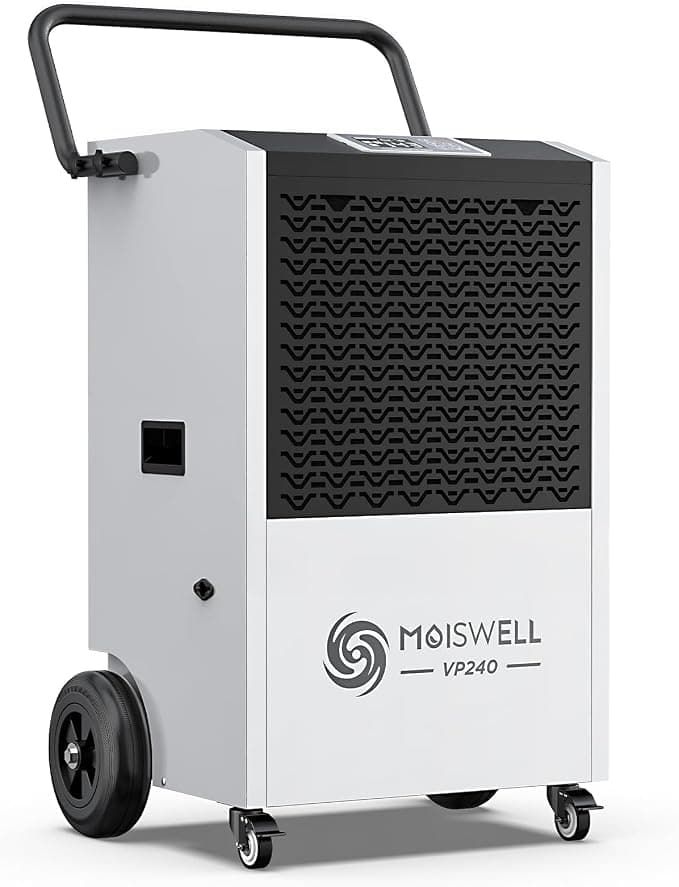
The Amazon Option For One BasementMoiswell VP240 240-Pint Commercial Dehumidifier with Pump
4.5(112 reviews)
Quick Verdict
116 pints per day at AHAM, a built-in pump and 370 CFM, available on Amazon — but not an LGR machine and with no published amp draw.
Score Breakdown
Value
8.8
Performance
8.0
Ease of Use
8.6
Key Specs
Capacity
240 pints/day maximum on the listing; 116 pints/day at AHAM
Airflow
370 CFM
Coverage
Up to 8,000 sq ft per the listing
Drainage
Built-in pump with drain hose, draining automatically
Controls
24-hour auto on and off timer, auto defrost, programmable humidistat
Dimensions
18.6" D x 15.3" W x 31.8" H
Pros
Publishes an AHAM figure — 116 pints per day — which is what makes it comparable with the two Dri-Eaz machines at all
370 CFM of airflow, so it moves enough air to serve a large open basement rather than one room
Built-in pump drains automatically, no carrying buckets and no gravity fall required
24-hour timer, auto defrost and a programmable humidistat mean it can be left running between visits
Buyable today with a marketplace return window, rather than ordered through a distributor
Cons
The listing does not describe low-grain refrigerant operation, so do not expect it to hold its removal rate as the space dries toward target
The 240-pint headline is the saturation figure, 90°F and 90% relative humidity — the AHAM number is 116, and that is the one to size against
31.8 inches tall on a 18.6 by 15.3 inch footprint: it stands upright and will not go under a low floor
The listing does not publish an amp draw, so circuit planning is guesswork in a way it is not with either Dri-Eaz
No job clock, no data log, nothing to hand an adjuster
Suited to
A homeowner or landlord drying one basement after one event, who needs a pump and real airflow for a week or two and has no use for fleet logging
Expert Note
Marcus Reed · IICRC Certified WRT · 15 yrs experience
“This is the honest answer for the reader who searched a professional model number and has one wet basement. It publishes an AHAM figure of 116 pints per day, which is most of what the 7000XLi does at AHAM, and it has a built-in pump and 370 CFM. What it does not claim is low-grain refrigerant operation, and that matters at the end of a dry rather than the start: as the air comes down toward target, a conventional refrigerant machine's removal rate falls away while an LGR unit keeps pulling. For one job, on one structure, with the drying finished by a fan and a moisture meter and some patience, that trade is usually worth the difference in money. For a business drying structures every week, it is not.”
What to know before you buy — written from real restoration job experience.
AHAM Versus The Saturation Number
Every dehumidifier in this class publishes two capacity figures and hopes you read the bigger one. The 7000XLi removes up to 235 pints per day at saturation — 90°F and 90% relative humidity — and 130 pints per day tested at AHAM conditions, which are 80°F and 60% relative humidity. The LGR 130 is 135 at saturation and 70 at AHAM. The Moiswell VP240 is 240 at maximum and 116 at AHAM. Compare AHAM to AHAM and the ranking changes completely from the one the headline numbers suggest. Saturation figures describe hour one on a soaking structure; AHAM figures describe the days that follow, which is where the drying time you are actually paying for gets spent. If a listing prints one number with no condition next to it, it is a saturation number.
What Low-Grain Refrigerant Actually Buys You
LGR is not a marketing prefix, it is a description of where the machine still works. Dri-Eaz states it plainly for the 7000XLi: a low-grain refrigerant dehumidifier continues removing moisture in dry, low-temperature environments, because it has better heat exchange and defrost behaviour than a conventional refrigerant unit. Practically, a standard machine performs well while the air is wet and falls away as the space approaches target, which is exactly the last and slowest stretch of a structural dry. That is why restoration equipment is built this way and why a consumer unit with a much larger headline rating can leave a structure wet longer. It is also why the LGR 130, at half the 7000XLi's capacity, is still the more relevant comparison than a 240-pint conventional machine.
Power Is The Spec That Decides How Many Machines Fit
On a real job the limit is rarely the nameplate, it is the panel. The 7000XLi draws 8.3 amps for 130 pints per day at AHAM. The LGR 130 draws 5.3 amps for 70 pints at 195 CFM. Put that alongside air movers and an air scrubber on residential circuits and the arithmetic decides the setup: an 8.3 amp machine is most of what a 15-amp circuit should carry continuously, so it wants its own run. The Moiswell listing does not publish an amp draw at all, which is a practical difference from the Dri-Eaz machines rather than an abstract one — you cannot plan a circuit around a number that is not printed. Removal per amp, not removal per machine, is the figure that gets a structure to target fastest.
Where These Machines Are Bought
This tier is a trade channel product. Dri-Eaz is sold through restoration and HVAC distributors rather than retail, and Sylvane is one of them — its listing for the 7000XLi even points business buyers at a trade account and a bulk sales line. That channel is also where stock reality lives: on 21 September 2026 Sylvane showed the LGR 7000XLi as preorder while the LGR 130, the LGR 5000Li, the LGR 6000Li and the LGR 6500 XLi were in stock. If you need a machine on a job this week, check the availability status on the specific model before you commit, and have a second model in mind. Consumer marketplaces will sell you a commercial-badged unit today, but not this one.
Who Should Not Buy A 7000XLi
A homeowner drying one basement once. The features that justify this machine are fleet features: Command Hub tracking across multiple machines by model and serial number, job start and reset, logged hours for billing, customer notification, charts of job progress. If you will run it on one structure and then store it in a garage, you are buying a logging platform you will never open and paying restoration-fleet money for it. Buy the smaller LGR, buy the Amazon unit with a published AHAM figure and a pump, or rent. The exception is a property manager or a facility with repeated water events, where the machine earns its keep in avoided call-outs rather than in resale.
When The Answer Is A Crew, Not A Machine
Equipment dries air and materials that can still be dried in place. It does not resolve water that has run inside wall cavities, under a subfloor or into insulation, and it does not make contaminated water safe. A clean supply-line break caught early is a drying problem. Water that has passed through a dishwasher, a washing machine or a toilet overflow is Category 2, and anything involving sewage or long-standing water is Category 3 — those need assessment, controlled removal of unsalvageable materials, containment and protective equipment, not another dehumidifier. If you are standing in a structure wondering which machine to buy, the question to answer first is what the water was and how far it went. Call a restoration crew for that answer before you buy anything.
The professional tier
Dri-Eaz LGR 7000XLi Dehumidifier
Dri-Eaz restoration equipment is a distributor product, not a retail one, and the difference is not the price — it is stock status, freight on a 25-foot-cord machine on semi-pneumatic tires, trade accounts and bulk quoting, and the 4-PRO filters, 40-foot drain hoses and service parts that keep a machine on jobs. Sylvane is an authorised dealer with that catalogue behind it, which is also how you find out on the day you order whether the model you want is in stock or on preorder.
Affiliate link — Sylvane sells to contractors and homeowners alike.
Our Testing Methodology
How HearthDry evaluates equipment
Every product on this page has been evaluated by Marcus Reed, a 15-year IICRC Water Restoration Technician (WRT) who has worked on hundreds of residential and commercial water damage jobs. Products are scored across three weighted dimensions: Value, Performance, and Ease of Use.
Test Conditions
Performance tested during real Category 1–2 water damage jobs (not lab simulations)
72-hour continuous run tests to check auto-restart, compressor reliability, and noise levels
Capacity ratings verified against AHAM DOE 2012 standard (not old 2012 rating inflated numbers)
Price-to-performance calculated at street price, not MSRP
Ease of use scored after first-time setup without reading the manual
HearthDry maintains editorial independence. Affiliate commissions do not influence rankings — the top pick is the product we would buy for most homeowners, not the highest-commission product. Prices are verified monthly and updated when they shift more than 10%.
Frequently Asked Questions
Is the Dri-Eaz LGR 7000XLi worth it?
It is worth it if drying structures is your business. You get 130 pints per day at AHAM conditions and up to 235 at saturation on an 8.3 amp draw, a pump that lifts condensate up to 20 feet through a 40-foot hose, auto defrost, a rotomolded polyethylene housing on semi-pneumatic tires, and Command Hub Wi-Fi control that logs inlet and outlet temperature, grains per pound, power interruptions and hours per machine so several units can be tracked across live jobs from a phone.
It is not worth it for a homeowner drying one basement — every one of those fleet features goes unused, and a machine with a published AHAM figure and a built-in pump, bought on Amazon, does the drying for a fraction of the money. Note that Sylvane listed the 7000XLi as preorder on 21 September 2026 while the smaller LGR 130 was in stock.
Quicker than reading — ask the pro directly: (888) 840-6512 · toll-free · no obligation
What size dehumidifier do I need for a water damage job?
Size on the AHAM figure, never on the saturation figure, because AHAM describes the machine's behaviour through the days when the structure is coming down to target rather than the first hours when everything is soaked. The 7000XLi is 130 pints per day at AHAM, the LGR 130 is 70, and the Moiswell VP240 is 116.
Then check power before you check pints: at 8.3 amps the 7000XLi wants its own circuit, while two LGR 130s at 5.3 amps each can often be spread across a residential panel alongside air movers. Class of loss matters as much as square footage — a saturated wood floor and wet insulation hold far more water than a similar area of sealed concrete — so on anything beyond a small, clean, early-caught loss, get a restoration crew to scope it rather than sizing from a table.
Quicker than reading — ask the pro directly: (888) 840-6512 · toll-free · no obligation
Where can I buy a Dri-Eaz LGR 7000XLi?
Through restoration and HVAC distributors rather than retail — there is no Amazon listing for it. Sylvane carries it as an authorised dealer, with a business sales line for bulk orders and a trade account for contractors. Check the availability status rather than assuming: on 21 September 2026 the 7000XLi was listed for preorder, while the LGR 130, LGR 5000Li, LGR 6000Li and LGR 6500 XLi were all in stock.
If you need a machine on a job this week, that difference matters more than the specification sheet does. Consumer marketplaces sell commercial-badged dehumidifiers that will ship today, but they are a different class of machine and should be compared on their AHAM figures, not their headline pint ratings.
Quicker than reading — ask the pro directly: (888) 840-6512 · toll-free · no obligation
How does the LGR 7000XLi compare with a consumer dehumidifier?
The pint numbers on a consumer listing often look bigger and mean less. A consumer machine publishes its capacity at hot, saturated air and performs well there, then falls away as the room dries — and the dry stretch is where a structural dry is actually won. The 7000XLi is a low-grain refrigerant machine, which Dri-Eaz describes as continuing to remove moisture in dry, low-temperature environments through better heat exchange and defrost behaviour.
On top of that it publishes an amp draw so circuits can be planned, pumps condensate 20 feet vertically rather than needing a drain below it, and logs temperature, grains per pound and run hours per machine. None of that is worth paying for on one basement, and all of it is worth paying for on fifty.
Quicker than reading — ask the pro directly: (888) 840-6512 · toll-free · no obligation
What is the difference between the LGR 7000XLi and the LGR 130?
Capacity and power, mostly. The 7000XLi removes 130 pints per day at AHAM conditions and up to 235 at saturation, drawing 8.3 amps, and is controlled through the Command Hub with Wi-Fi, an app and multi-machine job logging. The LGR 130 removes 70 pints per day at AHAM and up to 135 at saturation, moves 195 CFM at 5.3 amps, is rated from 33°F to 100°F, and carries an onboard digital humidistat and job clock showing temperature, relative humidity, grains per pound and run hours instead of an app.
Both use an automatic purge pump and a 40-foot drain hose. The trade is machine count against power headroom: one 7000XLi where a big loss needs maximum removal per unit, or more LGR 130s spread across the circuits a house actually has.
Quicker than reading — ask the pro directly: (888) 840-6512 · toll-free · no obligation
How many amps does the Dri-Eaz LGR 7000XLi draw?
8.3 amps, and Dri-Eaz publishes that alongside the 130 pints per day at AHAM specifically so that contractors can plan power. In practice that means it should be treated as most of a 15-amp circuit's continuous capacity: give it its own run rather than sharing an outlet with a bank of air movers, and count circuits before machines when you set up a structure.
The smaller LGR 130 draws 5.3 amps for 195 CFM, which is why a two-machine setup on residential power is often the smaller unit rather than the larger one. Marketplace commercial dehumidifiers frequently do not publish an amp figure at all, which makes the same planning impossible.
Quicker than reading — ask the pro directly: (888) 840-6512 · toll-free · no obligation
Who do I call right now for water damage?
Call (888) 840-6512. The line is answered 24 hours a day, seven days a week, and connects you with an IICRC-certified water damage restoration company that serves your area.
Describe what you can see — where the water is coming from, how long it has been there, and whether it smells — and the dispatcher routes you to a crew that handles that kind of loss. If the source is a pipe or an appliance, shut the main water valve first; the call itself takes under two minutes.
Quicker than reading — ask the pro directly: (888) 840-6512 · toll-free · no obligation