

Best Dehumidifier for a Closet in 2026 — Hanging Absorbers, Mini Units and a Compressor for Damp Walk-Ins

Best Dehumidifier for a Closet in 2026

Hanging Absorbers, Mini Units and a Compressor for Damp Walk-Ins

5 picks compared · prices, ratings and stock checked October 11, 2026

Our Top Pick

For a reach-in closet with no outlet, hang a fragrance-free DampRid bag on the rod and check it every couple of weeks. For a walk-in that smells musty against an outside wall or next to a shower, a small ENERGY STAR compressor such as the Midea 22 Pint is the step up.

4.7 on Amazon · 5,118 ratings

Quick answer

The best dehumidifier for most closets is not a machine at all: a closet with the door shut exchanges little air with the house, so a hanging moisture absorber can hold it dry where it could never dry a room. The DampRid Fragrance Free Hanging Moisture Absorber is the pick, rated 4.7 stars across 5,118 Amazon ratings, with each 16 oz bag lasting up to 60 days by the listing's count. With an outlet, a mini electric unit removes more; in a walk-in beside a damp exterior wall or a bathroom, step up to a small compressor. Aim for 30–50% relative humidity and confirm it with a hygrometer.

Our Picks at a Glance

Every pick below is currently stocked — ratings and stock read from Amazon on 11 October 2026.

How this page was made: we compare the current Amazon listings, the makers' published specs and what verified buyers report, then rank by fit for the job. Ratings, review counts and stock are read from Amazon and dated. We earn a commission on purchases through our links; it does not change the order. Reviewed by Marcus Reed, IICRC-certified Water Restoration Technician.

Full Reviews

Each pick in detail: what the listing states, what buyers report, and where it falls short.

#1
Best Overall

Check price

on Amazon ↗

Listing verified 13 Oct 2026

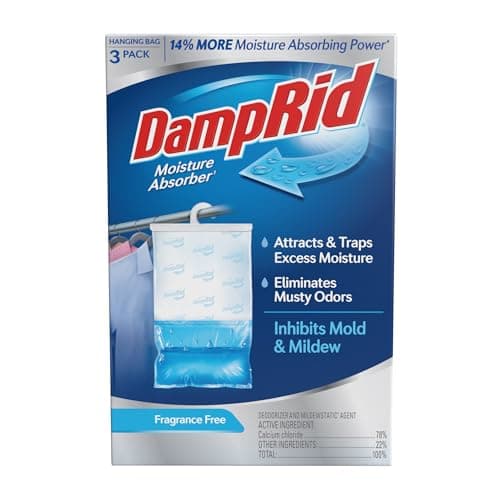
DampRid Fragrance Free Hanging Moisture Absorber (16 oz Bags, 3 Pack)See it on Amazon ↗

Quick Verdict

The default for a reach-in closet: hangs on the rod, needs no outlet, and does not mask the smell.

Key Specs

Type

Hanging bag of moisture-absorbing crystals

Pack

Three 16 oz bags

Life (claimed)

Up to 60 days per bag, depending on temperature and humidity

Capacity note

Listed as 14% more absorbing power than DampRid's 14 oz bags

Replacement

Discard when the liquid reaches the replacement line

Coverage

Not stated on the listing

Pros

  • Hangs from the closet rod among the clothes, so it takes no shelf or floor space
  • Fragrance free, so a musty smell that comes back still tells you the damp has returned
  • Needs no outlet, which most reach-in closets do not have
  • The collected liquid is visible against a replacement line, so there is no guessing when a bag is spent

Cons

  • It collects ounces over weeks, so it cannot catch up with a closet that has a leak or a wet wall behind it
  • A disposable that has to be replaced every few weeks to two months, and the listing gives no coverage area
  • A torn bag would drip brine; hang it where a leak cannot land on leather, shoes or a wood floor

Suited to

A reach-in closet with no outlet and a mild musty smell or damp-feeling clothes

Our take

This works in a closet for the same reason it fails in a basement: with the door shut, very little new moisture reaches the clothes, so a passive bag only has to keep pace with a trickle. DampRid's instructions say to hang it with room for air to circulate, and that is worth taking literally; push the hangers apart a few inches so the bag is not wrapped in fabric. Write the date on the tag when you hang it. If it reaches the replacement line well before the 60-day figure, the closet is taking on more water than an absorber can handle, and the next step is a hygrometer reading and a close look at the wall behind the clothes.

Check today's price on Amazon →

Affiliate link — commission at no extra cost to you

Compare elsewhere

These open a search for this model. We quote prices only where we can verify them — Amazon, Sylvane and eBay.

#2
Best for a Closet With an Outlet

Check price

on Amazon ↗

Listing verified 13 Oct 2026

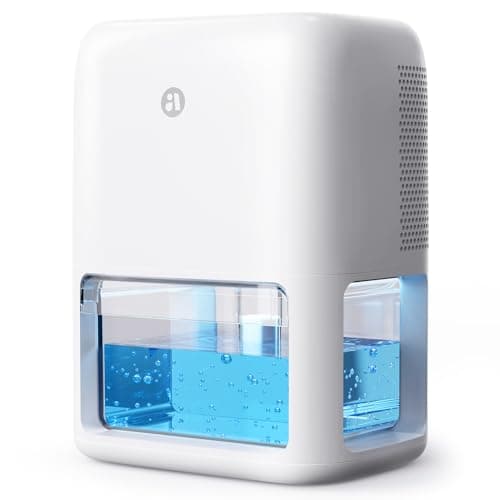
BREEZOME 60 oz Dual-Semiconductor Mini Dehumidifier (48 W, Auto Shut-Off)See it on Amazon ↗

Best for a Closet With an Outlet

BREEZOME 60 oz Dual-Semiconductor Mini Dehumidifier (48 W, Auto Shut-Off)

4.2(2,535 reviews)

Quick Verdict

The mini electric pick for a closet with an outlet, with an output figure you can trust — pair it with a hygrometer.

Key Specs

Type

Thermoelectric, with two semiconductor condensers

Moisture removal (stated)

Up to 700 ml (about 24 fl oz) per day at 86°F, 80% RH

Tank

1.8 L (60 oz); stops and flashes a red light when full

Power (stated)

48 W; 1.15 kWh per 24 hours

Modes

Power mode and a 35 dB sleep mode

Timer

12, 24, 36 or 48 hours

Pros

  • States its daily output and the temperature and humidity behind it, which few mini units do
  • At its stated maximum the 1.8 L tank takes more than two days to fill, and longer at closet temperatures
  • A 48 W draw and a stated 1.15 kWh a day make round-the-clock running practical
  • A stated defrost function keeps the cold plate working in a cool closet

Cons

  • Its output falls well below 700 ml at ordinary room temperatures; the figure is for warm, very humid air
  • The listing mentions no humidity setting or readout, so it runs until the tank fills or the timer ends
  • Needs an outlet inside or just outside the closet

Suited to

A reach-in or small walk-in closet that has an outlet and turns damp every summer

Our take

Thermoelectric units chill a small plate with a semiconductor and let moisture condense on it. There is no compressor, which is why they are quiet and light, and why their output is modest. BREEZOME's 700 ml a day is measured at 86°F and 80% RH, far warmer and wetter than a closet, so plan on a fraction of it in practice. In a closed closet a fraction can be enough, because the door keeps new moisture out. Since the listing describes no humidistat, the unit simply runs; use the timer, keep a hygrometer on a shelf, and if the reading will not drop below 60% after a week, the closet needs a compressor or a fix to its water source.

Check today's price on Amazon →

Affiliate link — commission at no extra cost to you

#3
Best for Damp Walk-In Closets

Check price

on Amazon ↗

Listing verified 13 Oct 2026

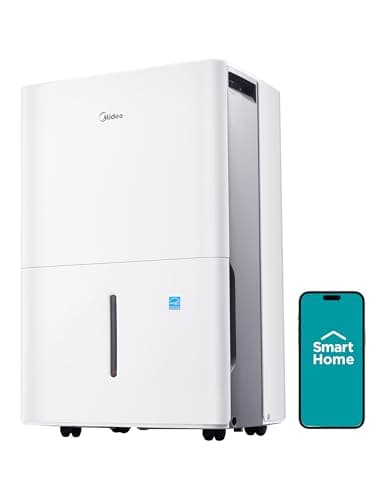
Midea 22 Pint ENERGY STAR Compressor Dehumidifier (35–85% Humidity Setting)See it on Amazon ↗

Quick Verdict

The step up for a damp walk-in: a compressor with a humidity setting, though the tank needs emptying.

Key Specs

Type

Compressor

Capacity (stated)

Up to 22 pints/day (test conditions not stated on the listing)

Coverage (claimed)

Up to 1,500 sq ft

Humidity control

Adjustable from 35% to 85% RH

Drainage

Tank that stops the unit when full and restarts it when emptied, or continuous drain through a standard hose (not included)

Noise (claimed)

47 dBA

Pros

  • A compressor removes pints a day rather than ounces, enough for a walk-in that a mini unit cannot hold
  • The humidity setting reaches down to 35%, so it can hold a closet at 45% and cycle off
  • Auto defrost and auto restart after an outage suit a closet nobody checks every day
  • ENERGY STAR certified

Cons

  • Much bigger than a mini unit, and the listing bullets give no dimensions, so measure the floor space first
  • No hose is included and few closets have a drain, so expect to empty the tank by hand
  • At a claimed 47 dBA it is the loudest pick here, noticeable if the walk-in opens onto a bedroom

Suited to

A walk-in closet on an exterior wall or sharing a wall with a bathroom, where the hygrometer stays above 60%

Our take

A walk-in beside a shower or against a cold outside wall can gain moisture faster than an absorber or a thermoelectric unit removes it, and that is the case for a compressor. Midea's 22 pints is a maximum with no stated test conditions, so do not read it literally; what matters here is that a compressor works in pints rather than ounces and that this one has a humidistat you can set to 45%. Place it on the floor where nothing hangs over the intake or the outlet, since it has to pull air through itself to work. If it runs without stopping and the reading still sits above 50%, the closet has a water source, and the wall should be checked with a moisture meter.

Check today's price on Amazon →

Affiliate link — commission at no extra cost to you

#4
Best Cordless Rechargeable

Check price

on Amazon ↗

Listing verified 13 Oct 2026

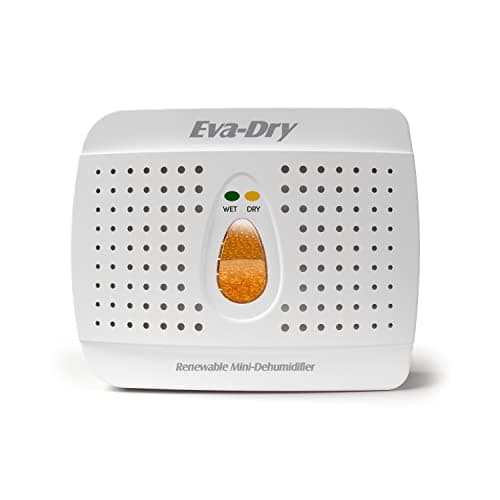
Eva-Dry E-333 Renewable Mini Dehumidifier (Silica Gel, Up to 333 Cubic Feet)See it on Amazon ↗

Quick Verdict

Reusable and leak-free for small closets and wardrobes, with six ounces of capacity as its limit.

Key Specs

Type

Rechargeable silica gel desiccant

Space (claimed)

Up to 333 cubic feet

Absorbing capacity (stated)

Up to 6 oz before recharging

Recharge interval (claimed)

Every 20–30 days

Power while working

None; no cord or batteries

Coverage term (stated)

5 years

Pros

  • Reusable, so there is no stream of disposable bags to buy and throw away
  • Silica gel keeps the water in the beads, with no liquid to spill onto clothes or a closet floor
  • Small enough to hang among clothes or sit on a shelf
  • Its 333 cubic foot rating covers a typical reach-in closet with room to spare

Cons

  • Holds up to 6 oz and then stops working until recharged; a damp closet can fill it well before 20 days
  • The listing bullets do not explain how recharging works or how long it takes; check the manual

Suited to

A small reach-in closet, linen closet or wardrobe where a liquid-filled bag is unwelcome

Our take

Silica gel works differently from the crystals in a DampRid bag: it holds water on the surface of the beads and stays dry to the touch, so nothing can leak onto a suit or a leather bag. The trade-off is capacity. Six ounces is a ceiling, and once the beads are saturated they do nothing until they are recharged. Use the 333 cubic foot figure to size it: a reach-in closet two feet deep, five feet wide and eight feet tall holds 80 cubic feet, well inside the rating, while a large walk-in can exceed it. If it needs recharging every week, the closet is wetter than any desiccant can manage.

Check today's price on Amazon →

Affiliate link — commission at no extra cost to you

#5
Best Multi-Pack for Several Closets

Check price

on Amazon ↗

Listing verified 13 Oct 2026

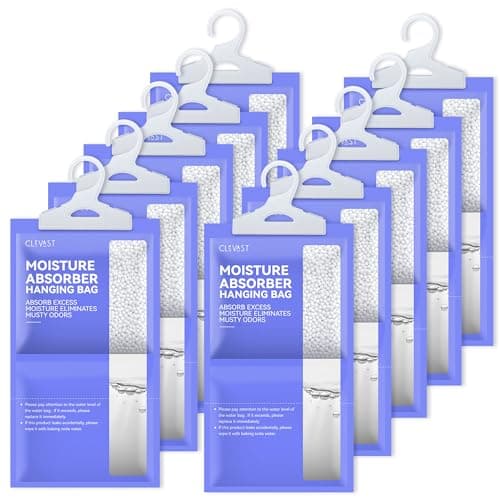
CLEVAST Unscented Hanging Moisture Absorber Bags (10 Pack, 230 g Each)See it on Amazon ↗

Best Multi-Pack for Several Closets

CLEVAST Unscented Hanging Moisture Absorber Bags (10 Pack, 230 g Each)

4.7(3,670 reviews)

Quick Verdict

Ten unscented bags for every closet in the house, and a simple way to find out which closet is the damp one.

Key Specs

Type

Hanging bag of calcium chloride granules with a hook

Pack

10 bags, 230 g net each, individually wrapped

Water chamber (stated)

500 ml per bag

Life (claimed)

Up to 60 days, depending on temperature and humidity

First signs (stated)

Droplets in 3–5 days; in high humidity the granules turn liquid in about 3–7 days

Power and scent

No power needed; unscented

Pros

  • Ten bags cover every closet in a typical house, with spares for a coat or linen closet
  • Each bag is wrapped separately, so the spares keep until they are needed
  • A separate 500 ml water chamber shows how much moisture each closet is producing
  • Unscented

Cons

  • The listing itself warns against placing the bags near valuables; keep them clear of leather and silk
  • In a very damp closet the granules can be used up within a week, which means more bags or a fix to the source

Suited to

A house with several reach-in closets that all smell a little stale in humid months

Our take

The useful thing about a ten-pack is the comparison it allows. Hang one bag in each closet on the same day and check them after two weeks: the closets whose water chamber has filled fastest are the ones taking on moisture, and they are the ones that deserve a hygrometer or a look behind the clothes. CLEVAST's own note that the granules can liquefy in three to seven days in high humidity is worth reading in reverse; a bag that fills that fast in a closet is reporting a water problem, not a humidity nuisance. Hang each bag from the rod, away from the back wall, with the hook secure so a full bag cannot drop.

Check today's price on Amazon →

Affiliate link — commission at no extra cost to you

Buyer's Guide

What to know before you buy.

Why a Small Product Can Keep Up in a Closet

A closet with the door shut trades very little air with the rest of the house, and that is the whole reason closet products can be small. Moisture gets in only a few ways: humid room air each time the door opens, clothes or shoes put away damp, condensation on a cold exterior wall, or water from a leak in a shared wall. The first two add a modest, steady amount that a hanging absorber or a mini dehumidifier can match. The last two can add more water in a day than either removes in a week. So before choosing, decide which kind of closet you have. If the musty smell or the damp clothes appeared with no visible change to the walls, start small. If there is a stain, peeling paint or a soft spot on the drywall, start with the wall.

Ounces or Pints: Matching the Product to the Closet

The options sort by how much water they take out and what they need to run. Hanging absorbers and rechargeable silica gel units need no power and collect ounces over weeks, which suits a reach-in closet with no outlet. A thermoelectric mini dehumidifier needs an outlet and removes ounces a day; BREEZOME states up to 700 ml, roughly 24 fl oz, at 86°F and 80% RH, and a cooler closet yields less. A compressor dehumidifier works in pints a day, with Midea listing up to 22, and it is the only kind here that can hold down a walk-in against a damp exterior wall or a bathroom next door. An oversized unit simply cycles off more often, while an undersized one leaves the clothes damp, so let a hygrometer reading decide when to step up.

What Humidity a Closet Should Hold

The EPA's guidance for the whole house applies to a closet: keep relative humidity below 60%, and ideally between 30% and 50%. Musty-smelling clothes, a white bloom on leather shoes and belts, and small dark mildew spots on a back wall all mean the closet has been above that range for a while. The way to know rather than guess is a hygrometer, a small humidity gauge sold at hardware stores. Put it on the floor or a low shelf at the back of the closet, close the door, and read it the next day; the back corner on an outside wall is usually the dampest spot. Read it again a week after adding an absorber or a dehumidifier. If the number has not moved below 60%, the closet needs a stronger product or a repair, not more of the same.

Give the Air Room to Move

Mildew in closets grows where air stands still, which is usually behind the clothes, against the back wall and on the floor under shoes. Leave a gap of a few inches between the hanging clothes and the wall so air can reach it, and avoid packing the rod so tightly that garments press together. Wire shelving dries faster than solid boards. Never put clothes, towels or shoes away damp; one wet coat can bring more water into a closed closet than an absorber collects in days. Keep stored items in breathable garment bags rather than sealed plastic, which traps whatever moisture is already inside. In a walk-in, a compressor or mini unit needs open space around its intake and outlet to pull air through, so do not tuck it between hanging clothes and expect it to dry them.

When the Closet Is the Symptom

Closets on exterior walls grow mold because the wall is cold, and warm room air condenses on it behind the clothes. Closets that back onto a bathroom or a plumbing wall can have a leak instead. Neither problem is solved by a product that dries the air. Empty the closet, look at the back wall and the ceiling in good light, and press the drywall near the floor; staining, bubbling paint or softness means water is reaching the wall from inside or out. The EPA's advice is to fix the water problem first, clean mold off hard surfaces with detergent and water, and dry them completely. Growth covering more than about 10 square feet is beyond that homeowner guidance. Once the wall is dry and clean, the products on this page are what keep it that way.

Frequently Asked Questions

Do closet dehumidifiers work?

YesWithin limits. A closed closet exchanges little air with the house, so a hanging absorber, a rechargeable silica gel unit or a mini electric dehumidifier can lower its humidity and stop the musty smell from building.

They work on damp air, not on water. If the closet has a leak, a wet wall or condensation running down a cold exterior wall, the moisture arrives faster than any small product can remove it, and the fix is the wall.

What is the best dehumidifier for a walk-in closet?

For a walk-in that only feels stale, a mini electric unit such as the BREEZOME, with the door kept shut, is usually enough.

For a walk-in on an exterior wall or beside a bathroom, where a hygrometer reads above 60% day after day, use a small compressor dehumidifier like the Midea 22 Pint, which has a humidity setting and removes pints rather than ounces. Empty its tank daily at first, since most closets have no drain.

What is the best moisture absorber for a closet?

A hanging, fragrance-free absorber that goes on the rod, such as the DampRid Fragrance Free Hanging bag, or a CLEVAST multi-pack if several closets need one. Hanging keeps the liquid off the floor and away from shoes, and a bag with no added scent will not hide a returning musty smell.

Cups and buckets also work but take shelf or floor space. Our moisture absorber comparison covers the other types, including refillable tubs and silica gel bags for cars.

How do I dehumidify a closet without electricity?

Use a hanging calcium chloride absorber, which draws water from the air into a sealed bag, or a rechargeable silica gel unit such as the Eva-Dry E-333, which holds the water in its beads until it is recharged.

Help either one by keeping the door closed, leaving a gap between the clothes and the back wall, and never putting damp clothes away. Check the humidity with a hygrometer after a week to confirm it has dropped.

What humidity should a closet be?

Between 30% and 50% relative humidity, the range the EPA gives for indoor air, and not above 60% for long. Below 30% is rarely a problem in a closet, though very dry air can make leather stiff over time.

When a closet sits above 60% for weeks, mildew becomes likely on fabric, leather and the back wall. A small hygrometer at the back of the closet is the only way to know the actual number.

Why do the clothes in my closet smell musty?

A musty smell on stored clothes means mildew is growing somewhere in the closet, on the fabric or on the wall behind it, because the humidity has stayed too high.

Wash the affected clothes on the hottest setting the fabric allows, dry them fully, and check the back wall for spots. Then bring the closet's humidity down with an absorber or a dehumidifier. A scented sachet will only cover the smell while the mildew keeps growing.

Who do I call right now for water damage?

Call (888) 840-6512. The line is answered 24 hours a day, seven days a week, and connects you with an IICRC-certified water damage restoration company that serves your area. A recorded menu picks up first: choose water damage or mold, key in your 5-digit ZIP code, and hold through the short silence while the call is passed to the company.

Describe what you can see — where the water is coming from, how long it has been there, and whether it smells — the more specific you are, the faster the right company is on the line. If the source is a pipe or an appliance, shut the main water valve first. Have four things ready and the call goes quickly: the address, when the water started, what is wet now, and whether you have filed an insurance claim.

Still not sure which of these is your situation? (888) 840-6512 · toll-free · answered 24/7

Sources

  1. EPA — A Brief Guide to Mold, Moisture, and Your Home
  2. ENERGY STAR — Dehumidifiers

Methodology: How we source and verify data · Report an error

How we chose these picks

  • Every pick is a current listing. Stock, star ratings and rating counts are read from Amazon by script and carry the date they were read.
  • Nothing under 4.0 stars makes the list, and the top pick needs a large rating count, so one good week of reviews cannot put it there.
  • Specs are quoted from the listing or the maker, with the test condition behind the number where there is one, and sized against the job rather than the room on the box.
  • We do not run lab or field tests. Where a spec matters, we say what it is measured under and what it cannot tell you.

Free 2-day shipping

Amazon Prime members pay no shipping on restoration equipment

Dehumidifiers, air movers, and moisture meters qualify for free Prime delivery — bulk items that otherwise cost $15–$40 to ship.

Try Prime free →

Affiliate link — HearthDry earns a bounty if you sign up; costs you nothing extra.

Also Worth Comparing

Best Moisture Absorbers in 2026 — For Cabinets, Storage Rooms, Cars and Bathrooms, and Where a Dehumidifier Wins

A moisture absorber is a no-power container of crystals or gel that draws water out of the air in a small, closed space. It is the right tool for a cabinet, a car or a boat and the wrong one for a basement or a room after a leak, so these picks are sorted by where they will sit.

Read the comparison

Best Dehumidifier for a Bedroom or Apartment in 2026 — Quiet Small-Room Units Compared

A bedroom dehumidifier has to be quiet enough to sleep beside, and five of the six picks here are thermoelectric units that remove ounces of water a day rather than pints. That is enough for a stuffy bedroom, closet or studio apartment; for a room with wet windows every morning, the sixth pick is a small compressor unit rated in pints.

Read the comparison

Best Dehumidifier for Mold and Musty Smells in 2026 — Picked to Hold a Room Below 50%

A dehumidifier stops mold by taking away the damp it needs, and the musty smell usually leaves with the damp. It does not kill mold that is already growing, so these picks are judged on the job they can do: holding a basement, a room or a closet below 50% humidity, day after day.

Read the comparison

Best Dehumidifiers for Gun Safes in 2026 — Heating Rods vs Rechargeable Desiccant

A gun safe dehumidifier comes in two kinds: a heating rod that needs a cord into the safe and keeps the air warm enough that relative humidity stays low, and a rechargeable desiccant that soaks up water with no cord at all. Which one is right depends on whether you can get power inside, how big the safe is and how damp the room around it gets.

Read the comparison

Best Mold Test Kits for Home in 2026 — Petri-Dish, Lab, 5-Minute and Air-Pump Kits Compared

A home mold test kit answers one question — is there mold here — and in almost every house the answer is yes. The kits differ in how well they answer the questions that matter, namely what kind, how much and whether it is growing, and this guide shows which kit answers which and when to skip the kit and fix the moisture instead.

Read the comparison

Best Mildew and Mold Remover for Clothes and Fabric in 2026 — What Goes in the Wash, and What Belongs on the Patio

Mildew on clothes comes out mostly in the wash and the dry, so the product you buy is for the mark it leaves, and it has to suit the fabric: color-safe for clothes, a bleach cleaner only for outdoor fabrics labeled for it. These picks cover washable clothes, patio cushions, the washer gasket behind musty towels and the damp closet that started it.

Read the comparison

Best Dehumidifier for a Grow Tent in 2026 — Sized by the Water You Pour In, Not the Tent's Footprint

Most of the water you pour into a grow tent's pots leaves the plants as vapor, so a tent dehumidifier has to remove roughly what you water each day, in air that is cooler and drier than the test conditions behind the figure on the box. These picks are compared on stated capacity and its test conditions, compressor against thermoelectric, drainage, and the heat each unit adds to the space.

Read the comparison

Best Small Dehumidifier in 2026 — Thermoelectric Minis vs a Small Compressor, by the Capacity Each Listing States

A small dehumidifier can mean a silica gel absorber, a thermoelectric mini that removes ounces a day or a compact compressor unit that removes pints, and the label rarely says which. These picks are compared on the capacity each listing actually states and the conditions behind it, with the room-size arithmetic and the point where a mini stops being enough.

Read the comparison

DampRid Review 2026 — Which DampRid Suits a Closet, a Cabinet or a Storage Room, and When You Need a Dehumidifier Instead

DampRid sells the same idea in five shapes: crystals that pull water from still air and turn it into a salty liquid you can see. This review compares the hanging bags, buckets, refillable cups, tablet tubs and charcoal canisters from their listings and buyer ratings, with the arithmetic that shows where an absorber stops and a dehumidifier has to take over.

Read the comparison