The Waykar 80 Pint is the best basement dehumidifier for most homes — ENERGY STAR certified, automatic defrost, a set point that goes down to 30% RH, and a drain hose that screws onto a standard garden-hose thread so it never needs emptying by hand. Two things decide this category and buyers skip both. The pint rating is measured at 95°F and 90% relative humidity, conditions a 60°F basement never reaches, so treat it as headroom rather than a daily figure. And a tank you empty by hand is a tank you stop emptying, so drainage matters more than capacity. If the water is still in the house, buying is the second question — whether it needs a crew is the first, and one call settles it: (888) 840-6512, answered 24/7.
Our Picks at a Glance
Every pick below is currently stocked — ratings and stock read from Amazon on 20 September 2026.
All picks compared at a glance
Pick
Product
Rating
Best Overall
Waykar 80 Pint ENERGY STAR Dehumidifier (5,000 Sq Ft, Drain Hose)
4.3 from 22,507 Amazon ratings · checked 20 SeptAmazon's Choice
Best for: Basements that are damp rather than wet, with a floor drain below the unit — the default choice unless the space is unusually large or unusually cold
4.3 from 3,119 Amazon ratings · checked 20 SeptAmazon's Choice
Best for: Large or unusually cold basements, and any below-grade space that still reads above 60% RH in winter with a smaller unit running continuously
Best for: Finished basements, basement bedrooms and below-grade home offices where noise matters as much as capacity, and the space is damp rather than actively wet
Capacity (stated):
50 pints/day at 95°F, 95% RH; 38 pints/day at 86°F, 80% RH
Updated September 20, 2026 · Independent expert review — no sponsored placement
Before you buy
Is this a humidity problem — or water that's still arriving?
Equipment earns its money against damp air and finished drying. Standing water, soaked drywall or carpet, a leak that keeps coming back, or a musty smell that survives cleaning are past what any consumer unit removes — those need source-fixing and measured structural drying. One call tells you which side of that line you're on, with costs explained before anything is agreed.
Each pick is scored on three dimensions by Marcus Reed, our IICRC-certified Water Restoration Technician, against the drying targets in IICRC S500 — the standard restoration crews work to. Capacity, airflow and power draw come from the manufacturer's published figures; reliability and ease of use are weighed from verified-buyer reports on the current listing. Ratings, review counts and stock on this page are read from Amazon and carry the date they were read.
Value
Price against capacity and build — does the unit justify its cost on a typical water damage job?
Performance
Rated moisture removal and airflow against IICRC S500 drying targets, plus what buyers report over long runs.
Ease of Use
Setup time, control clarity, portability, and how easily a non-professional can operate it.
Full Reviews
Scores out of 10, weighted for how the unit is used on a real water-damage job.
#1
Best Overall
Check current price
Listing verified 20 Sep 2026
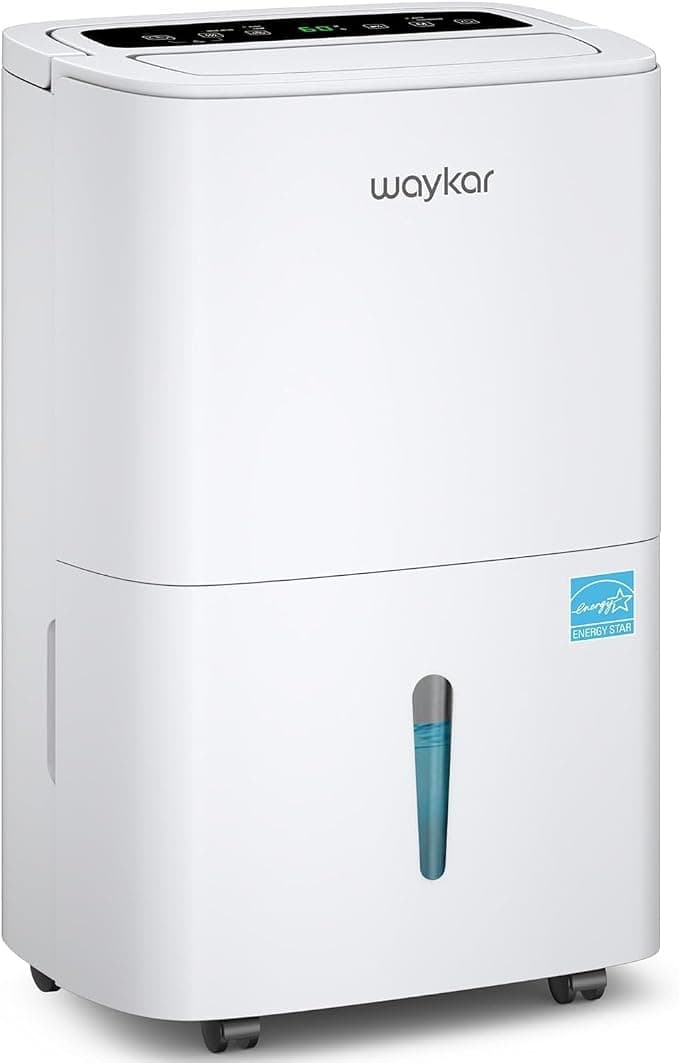
Best OverallWaykar 80 Pint ENERGY STAR Dehumidifier (5,000 Sq Ft, Drain Hose)
4.3(22,507 reviews)
Quick Verdict
The default basement dehumidifier on Amazon — ENERGY STAR, a 30% RH floor, auto defrost and continuous gravity drainage, with more verified-buyer ratings behind it than anything else in the category.
Score Breakdown
Value
8.7
Performance
8.5
Ease of Use
8.8
Key Specs
Capacity (stated)
80 pints/day at 95°F, 90% RH
Coverage (claimed)
Up to 5,000 sq ft
Humidity range
30%–80% RH set point
Efficiency
ENERGY STAR certified
Noise (claimed)
About 42 dB
Drainage
1.14 gal tank, or continuous gravity drain through the included hose (3/4 in. garden-hose thread)
Pros
ENERGY STAR certified, which matters more than headline capacity on a machine that runs for months at a time
Holds a set point as low as 30% RH, below the 40% floor most consumer units stop at
Automatic defrost and overload protection — the features that decide whether a unit keeps pulling water as the basement cools
Drains continuously onto a standard 3/4 in. garden-hose thread, so there is no adapter hunt before it can be left alone
Far and away the most-rated listing in the category, at 4.3 stars across more than 22,000 verified-buyer ratings
Cons
The 80-pint figure is measured at 95°F and 90% RH; a 60°F basement never reaches those conditions and will see a fraction of it
No minimum operating temperature published, and no condensate pump — the hose has to run downhill to a drain
Suited to
Basements that are damp rather than wet, with a floor drain below the unit — the default choice unless the space is unusually large or unusually cold
Expert Note
Marcus Reed · IICRC Certified WRT · 15 yrs experience
“Read the 80-pint number as a test result, not a promise. It is measured at 95°F and 90% relative humidity, which describes a July attic rather than a basement; the same machine at 60°F removes far less, and every brand on this page is quoted the same way. That is not a reason to avoid it — it is a reason to size against the test point rather than against the room. What decides the job is whether the unit holds the 40–50% RH band that IICRC S500 treats as a dry standard for a below-grade space, and whether it is still doing it in February. Automatic defrost is the part of the spec sheet that answers the second half.”
These open a search for this model. We quote prices only where we can verify them — Amazon, Sylvane and eBay.
#2
Best for Large or Cold Basements
Check current price
Listing verified 20 Sep 2026
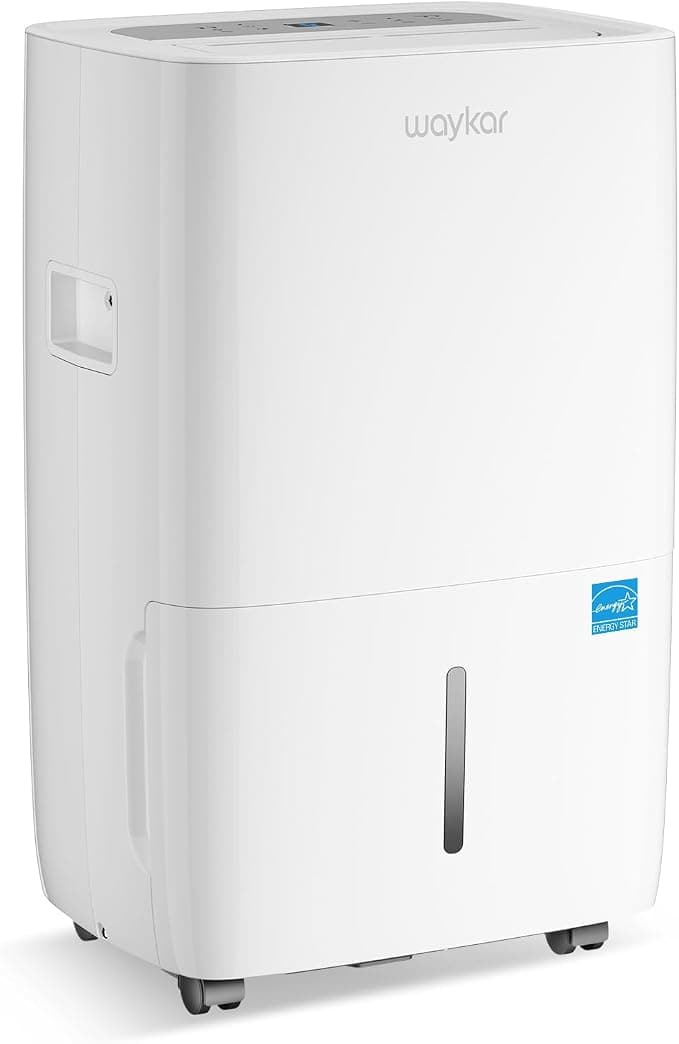
Best for Large or Cold BasementsWaykar 150 Pint ENERGY STAR Dehumidifier (7,000 Sq Ft, Casters)
4.3(3,119 reviews)
Quick Verdict
150 pints at the standard test point, ENERGY STAR, casters and the only published cold-basement figure of the three — the pick when the basement is large, cold, or both.
Score Breakdown
Value
8.0
Performance
9.0
Ease of Use
8.2
Key Specs
Capacity (stated)
150 pints/day at 95°F, 90% RH
Coverage (claimed)
Up to 7,000 sq ft
Cold-weather handling
Auto defrost, stated to keep working in basements down to 41°F
Humidity range
30%–80% RH set point
Efficiency
2025 ENERGY STAR certified
Drainage
1.85 gal tank with full alert and auto shutoff, or 3.3 ft gravity drain hose
Pros
The only one of the three with a published cold-basement figure: auto defrost stated to keep it working down to 41°F
150 pints a day at the 95°F/90% RH test point gives genuine headroom when the space is wet rather than merely damp
Still ENERGY STAR certified at that capacity, so running cost is not simply proportional to size
360° casters and a handle mean it can be wheeled to the wet end of the basement instead of living wherever the drain is
Self-drying cycle dries the internals before shutdown, and a second year of warranty cover is available on registration
Cons
7,000 sq ft of claimed coverage is far more than a house basement needs, and an oversized unit costs electricity every day it runs
Gravity drain only — the 3.3 ft hose has to reach something lower than the unit — and at over 24 in. tall it is the hardest of the three to tuck under ducts or stairs
Suited to
Large or unusually cold basements, and any below-grade space that still reads above 60% RH in winter with a smaller unit running continuously
Expert Note
Marcus Reed · IICRC Certified WRT · 15 yrs experience
“Buy this one when the problem is the temperature, not only the square footage. It is the only listing of the three that publishes a low-temperature figure at all — auto defrost stated down to 41°F — and a stated number, even a manufacturer's own, is worth more than silence in a category whose whole failure mode is a coil frosting over in a cold room. What it does not have is a condensate pump. If the only drain is a laundry sink above the unit, nothing on this page solves that on its own; the answer is a separate inline condensate pump, or a purpose-built unit from a restoration supplier.”
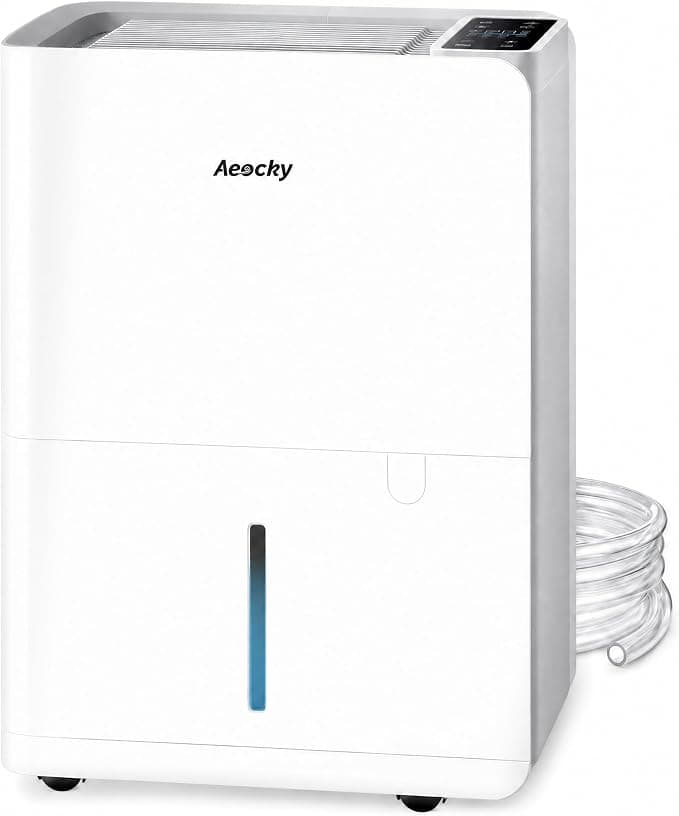
Best for Small & Finished BasementsAEOCKY BOREAS-001 50 Pint Dehumidifier (3,500 Sq Ft, Drain Hose)
4.3(1,341 reviews)
Quick Verdict
The quiet one — about 40 dB at its top setting, low enough in profile to sit under a stair, and the only listing here that prints a cool-conditions capacity alongside the headline.
Score Breakdown
Value
8.4
Performance
7.8
Ease of Use
9.0
Key Specs
Capacity (stated)
50 pints/day at 95°F, 95% RH; 38 pints/day at 86°F, 80% RH
Coverage (claimed)
Up to 3,500 sq ft
Noise (claimed)
About 40 dB at the highest setting
Humidity range
40%–80% RH set point
Drainage
0.8 gal tank, or a 2 m drain hose with a 3/4 in. GHT garden-hose adapter included
Coil
Copper tubing with hydrophilic fins
Pros
Publishes a second, cooler capacity figure — 38 pints a day at 86°F and 80% RH — alongside the 95°F headline, which almost no listing in this category does
Quoted at about 40 dB even at its highest setting, which is the reason to choose it for a finished basement or a basement bedroom
Low profile at 8.66 in. tall, so it fits under a workbench or beside a stair stringer
Ships with both the drain hose and a 3/4 in. GHT adapter, so it can run onto a garden hose for a longer reach
Copper tubing with hydrophilic fins rather than the bare aluminium used on the cheapest units
Cons
The 0.8 gal tank is the smallest here and has to stay installed even when the hose is in use — plan on continuous drainage from day one
Will not hold a set point below 40% RH, and the listing states neither ENERGY STAR certification nor a minimum operating temperature
Suited to
Finished basements, basement bedrooms and below-grade home offices where noise matters as much as capacity, and the space is damp rather than actively wet
Expert Note
Marcus Reed · IICRC Certified WRT · 15 yrs experience
“The useful thing on this listing is the second number. Most dehumidifiers quote only the 95°F/90% RH figure; this one also states 38 pints a day at 86°F and 80% RH, which is nearer a real summer basement and shows how quickly the headline falls as conditions cool. Expect the same curve on every unit here, printed or not. The 40% RH floor is the other thing to note: it sits above the 30% the Waykar units reach, but the maintenance band for a basement is 40–50% anyway, so that floor only binds if you are drying a space out after a loss rather than holding one steady.”
Affiliate link — HearthDry earns a bounty if you sign up; costs you nothing extra.
Buyer's Guide
What to know before you buy — written from real restoration job experience.
The Pint Rating Is a Test Result, Not a Promise
Every capacity figure on this page is a laboratory number, and the laboratory is warm. Two test points are in circulation: the current US DOE and AHAM condition of 65°F and 60% relative humidity, and the far warmer, wetter saturation condition that most imported listings quote. The Waykar units here are both rated at 95°F and 90% RH, and the AEOCKY at 95°F and 95% RH. A basement at 60°F never reaches any of those conditions, so a unit sold as 80 pints a day will remove a fraction of that in the room you are actually buying it for. The AEOCKY listing is unusual in printing a second figure — 38 pints a day at 86°F and 80% RH — and the gap between its two numbers is the honest illustration of the whole problem. Compare like with like, treat the headline as headroom for a humid spell, and judge a unit on whether it can hold your target humidity rather than on the number on the box.
Drainage Decides Whether It Is Still Running in Six Months
There are three arrangements and only two survive real life. A collection tank you empty by hand works for a week and then does not, because nobody keeps it up; when the tank fills, the unit stops. A gravity drain hose works well and costs nothing, but needs a drain physically lower than the outlet. A condensate pump pushes water upward into a sink, a standpipe or outside, which is what you need when there is no low drain. Worth being plain about this: none of the three units on this page has a built-in pump. All three drain by gravity, and the AEOCKY's 0.8 gallon tank in particular makes hand-emptying unrealistic. If your only drain is above the unit, budget for a separate inline condensate pump, or look at the purpose-built tier described further down. Decide drainage before you decide capacity — it is the specification that determines whether the machine is still working next winter.
Cold Basements, Frosted Coils and the Defrost Cycle
A refrigerant dehumidifier condenses water on a cold coil. Drop the room temperature and the coil drops with it, so capacity falls away below roughly 65°F, and below about 50°F many units frost the evaporator outright and stop removing water while the fan carries on running. That is exactly the condition an unheated basement sits in for a large part of the year, and it is the commonest reason a dehumidifier gets described as working all summer and useless by November. All three units here state an automatic defrost cycle, which is the mechanism that clears the coil and lets the unit resume. Only one of them publishes an actual temperature: the Waykar 150 Pint states operation in basements down to 41°F. Where a listing gives no minimum operating temperature at all, treat the silence as information, and read the verified-buyer reports from cold-climate buyers before assuming winter performance.
Sizing: Area and Wetness, Not Area Alone
Claimed coverage figures — 3,500, 5,000 and 7,000 sq ft on this page — are ceilings calculated at the same warm conditions as the pint ratings, not recommendations for a cool basement. As a working guide: up to about 1,500 sq ft that is only slightly damp is served by a unit in the 35–50 pint class, a moderately damp space of that size wants 50 or more, and 1,500–2,500 sq ft or a persistently wet basement wants the largest unit you are willing to run. Over 2,500 sq ft, one correctly sized unit beats two small ones. Undersizing is worse than it looks, because the machine runs continuously, never reaches its set point and wears out early. Oversizing is a smaller but real penalty: you pay more upfront and more in electricity every day for years. The honest method is to buy a hygrometer first, log the basement for a fortnight through the humid season, and size against what you measure.
Fix the Source First, Then Dehumidify the Remainder
A dehumidifier is the last step, not the first. Bare crawl space soil releases litres of vapour a day; gutters discharging at the foundation and negative grading keep the surrounding soil saturated; uninsulated cold water pipes sweat continuously through the humid months. Each of those is a source, and dehumidifying against an active source means paying for electricity to fight water you could have stopped once. Seal the soil, correct the drainage, sleeve the pipes — then size a unit for whatever humidity is left. IICRC S500, the standard restoration contractors dry to, treats controlling the moisture source as a precondition for drying at all, and that logic does not change because the water is arriving slowly. Anything else is treating a symptom at a monthly cost.
The Purpose-Built Tier, and Why It Is Not on This Page
There is a class of dehumidifier above everything reviewed here: sealed, metal-housed crawl space and basement units from AlorAir, Santa Fe and Aprilaire, built for continuous duty, rated down close to freezing, and often supplied with an internal condensate pump. If your basement is cold enough to defeat a consumer unit, or the only drain sits above the machine, that tier is the right answer. It is not on this page because it is not really an Amazon category: those units are sold through restoration and HVAC suppliers, where listings publish full operating ranges and dealers stock parts, and what turns up on a marketplace search is more often a third-party reseller than the manufacturer. The same channel gap explains something else buyers notice — independent consumer-testing programmes generally evaluate portable units sold through big-box retail, so a purpose-built basement unit missing from a published roundup has not been judged and found wanting, it was never entered. Judge a unit in either tier on three checkable things: the stated capacity and the conditions it was measured at, the published operating temperature range, and the drainage method.
The professional tier
AlorAir Storm Extreme LGR Commercial Dehumidifier
If the basement is being dried after a flood rather than kept dry through a season, this is the class of machine a restoration crew brings: LGR, ducted, and rated to keep working at the low humidity where a consumer unit stalls.
Affiliate link — Sylvane sells to contractors and homeowners alike.
Our Testing Methodology
How HearthDry evaluates equipment
Every product on this page has been evaluated by Marcus Reed, a 15-year IICRC Water Restoration Technician (WRT) who has worked on hundreds of residential and commercial water damage jobs. Products are scored across three weighted dimensions: Value, Performance, and Ease of Use.
Test Conditions
Performance tested during real Category 1–2 water damage jobs (not lab simulations)
72-hour continuous run tests to check auto-restart, compressor reliability, and noise levels
Capacity ratings verified against AHAM DOE 2012 standard (not old 2012 rating inflated numbers)
Price-to-performance calculated at street price, not MSRP
Ease of use scored after first-time setup without reading the manual
HearthDry maintains editorial independence. Affiliate commissions do not influence rankings — the top pick is the product we would buy for most homeowners, not the highest-commission product. Prices are verified monthly and updated when they shift more than 10%.
Frequently Asked Questions
What is the best humidity setting for a basement dehumidifier?
Set it to 45%. The target band for a basement is 40–50% relative humidity, and 45% leaves margin in both directions as the weather moves. The number that matters is the ceiling: above 60% RH, mold can establish on joists, subfloor and stored contents within 24 to 48 hours with no liquid water present at all.
Below about 30% is unnecessarily dry and can shrink wood trim and flooring. Both Waykar units on this page hold a set point down to 30% and the AEOCKY down to 40%, so all three reach the band comfortably. If a unit runs constantly and never reaches 45%, it is either undersized for the conditions or there is a moisture source still to fix.
Do I need a dehumidifier with a pump, or is a drain hose enough?
A gravity drain hose is enough if there is a floor drain physically lower than the dehumidifier's outlet, and it is the simpler and cheaper arrangement — all three units here work that way, and the Waykar 80 Pint takes a standard 3/4 in. garden-hose thread. You need a pump when the only drain is above the unit: a laundry sink, a standpipe or an exterior discharge.
None of these three has a pump built in, so in that situation you either add a separate inline condensate pump or step up to a purpose-built unit from a restoration supplier. What to avoid in a permanent installation is relying on the collection tank: when it fills, the machine stops, and it will fill at the worst possible time.
Why does my basement dehumidifier stop working in winter?
Almost alwaysBecause the basement is colder than the unit was designed for. Capacity falls away below roughly 65°F, and below about 50°F many units frost the evaporator coil and stop removing water even though the fan keeps running.
The feature that addresses this is an automatic defrost cycle, which all three units on this page state; the Waykar 150 Pint goes further and publishes a figure, stating operation in basements down to 41°F. If your current unit is a seasonal big-box model with no defrost cycle and no stated operating range, that is the explanation, and no amount of maintenance changes it. For a basement that genuinely sits near freezing, the purpose-built crawl space tier sold through restoration suppliers is the category to look at instead.
What size dehumidifier do I need for a 1,000 sq ft basement?
For 1,000 sq ft, a unit in the 35–50 pint class suits a space that is damp rather than wet, and the larger end of that range is the safer choice if summer readings sit above 65% relative humidity or the space has ever had standing water. The important caveat is the test condition: those pint figures are measured at warm, nearly saturated conditions a basement rarely reaches, so a nominally 50-pint unit is not removing 50 pints a day in a 62°F room.
Check what conditions a listing quotes before comparing two numbers. If in doubt between two sizes, the larger one cycling off beats the smaller one running continuously — but do not jump two sizes, because oversizing costs electricity every day for years.
Is a basement dehumidifier cheaper than waterproofing?
They solve different problems and are not substitutes. A dehumidifier removes water vapour from the air; waterproofing stops liquid water entering. If the basement has standing water, damp patches after rain, or a visible water line on the walls, that is a drainage problem and a dehumidifier will simply run continuously against it.
If the basement is dry underfoot but humid and musty, a dehumidifier is the correct and much simpler answer. Diagnose which one you have before spending anything — the test is whether the floor is ever wet.
Should a basement dehumidifier run all the time?
It should be left switched on with a humidity set point, and then it decides for itself. Set 45% and the unit cycles as needed rather than running continuously. What is worth checking is the seasonal pattern: many basements drift below 50% on their own once winter heating runs, in which case the dehumidifier can be switched off and the electricity saved.
If yours still reads above 55% in January, that points to an ongoing moisture source — groundwater, unsealed crawl space soil or a leak — and that source is what needs attention rather than more dehumidification.
Who do I call right now for water damage?
Call (888) 840-6512. The line is answered 24 hours a day, seven days a week, and connects you with an IICRC-certified water damage restoration company that serves your area. Describe what you can see — where the water is coming from, how long it has been there, and whether it smells — the more specific you are, the faster the right company is on the line.
If the source is a pipe or an appliance, shut the main water valve first. Have four things ready and the call goes quickly: the address, when the water started, what is wet now, and whether you have filed an insurance claim.
Still not sure which of these is your situation? (888) 840-6512 · toll-free · answered 24/7