Quick answer
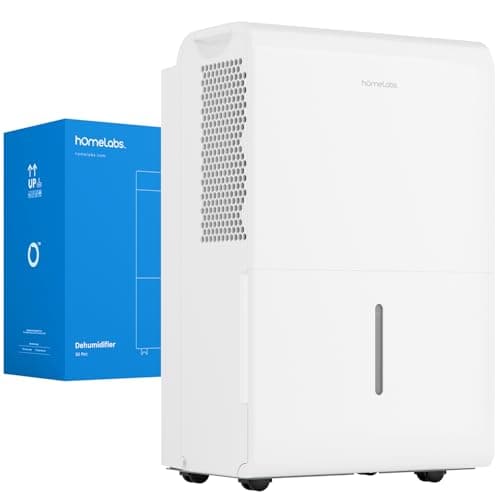
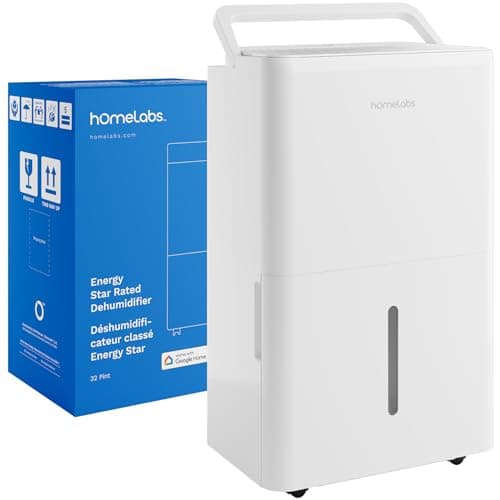
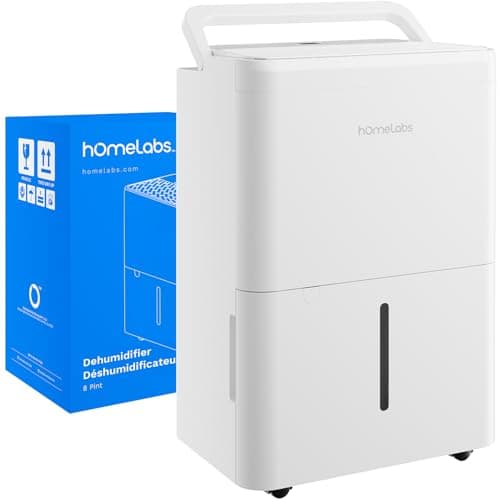
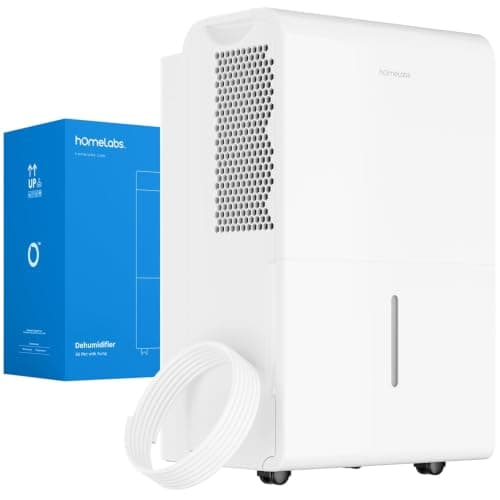
The hOmeLabs dehumidifier to buy depends on where the water goes: for a basement whose nearest drain is a sink or window above the floor, get the hOmeLabs 50 Pint Dehumidifier with Pump, rated 4.6 stars across 15,325 Amazon ratings and listed at 50 pints a day at 80°F and 60% RH. If a floor drain sits beside the unit, the plain hOmeLabs 50 Pint Dehumidifier does the same job through a gravity hose. The hOmeLabs 32 Pint Dehumidifier fits one damp room, and the hOmeLabs 8 Pint Dehumidifier suits a bedroom or closet.
Buyer's Guide
What to know before you buy.
How This Comparison Was Built
Nobody at HearthDry has run these machines. This review is built from the four hOmeLabs listings as read on 12 Oct 2026, the capacity conditions each one prints, ENERGY STAR's sizing guidance and certified-product list, and the buyer ratings Amazon shows on each card. hOmeLabs sells more models than appear here. A 25-pint version shares the 32 Pint's 19.6 x 12.2 x 8.2 in cabinet with less stated capacity, so the 32 is the better use of the same floor space. A 40-pint model with a pump is left out because its buyer reviews are markedly weaker than the rest of the range. Where a spec below says it is not stated, the listing does not give it, so ask hOmeLabs before you buy on that point.
What 50 Pints at 80°F Really Tells You
Every hOmeLabs listing here gives its capacity at 80°F and 60% relative humidity, with a much larger maximum at 95°F and 90%. That 80°F point is the one the older federal test used. ENERGY STAR says the current DOE procedure, in force since June 2019, tests portable dehumidifiers at 65°F instead. Cooler air holds less water, so the same machine reports a smaller number. ENERGY STAR's approximate conversion table lists an old 50-pint portable at about 30 pints on the new test. A hOmeLabs 50 Pint therefore should not be compared one-for-one with another brand's '50 pint, 2019 DOE' label. ENERGY STAR's current certified list, read on 12 Oct 2026, carries two hOmeLabs models: HME0088 at 24.48 pints a day and HME0089 at 32.46. The listing bullets print no model numbers, so match the label on the box.
Pump, Hose or Tank: Match the Model to Your Drain
Drainage decides which hOmeLabs to buy more than capacity does. The 50 Pint with Pump pushes water up and out, so it suits a basement whose nearest drain is a laundry sink or a window. The plain 50 Pint drains by gravity through a hose outlet, which only works when a floor drain or sump pit sits lower than the unit, and its listing says the hose is not in the box. The 32 Pint and 8 Pint include a hose. On every model the tank is the fallback, and each listing that describes it says the unit stops when it is full. A tank of 1 gallon holds 8 pints, so hand-emptying is a plan for a lightly damp room only.
Sizing: Pints, Square Feet and How Damp the Room Is
The square-foot claims on these listings (7,500, 7,000, 4,500 and 1,800) are ceilings, not sizing advice. ENERGY STAR sizes by how damp a space is as well as by its area. For a space under 2,000 sq ft, it suggests 20 to 30 pints a day if the air smells musty now and then, 25 to 40 if it always feels damp with damp spots on walls or floor, and 30 to 50 if walls sweat or water seeps in. Larger spaces need 30, 40 and 50 pints or more for the same three conditions. Against those numbers, the 8 Pint is a one-small-room machine, the 32 Pint covers a damp room or small basement, and either 50 Pint fits a wet or large basement. ENERGY STAR adds that it is better to oversize than undersize.
Who Should Not Buy a hOmeLabs Portable
Skip a portable hOmeLabs, or any portable, in four cases. A crawl space or unheated basement that stays below 65°F is the first: ENERGY STAR warns that frost can form on the coils below that temperature, and none of these listings states a low-temperature rating or a defrost cycle. A home that is damp on every floor is the second, since a whole-home unit on the ductwork handles that better than one machine per room. Standing water or soaked drywall after a leak is the third. Drying a structure takes air movers and larger equipment, the work the IICRC S500 water damage restoration standard covers. The fourth is visible mold over more than about 10 square feet, the size above which EPA's cleanup guide points you to its professional guidance. A dehumidifier helps prevent new growth; it does not remove mold that is already there.
Setting It Up So It Works
Where you put the unit matters as much as which one you buy. ENERGY STAR advises keeping it away from walls and furniture so air can circulate, and closing the doors and windows of the space while it runs. Set the humidity between 45% and 50% rather than as low as it will go: EPA advises keeping indoor humidity below 60%, ideally 30% to 50%, and a lower set point only adds running hours. Clean the filter when the check-filter light or the manual says to, since a clogged filter cuts airflow over the coil. Put a separate hygrometer across the room for the first week, because the unit's sensor reads the air right beside it. A reading that never drops below 60% means the machine is too small or the water source needs fixing.
Free 2-day shipping
Amazon Prime members pay no shipping on restoration equipment
Dehumidifiers, air movers, and moisture meters qualify for free Prime delivery — bulk items that otherwise cost $15–$40 to ship.
Affiliate link — HearthDry earns a bounty if you sign up; costs you nothing extra.