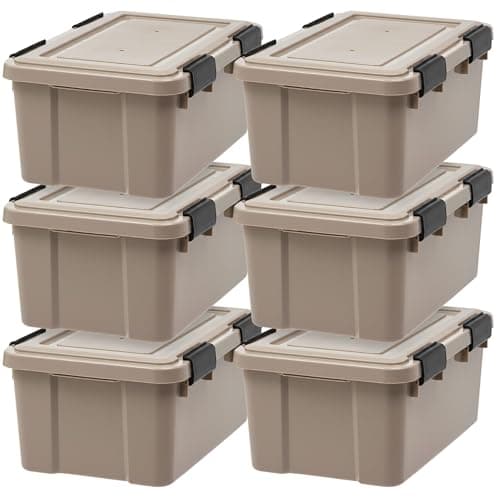
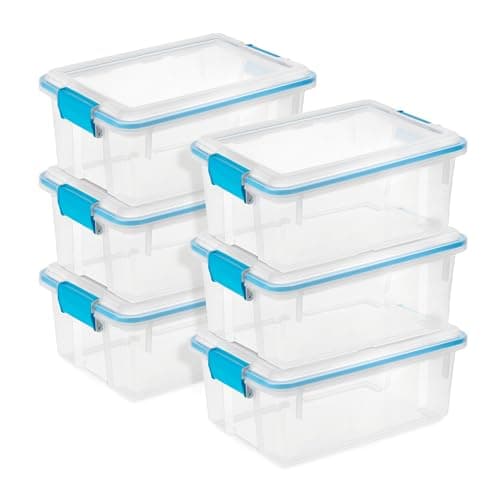
Best for: Documents, photos, manuals and keepsakes stored on a basement or closet shelf
- Capacity:
- 12 qt each, 6 boxes
- Outside (stated):
- 16 1/8 x 11 1/4 x 6 3/4 in
Listing verified 5 Nov 2026

Gasket Totes for Basements and Garages, and Why They Still Belong on a Shelf
4 picks compared · prices, ratings and stock checked October 12, 2026
Our Top Pick
For documents, photos and keepsakes, the Sterilite Gasket Storage Box 12 Quart 6-Pack: a gasket lid, latches, and an inside floor that holds letter-size paper flat. For seasonal clothes and bedding, the IRIS USA WeatherPro 44 Qt 2-Pack has the same gasket-and-buckle design at a larger size.
4.3 on Amazon · 5,876 ratings
Quick answer
For basement or garage storage, buy a bin with a gasket in the lid and latches on every side, and for papers and photos that is the Sterilite Gasket Storage Box 12 Quart 6-Pack, rated 4.3 stars across 5,876 Amazon ratings. Its listing states a gasket seal against air, moisture, dust and pests, and its inside floor of 12 1/2 by 9 in holds letter-size paper flat. No listing here claims the bin can go underwater, so set every bin on a shelf off the floor and keep the room below 60% humidity, as EPA advises.
Every pick below is currently stocked — ratings and stock read from Amazon on 12 October 2026.
Best for: Documents, photos, manuals and keepsakes stored on a basement or closet shelf
Listing verified 5 Nov 2026
Best for: Out-of-season clothes, bedding and linens in a basement or garage
Listing verified 5 Nov 2026
Best for: Hand tools, hardware, car-care supplies and camping gear in a garage or basement
Listing verified 5 Nov 2026
Best for: Sleeping bags, holiday decorations, camping gear and other light, bulky items
Listing verified 5 Nov 2026
How this page was made: we compare the current Amazon listings, the makers' published specs and what verified buyers report, then rank by fit for the job. Ratings, review counts and stock are read from Amazon and dated. We earn a commission on purchases through our links; it does not change the order. Reviewed by Marcus Reed, IICRC-certified Water Restoration Technician.
Full Reviews
Each pick in detail: what the listing states, what buyers report, and where it falls short.
Check price
on Amazon ↗
Listing verified 5 Nov 2026
See it on Amazon ↗Best Overall for Papers and Photos
Quick Verdict
Sterilite Gasket Storage Box 12 Quart 6-Pack: gasket-sealed, latching boxes sized for letter-size papers and photos on a shelf.
Key Specs
Capacity
12 qt each, 6 boxes
Outside (stated)
16 1/8 x 11 1/4 x 6 3/4 in
Inside at the bottom (stated)
12 1/2 x 9 x 5 1/2 in
Seal (stated)
Gasket seal against air, moisture, dust and pests
Lid (stated)
Tight-fitting latches
Waterproof or IP rating
Not stated on the listing
Pros
Cons
Suited to
Documents, photos, manuals and keepsakes stored on a basement or closet shelf
Our take
Small is the point. Paper is heavy and soaks up water, so one big bin of files is hard to lift down from a shelf and puts everything at risk at once. A 12 qt box with an inside floor of 12 1/2 by 9 in holds letter-size paper flat with a little room for folder tabs, and at 5 1/2 in deep it holds a stack you can still carry. Sterilite's listing claims protection against air and moisture as well as dust and pests, which is what a basement shelf needs most of the year. It does not claim to stay dry underwater. For records you cannot replace, scan them, keep the originals upstairs, and use bins like these for the copies.
Affiliate link — commission at no extra cost to you
Compare elsewhere
These open a search for this model. We quote prices only where we can verify them — Amazon, Sylvane and eBay.
Check price
on Amazon ↗
Listing verified 5 Nov 2026
See it on Amazon ↗Best for Seasonal Clothes and Bedding
Quick Verdict
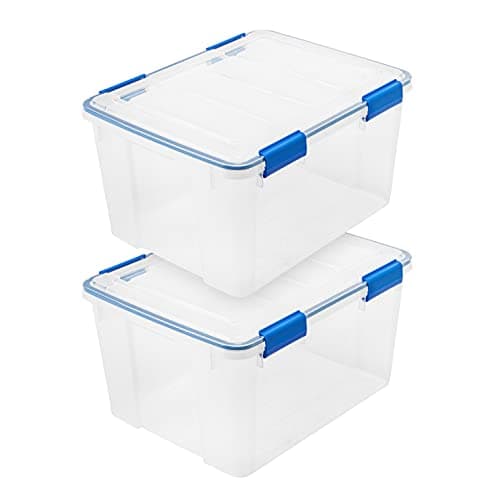
IRIS USA WeatherPro 44 Qt 2-Pack: gasket lids and buckle latches at a size made for folded clothes and bedding.
Key Specs
Capacity
44 qt each, 2 bins
Seal (stated)
WeatherPro gasket in the lid to lock out moisture and dust
Latches (stated)
Multi-buckle latching system
Stacking (stated)
Grooved lid and body
Material (stated)
BPA-free, acid-free and phthalate-free; made in the USA
Dimensions
Not stated on this listing
Pros
Cons
Suited to
Out-of-season clothes, bedding and linens in a basement or garage
Our take
Fabric is where a gasket earns its keep. Clothes and bedding in a basement do not have to touch water to go musty; damp air does it over one summer, and EPA's mold guide even pictures a suitcase grown over with mold in a humid basement. A gasketed lid keeps that air out. It also keeps air in, which is the catch: pack only fabric that is completely dry, because a damp sweater sealed in a bin mildews inside it. A 44 qt size is a sensible ceiling for clothes, roomy enough to be useful and still light enough to lift down from a shelf at chest height. The listing gives no dimensions, so check the size chart against your shelf before ordering.
Affiliate link — commission at no extra cost to you
Compare elsewhere
Check price
on Amazon ↗
Listing verified 5 Nov 2026
See it on Amazon ↗Best for Tools and Garage Hardware
Quick Verdict
IRIS USA 19 Qt Storage Bins with Gasket Lids 6-Pack: fully dimensioned gasket bins for tools and hardware on garage shelves.
Key Specs
Capacity
19 qt each, 6 bins
Outside (stated)
17.50 x 11.75 x 7.88 in
Inside (stated)
14.75 x 9.63 x 7 in
Seal (stated)
Airtight gasket seal in the lid against moisture, dust and dirt
Latches (stated)
Multi-buckle latches
Uses named
Tools, hardware, automotive gear and camping equipment in a garage, shed, basement or truck
Pros
Cons
Suited to
Hand tools, hardware, car-care supplies and camping gear in a garage or basement
Our take
Steel tools and hardware corrode in damp air long before a flood reaches them, so a gasket bin in a garage protects against humidity as much as against water. This IRIS listing is the most complete of the picks: it gives outside and inside dimensions, which lets you plan the shelf before buying. At 17.5 by 11.75 in outside, one sits front to back on an 18 in deep shelf, and two fit side by side in a 24 in wide shelf bay with a little room to spare. The 7 in inside height suits most hand tools and boxed hardware. Add a few silica gel packs with tools, since anything sealed in on a humid day keeps that moisture.
Affiliate link — commission at no extra cost to you
Compare elsewhere
Check price
on Amazon ↗
Listing verified 5 Nov 2026
See it on Amazon ↗Best for Light, Bulky Gear
Quick Verdict
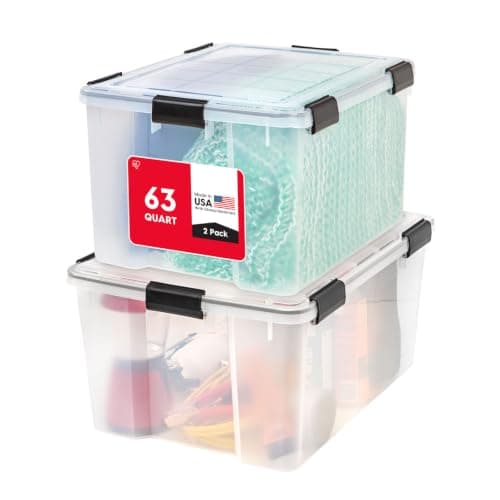
IRIS USA WeatherPro 63 Qt 2-Pack: gasket-sealed large bins for light, bulky gear, not for paper.
Key Specs
Capacity
63 qt each, 2 bins
Seal (stated)
WeatherPro gasket in the lid to lock out moisture and dust
Latches (stated)
Multi-buckle latching system
Stacking (stated)
Grooved lid and body
Material (stated)
BPA-free, acid-free and phthalate-free; made in the USA
Dimensions
Not stated on this listing
Pros
Cons
Suited to
Sleeping bags, holiday decorations, camping gear and other light, bulky items
Our take
A quart is about 58 cubic inches, so a 63 qt bin holds a little over 2 cubic feet. That is the right size for bulk without much weight: sleeping bags, artificial wreaths, a tent, winter coats. It is the wrong size for paper. Packed with books or files, 2 cubic feet can weigh 60 lb or more, too much to lift down from a shelf, and a bin that heavy usually ends up on the floor, the one place it should not be. Keep the weight down and the bin up. The listing gives no dimensions, so measure your shelf and check the size chart; a bin this size may need to sit lengthwise along the shelf rather than front to back.
Affiliate link — commission at no extra cost to you
Compare elsewhere
What to know before you buy.
A latching lid on its own only keeps the lid on. The seal comes from a gasket, a rubber or foam strip in the lid that presses on the rim when the latches close, and every pick here has one. Waterproof is a stronger word than these listings back up: their claims are moisture, dust, dirt and pests. Some bins do carry an IP rating, a code from the IEC 60529 standard in which the second digit covers water: 5 means water jets, 7 means temporary immersion to 1 meter for 30 minutes, and 8 means longer immersion on terms the maker sets. None of the picks here states one, so treat them as protection from damp air, drips and splashes. If a bin has to survive going underwater, look for IP67 or IP68 on the listing, and still keep it off the floor.
Most basement water arrives at floor level, from seepage, a failed sump pump, a water heater or a backed-up floor drain, and an inch or two ruins anything in a box on the slab. Put every bin on shelving with the lowest shelf a few inches up, and keep anything irreplaceable on the upper shelves. Wire or steel shelving lets air move and does not soak up water the way particleboard does. Keep bins a few inches away from outside walls, where condensation forms and seepage starts, and away from the water heater, washer and sump pit. A water sensor on the floor beside the shelves warns you before water reaches the bottom shelf. In a garage, the same rules apply, plus distance from the door, where rain and snowmelt blow in.
Cardboard is paper, and paper pulls in water. A box on a damp slab wicks moisture up from the floor, swells and softens at the base, and stays damp long after the floor looks dry. Humid air does the same thing more slowly. Mold needs moisture and something to feed on, and wet paper supplies both, which is why so many musty basements smell of their stored boxes. EPA's guide notes that molds gradually destroy the things they grow on, and that absorbent or porous materials that become moldy may have to be thrown away. Once a box has gone soft and spotted, whatever sits beside it is at risk too. Moving into plastic is the easy half of the fix; keeping the room dry is the other half.
A gasket works in both directions. Seal a bin on a muggy August day and it holds that August air, and when the garage cools at night, the moisture can condense on the inside of the lid and drip onto the contents. Pack on a dry day or in an air-conditioned room. Make sure everything going in is completely dry: laundered clothes a day out of the dryer, camping gear wiped down after the trip, no damp towels. Add a few silica gel packs to bins holding paper, photos, tools or electronics. Then open each bin once a season and look and smell. A musty smell inside a sealed bin means moisture got in or was sealed in, and the contents need airing out before it spreads.
A quart is about 58 cubic inches and four quarts make a gallon, so a 44 qt bin is 11 gallons, roughly 1.5 cubic feet. Size by weight first. Paper and books are dense, so keep them in bins of about 12 to 20 qt; clothes and bedding suit 40 to 50 qt; light, bulky gear can go in 60 qt and up. Then match bins to the shelf. Steel shelving units commonly come 18 or 24 in deep, so check each bin's outside length and width and decide whether it sits lengthwise or front to back. Leave a few inches between the lid and the shelf above so the lid can lift without pulling the bin out. Stacking two sealed bins is fine; a stack of four topples when you need the bottom one.
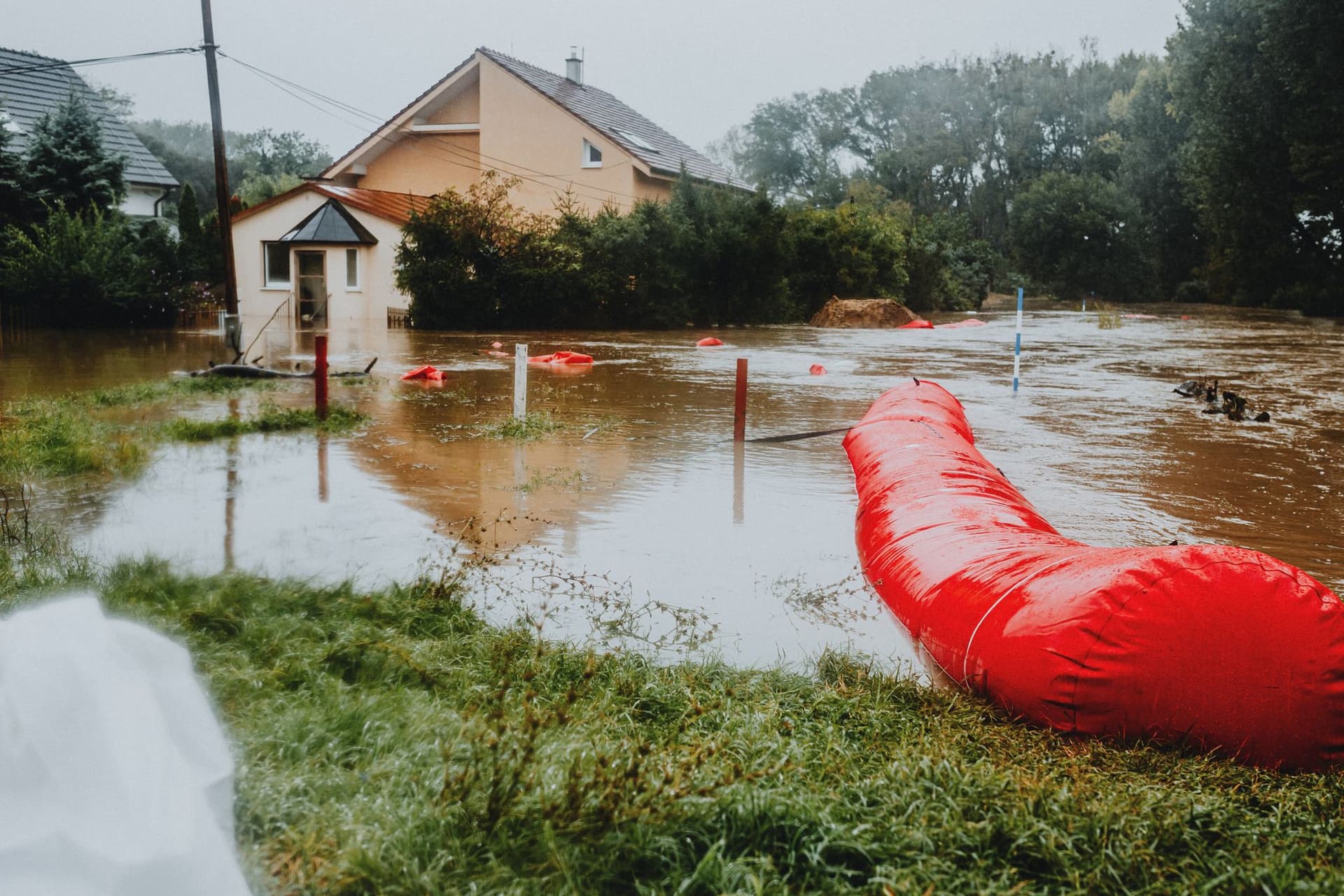
Bins are the wrong answer if the basement floods every spring or sits in a flood zone. None of these listings claims the bin stays sealed underwater, and floodwater can float a half-empty bin, tip it and soak what is inside. Water from a sewer backup or a flood is contaminated, and anything it touches, bin included, needs cleaning or discarding. If water comes in more than once a year, the fix is drainage, a sump pump or grading, not packaging. Irreplaceable things such as birth certificates, deeds, photo albums and hard drives belong upstairs or in a fire- and water-rated safe, with scanned copies kept off-site. And if the basement smells musty with no visible water, a dehumidifier comes before new bins.
Most are not; a standard plastic tote keeps out dust and splashes but lets water in around the lid. Bins with a gasket in the lid and latches on every side seal far better against damp air and dripping water, which is what basement storage needs most of the time.
Even gasket bins are not rated to sit underwater unless the listing gives an IP67 or IP68 rating, and none of the picks on this page does.
IP67 means the bin is dust-tight and protected against temporary immersion in water up to 1 meter deep for 30 minutes. The code comes from the IEC 60529 standard: the first digit rates dust and the second rates water.
IP68 means immersion beyond that, on terms the maker states. A rating describes a test on a new, properly latched seal, so a cracked gasket or an open latch cancels it.
YesIf the clothes go in clean and completely dry, the bin has a gasket seal, and it sits on a shelf.
Basement air is often damp enough to make fabric musty over a single summer, and a gasket keeps that air out. Add a silica gel pack, open the bin each season to check the smell, and keep the basement below 60% humidity with a dehumidifier.
Only when what goes in is dry and the air around the bins stays dry. A sealed bin shuts out the damp air mold needs, unlike cardboard, which soaks up moisture and feeds growth.
A bin packed with damp items, or one that cools enough for condensation to form inside, can still grow mold within. Pack dry, add desiccant, and keep humidity below 60%, the level EPA advises.
At least a few inches for the lowest shelf, and higher for anything you cannot replace. Most basement water arrives at floor level from seepage, a failed sump pump or an appliance leak, and a few inches keeps bins clear of the common small event.
If your basement has flooded deeper before, keep the lowest shelf above that high-water mark and put valuables on the top shelf.
YesFor a basement, garage or attic, when the contents would be harmed by damp, dust or pests.
Papers, photos, fabric, tools and electronics all qualify. Plastic holiday decorations or sports gear that can get wet and be wiped dry do fine in a plain latching tote. A gasket bin is not a flood defense, so it pays off only alongside shelving and humidity control.
Call (888) 840-6512. The line is answered 24 hours a day, seven days a week, and connects you with an IICRC-certified water damage restoration company that serves your area. A recorded menu picks up first: choose water damage or mold, key in your 5-digit ZIP code, and hold through the short silence while the call is passed to the company.
Describe what you can see — where the water is coming from, how long it has been there, and whether it smells — the more specific you are, the faster the right company is on the line. If the source is a pipe or an appliance, shut the main water valve first. Have four things ready and the call goes quickly: the address, when the water started, what is wet now, and whether you have filed an insurance claim.
Still not sure which of these is your situation? (888) 840-6512 · toll-free · answered 24/7
Methodology: How we source and verify data · Report an error
Free 2-day shipping
Amazon Prime members pay no shipping on restoration equipment
Dehumidifiers, air movers, and moisture meters qualify for free Prime delivery — bulk items that otherwise cost $15–$40 to ship.
Affiliate link — HearthDry earns a bounty if you sign up; costs you nothing extra.

Most basement dehumidifier disappointment comes from two numbers nobody reads properly: the pint rating, measured at warm test conditions a 60°F basement never reaches, and the drainage method. Five units are compared here on those two points first, from a garden-hose drain to a built-in pump with a stated 15 ft lift.
Read the comparisonA water leak detector catches a leak while it is still a puddle rather than an insurance claim. These four flood sensors and water alarms range from a standalone 110 dB alarm with no Wi-Fi to a LoRa kit that sounds on the spot and texts your phone.
Read the comparisonA moisture absorber is a no-power container of crystals or gel that draws water out of the air in a small, closed space. It is the right tool for a cabinet, a car or a boat and the wrong one for a basement or a room after a leak, so these picks are sorted by where they will sit.
Read the comparisonA hygrometer is the small, inexpensive instrument that tells you whether a room needs a dehumidifier, a humidifier or nothing at all. These picks are judged on the accuracy each listing states, how easily you can read them, and whether they can warn you about a damp basement before you smell it.
Read the comparisonA garage is the hardest space in a house to dehumidify: it runs cold, it leaks air and it rarely has a drain. These four picks are judged on the specifications that decide whether a unit keeps working there, from a capacity stated at cool conditions and auto defrost to a desiccant option for winter and a hose that reaches a drain.
Read the comparisonA basement floor is where a failed sump pump, a burst pipe or seepage puts water first, and cardboard boxes standing on it soak that water up from the bottom. These steel shelving units are compared on what each listing states about load per shelf, finish and anchoring, with the bottom-shelf height and the moisture fixes that shelving cannot replace.
Read the comparison