Best for: Bins, paint cans and tools along a basement wall where water has rarely or never reached
- Load (stated):
- 350 lb per shelf, evenly distributed; 1,400 lb total
- Size (stated):
- 36 in W x 14 in D x 54 in H
Listing verified 5 Nov 2026

Steel Units Compared on Load per Shelf, Rust and Tip-Over, and How High the Bottom Shelf Should Sit
5 picks compared · prices, ratings and stock checked October 12, 2026
Our Top Pick
For most basements, the Amazon Basics 4-Shelf Steel Wire Shelving, stated at 350 lb per shelf. For heavy tools and full bins along a long wall, the REIBII 5-Tier Wire Shelving, stated at 640 lb per tier. Either way, raise the first shelf at least 6 in off the slab.
4.6 on Amazon · 264,002 ratings
Quick answer
If you need shelving to keep stored things off a basement floor that can get wet, buy open steel wire shelving and set its lowest shelf at least 6 in up; the Amazon Basics 4-Shelf Steel Wire Shelving is the default pick, stated at 350 lb per shelf, evenly distributed, and 1,400 lb in total. It is rated 4.6 stars across 264,002 Amazon ratings. Wire decks let air reach every side of a bin and let drips fall through, and steel does not swell in damp air the way MDF or particleboard does. Anchor any tall unit to the wall, and fix the water source as well.
Every pick below is currently stocked — ratings and stock read from Amazon on 12 October 2026.
Best for: Bins, paint cans and tools along a basement wall where water has rarely or never reached
Listing verified 5 Nov 2026
Best for: Heavy tool boxes, full bins and bulk supplies across a long basement wall
Listing verified 5 Nov 2026
Best for: A narrow wall or alcove where a tall unit has to be anchored
Listing verified 5 Nov 2026
Best for: Light storage you may need to roll away from a wall during a leak or an inspection
Listing verified 5 Nov 2026
Best for: Large lidded totes and bulky items along a long, dry basement wall
Listing verified 5 Nov 2026
How this page was made: we compare the current Amazon listings, the makers' published specs and what verified buyers report, then rank by fit for the job. Ratings, review counts and stock are read from Amazon and dated. We earn a commission on purchases through our links; it does not change the order. Reviewed by Marcus Reed, IICRC-certified Water Restoration Technician.
Full Reviews
Each pick in detail: what the listing states, what buyers report, and where it falls short.
Check price
on Amazon ↗
Listing verified 5 Nov 2026
See it on Amazon ↗Best Overall
Quick Verdict
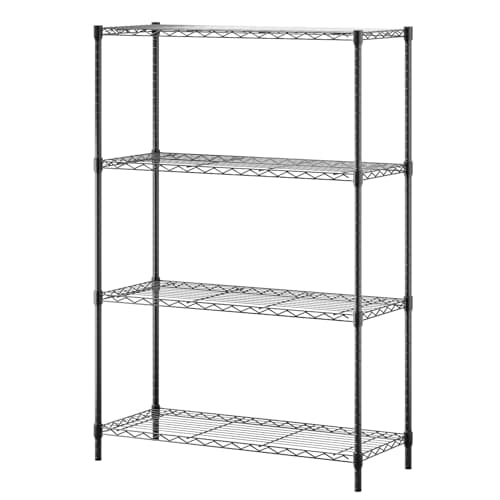
Amazon Basics 4-Shelf Steel Wire Shelving: 350 lb per shelf on open wire decks, though the listing makes no rust claim for its finish.
Key Specs
Load (stated)
350 lb per shelf, evenly distributed; 1,400 lb total
Size (stated)
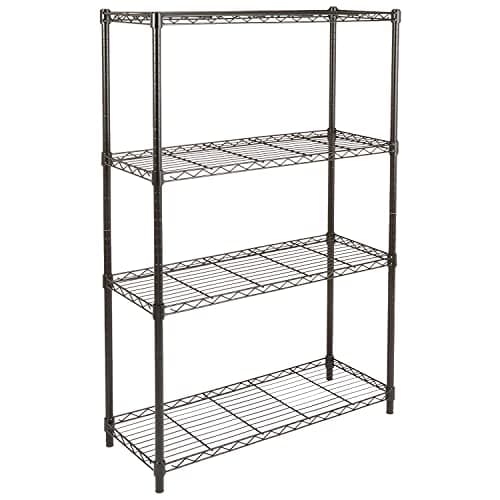
36 in W x 14 in D x 54 in H
Shelves (stated)
4 wire shelves, adjustable in 1 in steps
Material and finish (stated)
Steel with a black finish
Feet (stated)
4 leveling feet
Assembly (stated)
No tools needed
Pros
Cons
Suited to
Bins, paint cans and tools along a basement wall where water has rarely or never reached
Our take
The case for this unit is its load per shelf. Amazon Basics states 350 lb per shelf, evenly distributed, with a 1,400 lb total, and that condition is the one most shelving ratings assume: weight spread across the whole deck, not piled at one end. It comfortably covers bins of books or paperwork, which weigh far more than bins of holiday decorations. Wire decks are the right surface for a basement, because air reaches every side of the bins and drips fall through instead of pooling. The listing makes no rust claim for its black finish, so keep the feet out of standing water and wipe off condensation when you see it.
Affiliate link — commission at no extra cost to you
Compare elsewhere
These open a search for this model. We quote prices only where we can verify them — Amazon, Sylvane and eBay.
Check price
on Amazon ↗
Listing verified 5 Nov 2026
See it on Amazon ↗Best for Heavy Loads
Quick Verdict
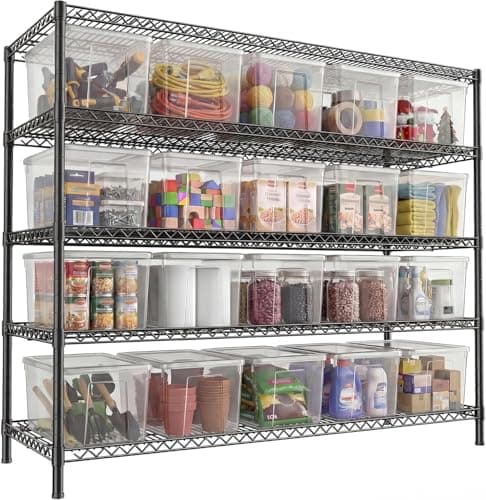
REIBII 5-Tier Wire Shelving: 640 lb per tier and a stated powder coating, for long walls and heavy bins.
Key Specs
Load (stated)
640 lb per tier; 3,200 lb total
Size (stated)
55.5 in W x 18 in D x 71 in H
Shelves (stated)
5 wire tiers, adjustable
Frame (stated)
Heavy-duty steel wire, 25 mm rods, V-type reinforcing braces
Finish (stated)
Powder coating for rust and oxidation resistance
Split use (stated)
Separates into two units, or one becomes a workbench
Pros
Cons
Suited to
Heavy tool boxes, full bins and bulk supplies across a long basement wall
Our take
REIBII states 640 lb per tier and 3,200 lb for the unit, with V-shaped braces under each shelf. Those figures assume the weight is spread evenly, so set the heaviest bins in the middle of a tier rather than at one end. The 18 in depth gives large storage totes more room than the 14 in decks on the smaller units, but measure your bins before ordering. A powder coating for rust and oxidation resistance is stated, and that is the finish you want near a damp slab. At 71 in tall and 55.5 in wide, this rack is too big to leave freestanding: anchor it to the wall before loading the top tiers.
Affiliate link — commission at no extra cost to you
Compare elsewhere
Check price
on Amazon ↗
Listing verified 5 Nov 2026
See it on Amazon ↗Best Tall Unit With a Wall Kit
Quick Verdict
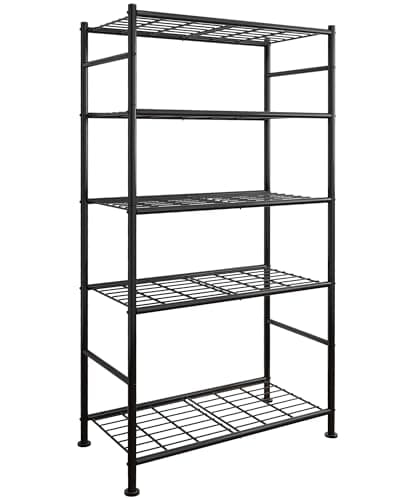
Sakugi 5-Tier Steel Wire Shelving: tall, narrow and the one pick here with a wall kit in the box.
Key Specs
Load (stated)
1,000 lb total; no per-shelf figure stated
Size (stated)
33 in W x 12.6 in D x 72 in H
Shelves (stated)
5 wire tiers
Frame (stated)
Metal tubes 0.9 in across
Stability (stated)
4 non-slip leveling feet and a wall fixing kit
Finish (stated)
A protective finish the listing calls waterproof and rustproof
Pros
Cons
Suited to
A narrow wall or alcove where a tall unit has to be anchored
Our take
Sakugi is the only pick on this page whose listing states a wall fixing kit in the box, and that matters for a 72 in unit standing on a basement slab. Tall, narrow shelving tips easily when someone pulls a heavy bin off a top shelf. The load figure is 1,000 lb for the whole unit with no per-shelf number; spread over five tiers, that averages 200 lb a tier, so keep the heaviest bins low. The listing calls the finish waterproof and rustproof, which is best read as a coated finish rather than a promise. Keep the feet dry and look for scratches after assembly.
Affiliate link — commission at no extra cost to you
Compare elsewhere
Check price
on Amazon ↗
Listing verified 5 Nov 2026
See it on Amazon ↗Best on Casters
Quick Verdict
BestOffice 4-Tier Wire Shelf: feet or casters and a powder-coated finish, best kept for lighter loads.
Key Specs
Load on leveling feet (stated)
250 lb per shelf; 1,000 lb total
Load on casters (stated)
Up to 220 lb, evenly distributed
Size (stated)
36 in W x 14 in D x 54 in H
Shelves (stated)
4 wire tiers, adjustable in 1 in steps
Finish (stated)
Powder coated, described as rust resistant
Assembly (stated)
No tools required
Pros
Cons
Suited to
Light storage you may need to roll away from a wall during a leak or an inspection
Our take
BestOffice offers a choice the other units here do not: leveling feet or casters. On feet the listing states 250 lb per shelf and 1,000 lb in total. On casters the figure drops to 220 lb, and the listing does not say whether that is per shelf or for the whole unit, so plan on the lower reading and keep a rolling shelf for light bins, cleaning supplies and holiday boxes. The reason to roll a basement shelf is access. Cracks and seepage often show on the stretch of wall that stored boxes hide, and a unit you can pull out makes that check quick. The powder-coated finish is stated as rust resistant.
Affiliate link — commission at no extra cost to you
Compare elsewhere
Check price
on Amazon ↗
Listing verified 5 Nov 2026
See it on Amazon ↗Best Deep Shelves for Large Bins
Quick Verdict
SISESOL 4-Tier Heavy Duty Steel Shelving: deep solid steel shelves for big totes, with a total load figure only.
Key Specs
Load (stated)
5,000 lb total; no per-shelf figure stated
Size (stated)
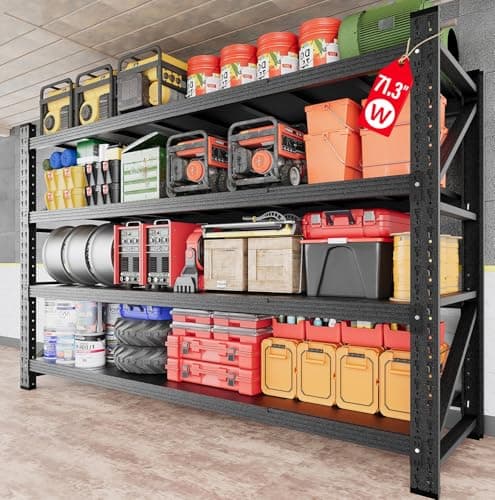
71.3 in W x 24 in D x 70 in H
Shelves (stated)
4 adjustable steel shelves held by locking pins
Frame (stated)
One-piece uprights, reinforced beams, 8 lateral stabilizer bars
Finish (stated)
Anti-corrosion coating
Expansion (stated)
Units can be connected side by side
Pros
Cons
Suited to
Large lidded totes and bulky items along a long, dry basement wall
Our take
SISESOL's shelves are solid steel rather than wire, 24 in deep and 71.3 in wide, which makes this the pick for big lidded totes that would overhang a 14 in deck. The title and bullets state a 5,000 lb total with no per-shelf number and no test condition, so treat it as a sign of a heavy frame rather than a figure to load toward. Solid decks change two things in a basement. They shield the bins below from a drip coming through the ceiling, but they also hold any water that lands on them, so dry them after a leak. An anti-corrosion coating is stated; check the feet for scratches once it is assembled.
Affiliate link — commission at no extra cost to you
Compare elsewhere
What to know before you buy.
Water in a basement starts at the floor. A sump pump that stops during a storm, a water heater that lets go, seepage where the wall meets the slab, or a split washer hose can each spread an inch or two of water across the concrete before anyone goes downstairs. Cardboard boxes standing in it wick the water up from the bottom and pass it to whatever is inside. EPA says water-damaged items should be dried within 24 to 48 hours to prevent mold growth, and boxes stacked at the back of a storage room are rarely found that fast. Even in a basement that never floods, condensation can form on a cold slab and on the foundation walls in humid weather. Shelving handles the simplest part of the problem: it lifts your things off the floor and lets air reach the sides of every box.
Every pick on this page is steel, and four of the five use open wire decks. Wire is the better basement surface because air moves through it and drips fall through it instead of pooling under a bin. Solid steel shelves, like the SISESOL unit's, hold small items better and shield the bins below from a ceiling drip, but they keep any water that lands on them. Look closely at heavy-duty listings that pair a steel frame with MDF boards: MDF is pressed wood fiber, and in damp air or a leak it swells and loses strength, so leave those for a dry garage. Plastic shelving cannot rust at all and is the better choice if standing water reaches your storage area often, though home plastic units usually carry less weight per shelf. Bare wood and particleboard are the poorest choices for a damp basement.
Shelving listings give a total for the unit, and the better ones give a per-shelf figure too: 350 lb per shelf for the Amazon Basics unit and 640 lb per tier for the REIBII. When only a total is stated, divide by the number of shelves for a rough average, so Sakugi's 1,000 lb over five tiers works out to 200 lb a tier. Those ratings assume the weight is spread evenly, the unit is level and every shelf is in place; a load stacked at one end or along the front edge can hold less. Weigh one full bin on a bathroom scale before you plan, because a bin of paperwork or books weighs far more than one of holiday decorations. Put the heaviest bins on the lowest shelf that stays dry, and keep the top shelves for light, valuable things.
Set the lowest shelf at least 6 in above the floor, and higher if your basement has flooded before. Look for the highest water line you have seen, on the foundation wall, the water heater or old boxes, and put the bottom shelf above it. The Amazon Basics and BestOffice units adjust in 1 in steps, so their first shelf does not have to sit at floor level. Keep any unit 2 to 3 in away from the foundation wall so air can move behind the bins, because a cold concrete wall is where condensation forms first. Do not put shelving beside the sump pit, under the water heater's relief valve pipe or below a window well, since those are the spots where water tends to show up first. Use lidded plastic bins instead of cardboard, and keep paper, photos and fabric on the upper shelves.
A loaded 70 in shelving unit is tall and narrow, and it can tip if someone climbs it, pulls a heavy bin off the top shelf or bumps it with a laundry basket. Anchor the top of the unit to the wall. Sakugi includes a wall fixing kit; the other listings name no anchor, so buy a furniture anti-tip kit for those. Basement walls are usually poured concrete or block, so use concrete screws or masonry anchors rather than the plastic drywall plugs found in many kits, and on a framed wall drive the screw into a stud. Load the heaviest items low, level the unit with its feet before loading, and check the anchors whenever you move the shelves. If children use the basement, anchor every tall unit, not only the heavy ones.
Shelving buys time; it does not dry a wet basement. If water comes in with most heavy rains, the fix is outside and below the floor: gutters and downspout extensions, the grade around the house, a sump pump with a backup, or a waterproofing contractor. If the basement smells musty or a hygrometer reads above 60 percent, a dehumidifier will protect more of what you store than any shelf; EPA advises keeping indoor humidity below 60 percent, ideally between 30 and 50 percent. If boxes have already grown mold, shelving them is the wrong next step. EPA notes that porous materials may have to be thrown away once they become moldy, and that growth covering more than about 10 square feet calls for its fuller remediation guidance rather than a quick wipe-down.
Open steel wire shelving with a coated finish, with its lowest shelf raised at least 6 in. Wire lets air move around stored bins and lets drips fall through, and steel does not swell when the air is damp.
Skip units with MDF or particleboard shelf boards, which are wood fiber and soften when wet. Pair the shelves with lidded plastic bins rather than cardboard boxes.
Metal is better for heavy loads, and plastic is better where the floor floods. Coated steel carries much more weight per shelf, but a scratched leg standing in water can rust.
Plastic cannot rust and wipes clean, though home plastic units usually hold less and their shelves can bow under a constant heavy load. Every pick on this page is steel; choose plastic if standing water reaches your storage area more than once.
At least 6 in for the lowest shelf, and higher if your basement has flooded before. Find the highest water line you have seen, on a wall, the water heater or old boxes, and set the bottom shelf above it.
Use that shelf for things that tolerate water, such as sealed plastic bins or hand tools, and keep paper, photos and fabric on the upper shelves.
They can, where the finish is scratched or where a leg sits in water. Powder-coated and plated steel resist rust while the coating is whole, and rust tends to start at the feet, at cut ends and at scratches made during assembly.
Keep the feet out of puddles, touch up chips with paint, and hold basement humidity under 60 percent, the upper limit EPA advises for homes.
YesAny tall unit should be, especially one 70 in or more in height.
A loaded shelf can tip when someone climbs it or pulls a heavy bin from the top. Basement walls are usually poured concrete or block, so use concrete screws or masonry anchors, not drywall plugs. Of the picks here, only the Sakugi listing states a wall fixing kit in the box.
As much as its listing states per shelf, under the conditions it states, which usually means weight spread evenly with the unit level. On this page the stated figures run from up to 220 lb for the BestOffice unit on casters to 640 lb per tier for the REIBII.
A total divided by the number of shelves gives a rough per-shelf average, but a shelf loaded at one end or on its front edge can hold less.
Call (888) 840-6512. The line is answered 24 hours a day, seven days a week, and connects you with an IICRC-certified water damage restoration company that serves your area. A recorded menu picks up first: choose water damage or mold, key in your 5-digit ZIP code, and hold through the short silence while the call is passed to the company.
Describe what you can see — where the water is coming from, how long it has been there, and whether it smells — the more specific you are, the faster the right company is on the line. If the source is a pipe or an appliance, shut the main water valve first. Have four things ready and the call goes quickly: the address, when the water started, what is wet now, and whether you have filed an insurance claim.
Still not sure which of these is your situation? (888) 840-6512 · toll-free · answered 24/7
Methodology: How we source and verify data · Report an error
Free 2-day shipping
Amazon Prime members pay no shipping on restoration equipment
Dehumidifiers, air movers, and moisture meters qualify for free Prime delivery — bulk items that otherwise cost $15–$40 to ship.
Affiliate link — HearthDry earns a bounty if you sign up; costs you nothing extra.

Most basement dehumidifier disappointment comes from two numbers nobody reads properly: the pint rating, measured at warm test conditions a 60°F basement never reaches, and the drainage method. Five units are compared here on those two points first, from a garden-hose drain to a built-in pump with a stated 15 ft lift.
Read the comparisonA water leak detector catches a leak while it is still a puddle rather than an insurance claim. These four flood sensors and water alarms range from a standalone 110 dB alarm with no Wi-Fi to a LoRa kit that sounds on the spot and texts your phone.
Read the comparisonThe right sump pump prevents basement flooding before it starts — and handles it fast when it happens. These are the 3 best sump pumps for basement flooding in 2026, tested and ranked by an IICRC-certified water damage restoration technician.
Read the comparisonA hygrometer is the small, inexpensive instrument that tells you whether a room needs a dehumidifier, a humidifier or nothing at all. These picks are judged on the accuracy each listing states, how easily you can read them, and whether they can warn you about a damp basement before you smell it.
Read the comparisonA moisture absorber is a no-power container of crystals or gel that draws water out of the air in a small, closed space. It is the right tool for a cabinet, a car or a boat and the wrong one for a basement or a room after a leak, so these picks are sorted by where they will sit.
Read the comparisonGasket bins with latching lids keep basement damp, dust and pests away from what you store, but none of the listings here claims the bin can sit underwater, so where you put it matters as much as which you buy. These picks are compared on gasket, latches and size as each listing states them, with the shelf height, packing and humidity habits that keep the contents dry.
Read the comparison