
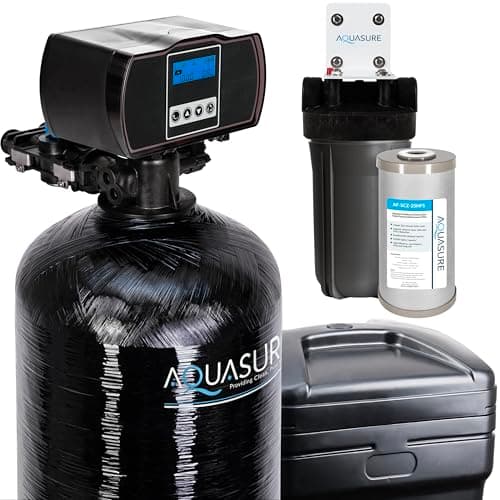
Best for: A 3 to 4 bathroom home with tested hard water and room for a brine tank near the main line
- Rated capacity (stated):
- 48,000 grains of hardness
- Home size (stated):
- Designed for 3 to 4 bathrooms
Listing verified 13 Oct 2026

Salt-Based Softeners Sized by Grain Capacity, the Salt-Free Option That Does Not Soften, and the Drain Line That Can Leak
5 picks compared · prices, ratings and stock checked October 12, 2026
Our Top Pick
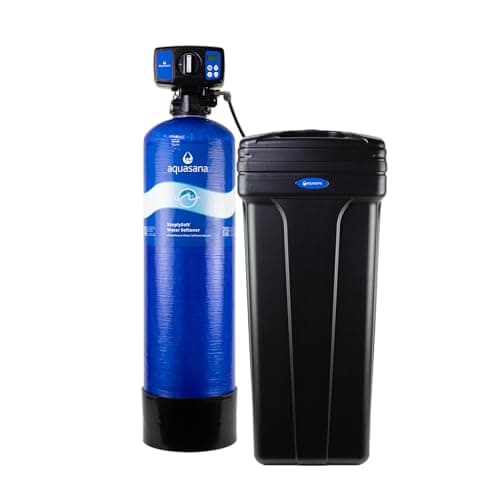
For most homes with 3 or 4 bathrooms, the Aquasure Harmony Series 48,000 Grain Whole House Water Softener, with a metered digital control head. If you want a stated NSF/ANSI 44 certification, the Aquasana SimplySoft 40,000 Grain Whole House Water Softener.
4.4 on Amazon · 3,209 ratings
Quick answer
The best water softener for most homes is a salt-based ion exchange unit sized to your hardness and daily water use; for a household with 3 to 4 bathrooms, that is the Aquasure Harmony Series 48,000 Grain Whole House Water Softener, rated 4.4 stars across 3,209 Amazon ratings. Test your water first. Multiply hardness in grains per gallon by the gallons you use each day, and pick a size that runs about 7 days between regenerations. If you cannot add a drain line or handle salt, a salt-free conditioner limits scale, but it does not remove hardness.
Every pick below is currently stocked — ratings and stock read from Amazon on 12 October 2026.
Best for: A 3 to 4 bathroom home with tested hard water and room for a brine tank near the main line
Listing verified 13 Oct 2026
Best for: Buyers who want an independently certified softener for a home of up to 5 people
Listing verified 13 Oct 2026
Best for: A household of 1 to 4 people with moderate hardness and a small utility space
Listing verified 13 Oct 2026
Best for: Moderate hardness under 15 grains per gallon where salt, a drain or power is not an option
Listing verified 13 Oct 2026
Best for: A 4 to 6 bathroom home, or very hard well water with dissolved iron
Listing verified 13 Oct 2026
How this page was made: we compare the current Amazon listings, the makers' published specs and what verified buyers report, then rank by fit for the job. Ratings, review counts and stock are read from Amazon and dated. We earn a commission on purchases through our links; it does not change the order. Reviewed by Marcus Reed, IICRC-certified Water Restoration Technician.
Full Reviews
Each pick in detail: what the listing states, what buyers report, and where it falls short.
Check price
on Amazon ↗
Listing verified 13 Oct 2026
See it on Amazon ↗Best Overall
Quick Verdict
Aquasure Harmony Series 48,000 Grain Whole House Water Softener: the deepest buyer record here, a metered control head, and capacity sized for a 3 to 4 bathroom home.
Key Specs
Rated capacity (stated)
48,000 grains of hardness
Home size (stated)
Designed for 3 to 4 bathrooms
Control (stated)
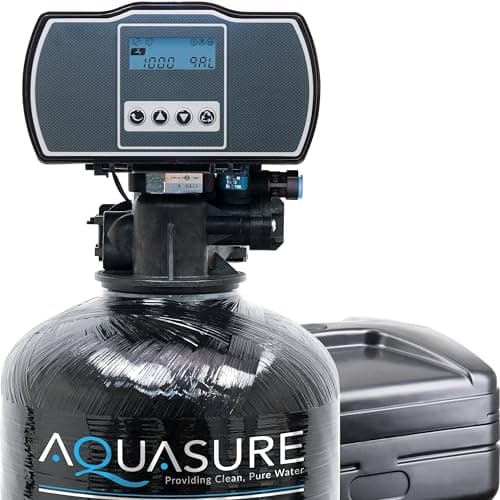
Programmable metered digital control head with backlit display
Tank (stated)
Fiberglass-lined polyethylene resin tank with prefilled resin; bypass valve included
Pre-filter (described)
Sediment, carbon and zinc pre-filter described on the listing
Warranty (stated)
5-year extended manufacturer warranty when the product is activated online
Pros
Cons
Suited to
A 3 to 4 bathroom home with tested hard water and room for a brine tank near the main line
Our take
The number to understand here is 48,000 grains. That is how much hardness the resin can hold before it must regenerate, and Aquasure does not say which salt setting that figure assumes. Resin holds less per cycle at thriftier salt settings, so treat 48,000 as the ceiling. Take a family using 300 gallons a day on 12 grain water: 3,600 grains go into the resin daily, which is about 13 days at the full rating and still more than a week at a lower setting. The metered head counts gallons and regenerates only when the resin is close to full, which wastes less salt and water than a timer. Ask Aquasure for the flow rate if several showers often run at once.
Affiliate link — commission at no extra cost to you
Compare elsewhere
These open a search for this model. We quote prices only where we can verify them — Amazon, Sylvane and eBay.
Check price
on Amazon ↗
Listing verified 13 Oct 2026
See it on Amazon ↗Best Certified Pick
Quick Verdict
Aquasana SimplySoft 40,000 Grain Whole House Water Softener: stated NSF/ANSI 44 certification and metered salt savings, with low stock and a shorter buyer record.
Key Specs
Rated capacity (stated)
40,000 grains
Home size (stated)
Up to 5 people and 4 bathrooms
Certification (stated)
IAPMO certified to NSF/ANSI Standard 44 for hardness reduction, and to CSA B483.1
Salt and water use (stated)
Can be set to use 50% less salt and 28% less water in metered mode than standard time-based softeners
Water source (stated)
City or well water
Format (stated)
Base tank and cabinet system with an LCD control
Pros
Cons
Suited to
Buyers who want an independently certified softener for a home of up to 5 people
Our take
Aquasana's listing gives the detail most softener listings skip: certification by IAPMO to NSF/ANSI Standard 44, the third-party standard for residential softeners. That means someone other than the maker has checked the hardness reduction claim. The 40,000 grain rating sits a little below the Aquasure, yet Aquasana rates it for up to 5 people and 4 bathrooms, so run your own hardness and usage numbers rather than going by bathroom count. Use the metered mode; the listing says it can cut salt by 50% and water by 28% against timer-based softeners. Budget for the pre-filter kit Aquasana recommends, especially on well water that carries sand or sediment.
Affiliate link — commission at no extra cost to you
Compare elsewhere
Check price
on Amazon ↗
Listing verified 13 Oct 2026
See it on Amazon ↗Best for Smaller Households
Quick Verdict
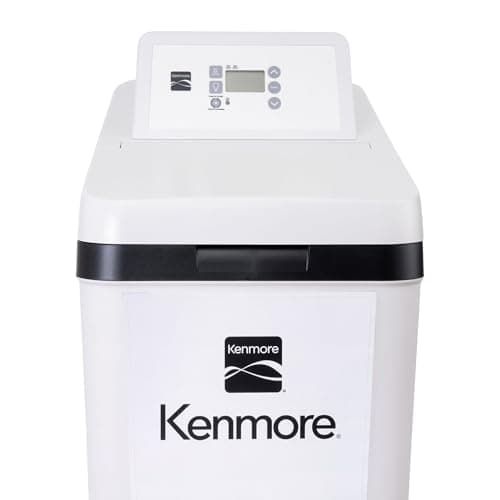
Kenmore 350 Whole House Water Softener: 32,000 grains for 1 to 4 people, with a salt level display and demand-based regeneration.
Key Specs
Rated capacity (stated)
32,000 grains
Household size (stated)
1 to 4 people
Control (stated)
IntelliSoft: learns household water use and regenerates only when needed
Valve (stated)
3/4 in high-flow valve
Display (stated)
Shows flow rate and salt level
Iron (stated)
Helps reduce clear water iron; no ppm limit given
Pros
Cons
Suited to
A household of 1 to 4 people with moderate hardness and a small utility space
Our take
Kenmore sizes this one by people rather than bathrooms: 32,000 grains for 1 to 4 people. That covers a couple on hard water easily, and a family of four on moderate hardness. At 10 grains per gallon and 250 gallons a day, the resin takes on 2,500 grains daily, close to 13 days at the full rating. The IntelliSoft control learns your daily use and regenerates when the resin needs it. The salt level display is a small feature that heads off a common failure, a softener that quietly runs out of salt and passes hard water for weeks. Read the warranty layers too: one year on the whole unit, three on electronics and ten on the tank.
Affiliate link — commission at no extra cost to you
Compare elsewhere
Check price
on Amazon ↗
Listing verified 13 Oct 2026
See it on Amazon ↗Best Salt-Free Scale Control
Quick Verdict
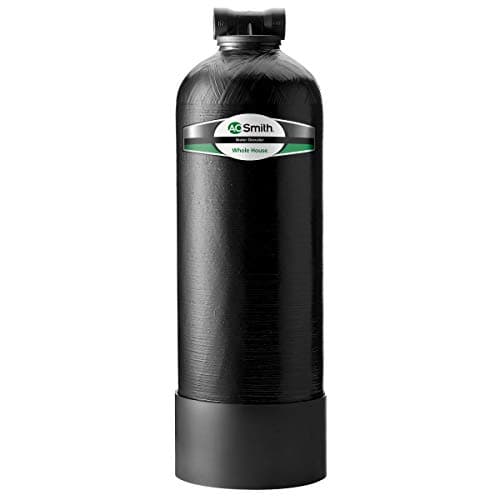
A. O. Smith Whole House Salt-Free Scale Control: no salt, drain or power, inside stated water limits, and by its own listing not a softener.
Key Specs
Type (stated)
Salt-free descaler; does not soften water or remove hardness minerals
Water limits (stated)
Hardness under 15 grains per gallon, alkalinity under 250 mg/L, pH under 8.3, iron under 0.3 ppm
Service life (stated)
Up to 6 years or 600,000 gallons
Upkeep (stated)
No salt, backwashing, cleaning or electricity
Household (stated)
Households of 4 or more people; well or city water
In the box (stated)
Descaler, shut-off valve, hose adapter and nipple; a pre-filter is recommended
Pros
Cons
Suited to
Moderate hardness under 15 grains per gallon where salt, a drain or power is not an option
Our take
Read this listing's first line before buying. A. O. Smith says the descaler reduces scale build-up but does not soften water or remove the minerals that cause hardness, which is an honest description of a salt-free conditioner. The calcium and magnesium stay in the water, and the system's job is to reduce how much of them sticks as scale in pipes and fixtures, so a hardness test reads about the same afterward. It works only inside stated limits: under 15 grains per gallon, alkalinity under 250 mg/L, pH under 8.3 and iron under 0.3 ppm. If your test sits inside all four and you want no salt, no drain and no power, it is a sensible choice. Otherwise, buy an ion exchange softener.
Affiliate link — commission at no extra cost to you
Compare elsewhere
Check price
on Amazon ↗
Listing verified 13 Oct 2026
See it on Amazon ↗Best for Large Homes With Iron
Quick Verdict
Aquasure Harmony Series 70,000 Grain Whole House Water Softener: capacity for 4 to 6 bathrooms and a stated iron figure, oversized for small homes.
Key Specs
Rated capacity (stated)
Up to 70,000 grains
Home size (stated)
4 to 6 bathrooms
Iron (stated)
Prefilled fine mesh resin reduces iron by up to 10 ppm
Pre-filter (stated)
Triple-purpose pre-filter
Control (stated)
Programmable metered digital control head with backlit display
Warranty (stated)
5-year extended manufacturer warranty when activated online within 60 days
Pros
Cons
Suited to
A 4 to 6 bathroom home, or very hard well water with dissolved iron
Our take
70,000 grains is the size for a big household or very hard water. Picture a family of six using 450 gallons a day on 20 grain water. At 9,000 grains a day, a 48,000 grain unit would need to regenerate about every five days at its full rating, and sooner at a thrifty salt setting, while this model runs close to 8 days. Iron is the other reason to choose it. Aquasure says its fine mesh resin reduces iron by up to 10 ppm, a figure the 48,000 grain listing does not give. Iron also uses up softening capacity, so size up when your test shows it, and change the pre-filter on schedule so sediment does not foul the resin.
Affiliate link — commission at no extra cost to you
Compare elsewhere
What to know before you buy.
Hard water carries dissolved calcium and magnesium. Heat drives those minerals out of solution, so the worst scale forms where water gets hot: the bottom of a tank water heater, its heating element, the dishwasher and the washing machine. A crust on the tank floor sits between the water and the heat source, so the heater works harder for the same hot water. Scale also narrows aerators and showerheads and builds up inside toilet fill valves and appliance inlet valves, which can then stop sealing and drip. A salt-based softener fixes the cause. Water passes through a tank of resin beads that trade sodium for the hardness minerals, a process called ion exchange. When the beads are full, the softener rinses them with brine from the salt tank and flushes the minerals down a drain.
Start with a number. A hardness test kit or your water utility's annual quality report gives hardness in grains per gallon (gpg) or in mg/L, also written ppm; divide mg/L by 17.1 to get gpg. Next, find your daily use: take the gallons on a water bill and divide by the days in the billing period. Multiply the two. A home using 300 gallons a day on 12 gpg water puts 3,600 grains a day into the resin. Divide a softener's rated grains by that figure to see how many days it runs between regenerations, and aim for about a week. Two things push you a size up. The headline grain figure is usually what the resin removes at its highest salt setting, and it removes fewer grains per cycle at thriftier settings. Iron in the water uses up capacity as well.
Only ion exchange removes hardness. A salt-free conditioner leaves the calcium and magnesium in the water and aims to stop them sticking as scale. A. O. Smith's listing says so directly: its descaler does not soften water or remove the minerals that cause hardness, and it is meant for water under 15 gpg with alkalinity under 250 mg/L, pH under 8.3 and iron under 0.3 ppm. Inside those limits, a conditioner needs no salt, no drain and no power, a real advantage in a condo or a home with nowhere to send brine. Outside them, or if you want the slick feel and easy lather of soft water, buy a softener. Check two more things before choosing salt. Some communities, mostly in California, restrict softeners that discharge brine to the sewer. And softened water carries added sodium, so anyone on a sodium-restricted diet should ask their doctor; a plumber can leave the kitchen cold tap unsoftened.
A whole-house softener goes on the main line near where water enters the house, after the meter or a well's pressure tank and before the water heater. Many installers leave outdoor spigots on hard water so you are not softening water for the lawn. The softener needs a level floor that never freezes, an outlet for the control head and a drain for regeneration water. Two connections are easy to get wrong. The drain line must be secured where it discharges, and plumbing codes generally require an air gap there so wastewater cannot siphon back. The brine tank has an overflow fitting; run a hose from it to a floor drain, because a stuck float or valve can keep filling the tank. Put a water leak sensor on the floor beside the tanks. Most homeowners should have a plumber cut into the main line, and some towns require a permit.
Skip a softener if your test shows soft or only slightly hard water; the salt, the drain water and the cost buy you very little. Renters usually cannot cut into the main line, so the landlord, who owns the plumbing, has to agree first. A softener is also the wrong tool for safety problems. It is not a disinfection system, and none of the listings here name a certification for removing lead or bacteria, so a well with a failed bacteria test or a home worried about lead needs treatment certified for that contaminant. Water that turns orange in the glass carries oxidized iron, which fouls resin and needs an iron filter first. And if there is already rust around the water heater or a damp patch under it, fix that leak before thinking about scale.
Set the control head to your tested hardness, not the factory default, or the unit will regenerate too often or too late. Check the salt every few weeks and keep it topped up with pellets or crystals made for softeners. A hard crust called a salt bridge can form above the water in the brine tank, so the tank looks full while no brine is being made; push a broom handle down through the salt now and then to break it up. Change any pre-filter on the maker's schedule, because sediment clogs resin. After installation, EPA WaterSense suggests reading your water meter before and after a two-hour period when no water is used; if the meter moves, you probably have a leak, and a softener stuck in regeneration is one place to look.
You need one if a test shows hard water and you are seeing its effects: scale on fixtures, crusty showerheads, spots on dishes or sediment in the water heater.
Get a number first from a test kit or your utility's water quality report, and divide a mg/L figure by 17.1 to read it in grains per gallon. If the water tests soft, a softener adds cost and salt without a matching benefit.
NoA salt-free unit is a conditioner: the hardness minerals stay in the water, and the system aims to reduce how much of them forms scale.
A. O. Smith's listing says its descaler does not soften water or remove the minerals that cause hardness, and it limits the unit to water under 15 grains per gallon. Your water will still test hard afterward. Only an ion exchange softener removes hardness.
Multiply your hardness in grains per gallon by the gallons your home uses a day, then choose a softener whose rated grains last about a week at that rate. At 12 gpg and 300 gallons a day, that is 3,600 grains a day, or about 25,000 grains a week.
Size up from there, because rated capacity assumes the highest salt setting and iron uses capacity too. In that example, a 32,000 to 48,000 grain unit fits.
YesA softener has a drain line for regeneration water, a brine tank with an overflow fitting, a bypass valve and two connections to the main line, and any of them can leak.
A stuck float or control valve can keep filling the brine tank until it spills over. Run the overflow to a floor drain, secure the drain line at an air gap and put a leak sensor beside the tanks. EPA advises drying water-damaged areas within 24 to 48 hours to prevent mold.
Near the main shutoff where water enters the house, after the meter or a well's pressure tank and before the water heater, so the heater gets soft water.
The spot needs a level floor that stays above freezing, an outlet for the control head and a drain for regeneration water. Many installers leave outdoor spigots on hard water. A basement or garage utility area usually fits.
You can if you are comfortable cutting into the main water line, making code-compliant joints and running a drain line with an air gap.
Most homeowners should hire a licensed plumber, because a bad joint on the main line leaks at full house pressure, and some towns require a permit. Whoever installs it, check every joint after the first regeneration and read the water meter for hidden leaks.
Call (888) 840-6512. The line is answered 24 hours a day, seven days a week, and connects you with an IICRC-certified water damage restoration company that serves your area. A recorded menu picks up first: choose water damage or mold, key in your 5-digit ZIP code, and hold through the short silence while the call is passed to the company.
Describe what you can see — where the water is coming from, how long it has been there, and whether it smells — the more specific you are, the faster the right company is on the line. If the source is a pipe or an appliance, shut the main water valve first. Have four things ready and the call goes quickly: the address, when the water started, what is wet now, and whether you have filed an insurance claim.
Still not sure which of these is your situation? (888) 840-6512 · toll-free · answered 24/7
Methodology: How we source and verify data · Report an error
Free 2-day shipping
Amazon Prime members pay no shipping on restoration equipment
Dehumidifiers, air movers, and moisture meters qualify for free Prime delivery — bulk items that otherwise cost $15–$40 to ship.
Affiliate link — HearthDry earns a bounty if you sign up; costs you nothing extra.
Most homeowners do not discover a leak until it has soaked into subfloor and drywall. A Wi-Fi water leak detector sends the alert to your phone while the water is still on the floor, whether or not anyone is home to hear a siren.
Read the comparisonA drain pan sits under a tank water heater and catches drips from valves, fittings and a seeping tank, carrying them to a drain instead of across the floor. These picks are sized against the tank, matched to gas or electric heaters by what each listing states, and paired with an alarm and an automatic shutoff for the leak a pan cannot hold.
Read the comparisonA smart water shutoff closes the supply when it detects a leak, so a burst pipe does not run for hours while nobody is home. The four systems here split into two designs: leak sensors that close the valve you already have, and valves on the main line that watch the flow itself.
Read the comparisonA water pressure regulator comes in two very different kinds: a whole-house pressure reducing valve (PRV) that a plumber fits on the main line, and a small hose-thread regulator for an RV, a camper or a garden hose. These picks say plainly which kind each one is, compared on connection, stated adjustment range and what each listing leaves out, with the gauge test to run first and the expansion tank a PRV can make necessary.
Read the comparisonA water leak detector catches a leak while it is still a puddle rather than an insurance claim. These four flood sensors and water alarms range from a standalone 110 dB alarm with no Wi-Fi to a LoRa kit that sounds on the spot and texts your phone.
Read the comparisonA whole house water filter takes sand, rust and chlorine out at the main line, before the water reaches your fixtures and water heater. These systems are compared on stages, stated flow, bypass valves and the housing details that keep a filter on the main line from turning into a leak.
Read the comparisonAn under-sink reverse osmosis system adds a feed tee, a drain saddle, a faucet and a tank or pump inside the one cabinet nobody looks in, so a slow drip there can go unseen for months. These picks are compared on tank or tankless design, output and drain ratio as stated, NSF/ANSI 58 wording per listing, filter intervals and leak protection, with the checks that keep the cabinet floor dry.
Read the comparison