Quick answer
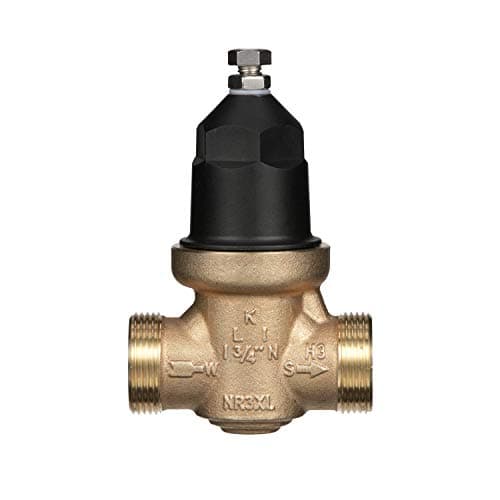
If a gauge on an outdoor faucet reads above 80 psi with no water running, your house needs a whole-house pressure reducing valve on the main line, and for a 3/4 in main that is the Zurn Wilkins 34-NR3XLDU 3/4 in Pressure Reducing Valve, rated 4.6 stars across 1,718 Amazon ratings. Plumbing codes commonly cap static pressure in a home at 80 psi, so check the code where you live. A hose-thread regulator such as the RVGUARD protects only what sits downstream of that hose. Because a PRV closes the system, ask your plumber whether the water heater also needs an expansion tank.
Buyer's Guide
What to know before you buy.
Test First: What Your Pressure Actually Is
Before buying anything, measure. Screw a hose-thread pressure gauge onto an outdoor faucet or the washer's cold valve, make sure nothing in the house is using water, including the washer, dishwasher, ice maker and irrigation, then open the valve fully and read the needle. That is your static pressure. Take readings at a few times of day, including late evening, because street pressure often rises when demand in the neighborhood drops. Plumbing codes commonly limit static pressure inside a home to 80 psi and call for a pressure reducing valve above that, so check the code your town has adopted. If you already have a PRV and the reading creeps upward over weeks, or climbs after a long hot shower, the valve may be failing or the system may need expansion control.
Whole-House PRV or Hose Regulator: Two Different Jobs
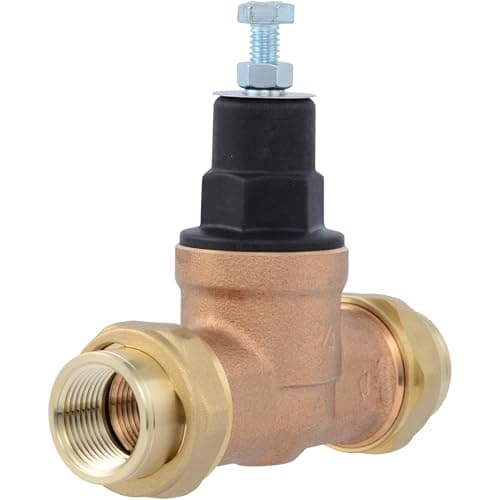
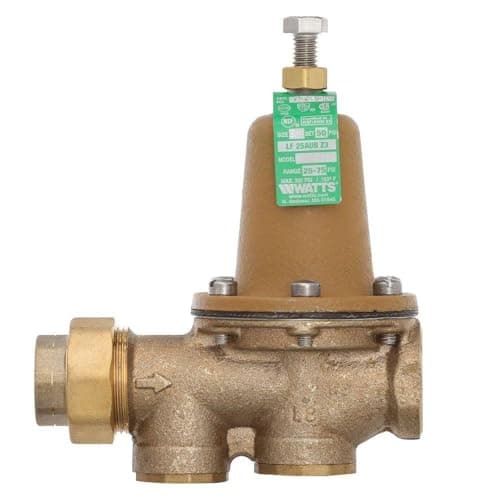
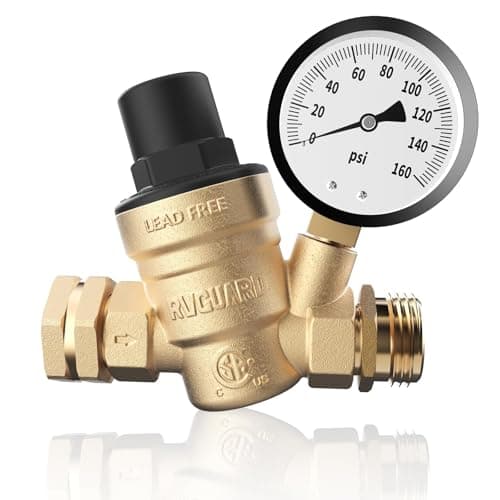
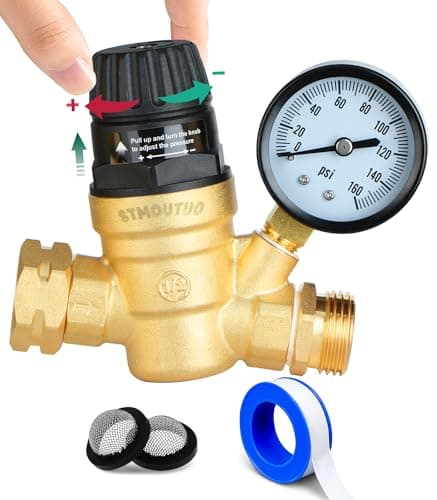
The search term covers two products that do not swap for each other. A whole-house PRV, such as the Zurn, Cash Acme or Watts valves here, is a bell-shaped brass valve on the main line, usually just after the main shutoff where the pipe enters the house. It protects every pipe, fixture and appliance inside, it is sized to the main (often 3/4 in or 1 in), and installing it is plumbing work. The small regulators, the RVGUARD and STMOUTUO, screw onto a spigot and look after only what is connected through that hose: an RV, a camper, a drip line. Neither kind can raise pressure. A regulator only lowers it, so a house with weak flow needs a different diagnosis.
What High Pressure Does to a House
Pressure above the code limit does not usually burst a pipe on the first day. It works on the weak points over months. Washer fill hoses and the braided supply lines under sinks and toilets carry the full pressure every hour of the day. Faucet cartridges and toilet fill valves wear faster, which shows up as drips and a toilet that refills on its own. A water heater's relief valve may weep. Pipes bang when a valve shuts quickly, a sign of water hammer that high pressure makes worse. EPA's WaterSense program suggests a simple leak check: read your water meter before and after a two-hour period when no water is being used, and if the reading changes, a leak is likely.
The Closed System and the Expansion Tank
Most pressure reducing valves stop water from flowing back toward the street, which turns your plumbing into a closed system. That matters every time the water heater runs. Heated water expands, and with nowhere to go, the extra volume raises pressure throughout the house until the water heater's temperature and pressure relief valve opens. A relief valve that drips after hot water use, or a gauge that climbs overnight, points to this. The usual fix is a thermal expansion tank on the cold supply to the water heater, charged to match the house pressure, and plumbing codes commonly require some form of expansion control once a PRV or backflow preventer closes the system. The Watts bypass helps only where water can pass back to the main. Have a plumber install and size both together.
Sizing, Range and Installation Details
Match the valve to your main line, not to the faucet where you took the reading. Homes commonly have a 3/4 in or 1 in main, and Zurn lists its NR3XL in both. Choose ends that suit the pipe: threaded NPT, PEX, copper sweat, CPVC or push-to-connect. Check that the adjustment range covers the setting you want, which is why the Watts listing's 10 to 35 psi range needs confirming before you buy. A built-in strainer is worth having. If a PRV is already installed, try adjusting it before replacing it: on many valves you loosen the locknut and turn the screw clockwise to raise pressure or counterclockwise to lower it, a turn at a time, checking a gauge after each change. Tighten the locknut once the reading settles.
Who Should Not Buy One, and When to Call a Plumber
Skip a regulator if your gauge reads well under the 80 psi line; lowering an already normal pressure buys nothing. It is also the wrong purchase for weak water pressure, because a regulator cannot add pressure. Low flow points to a failing existing PRV, a partly closed main valve, corroded pipes or a supply problem the water utility should check. A home on a private well has its pressure set by the well's pressure switch, so start there. Call a plumber for any main-line installation, any valve soldered in place, an expansion tank, or water leaking from an existing PRV. If a supply line has already burst, the EPA advises fixing plumbing leaks as soon as possible and drying wet areas within 24 to 48 hours to prevent mold.
Free 2-day shipping
Amazon Prime members pay no shipping on restoration equipment
Dehumidifiers, air movers, and moisture meters qualify for free Prime delivery — bulk items that otherwise cost $15–$40 to ship.
Affiliate link — HearthDry earns a bounty if you sign up; costs you nothing extra.