Best Water Heater Expansion Tanks in 2026 — Sized to the Heater and House Pressure, Charged to Match, and Held Up Properly

Best Water Heater Expansion Tanks in 2026

Sized to the Heater and House Pressure, Charged to Match, and Held Up Properly

5 picks compared · prices, ratings and stock checked October 12, 2026

Our Top Pick

For a typical 40 or 50 gallon tank heater, the Eastman 60022 2 Gallon Thermal Expansion Tank, with a stated 40 psi pre-charge, 150 psi and 210°F ratings and a 3/4 in MIP connection. For a bigger heater or higher house pressure, step up to the EFIELD 4.5 Gallon Water Heater Expansion Tank.

4.7 on Amazon · 699 ratings

Quick answer

If a check valve, backflow preventer or pressure-reducing valve on your main makes the plumbing a closed system, your water heater needs an expansion tank on its cold supply; for a typical 40 or 50 gallon heater at ordinary house pressure, makers' charts generally call for about a 2 gallon tank, such as the Eastman 60022 2 Gallon Thermal Expansion Tank, rated 4.7 stars across 699 Amazon ratings. Its listing states a 40 psi factory pre-charge and 150 psi and 210°F ratings. Before installing, read your static water pressure with a gauge and set the tank's air charge to match.

Our Picks at a Glance

Every pick below is currently stocked — ratings and stock read from Amazon on 12 October 2026.

Best for Point-of-Use and Tankless
Eastman 60008 Mini Thermal Expansion Tank (1/2 in MIP, Stainless Steel, for Heaters Storing 2 Gallons or Less)
4.5 from 104 Amazon ratings · checked 12 OctAmazon's Choice

Best for: An under-sink point-of-use heater or a tankless setup on a closed system, where the heater's maker calls for expansion control

Suits (stated):
Tankless or point-of-use water heaters with a storage capacity of 2 gallons or less
Connection:
1/2 in MIP

Listing verified 13 Oct 2026

How this page was made: we compare the current Amazon listings, the makers' published specs and what verified buyers report, then rank by fit for the job. Ratings, review counts and stock are read from Amazon and dated. We earn a commission on purchases through our links; it does not change the order. Reviewed by Marcus Reed, IICRC-certified Water Restoration Technician.

Full Reviews

Each pick in detail: what the listing states, what buyers report, and where it falls short.

#1
Best Overall

Check price

on Amazon ↗

Listing verified 13 Oct 2026

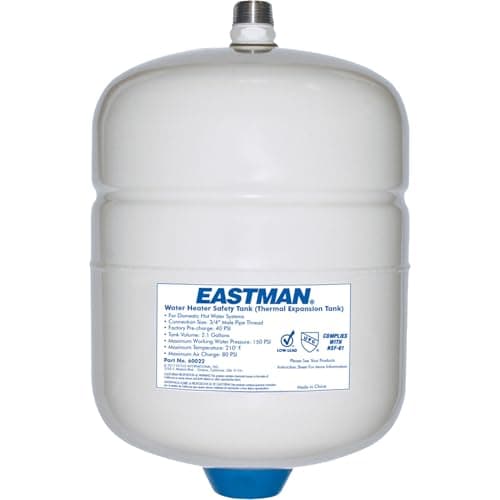
Eastman 60022 2 Gallon Thermal Expansion Tank (3/4 in MIP, 40 psi Pre-Charge, Rated 150 psi and 210°F)See it on Amazon ↗

Quick Verdict

Eastman 60022 2 Gallon Thermal Expansion Tank: the fully specified 2 gallon tank for a typical heater, once its air charge is set to your pressure.

Key Specs

Capacity

2 gallons

Pre-charge (stated)

40 psi from the factory

Ratings (stated)

Up to 150 psi and 210°F

Connection

3/4 in MIP

Construction (stated)

Butyl rubber diaphragm; 304 stainless steel system connection

Warranty (stated)

6-year limited warranty

Pros

  • States every number an installer checks: size, pre-charge, pressure and temperature ratings
  • A 304 stainless steel system connection where the tank meets the water
  • The 3/4 in MIP thread matches the common cold supply size on tank heaters
  • The only warranty term stated on this page, 6 years limited

Cons

  • The 40 psi factory charge is lower than many homes' water pressure, so it usually needs air added
  • No heater-size guidance on the listing itself
  • No mounting bracket included

Suited to

A standard 40 or 50 gallon tank water heater on a closed system at ordinary house pressure

Our take

Eastman's listing gives the numbers that matter for a standard install: 2 gallons, a 40 psi factory pre-charge, ratings of 150 psi and 210°F, a butyl rubber diaphragm and a 304 stainless steel connection on a 3/4 in MIP thread. Treat the 40 psi as a starting point, not a setting. Many homes run higher, and a tank charged below house pressure fills partly with water as soon as it is connected, which uses up room meant for expansion and flexes the diaphragm harder. Read your static pressure with a gauge and add air to match before the tank goes in. Plan a strap or bracket too, since none comes in the box.

Check today's price on Amazon →

Affiliate link — commission at no extra cost to you

Compare elsewhere

These open a search for this model. We quote prices only where we can verify them — Amazon, Sylvane and eBay.

#2
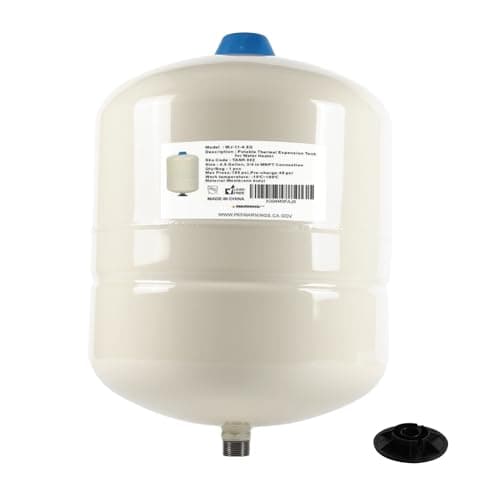
Best Larger Tank

Check price

on Amazon ↗

Listing verified 13 Oct 2026

EFIELD 4.5 Gallon Water Heater Expansion Tank (3/4 in MNPT, Potable Water Certified, TANK002)See it on Amazon ↗

Quick Verdict

EFIELD 4.5 Gallon Water Heater Expansion Tank: the step-up size for big heaters or high pressure, on a listing that leaves its ratings to the label.

Key Specs

Capacity

4.5 gallons

Connection

3/4 in MNPT

Water use (stated)

Certified for potable water

Model

TANK002; a 2.1 gallon version (TANK001) is sold separately

Pre-charge, pressure and temperature ratings

Not stated on the listing

Diaphragm material

Not stated on the listing

Pros

  • More than twice the volume of a 2 gallon tank, for bigger heaters or higher pressure
  • Certified for drinking water, per the listing
  • Standard 3/4 in MNPT connection

Cons

  • No pre-charge, pressure rating or temperature rating on the listing, so read them off the tank's label
  • A thinner listing than Eastman's
  • Much heavier than a 2 gallon tank if the diaphragm ever fails, so it needs firm support

Suited to

A heater larger than 50 gallons, a home with high water pressure, or a heater set hotter than usual

Our take

A 4.5 gallon tank is the usual next size up, and three things push you toward it: a larger heater, higher house pressure, and a hotter tank setting, because each puts more water into the tank per heating cycle or leaves less room in the air cushion. EFIELD's listing confirms potable-water certification and a standard 3/4 in MNPT connection, but leaves out the factory pre-charge, the pressure and temperature ratings and the diaphragm material. Read those off the tank's label when it arrives, and set the pre-charge before installing. Full of water after a diaphragm failure, 4.5 gallons weighs more than 37 lb, so strap or bracket it.

Check today's price on Amazon →

Affiliate link — commission at no extra cost to you

#3
Best With Mounting Bracket

Check price

on Amazon ↗

Listing verified 13 Oct 2026

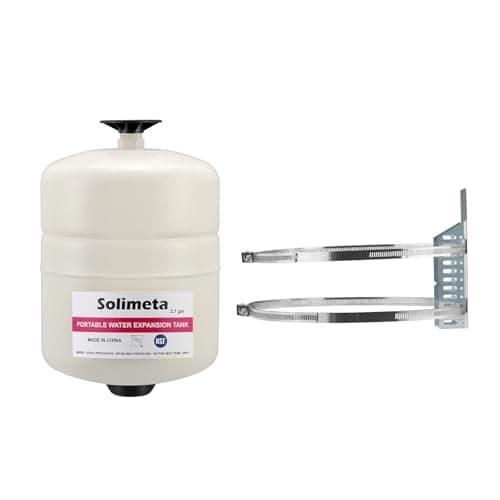
Solimeta 2.1 Gallon Potable Water Expansion Tank (Wall Mounting Bracket, 3/4 in MNPT, 150 psi, 200°F)See it on Amazon ↗

Quick Verdict

Solimeta 2.1 Gallon Potable Water Expansion Tank: a 2 gallon-class tank that comes with the wall bracket most installs should have.

Key Specs

Capacity

2.1 gallons

Ratings (stated)

150 psig maximum pressure; 200°F maximum temperature

Connection

3/4 in MNPT, with a rubber thread protector

Construction (stated)

Butyl rubber diaphragm; 304 stainless steel fittings

Mounting (stated)

Adjustable wall mounting bracket set included

Pre-charge

Not stated on the listing

Pros

  • Comes with an adjustable wall bracket, so the pipe joint does not carry the tank
  • States its pressure and temperature limits, diaphragm and fitting materials
  • Sold as a potable water tank, per its title

Cons

  • No factory pre-charge on the listing, so check it with a tire gauge
  • Its bullets also mention boilers and hydronic heating, so confirm the label says potable before fitting it to drinking water
  • No warranty term stated

Suited to

A 2 gallon-class install where the tank hangs off a long pipe run or a wall, and needs support

Our take

The bracket is the reason to pick this tank. An expansion tank screwed onto a tee hangs its weight on that one joint, and if the diaphragm ever fails the tank fills with about 17 lb of water. Solimeta includes an adjustable wall bracket, so the wall carries the tank and the pipe only carries water. The listing states a 150 psig limit, a 200°F limit, a butyl rubber diaphragm and 304 stainless fittings, but not the factory pre-charge, so check it with a tire gauge and match it to your house pressure. Its bullets also mention boilers and hydronic heating; on a water heater, make sure the tank's label says potable.

Check today's price on Amazon →

Affiliate link — commission at no extra cost to you

#4
Best for Point-of-Use and Tankless

Check price

on Amazon ↗

Listing verified 13 Oct 2026

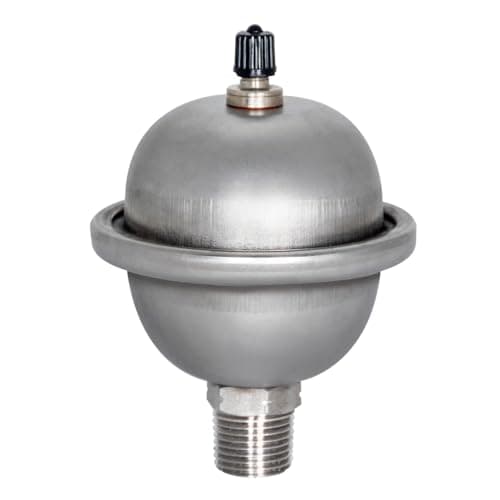
Eastman 60008 Mini Thermal Expansion Tank (1/2 in MIP, Stainless Steel, for Heaters Storing 2 Gallons or Less)See it on Amazon ↗

Quick Verdict

Eastman 60008 Mini Thermal Expansion Tank: the right size for a small point-of-use or tankless heater, and the wrong one for a tank heater.

Key Specs

Suits (stated)

Tankless or point-of-use water heaters with a storage capacity of 2 gallons or less

Connection

1/2 in MIP

Body (stated)

304 stainless steel; indoor or outdoor installation

Ratings (stated)

Max 150 psi; max 210°F

Mounting (stated)

Any orientation

Pressure (stated)

Adjustable; factory pre-charge not stated

Pros

  • Sized for small heaters, where a full 2 gallon tank would be oversized
  • Mounts in any orientation, per the listing, which helps under a sink
  • Stainless steel body rated for indoor or outdoor installation

Cons

  • Not for a 40 or 50 gallon tank heater, despite the 2-gallon in its title
  • The factory pre-charge is not stated
  • 1/2 in MIP will not thread straight onto a 3/4 in line

Suited to

An under-sink point-of-use heater or a tankless setup on a closed system, where the heater's maker calls for expansion control

Our take

Read this listing carefully, because the 2-gallon in its title describes the heater, not the tank. Eastman sells the 60008 as a mini tank for tankless or point-of-use heaters that store 2 gallons or less, and it is far too small for a 40 or 50 gallon heater. On a small heater it makes sense: a closed system still pushes pressure up when that water heats, and a compact stainless tank that mounts in any orientation fits under a sink where a full-size tank would not. It has a 1/2 in MIP connection and ratings of 150 psi and 210°F. Check the heater's manual first, since not every tankless maker calls for one.

Check today's price on Amazon →

Affiliate link — commission at no extra cost to you

#5
Clearest Air-Charge Limits

Check price

on Amazon ↗

Listing verified 13 Oct 2026

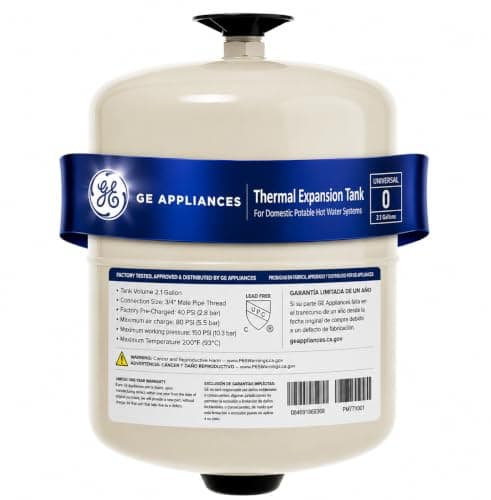
GE Appliances 2.1 Gallon Water Heater Expansion Tank (40 psi Pre-Charge, 80 psi Max Charge, 3/4 in MNPT)See it on Amazon ↗

Quick Verdict

GE Appliances 2.1 Gallon Water Heater Expansion Tank: a 2 gallon-class tank with its 40 psi pre-charge and 80 psi charge ceiling stated plainly.

Key Specs

Capacity

2.1 gallons

Pre-charge (stated)

40 psi from the factory

Maximum charge (stated)

80 psi

Temperature (stated)

Up to 200°F

Connection

3/4 in MNPT

Diaphragm and working pressure rating

Not stated on the listing

Pros

  • States both the factory charge and the highest charge the tank accepts
  • Standard 3/4 in MNPT connection for tank heaters
  • Rated to 200°F, per the listing

Cons

  • The newest listing here, with the shortest buyer record
  • No diaphragm material or working pressure rating stated
  • No bracket included

Suited to

A homeowner who wants the air-charge limits spelled out before setting the tank

Our take

GE's listing is the clearest here on air charge: 40 psi from the factory, with a stated maximum charge of 80 psi. That ceiling is useful. If your static water pressure reads above 80 psi, you cannot charge this tank to match it, and that pressure is a problem in its own right, because many US plumbing codes call for a pressure-reducing valve once static pressure passes 80 psi. In that house, fit the PRV first, then charge the tank to the PRV's outlet setting. Beyond that, the listing gives a 200°F limit and a 3/4 in MNPT connection, but no diaphragm material or working pressure rating, so check the label.

Check today's price on Amazon →

Affiliate link — commission at no extra cost to you

Buyer's Guide

What to know before you buy.

Why a Closed System Needs Somewhere for the Water to Go

Water takes up more room when it is heated. Warming it from about 50°F at the cold main to 120°F grows its volume by roughly 1 percent, so a 50 gallon heater has about half a gallon of extra water to put somewhere each time it heats a full tank. In an open system, that water is pushed back out toward the street main and nobody notices. A check valve, backflow preventer or pressure-reducing valve (PRV) on the main closes the system. Water barely compresses, so house pressure climbs instead until something gives, usually the temperature and pressure (T&P) relief valve on the heater. Model codes such as the International Plumbing Code call for thermal expansion control on a closed system, and your local code decides the details. An expansion tank gives that half gallon a cushion of air to push into.

Sizing: Heater Gallons, House Pressure and the Maker's Chart

Three things set the size: the heater's gallons, the water temperature, and the house pressure. More gallons and a hotter setting mean more expansion. Higher pressure matters in a less obvious way. The tank's air is charged to match house pressure, so at high pressure the cushion starts out already squeezed and has less room left to take water before pressure climbs. That is why makers publish sizing charts by heater size and supply pressure. On typical charts, a 2 gallon tank covers a 40 or 50 gallon heater at moderate pressure, and the chart moves you to a larger tank, often around 4.5 gallons, for a bigger heater or higher pressure. Use the chart for the exact tank you buy. None of the 2 gallon-class listings on this page prints its own chart.

Set the Air Charge to Your House Pressure

This is the step most installs skip. Every tank has an air valve like a tire valve, and the air behind the diaphragm should match your home's static water pressure, the reading with no water running anywhere. Measure it with a pressure gauge on a hose bib or the heater's drain valve. If you have a PRV, use the pressure it delivers. Then check the tank with a tire gauge before it is connected, while it holds no water, and add air with a bicycle pump or compressor, or let some out, until it matches. Eastman and GE ship at 40 psi, which is lower than many homes run. Never charge past the tank's stated limit; GE gives 80 psi as its maximum. If a tank is already in place, shut off the water and relieve the pressure before checking it.

Where It Goes and How to Hold It Up

The tank goes on the cold water supply to the heater, downstream of the check valve, backflow preventer or PRV that closes the system, so it sits between that valve and the heater. Use a tank sold for potable water; tanks made only for boiler and hydronic heating loops are not meant for drinking water. Then think about weight. Water weighs about 8.3 lb per gallon, so if the diaphragm fails, a 2 gallon tank fills with about 17 lb of water and a 4.5 gallon tank with more than 37 lb, all hanging on one threaded joint. Support it with a bracket, strap or shelf; Solimeta includes a wall bracket. Follow the maker's instructions on orientation. Eastman says its 60008 mini mounts any way, but the other listings here do not address it.

Signs a Tank Has Failed, and What a Dripping T&P Valve Means

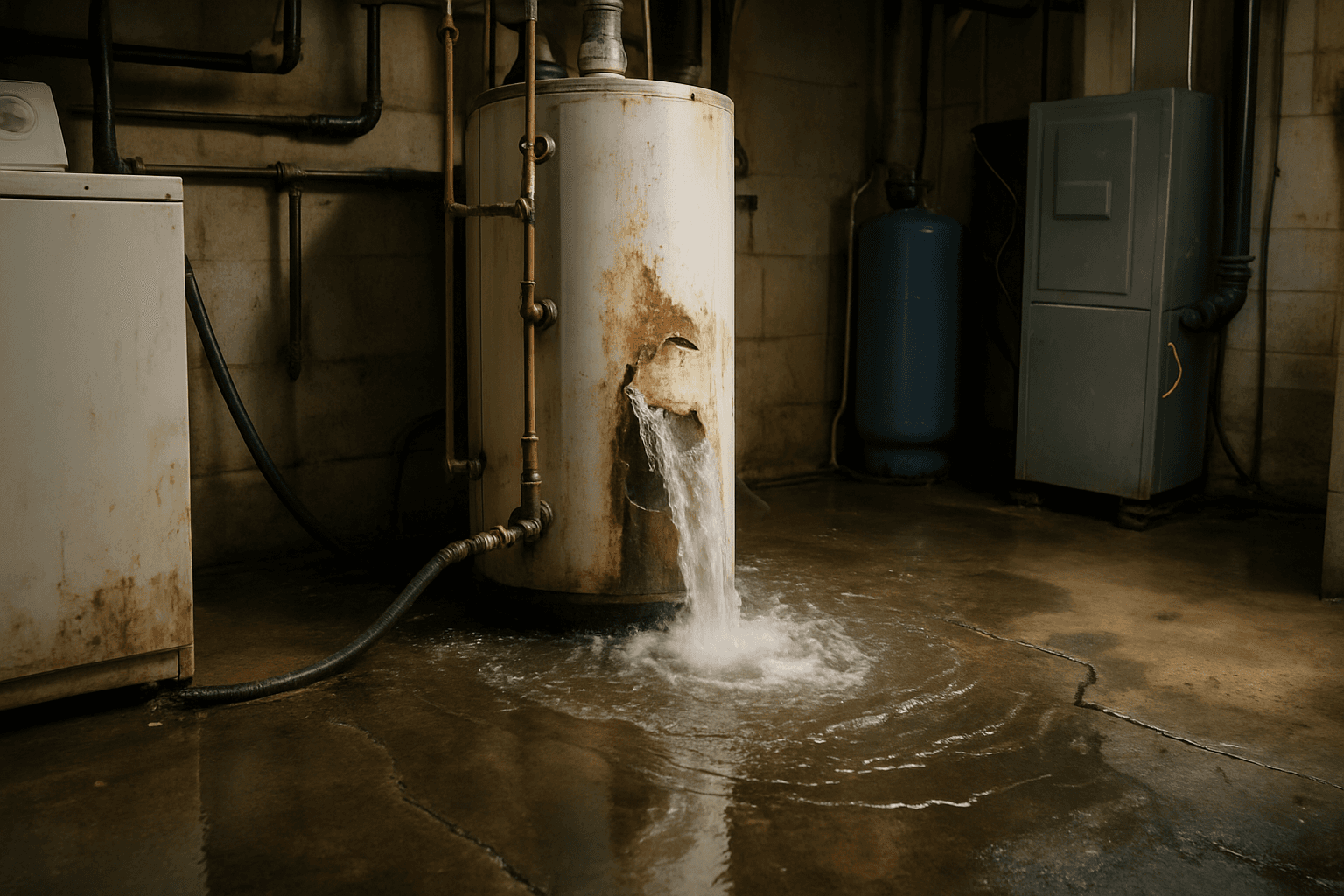
A working tank is mostly air. Tap it with your knuckles: the top should sound hollow, and a dull thud all the way up suggests it has filled with water. Press the air valve stem briefly; water instead of air means the diaphragm has failed and the tank needs replacing. A pressure gauge with a red max needle, left on a hose bib overnight, shows the spikes a dead tank no longer absorbs. The classic symptom is a T&P relief valve that dribbles after the heater runs, since that valve is usually set to open at 150 psi or 210°F. Never cap or plug a T&P valve. EPA WaterSense notes that a faucet dripping once per second wastes more than 3,000 gallons a year, and a relief valve that drips every cycle is wasting water and warning you.

Who Should Not Buy One, and When to Call a Plumber

You may not need a tank at all if your home has an open system, with no check valve, backflow preventer or PRV on the main, though some heater makers and local codes call for expansion control anyway, so check the heater's manual. A tankless heater stores little water, and many need no tank; a mini tank like the Eastman 60008 is for small heaters whose makers call for one. If static pressure reads above 80 psi, fix that first with a PRV; a tank alone cannot fix high pressure. Call a licensed plumber for soldered connections, work on a gas heater, any job your area requires a permit for, or a T&P valve that keeps dripping with a charged tank in place. If a leak has already soaked the floor, EPA advises drying it within 24 to 48 hours to prevent mold growth.

Frequently Asked Questions

Do I need an expansion tank on my water heater?

You need one if your plumbing is a closed system, meaning a check valve, backflow preventer or pressure-reducing valve on the main stops heated water from pushing back into the street supply.

Many water utilities and local codes require one in that case. Look for a valve where the main enters the house, and check the heater's manual. A T&P valve that drips after the heater runs is a common sign the system is closed.

What size expansion tank do I need for a 50 gallon water heater?

Usually about 2 gallons at moderate house pressure, but the maker's sizing chart for your exact tank decides. Charts size by heater gallons and supply pressure, because higher pressure leaves the air cushion less room.

At high pressure, or with a hot tank setting, the chart may move you up to a larger tank of around 4.5 gallons, such as the EFIELD 4.5 Gallon. Measure your static pressure before you choose.

What should the pressure be in a water heater expansion tank?

The air charge should match your home's static water pressure, measured with no water running, or the outlet setting of your PRV if you have one. Tanks often ship at 40 psi, as Eastman's and GE's listings state, so most need air added.

Set it with a tire gauge and bicycle pump before connecting the tank, and stay within the tank's limit, such as the 80 psi maximum charge GE states.

Where should a water heater expansion tank be installed?

On the cold water supply line to the heater, between the heater and the check valve, backflow preventer or PRV that makes the system closed. Model codes such as the International Plumbing Code place it downstream of those valves.

Close to the heater is common and easy to service. Support the tank with a bracket or strap rather than letting it hang from the pipe joint.

How do I know if my expansion tank is bad?

Tap it and press its air valve: a hollow sound near the top is good, while a solid sound throughout or water from the valve means the diaphragm has failed.

Other signs are a T&P valve that drips after the heater runs and pressure spikes shown on a gauge with a red max needle left on a hose bib overnight. A failed tank should be replaced, not recharged.

Can a water heater expansion tank be installed horizontally?

SometimesDepending on the maker.

Eastman says its 60008 mini tank can be mounted in any orientation, but the other listings on this page do not say, so follow the installation sheet that comes with your tank. Whatever the angle, support the tank with a bracket or strap, because a sideways tank puts even more bending load on the threaded joint.

Who do I call right now for water damage?

Call (888) 840-6512. The line is answered 24 hours a day, seven days a week, and connects you with an IICRC-certified water damage restoration company that serves your area. A recorded menu picks up first: choose water damage or mold, key in your 5-digit ZIP code, and hold through the short silence while the call is passed to the company.

Describe what you can see — where the water is coming from, how long it has been there, and whether it smells — the more specific you are, the faster the right company is on the line. If the source is a pipe or an appliance, shut the main water valve first. Have four things ready and the call goes quickly: the address, when the water started, what is wet now, and whether you have filed an insurance claim.

Still not sure which of these is your situation? (888) 840-6512 · toll-free · answered 24/7

Sources

  1. EPA WaterSense — Fix a Leak Week
  2. EPA — A Brief Guide to Mold, Moisture, and Your Home

Methodology: How we source and verify data · Report an error

How we chose these picks

  • Every pick is a current listing. Stock, star ratings and rating counts are read from Amazon by script and carry the date they were read.
  • Nothing under 4.0 stars makes the list, and the top pick needs a large rating count, so one good week of reviews cannot put it there.
  • Specs are quoted from the listing or the maker, with the test condition behind the number where there is one, and sized against the job rather than the room on the box.
  • We do not run lab or field tests. Where a spec matters, we say what it is measured under and what it cannot tell you.

Free 2-day shipping

Amazon Prime members pay no shipping on restoration equipment

Dehumidifiers, air movers, and moisture meters qualify for free Prime delivery — bulk items that otherwise cost $15–$40 to ship.

Try Prime free →

Affiliate link — HearthDry earns a bounty if you sign up; costs you nothing extra.

Also Worth Comparing

Best Water Pressure Gauge in 2026 — Hose-Thread Test Gauges With a Max Needle, Where to Screw One On, and What the Reading Means

A water pressure gauge shows the pressure your pipes, hoses and fill valves sit under all day, and if it passes the 80 psi line many plumbing codes draw. These picks are hose-thread test gauges compared on range, max needle, case and stated accuracy, with the test method and the reading that means it is time for a regulator.

Read the comparison

Best Water Pressure Regulator in 2026 — Whole-House Pressure Reducing Valves vs Hose and RV Regulators, and the Gauge Test to Run First

A water pressure regulator comes in two very different kinds: a whole-house pressure reducing valve (PRV) that a plumber fits on the main line, and a small hose-thread regulator for an RV, a camper or a garden hose. These picks say plainly which kind each one is, compared on connection, stated adjustment range and what each listing leaves out, with the gauge test to run first and the expansion tank a PRV can make necessary.

Read the comparison

Best Water Heater Drain Pans in 2026 — Sized to the Tank, Matched to Gas or Electric, Paired With a Leak Alarm

A drain pan sits under a tank water heater and catches drips from valves, fittings and a seeping tank, carrying them to a drain instead of across the floor. These picks are sized against the tank, matched to gas or electric heaters by what each listing states, and paired with an alarm and an automatic shutoff for the leak a pan cannot hold.

Read the comparison

Best Water Leak Detectors in 2026 — Wi-Fi and Smart Sensors That Alert Your Phone

Most homeowners do not discover a leak until it has soaked into subfloor and drywall. A Wi-Fi water leak detector sends the alert to your phone while the water is still on the floor, whether or not anyone is home to hear a siren.

Read the comparison

Best Automatic (Smart) Water Shut-Off Valves in 2026 — YoLink vs Flo by Moen vs Frizzlife

A smart water shutoff closes the supply when it detects a leak, so a burst pipe does not run for hours while nobody is home. The four systems here split into two designs: leak sensors that close the valve you already have, and valves on the main line that watch the flow itself.

Read the comparison

Best Tankless Water Heaters in 2026 — Electric and Gas Units Judged by Flow at Your Winter Temperature Rise, the Wiring or Venting They Need, and the Leaks They Can Still Have

A tank water heater stores 40 or 50 gallons that end up on the floor when the tank rusts through, and a tankless unit takes that stored water away. These picks are electric and gas models compared on flow at your winter temperature rise, the breakers or venting each listing asks for, and the flushing that hard water adds.

Read the comparison

Best Water Heater Anode Rods in 2026 — Powered, Magnesium and Aluminum-Zinc Rods Compared, and the Rusted-Through Tank They Exist to Prevent

A water heater's anode rod corrodes so the steel tank does not, and once the rod is gone the tank rusts from the inside until it weeps or splits. These picks are a powered rod, flexible magnesium and aluminum-zinc rods and a hot-water-outlet model compared from their listings and buyer ratings, with the clearance arithmetic, the smell question and the jobs that belong to a licensed plumber.

Read the comparison