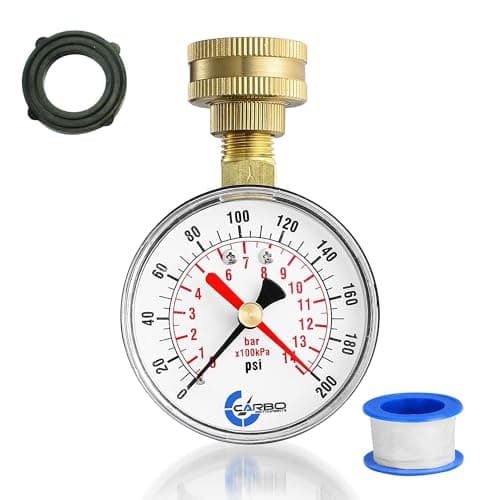
Best for: A first gauge for checking house pressure and catching overnight peaks at a spigot or washer valve
- Range (stated):
- 0-200 psi / 0-14 bar, dual scale
- Dial (stated):
- 2-1/2 in
Listing verified 13 Oct 2026

Hose-Thread Test Gauges With a Max Needle, Where to Screw One On, and What the Reading Means
5 picks compared · prices, ratings and stock checked October 12, 2026
Our Top Pick
For most homes, the CARBO Instruments 2-1/2 in Water Pressure Test Gauge, with a 0 to 200 psi dial, a red max pointer and a 3/4 in female hose thread. For a gauge that will stay on a drinking-water line for weeks, the SENCTRL Lead-Free Water Pressure Test Gauge in its 0 to 200 psi version.
4.4 on Amazon · 4,488 ratings
Quick answer
The best water pressure gauge for a home is a 0 to 200 psi dial with a 3/4 in hose thread and a red max needle; if you want one gauge that also catches overnight spikes, buy the CARBO Instruments 2-1/2 in Water Pressure Test Gauge, rated 4.4 stars across 4,488 Amazon ratings. Screw it onto the spigot nearest your water meter with every fixture off, read the static pressure, then check the red needle again the next morning. Many US plumbing codes call for a pressure-reducing valve once static pressure passes 80 psi, so a reading above that is the one to act on.
Every pick below is currently stocked — ratings and stock read from Amazon on 12 October 2026.
Best for: A first gauge for checking house pressure and catching overnight peaks at a spigot or washer valve
Listing verified 13 Oct 2026
Best for: Someone who wants a steel-cased test gauge with a max hand from an established plumbing brand
Listing verified 13 Oct 2026
Best for: A gauge that will stay connected to a drinking-water line, such as a laundry valve, while you track pressure
Listing verified 13 Oct 2026
Best for: A second check after a regulator is adjusted, or tracking a slow change in a home known to sit under 100 psi
Listing verified 13 Oct 2026
Best for: Watching pressure live, such as through a well pump cycle or while fixtures are opened one by one
Listing verified 13 Oct 2026
How this page was made: we compare the current Amazon listings, the makers' published specs and what verified buyers report, then rank by fit for the job. Ratings, review counts and stock are read from Amazon and dated. We earn a commission on purchases through our links; it does not change the order. Reviewed by Marcus Reed, IICRC-certified Water Restoration Technician.
Full Reviews
Each pick in detail: what the listing states, what buyers report, and where it falls short.
Check price
on Amazon ↗
Listing verified 13 Oct 2026
See it on Amazon ↗Best Overall
Quick Verdict
CARBO Instruments 2-1/2 in Water Pressure Test Gauge: a max pointer and the tightest stated accuracy here, in a plastic case.
Key Specs
Range (stated)
0-200 psi / 0-14 bar, dual scale
Dial (stated)
2-1/2 in
Max needle (stated)
Red max pointer holds the peak reading until reset
Connection (stated)
3/4 in female hose thread, brass connector
Accuracy (stated)
±2-1-2%, ASME B40.1 Grade A
Case (stated)
Black plastic case, anti-fog lens
Pros
Cons
Suited to
A first gauge for checking house pressure and catching overnight peaks at a spigot or washer valve
Our take
The CARBO earns the top spot for the feature a basic gauge lacks: the red max pointer. As pressure rises, the black needle pushes it up, and it stays at the highest point until you turn it back down. Leave the gauge on overnight and it records peaks a daytime check never sees. The listing also states Grade A accuracy, ±1% of the scale across its middle half, which works out to about 2 psi on a 200 psi dial. That is plenty to tell a healthy reading from one past 80 psi. The case is plastic rather than steel, so keep it as a test tool you store indoors, not a gauge left on the spigot through winter.
Affiliate link — commission at no extra cost to you
Compare elsewhere
These open a search for this model. We quote prices only where we can verify them — Amazon, Sylvane and eBay.
Check price
on Amazon ↗
Listing verified 13 Oct 2026
See it on Amazon ↗Best From a Plumbing-Valve Brand
Quick Verdict
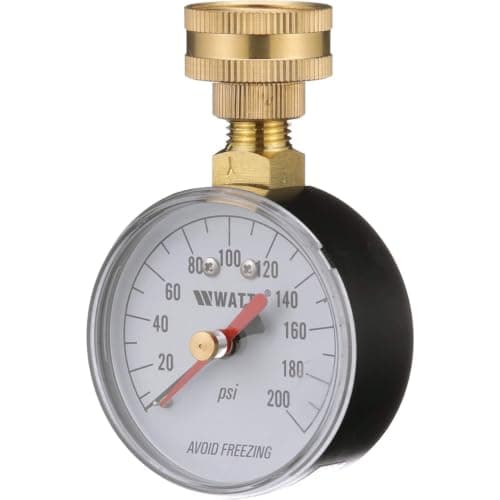
Watts Water Pressure Test Gauge: a steel-cased 0-200 psi gauge with a max hand; confirm the dial range in the photos.
Key Specs
Range (stated)
0-200 psi in the title; maximum working pressure 200 psi (13.8 bar)
Max needle (stated)
Red indicator hand holds at the highest reading registered
Connection (stated)
3/4 in hose thread (HT)
Accuracy (stated)
ASME Type B
Case (stated)
Black enamel steel, Kostil polymer window
Size (stated)
4 in high x 2.5 in
Pros
Cons
Suited to
Someone who wants a steel-cased test gauge with a max hand from an established plumbing brand
Our take
Watts sells this as a gauge for testing supply pressure in a distribution system, and it does the core job: thread it onto a spigot, read the black needle, and let the red hand hold the highest reading. The listing goes further than most on limits, giving a 200 psi maximum working pressure and an operating range of 40°F to 140°F. That lower figure is a useful reminder. A gauge left on an outdoor spigot in freezing weather holds water inside its Bourdon tube, and ice can ruin it, so bring it in. One bullet muddies things by mentioning a 0 to 300 psi scale; look at the dial photo before ordering if the range matters.
Affiliate link — commission at no extra cost to you
Compare elsewhere
Check price
on Amazon ↗
Listing verified 13 Oct 2026
See it on Amazon ↗Best Lead-Free Gauge
Quick Verdict
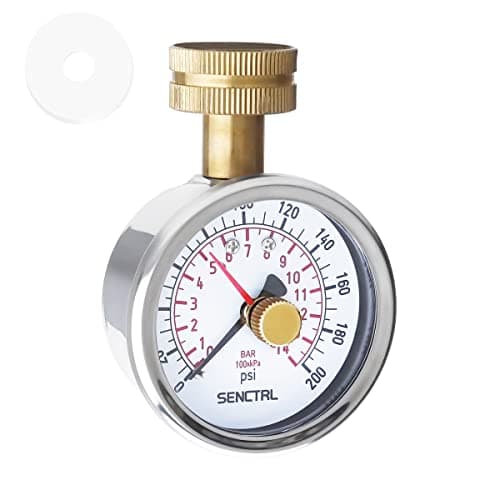
SENCTRL Lead-Free Water Pressure Test Gauge (0-200 psi): lead-free wetted parts and a sealed stainless case for longer hookups.
Key Specs
Range (stated)
0-200 psi / 0-14 bar, dual scale
Max needle (stated)
Red max pointer (lazy hand), reset by turning it back down
Connection (stated)
3/4 in female hose thread
Wetted parts (stated)
Lead-free brass, stainless steel, food-grade silicone seal
Case (stated)
304 stainless steel, IP67 waterproof, vent to cut window fogging
Accuracy (stated)
±3/2/3% over the range
Pros
Cons
Suited to
A gauge that will stay connected to a drinking-water line, such as a laundry valve, while you track pressure
Our take
Choose the SENCTRL when the gauge will stay on a supply line rather than come off after five minutes, for example on a washer valve for a week while you watch a regulator. Its wetted parts are lead-free brass and stainless steel with a food-grade silicone seal, and the stainless case carries an IP67 rating, so it handles a dripping spigot better than a plastic body. The listing's instructions are worth following exactly: rest the red pointer just above the black one, let the black hand drag it up as pressure rises, and turn it back to zero to reset. Its ±2% mid-scale tolerance on a 200 psi dial is about 4 psi.
Affiliate link — commission at no extra cost to you
Compare elsewhere
Check price
on Amazon ↗
Listing verified 13 Oct 2026
See it on Amazon ↗Best for Reading Small Changes
Quick Verdict
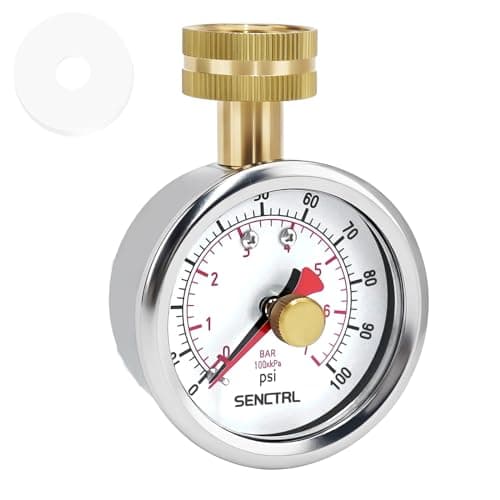
SENCTRL Lead-Free Water Pressure Test Gauge (0-100 psi): a finer scale for homes known to sit below 100 psi.
Key Specs
Range (stated)
0-100 psi / 0-7 bar, dual scale
Max needle (stated)
Red max pointer (lazy hand)
Connection (stated)
3/4 in female hose thread
Wetted parts (stated)
Lead-free brass, stainless steel, food-grade silicone seal
Case (stated)
304 stainless steel, IP67 waterproof
Accuracy (stated)
±3/2/3% over the range
Pros
Cons
Suited to
A second check after a regulator is adjusted, or tracking a slow change in a home known to sit under 100 psi
Our take
This is the same SENCTRL gauge with half the range, and that changes how readable it is. Spread over a 0 to 200 psi dial, everything below 80 psi sits in a narrow arc, so telling 72 psi from 78 psi takes a close look. A 0 to 100 psi dial spreads that band across most of the face. Accuracy is quoted as a percentage of the full scale, so the same ±2% grade means about 2 psi here instead of 4. That suits a follow-up check after a plumber sets a regulator, or a well system you want to watch through a pump cycle. Do not make it your first gauge in a home with no regulator, where street pressure could top 100 psi.
Affiliate link — commission at no extra cost to you
Compare elsewhere
Check price
on Amazon ↗
Listing verified 13 Oct 2026
See it on Amazon ↗Best Glycerin-Filled Dial
Quick Verdict
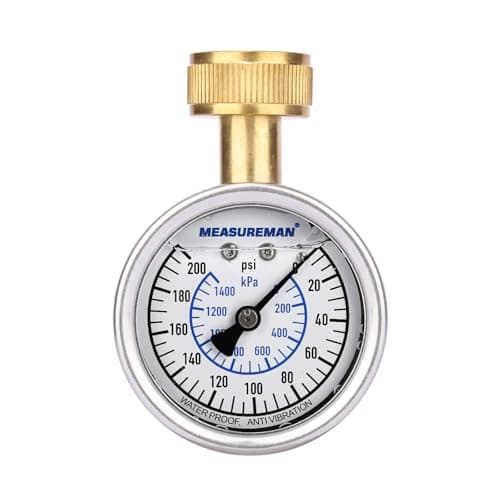
MEASUREMAN 2-1/2 in Glycerin-Filled Water Pressure Test Gauge: a steady needle for live readings, but no max pointer.
Key Specs
Range (stated)
0-200 psi / kPa, dual scale
Dial (stated)
2-1/2 in
Connection (stated)
3/4 in female hose thread adapter
Fill (stated)
Glycerin
Case and wetted parts (stated)
304 stainless steel case, brass wetted parts
Accuracy (stated)
±3-2-3%
Pros
Cons
Suited to
Watching pressure live, such as through a well pump cycle or while fixtures are opened one by one
Our take
The MEASUREMAN is the one pick without a max needle, and it is here for a different job. Glycerin inside a gauge slows the needle, so it settles rather than shakes when pressure pulses, which is what you see near a well pump as it starts and stops or on a line where valves snap shut. That makes the live reading easier to trust while you stand and watch, for example while someone opens fixtures around the house to see how far pressure drops under flow. What it cannot do is report a peak at 3 a.m. Buy it as a second gauge for watching, not as the one that answers the overnight question.
Affiliate link — commission at no extra cost to you
Compare elsewhere
What to know before you buy.
A water pressure test gauge is a dial on a 3/4 in female hose thread. It screws onto an outdoor spigot, a laundry faucet with hose threads or a washing machine valve, and reads in psi. With every fixture closed, that number is static pressure: the push your pipes, hoses, toilet fill valves and water heater live under all day and all night. Plumbing codes and pressure regulators work to that figure. What it does not measure is flow. If static pressure looks fine but one shower is weak, the problem sits in that fixture or its branch, often a clogged aerator, showerhead or cartridge, and a gauge will not find it. Four of these picks use a 0 to 200 psi scale, and the fifth stops at 100 psi.
A daytime reading shows one moment, and pressure can run higher at other hours. Some city systems deliver more pressure at night, when demand drops. In a home with a pressure regulator or a check valve at the meter, water heated in the tank expands with nowhere to go, so pressure climbs after each heating cycle; that is thermal expansion, and plumbing codes generally require a way to absorb it, usually an expansion tank. A max needle, sold as a lazy hand, drag pointer or red max pointer, rides up with the main needle and stays at the peak. Set it against the black needle, leave the gauge on overnight, and read the peak before anyone showers. A valve snapping shut can cause a brief spike, so repeat the test before acting on a single high peak.
Choose the spigot nearest the water meter or the point where the main line enters the house. On a well, use one close to the pressure tank. Turn off everything that draws water: faucets, the washer, the dishwasher, the ice maker, irrigation and a softener that might regenerate. Check that the gauge's rubber washer is seated, then thread it on by hand. Open the spigot fully and read the black needle; write that number down with the time. Next, turn the red needle down onto the black one, leave the spigot open and look again the next morning. Well pressure rises and falls between the pump switch's cut-in and cut-out settings, so watch one full pump cycle and note both readings. Bring the gauge inside afterward, since water left in the dial can freeze.
Outdoor spigots are not always on the house side of the regulator. In some homes one or more hose bibs are teed off before the pressure-reducing valve, often so irrigation gets full pressure, and a gauge there shows street pressure rather than what your fixtures see. If the outdoor reading looks high and the house has a regulator, test again indoors. A washing machine valve has the same 3/4 in hose thread as a spigot: close the valve, take off one fill hose with a towel underneath, screw on the gauge and open the valve. The CARBO and both SENCTRL listings name washing machines among their uses. When the indoor number is well below the outdoor one, the regulator is working and that spigot sits before it. If both read high, the regulator is missing, set too high or failing.
Many US plumbing codes require a pressure-reducing valve when static pressure is above 80 psi, so treat 80 psi as the upper line unless your local code says otherwise. Roughly 40 to 60 psi is the band many plumbers and water utilities describe as comfortable. Above 80 psi, every washer hose, toilet supply line, fill valve and faucet cartridge works harder, and banging pipes and dripping fixtures often follow. The fix is a regulator, or adjusting or replacing the one you have, not a sturdier hose. Low readings point somewhere else. Low static pressure at the meter-side spigot means the cause is upstream: a partly closed main valve, a failing regulator, a well pump or pressure tank fault, a leak on the service line, or the supply itself. Your water utility can tell you what pressure it delivers to your street.
Skip the purchase if your home already has a permanent gauge near the main shutoff or the regulator; read that one instead. It is also the wrong first step when water is already leaking. Close the main valve and deal with the leak, because a gauge reports a number and fixes nothing. Call a licensed plumber when the reading is over 80 psi and there is no regulator, when an existing regulator will not adjust down or creeps back up, or when pressure climbs at night in a closed system and an expansion tank may be needed. If you suspect a hidden leak, EPA WaterSense suggests reading your water meter before and after a two-hour period when no water is used; if the meter changes at all, you probably have a leak. A well pressure switch has live electrical contacts, so leave its settings to a pro.
Thread a hose-thread gauge onto the spigot closest to your water meter, shut off every fixture in the house, open the spigot all the way and read the needle. That number is your static pressure.
For a fuller picture, rest the red max needle against the black one and leave the gauge on overnight, since the morning peak can be higher than the afternoon reading. If the house has a regulator, repeat the test at a washer valve.
Somewhere under 80 psi, and for most homes a reading in the 40s to 60s feels comfortable at every tap. Past 80 psi, many US plumbing codes call for a pressure-reducing valve, and every hose and valve in the house carries extra load.
Well below 40 psi, upstairs showers tend to feel weak. If the overnight max needle sits far above the daytime number, that gap matters as much as the daytime reading itself.
80 psi is the ceiling, not the target. Many US plumbing codes require a pressure-reducing valve once static pressure goes above it, and a home sitting right at that line still puts steady strain on hoses, supply lines, toilet fill valves and appliance valves.
If your gauge reads 80 or more, or the max needle passes it overnight, have the regulator checked or adjusted, or have one fitted if the house has none.
Put it on the outdoor spigot nearest the meter or main line, or on a washing machine valve. Both take a 3/4 in hose thread, so the same gauge fits either.
The washer valve gives the truer house reading when a regulator is fitted, because an outdoor spigot piped ahead of the regulator shows street pressure. On a private well, use a spigot or drain close to the pressure tank.
Usually because demand falls or because of thermal expansion. When the neighborhood stops using water, a city system can deliver more pressure to your street.
In a closed system, one with a regulator or meter check valve, water heated in the tank expands and pushes pressure up until someone opens a tap. A worn regulator can also let pressure creep. A max-needle gauge left on overnight shows how high it goes, and a plumber can tell which cause fits.
YesIt can bring them on sooner. Pressure above 80 psi loads every hose, supply line, valve seat and fitting in the house, and the rubber and plastic parts tend to give way first: washing machine hoses, toilet and faucet supply lines and fill valves.
A regulator set to a sensible pressure protects all of them at once. If a line has already failed, EPA advises drying water-damaged areas and items within 24 to 48 hours to prevent mold growth.
Call (888) 840-6512. The line is answered 24 hours a day, seven days a week, and connects you with an IICRC-certified water damage restoration company that serves your area. A recorded menu picks up first: choose water damage or mold, key in your 5-digit ZIP code, and hold through the short silence while the call is passed to the company.
Describe what you can see — where the water is coming from, how long it has been there, and whether it smells — the more specific you are, the faster the right company is on the line. If the source is a pipe or an appliance, shut the main water valve first. Have four things ready and the call goes quickly: the address, when the water started, what is wet now, and whether you have filed an insurance claim.
Still not sure which of these is your situation? (888) 840-6512 · toll-free · answered 24/7
Methodology: How we source and verify data · Report an error
Free 2-day shipping
Amazon Prime members pay no shipping on restoration equipment
Dehumidifiers, air movers, and moisture meters qualify for free Prime delivery — bulk items that otherwise cost $15–$40 to ship.
Affiliate link — HearthDry earns a bounty if you sign up; costs you nothing extra.

A washing machine's two fill hoses sit under full house pressure whenever the valves are open, and an old rubber hose that splits keeps releasing water until someone closes the valve. These picks are braided stainless hoses compared on fittings, length, elbows and what each listing actually states, with the replacement habit and the shutoff valve that a better hose does not replace.
Read the comparisonA pipe repair clamp, a wrap of self-fusing tape or a lump of epoxy putty can stop a leaking pipe within the hour, but only after the main valve is off and only until the damaged section is properly replaced. These picks are matched to the kind of damage, the pipe material and the size, using each listing's own pressure and temperature figures and noting what it leaves unsaid.
Read the comparisonA smart water shutoff closes the supply when it detects a leak, so a burst pipe does not run for hours while nobody is home. The four systems here split into two designs: leak sensors that close the valve you already have, and valves on the main line that watch the flow itself.
Read the comparisonA water pressure regulator comes in two very different kinds: a whole-house pressure reducing valve (PRV) that a plumber fits on the main line, and a small hose-thread regulator for an RV, a camper or a garden hose. These picks say plainly which kind each one is, compared on connection, stated adjustment range and what each listing leaves out, with the gauge test to run first and the expansion tank a PRV can make necessary.
Read the comparisonWhen a check valve or pressure-reducing valve closes your plumbing, the water a heater expands has nowhere to go, and house pressure spikes after every heating cycle. These expansion tanks are compared on size, stated pre-charge, pressure and temperature ratings and mounting, with the air-charge step most installs skip.
Read the comparison