
Best Radon Detectors in 2026 — Continuous Home Monitors Compared on First Reading, Power and Display, and What a Monitor Cannot Replace

Best Radon Detectors in 2026

Continuous Home Monitors Compared on First Reading, Power and Display, and What a Monitor Cannot Replace

5 picks compared · prices, ratings and stock checked October 12, 2026

Our Top Pick

For most homes, the Airthings Corentium Home 223 Radon Detector: battery powered, with short- and long-term readings on its own screen, per the listing. To check a mitigation system or see a change within hours, the Ecosense RadonEye RD200 lists a first reading in 10 minutes.

4.6 on Amazon · 10,793 ratings

Quick answer

If you want to watch radon over months rather than get one lab result, buy a continuous monitor that shows a long-term average, and for most homes that is the Airthings Corentium Home 223 Radon Detector, rated 4.6 stars across 10,793 Amazon ratings. It runs on 3 AAA batteries and shows short- and long-term readings on screen, per its listing. Act on the long-term average, not a one-day spike: EPA recommends fixing your home at 4 pCi/L or higher and says to consider fixing between 2 and 4 pCi/L. For a home sale, a qualified tester is still the safer route.

Our Picks at a Glance

Every pick below is currently stocked — ratings and stock read from Amazon on 12 October 2026.

How this page was made: we compare the current Amazon listings, the makers' published specs and what verified buyers report, then rank by fit for the job. Ratings, review counts and stock are read from Amazon and dated. We earn a commission on purchases through our links; it does not change the order. Reviewed by Marcus Reed, IICRC-certified Water Restoration Technician.

Full Reviews

Each pick in detail: what the listing states, what buyers report, and where it falls short.

#1
Best Overall

Check price

on Amazon ↗

Listing verified 13 Oct 2026

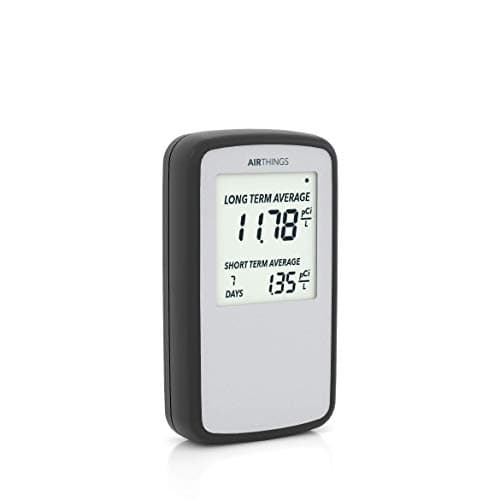
Airthings Corentium Home 223 Radon Detector (Battery Powered, 3 AAA, pCi/L)See it on Amazon ↗

Quick Verdict

Airthings Corentium Home 223 Radon Detector: battery powered, short- and long-term readings on screen, and no app to set up.

Key Specs

Type

Continuous digital radon detector

Power (stated)

3 AAA batteries; no outlet needed

Display (stated)

Short-term and long-term readings on screen

Report (stated)

Generates a radon self-inspection report

App or Bluetooth

Not stated on this listing

Time to first reading

Not stated on this listing

Pros

  • Shows both short-term and long-term readings on screen, the two kinds of number EPA's testing steps are built around
  • Runs on AAA batteries, so it can sit in a basement den or bedroom with no outlet nearby
  • No app, account or pairing: the numbers are on the device itself

Cons

  • Time to first reading, battery life and any accuracy figure are not stated on this listing
  • No app or history graph is mentioned, so following a trend means noting readings yourself or using the report feature

Suited to

Tracking a home's long-term radon average without an app or an outlet

Our take

The pair of numbers on its screen is what makes this a good default. EPA's Citizen's Guide to Radon treats a short reading as a screen and a reading of more than 90 days as the better guide to your year-round level, and this unit shows both, per the listing. In practice, glance at the short-term figure after a change, such as sealing a sump lid or starting a mitigation fan, and make decisions on the long-term figure once it has run for months. The listing leaves out the time to first reading, battery life and any accuracy figure, so check the manual before you lean on an early number. For graphs on a phone, Airthings also lists a Corentium Home 2 (model 325) that adds Bluetooth plus humidity and temperature sensors.

Check today's price on Amazon →

Affiliate link — commission at no extra cost to you

Compare elsewhere

These open a search for this model. We quote prices only where we can verify them — Amazon, Sylvane and eBay.

#2
Best for Fast Readings

Check price

on Amazon ↗

Listing verified 13 Oct 2026

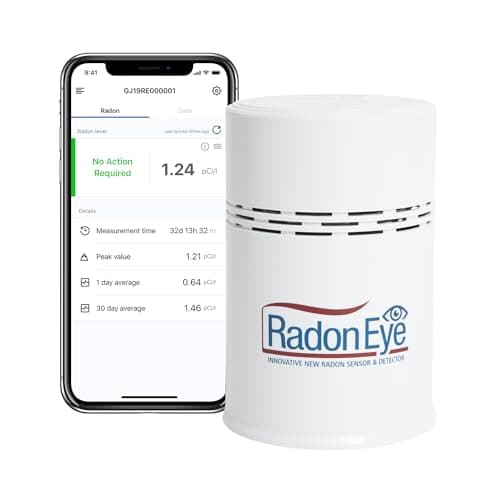
Ecosense RadonEye RD200 Continuous Radon Detector (Ion Chamber, OLED Display, Bluetooth)See it on Amazon ↗

Quick Verdict

Ecosense RadonEye RD200: ion-chamber monitor with a stated 10-minute first reading and an hourly trend chart, powered by a cable.

Key Specs

First reading (stated)

10 minutes

Sensor (stated)

Patented ion chamber

Counting efficiency (stated)

30 counts per hour per pCi/L

Trend (stated)

Long-term trend chart built from hourly averages

Display and app

OLED screen plus a Bluetooth app

Power

Power cable included; no battery mentioned on the listing

Pros

  • First reading in 10 minutes, per the listing, so a change shows up the same day
  • States a counting efficiency, 30 counts per hour per pCi/L, a figure none of the other listings here give
  • Hourly averages feed a long-term trend chart, so you can see when levels peak during the day
  • Numbers on the device's own screen and in the app

Cons

  • Runs from a power cable, so it needs an outlet near the spot where it should sit
  • The third-party validation it mentions is not named on the listing

Suited to

Checking a mitigation system or comparing rooms when you want an answer in hours, not days

Our take

Its counting figure explains why even a fast monitor needs time. At 30 counts per hour per pCi/L, a room at 4 pCi/L produces about 120 counts an hour, and about 20 in the first 10 minutes. Counts like these scatter by roughly one over their square root, so a 10-minute number can wander by around a fifth, an hour by about 9%, and a full day by under 2%, from counting alone and before any calibration error. That makes the RD200 a strong tool for watching a trend or seeing a mitigation fan's effect within a day, and a weak one for judging a home on its first reading. Put it near an outlet on the lowest lived-in level and let several days of hourly averages build before you compare.

Check today's price on Amazon →

Affiliate link — commission at no extra cost to you

#3
Best With a Phone App

Check price

on Amazon ↗

Listing verified 13 Oct 2026

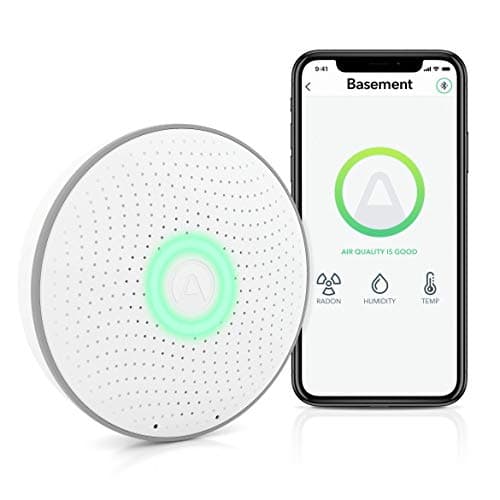
Airthings Wave Radon 2950 Smart Radon Detector (Bluetooth App, Humidity and Temperature, Battery)See it on Amazon ↗

Quick Verdict

Airthings Wave Radon 2950: radon, humidity and temperature in a phone app, with only a color light on the device.

Key Specs

Connection (stated)

Bluetooth to a phone app; connects to an Airthings Hub for 24/7 online data

On the device (stated)

Green, yellow or red light when you wave a hand in front of it

Readings (stated)

Long- and short-term radon results in the app

Other sensors (stated)

Humidity and temperature

Power (stated)

Battery operated

Report (stated)

Radon report through the Airthings Dashboard

Pros

  • Long- and short-term radon results on your phone, plus a report you can generate from the Airthings Dashboard
  • Logs humidity beside radon, the number that matters most in a damp basement
  • Battery powered, so placement is not tied to an outlet

Cons

  • The device itself gives only a color light, per the listing; the actual numbers need the app
  • Remote access away from home needs an Airthings Hub, which the listing does not say is included
  • No accuracy figure beyond the word accurate in the title

Suited to

A damp basement where you want radon and humidity history on your phone

Our take

Choose this one for a basement you already watch for damp, because it logs radon, humidity and temperature in one place. EPA's mold guidance is to keep indoor humidity below 60%, ideally between 30% and 50%, and seeing that number next to radon saves a second device. The trade is the screen. Per the listing, waving a hand in front of the Wave gives a green, yellow or red light, while the radon numbers and their short- and long-term results live in the app over Bluetooth. Anyone who will not open an app is better served by a unit with a numeric display. Remote alerts away from home need an Airthings Hub; the listing says the Wave can connect to one but does not say one comes in the box.

Check today's price on Amazon →

Affiliate link — commission at no extra cost to you

#4
Best Battery Life

Check price

on Amazon ↗

Listing verified 13 Oct 2026

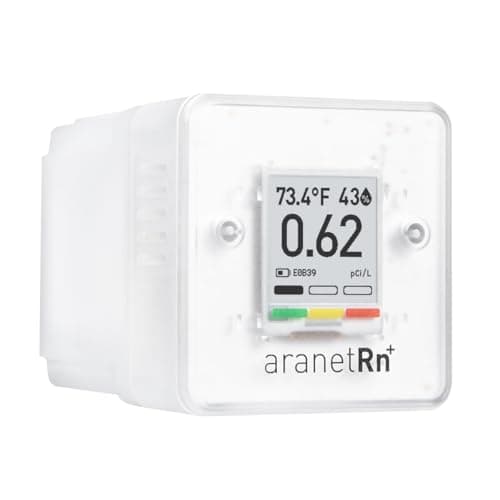
Aranet Radon Plus Radon Detector (10-Minute Readings, 2 AA Batteries, E-Ink Display)See it on Amazon ↗

Quick Verdict

Aranet Radon Plus: 10-minute updates and up to seven years on 2 AA batteries, though its display tops out at a 30-day average.

Key Specs

Measurement interval (stated)

Every 10 minutes

Power (stated)

2 AA batteries, up to a 7-year lifetime

Display (stated)

E-Ink, color-coded green, yellow and red

Averages shown (stated)

Real-time, 24-hour, 7-day and 30-day

Other sensors (stated)

Temperature, relative humidity and atmospheric pressure

Units (stated)

pCi/L or Bq/m³

Pros

  • Up to a 7-year lifetime on 2 AA batteries, per the listing, the longest power claim on this page
  • A new measurement every 10 minutes on a battery unit, so it can sit anywhere and still update often
  • Shows 24-hour, 7-day and 30-day averages on its screen without the app
  • Logs atmospheric pressure, so you can line up a radon jump with a passing storm

Cons

  • The longest average named on the listing is 30 days, short of the more-than-90-day span EPA's guide calls long-term
  • Accuracy and the time to a first steady reading are not stated on the listing

Suited to

A monitor you can place once and leave for years without charging

Our take

Two numbers set this one apart: a fresh measurement every 10 minutes and up to seven years on two AA batteries, per the listing. Low power is what lets it sit in the far corner of a basement room, at the right height, with no cord across the floor. The display shows real-time, 24-hour, 7-day and 30-day averages. None of those is a long-term figure in EPA's terms, which begin past 90 days, so check whether the app keeps a longer history, or write down the 30-day average each month and average three or more of them. The pressure reading is a useful extra. EPA's guide warns against short tests during severe storms and high winds, and a falling pressure figure on the screen tells you one is passing.

Check today's price on Amazon →

Affiliate link — commission at no extra cost to you

#5
Best With a Built-In Alarm

Check price

on Amazon ↗

Listing verified 13 Oct 2026

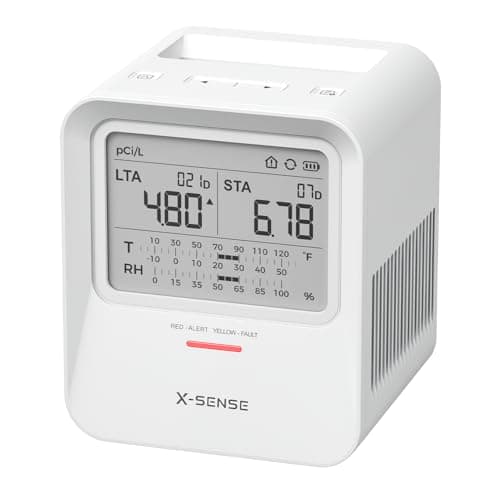
X-Sense XR0B-SR Radon Detector (Audible and Visual Alerts, 2-Year Battery)See it on Amazon ↗

Quick Verdict

X-Sense XR0B-SR Radon Detector: sound-and-light alerts, room-to-room reset and a 2-year battery, with an accuracy claim that lacks detail.

Key Specs

First results (stated)

In 24 hours

Accuracy claim (stated)

Reaching 95% after 7 days or more; how it was measured is not stated

Alerts (stated)

Sound and light when radon passes the threshold

Battery (stated)

2-year battery life, with low-power notifications

Tracking (stated)

Up to 999 days; up to 99 saved records

Size (stated)

3.6 x 3.2 x 3.0 in

Pros

  • Sounds and flashes when radon passes its threshold, so a rise gets noticed without checking a screen
  • A long-press reset starts a new session, so one unit can check room after room
  • Two-year battery life and up to 999 days of tracking, per the listing

Cons

  • The 95% accuracy figure does not say against what reference or at what radon level
  • Whether the alarm threshold can be changed is not stated on this listing
  • No app on this model; phone alerts need the separate Wi-Fi version

Suited to

Someone who wants an alarm to flag a rise, or one unit to compare rooms one at a time

Our take

The alarm is the reason to pick this one, and it needs a little care. Radon swings over hours, so if the threshold sits at or near EPA's 4 pCi/L action level, it may sound on a short peak that a long-term average would smooth away. Treat an alert as a prompt to look at the longer trend, not a verdict on the house. The listing ties its 95% accuracy line to 7 days or more without saying how that was measured, so give it at least a week in one spot before trusting a number. The reset button makes room-by-room checks simple: leave it several days in each room with the house closed up, save the record, then move it. Its 24-hour first result is a start, not an answer.

Check today's price on Amazon →

Affiliate link — commission at no extra cost to you

Buyer's Guide

What to know before you buy.

Short-Term and Long-Term Averages: Which Number to Act On

A continuous monitor counts radon around the clock and turns those counts into averages. EPA's Citizen's Guide to Radon lists continuous monitors among the devices commonly used for short-term tests, which run two days to 90 days, and it calls anything over 90 days long-term, the figure more likely to reflect your year-round level. Read a monitor the same way. A 1-day number tells you what the house did yesterday. A 7-day number works as a screen. An average of 90 days or more is the one to plan around, because radon changes with weather and season. EPA recommends fixing a home at 4 pCi/L or above, so a long-term average at that level means the next step is a mitigation contractor, not another month of watching. Units that put both kinds of average on screen, like the Corentium Home 223, make this easy to follow.

Why the First Reading Is Not a Result

A radon monitor counts tiny decay events, and a small count carries a lot of random scatter, which shrinks as the hours add up. That is why a first reading proves the unit works but says little about the house. The listings here quote first readings from 10 minutes to a day, and two of them state no time at all. Only the X-Sense listing links its accuracy claim to a period, 7 days or more, and that is a fair rule for any of them. To get a number you can set beside a 2-to-7-day lab kit, keep the house closed up as you would for a kit, leave the monitor in one spot at least that long, and do not act on the first day. Moving it, opening windows for a day, or a stormy spell all show up in the short averages, so note them when you read the trend.

Battery or Plug-In, Screen or App

Power decides placement. EPA's guide wants a test in a regularly used room on the lowest lived-in level, at least 20 inches off the floor and away from exterior walls, and that spot rarely has an outlet. Battery units such as the Corentium Home 223 (3 AAA), Aranet Radon Plus (2 AA, up to 7 years stated) and X-Sense XR0B-SR (2 years stated) can sit anywhere. The RadonEye RD200 runs from a power cable, so plan for an outlet or a tidy extension. The display comes next. To read the number at a glance, choose a numeric screen; the Wave Radon shows only a color light on the device and keeps its numbers in the app. An app adds history graphs and reports, handy when you are talking to a mitigation contractor. For alerts away from home, these listings point to an Airthings Hub or X-Sense's separate Wi-Fi model.

Using a Monitor to Check a Mitigation System

A monitor earns its keep after a radon system goes in. EPA's guide says to test again once a home is fixed, to be sure levels came down, and to retest every two years after that. A continuous unit covers both without buying kit after kit. Set it where you tested before mitigation so the numbers compare. Most soil suction systems include a built-in indicator that shows whether the system is running properly, per EPA's guide, but that indicator does not report the radon level in your rooms; a monitor does. If the fan fails, readings drift back toward the old level over days, and a unit with an alarm or app alert flags it sooner. A drop that stalls above 4 pCi/L is worth a call to the installer, since EPA's guide says most homes today can be brought to 2 pCi/L or below.

Who Should Not Rely on a Home Radon Monitor

A home monitor is your own data, and some decisions need someone else's. In a home sale, EPA's guide notes that buyers frequently want a test made by someone not involved in the sale; your state radon office can help find a qualified tester, and EPA's page on finding professionals names NRPP and NRSB as the national programs that credential them. If you only want to know once whether a house is above 4 pCi/L, a mail-in lab kit plus a follow-up test costs less than a monitor. If your water comes from a private well, a monitor reads radon in your air, not in the water. And no monitor can tell you where radon gets in or design the fix. That is work for a qualified mitigation contractor, and EPA's advice is to find one through your state radon program.

Frequently Asked Questions

Are digital radon detectors accurate?

They can be, but the listings say little about it, so trust a long average over a short one. The RadonEye RD200 states 30 counts per hour per pCi/L, and the X-Sense XR0B-SR claims 95% accuracy after 7 days without saying how that was checked.

The Corentium Home 223, Wave Radon and Aranet Radon Plus listings give no accuracy figure. Any monitor gets steadier the longer it counts in one place, so a week's average deserves more weight than a day's.

Radon detector vs test kit: which one do I need?

Buy a test kit for a single answer and a detector to keep watching. A mail-in kit gives one lab-read result for the days it was out, which suits a first screen or a follow-up test.

A detector costs more up front but keeps counting, so it can show a long-term average, catch seasonal changes and check a mitigation system for years. A sensible order is a kit first, then a monitor if that first number lands near or above EPA's 4 pCi/L action level.

How long does a radon detector take to give a reading?

Anywhere from 10 minutes to 24 hours for a first number, per these listings, and several days for one worth acting on. The RadonEye RD200 states a first reading in 10 minutes, the Aranet Radon Plus measures every 10 minutes, and the X-Sense XR0B-SR gives first results in 24 hours.

Give any monitor at least two days in one spot with windows and outside doors closed, the shortest test EPA's guide describes, and a week if you can.

Where should I put a radon detector in my house?

Put it in the lowest level you use regularly, in a living room, den, playroom or bedroom rather than a kitchen or bathroom. That follows the placement EPA's Citizen's Guide gives for testing, and the basement counts only if someone spends time there.

Keep the unit at least 20 inches above the floor, away from drafts, high heat, high humidity and outside walls. In a basement, a dehumidifier's warm exhaust is both a draft and a heat source, so keep the monitor clear of it.

Can I use a radon monitor when buying or selling a house?

You can use one for your own information, but expect the other side to want an independent test. EPA's guide notes that buyers frequently want a test made by someone not involved in the sale.

A qualified tester, credentialed through your state or through NRPP or NRSB as EPA's page lists, is the safer route. A seller's monitor is still worth running early, since EPA's guide advises fixing a radon problem before the sale so it does not complicate it.

Are radon detectors worth it?

YesIf you plan to stay in the home, have a mitigation system to check, or got a first result near 4 pCi/L.

Radon changes from day to day and season to season, and a monitor shows that pattern where one kit shows a single window. EPA estimates radon is responsible for about 21,000 lung cancer deaths every year, and its guide suggests testing again in the future even after a result below 4 pCi/L. For a single answer, a lab kit does that job for less.

Who do I call right now for water damage?

Call (888) 840-6512. The line is answered 24 hours a day, seven days a week, and connects you with an IICRC-certified water damage restoration company that serves your area. A recorded menu picks up first: choose water damage or mold, key in your 5-digit ZIP code, and hold through the short silence while the call is passed to the company.

Describe what you can see — where the water is coming from, how long it has been there, and whether it smells — the more specific you are, the faster the right company is on the line. If the source is a pipe or an appliance, shut the main water valve first. Have four things ready and the call goes quickly: the address, when the water started, what is wet now, and whether you have filed an insurance claim.

Still not sure which of these is your situation? (888) 840-6512 · toll-free · answered 24/7

Sources

  1. EPA — Health Risk of Radon
  2. EPA — Find a Radon Test Kit or Measurement and Mitigation Professional
  3. EPA — A Brief Guide to Mold, Moisture, and Your Home

Methodology: How we source and verify data · Report an error

How we chose these picks

  • Every pick is a current listing. Stock, star ratings and rating counts are read from Amazon by script and carry the date they were read.
  • Nothing under 4.0 stars makes the list, and the top pick needs a large rating count, so one good week of reviews cannot put it there.
  • Specs are quoted from the listing or the maker, with the test condition behind the number where there is one, and sized against the job rather than the room on the box.
  • We do not run lab or field tests. Where a spec matters, we say what it is measured under and what it cannot tell you.

Free 2-day shipping

Amazon Prime members pay no shipping on restoration equipment

Dehumidifiers, air movers, and moisture meters qualify for free Prime delivery — bulk items that otherwise cost $15–$40 to ship.

Try Prime free →

Affiliate link — HearthDry earns a bounty if you sign up; costs you nothing extra.

Also Worth Comparing

Best Hygrometers for Home in 2026 — Indoor Humidity Monitors That Tell You When a Room Is Too Damp

A hygrometer is the small, inexpensive instrument that tells you whether a room needs a dehumidifier, a humidifier or nothing at all. These picks are judged on the accuracy each listing states, how easily you can read them, and whether they can warn you about a damp basement before you smell it.

Read the comparison

Best Dehumidifier for Basement Use in 2026 — Drain Hose, Built-In Pump and Honest Pint Ratings

Most basement dehumidifier disappointment comes from two numbers nobody reads properly: the pint rating, measured at warm test conditions a 60°F basement never reaches, and the drainage method. Five units are compared here on those two points first, from a garden-hose drain to a built-in pump with a stated 15 ft lift.

Read the comparison

Best Mold Test Kits for Home in 2026 — Petri-Dish, Lab, 5-Minute and Air-Pump Kits Compared

A home mold test kit answers one question — is there mold here — and in almost every house the answer is yes. The kits differ in how well they answer the questions that matter, namely what kind, how much and whether it is growing, and this guide shows which kit answers which and when to skip the kit and fix the moisture instead.

Read the comparison

Best Crawl Space Vapor Barrier 2026 — 6 mil vs 10 mil vs 20 mil Woven, and the Tape That Seals the Seams

A properly installed vapor barrier is the most cost-effective way to keep ground moisture out of a crawl space, and most failures come from thin film and untaped seams rather than the wrong brand. This guide compares 6-mil, 10-mil and 20-mil woven liners on the specifications you can actually check, and covers the tape and overlaps that decide whether the barrier works.

Read the comparison

Best Radon Test Kits in 2026 — Mail-In Kits Compared on Lab Fees and Test Length, and the Follow-Up Test Before Mitigation

A mail-in radon kit tells you whether your home needs a closer look, and what you actually pay depends on whether the lab fee and return postage are in the box. These kits are compared on what each listing states about the lab, test length and turnaround, with EPA's action level and the follow-up test that should come before any mitigation decision.

Read the comparison

Best Radon Fan in 2026 — Inline Fans for Sub-Slab Systems, Matched by Suction, Not the Biggest CFM Number

A radon fan is one part of a sub-slab system, and the right one is the fan whose airflow holds up at the suction your pipe and soil demand. These picks are compared on what each listing states about pipe size, airflow at pressure, power and outdoor use, alongside EPA's advice on the 4 pCi/L action level, venting above the roof and finding a qualified mitigator.

Read the comparison

Best Air Quality Monitor for Home in 2026 — What Each Sensor Reads, and Why Humidity Is the Number That Warns of Mold

A home air quality monitor reads humidity, temperature and, depending on the model, CO2, fine particles, VOCs or radon, but none of them can tell you that mold is growing. These picks are compared on what each listing says its sensors measure, whether you need an app to see the numbers, and the humidity range EPA advises for keeping mold away.

Read the comparison