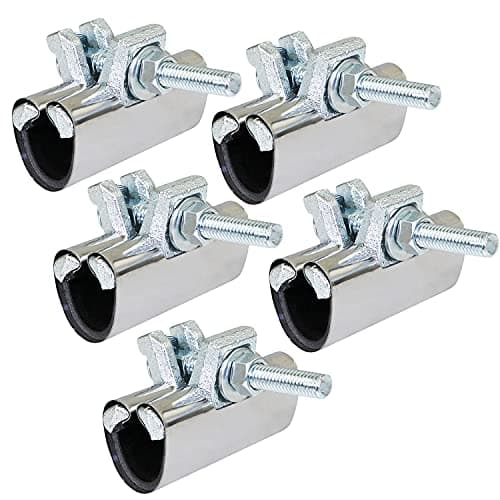
Best for: A pinhole or short split on a straight run of rigid copper, PVC, galvanized or steel pipe
- Pipe size:
- 3/4 in IPS (iron pipe size); 1/2 in and 1 in versions are sold as separate listings
- Length:
- 3 in
Listing verified 13 Oct 2026

Clamps, Tape, Epoxy Putty and Slip Couplings Matched to the Leak
5 picks compared · prices, ratings and stock checked October 11, 2026
Our Top Pick
For a pinhole or short split on straight rigid pipe, the Highcraft 3/4 in IPS Stainless Steel Pipe Repair Clamp. For a burst section of copper or CPVC, cut it out and fit the SharkBite 1/2 in Slip Coupling U3008LFA, which its listing rates to 200 PSI and 200°F.
4.6 on Amazon · 83 ratings
Quick answer
The best pipe repair clamp for a pinhole or short split in straight rigid pipe is the Highcraft 3/4 in IPS Stainless Steel Pipe Repair Clamp, rated 4.6 stars across 83 Amazon ratings: if the damage fits under its 3 in body, clamp it; if not, cut the section out. Shut the main water valve and open a faucet first. Use epoxy putty or a fiberglass wrap at joints and elbows, where a clamp cannot sit, and a SharkBite slip coupling for a burst in copper or CPVC. Treat every patch as temporary until a plumber replaces the section.
Every pick below is currently stocked — ratings and stock read from Amazon on 11 October 2026.
Best for: A pinhole or short split on a straight run of rigid copper, PVC, galvanized or steel pipe
Listing verified 13 Oct 2026
Best for: A split or burst on a straight run of 1/2 in copper or CPVC that you can reach and cut
Listing verified 13 Oct 2026
Best for: A pinhole or seep at a joint, elbow or fitting on metal or plastic pipe
Listing verified 13 Oct 2026
Best for: A leak at a joint, tee or elbow, or a weeping corroded patch, on supply or drain pipe
Listing verified 13 Oct 2026
Best for: Slowing a small leak or a weeping pinhole on hose or an awkward bend while you wait for parts or a plumber
Listing verified 13 Oct 2026
How this page was made: we compare the current Amazon listings, the makers' published specs and what verified buyers report, then rank by fit for the job. Ratings, review counts and stock are read from Amazon and dated. We earn a commission on purchases through our links; it does not change the order. Reviewed by Marcus Reed, IICRC-certified Water Restoration Technician.
Full Reviews
Each pick in detail: what the listing states, what buyers report, and where it falls short.
Check price
on Amazon ↗
Listing verified 13 Oct 2026
See it on Amazon ↗Best Pipe Repair Clamp
Quick Verdict
Highcraft 3/4 in IPS Stainless Steel Pipe Repair Clamp: stainless, five to a pack, and only as good as your measurement of the pipe.
Key Specs
Pipe size
3/4 in IPS (iron pipe size); 1/2 in and 1 in versions are sold as separate listings
Length
3 in
Body
304 stainless steel; plated lug, carriage bolts and nuts
Gasket
NBR rubber, stated to withstand heat up to 180° (unit not given on the listing)
Pipe materials (stated)
Rigid copper, PVC, galvanized and steel
Damage covered (stated)
Pinholes, punctures and splits
Pros
Cons
Suited to
A pinhole or short split on a straight run of rigid copper, PVC, galvanized or steel pipe
Our take
A repair clamp works by squeezing a rubber gasket against the pipe wall, so two things decide whether it seals: the gasket has to cover the hole with margin on every side, and the clamp has to match the pipe's outside diameter. IPS means iron pipe size, and copper tube labeled with the same nominal number is narrower, so measure across the pipe before ordering. Center the gasket over the leak, then tighten the bolt evenly until the drip stops; cranking it far past that on thin copper can distort the pipe. Highcraft states no pressure rating, so treat the clamp as a holding measure and have the section replaced.
Affiliate link — commission at no extra cost to you
Compare elsewhere
These open a search for this model. We quote prices only where we can verify them — Amazon, Sylvane and eBay.
Check price
on Amazon ↗
Listing verified 13 Oct 2026
See it on Amazon ↗Best Lasting Fix for Copper and CPVC
Quick Verdict
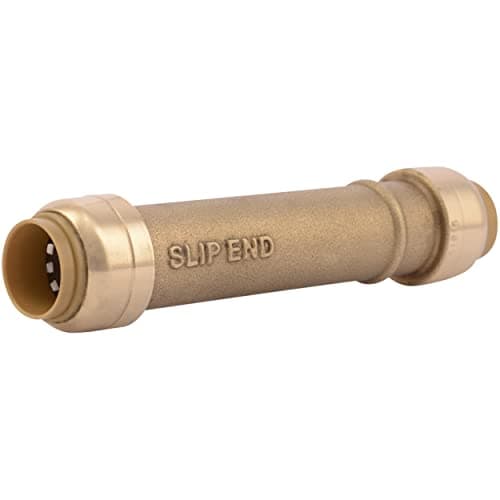
SharkBite U3008LFA slip coupling: a cut-in fitting with a stated 200 PSI rating for burst copper or CPVC, not a patch.
Key Specs
Size
1/2 in
Pipe (slip end)
Copper and CPVC only, per the listing's compatibility note
Rated (stated)
200°F working temperature; 200 PSI working pressure
Body
Forged DZR brass
Install
Push-to-connect; no tools, crimping, glue or soldering; can be installed in wet lines
Design
Stop on one end only, so the other end slides along the pipe; does the job of two couplings and extra pipe
Pros
Cons
Suited to
A split or burst on a straight run of 1/2 in copper or CPVC that you can reach and cut
Our take
This is the repair the others buy time for. A slip coupling has a stop on only one end, so it slides along the pipe past the cut, then back over the gap once the damaged piece is out; the listing says it does the job of two couplings and extra pipe. Cut square and clean, remove burrs, and push each pipe end fully home, since a push-fit seal depends on full insertion. The listing does not say how long a gap it can bridge, so cut out only the damaged length and check the fit before cutting more. SharkBite also sells a Max version of this coupling whose listing states 400 PSI.
Affiliate link — commission at no extra cost to you
Compare elsewhere
Check price
on Amazon ↗
Listing verified 13 Oct 2026
See it on Amazon ↗Best Epoxy Putty
Quick Verdict
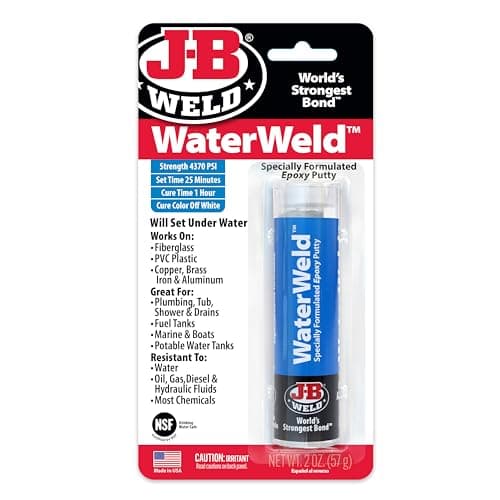
J-B Weld 8277 WaterWeld: NSF-certified putty for the joints and fittings a clamp cannot cover.
Key Specs
Type
Hand-mixed two-part epoxy putty stick, 2 oz
Set and cure (stated)
Sets in 25 minutes; cures in 1 hour
Potable water
Certified by NSF and safe for contact with potable water, per the listing
Wet use
Can cure under water
Strength (stated)
1,300 PSI lap shear, a bond-strength figure rather than a pipe pressure rating
Temperature (stated)
Up to 300°F continuous and 350°F intermittent
Pros
Cons
Suited to
A pinhole or seep at a joint, elbow or fitting on metal or plastic pipe
Our take
Epoxy putty earns a place in every leak kit because it goes where nothing else will: the curve of an elbow, the shoulder of a fitting, a seep where a pipe meets a valve. WaterWeld sets in 25 minutes and cures in an hour, per the listing, and its NSF certification for potable water matters on a supply line. Knead it until the color is even, scuff and wipe the pipe, then press the putty well past the hole on all sides. It can cure under water, but a leak that is still spraying will push soft putty away, so shut the water off first. Treat the patch as a bridge to a plumber's repair.
Affiliate link — commission at no extra cost to you
Compare elsewhere
Check price
on Amazon ↗
Listing verified 13 Oct 2026
See it on Amazon ↗Best Wrap for Joints and Odd Shapes
Quick Verdict
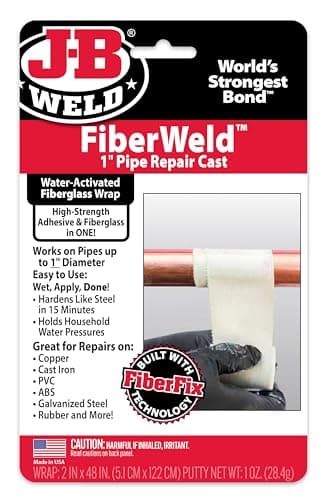
J-B Weld FiberWeld Pipe Repair Cast: putty plus a 15-minute fiberglass wrap for joints, with the maker's household-pressure claim.
Key Specs
Size
2 in x 48 in wrap; the listing describes it as a 1 in pipe repair cast
Cure (stated)
Dip in water for 5–7 seconds; 5–10 minutes of working time; full cure in 15 minutes
Pressure (stated)
Withstands household water pressure; 1,800 PSI bend strength
In the kit
Fiberglass wrap, epoxy putty stick, securing bandage and a pair of gloves
Pipe materials (stated)
Copper, cast iron, PVC, ABS, galvanized steel, rubber
Use
One-time; can be sanded and painted once cured
Pros
Cons
Suited to
A leak at a joint, tee or elbow, or a weeping corroded patch, on supply or drain pipe
Our take
FiberWeld combines what a joint repair needs: putty to fill the hole and a hardening wrap to hold it under pressure. The usual method is to press putty over the leak, dip the wrap in water for 5 to 7 seconds, then wind it tightly past the damage on both sides inside the 5 to 10 minute working window. J-B Weld says it withstands household water pressure and cures in 15 minutes, and the listing calls the bond permanent. That is the maker's claim. A wrap still sits over corroded or split pipe, so treat it as a sound holding repair and have the section looked at. Wear the gloves, since the resin is sticky until it sets.
Affiliate link — commission at no extra cost to you
Compare elsewhere
Check price
on Amazon ↗
Listing verified 13 Oct 2026
See it on Amazon ↗Best Self-Fusing Repair Tape
Quick Verdict
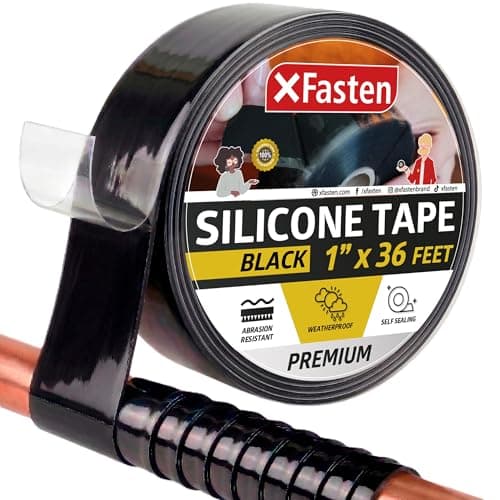
XFasten Self-Fusing Silicone Tape: the quickest wrap for a weeping pinhole, with no pressure rating, so a stopgap.
Key Specs
Size
1 in wide x 36 ft
Type
Self-fusing (self-amalgamating) silicone rubber that bonds to itself
Temperature (stated)
Does not melt up to 500°F; stays flexible down to -60°F
Tensile strength (stated)
900 PSI, a property of the rubber rather than a pipe pressure rating
Standards (stated)
Meets UL 510; ISO 9001
Electrical (stated)
Insulates up to 600 volts/mil
Pros
Cons
Suited to
Slowing a small leak or a weeping pinhole on hose or an awkward bend while you wait for parts or a plumber
Our take
Self-fusing silicone tape has no glue. It bonds to itself when stretched and overlapped, so the seal comes from the tension of each turn pressing on the layer below. Dry the pipe as well as you can, start a few inches before the leak, stretch the tape hard, overlap each turn by about half and finish a few inches past it. The listing's 900 PSI is tensile strength, the force needed to tear the rubber, not the pressure a wrap can hold on a pipe, and no pressure rating is given. That makes it the fastest of these fixes to apply and the one to replace soonest.
Affiliate link — commission at no extra cost to you
Compare elsewhere
What to know before you buy.
Every product on this page works better, and some work only, on a pipe with no water pushing through it. Close the main shutoff valve, then open the lowest faucet in the house to drain the line and relieve the pressure, and open a faucet near the leak as well. Epoxy putty and tape bond best to a pipe that has stopped dripping, and a clamp gasket seats more evenly when the pipe is not spraying. If the pipe froze before it split, the American Red Cross advises keeping the faucet open while thawing, applying heat with a hair dryer, an electric heating pad or towels soaked in hot water, never using an open flame, and calling a licensed plumber if you cannot find or thaw the frozen section. Thaw first, then repair, since ice further along the pipe can split it again.
Start with what failed and where. A pinhole, or a split shorter than the clamp, on a straight run of rigid pipe is clamp work, and the Highcraft clamp covers 3 in. A seep at a joint, elbow, tee or valve shoulder needs something that follows the shape, so use epoxy putty such as J-B Weld WaterWeld or a putty-and-fiberglass kit such as FiberWeld. A weeping hose, or a pinhole you need to slow within minutes, suits self-fusing silicone tape. A pipe that has burst open, bulged or split along a long length is past patching. Cut that section out and fit a SharkBite slip coupling if the pipe is copper or CPVC, or call a plumber if it is another material or the damage runs into a wall.
Pipe sizes are nominal rather than actual, and two sizing systems share the same numbers. Repair clamps such as the Highcraft are sold by IPS, iron pipe size, which is how steel and PVC pipe are sized. Copper tube with the same nominal size has a smaller outside diameter, so a clamp chosen by the number stamped on a copper pipe can be too loose to seal. Wrap a strip of paper around the pipe, mark where it overlaps, and divide that length by 3.14 to get the outside diameter, then compare it with the clamp's stated size. Push-fit couplings are sized to copper tube and CPVC, so the 1/2 in SharkBite suits 1/2 in copper. Putty and tape fit any size, which is one reason a home leak kit should hold both.
No listing on this page states a service life, and the claims they do make differ. Only the SharkBite slip coupling gives a working pressure, 200 PSI, because it is a plumbing fitting rather than a patch. FiberWeld says it withstands household water pressure and calls its bond permanent. WaterWeld's 1,300 PSI and XFasten's 900 PSI describe the material's strength, not a rating for a pressurized pipe, and the Highcraft clamp gives no pressure figure at all. One wrap maker, Weld-On, states on its listing that pipe repair wrap is not intended as a permanent repair and should be used until the pipe can be replaced. That is the safe way to read all of them: a clamp, putty or wrap stops the water today, and a plumber replaces the damaged section afterward.
Skip the kit and call a licensed plumber if the leak is inside a wall, ceiling or slab, where you cannot see how far the damage runs. The same goes for a leak on the service line before the main shutoff, which you have no way to turn off, and for old galvanized pipe corroded along its length, where patching one spot does nothing for the rest. Gas lines are never a DIY patch, whatever a repair product's listing says about gas: leave the house and call the gas utility from outside. Pipe that a product listing does not name, such as polybutylene, is outside what that product claims to fix. Finally, a leak that has already soaked drywall, insulation or subfloor needs drying as much as plumbing, and a patch on the pipe does nothing for the water already in the building.
Turn the main valve back on slowly and watch the repair for several minutes at full pressure, then check it again the next morning. EPA WaterSense suggests a simple meter test for leaks you cannot see: read the water meter, use no water for two hours, and read it again, since a change means water is still going somewhere. Then deal with what got wet. The EPA's mold guidance says to dry water-damaged areas and items within 24 to 48 hours to prevent mold growth, which after a burst pipe means extracting standing water, running fans and a dehumidifier, and checking behind baseboards and under flooring with a moisture meter. Water from a pressurized pipe travels inside walls and under floors, so measure moisture rather than trusting what looks dry.
NoTreat it as temporary. A clamp presses a rubber gasket over the damage, but the pipe underneath is still corroded, split or thinned, and the Highcraft listing states no pressure rating or service life.
A clamp can hold for a long time on a clean pinhole, yet the sound repair is to cut out the damaged section and replace it, with soldered or glued pipe or with a push-fit fitting such as a SharkBite slip coupling. Use the clamp to stop the water, then book the replacement.
Shut off the main water valve, open a faucet to drain the line, then cover the damage with a repair clamp, epoxy putty or self-fusing tape. A clamp suits a short split on straight pipe, putty or a fiberglass wrap suits a joint, and tape suits a quick wrap on an awkward bend.
A pipe that has opened along a long length needs that section cut out, so call a plumber. Start drying anything wet straight away, since the EPA advises drying water-damaged materials within 24 to 48 hours to prevent mold.
It can slow or stop a small leak, but it is a stopgap and holds far better with the water off. The tape seals by being stretched hard and overlapped so each layer squeezes the one below.
XFasten's listing gives a 900 PSI tensile strength, which describes the rubber rather than the pressure a wrapped pipe can hold, and it states no pressure rating. Wrap well past the leak on both sides, then plan to replace the section.
YesFor a pinhole or a seep at a joint, as long as the putty suits copper and drinking water.
J-B Weld WaterWeld lists copper and brass among its surfaces and states NSF certification for potable-water contact. Shut the water off, clean and scuff the copper, press the kneaded putty well past the hole, and leave it the hour the listing gives to cure. It will not hold a long split, and it does not replace a proper repair of the damaged pipe.
It is a plumbing fitting rather than a patch, which makes it the most lasting option on this page. The listing for the SharkBite U3008LFA rates it to 200 PSI working pressure and 200°F, and says SharkBite fittings meet the same standards for commercial and residential plumbing applications.
Whether it stays in place long term is a decision for your plumber and local code. Its slip end fits copper and CPVC only, so it is not the answer for PEX, PVC or galvanized pipe.
Buy the clamp that matches the pipe's measured outside diameter, not just the nominal size printed on it. Clamps are usually sold by iron pipe size, and copper tube of the same nominal size is narrower, so a 3/4 in IPS clamp is too large to seal 3/4 in copper.
Calipers give the outside diameter directly. Pick a clamp long enough to cover the damage with margin at both ends, and use a fitting or a plumber when no clamp is long enough.
Call (888) 840-6512. The line is answered 24 hours a day, seven days a week, and connects you with an IICRC-certified water damage restoration company that serves your area. A recorded menu picks up first: choose water damage or mold, key in your 5-digit ZIP code, and hold through the short silence while the call is passed to the company.
Describe what you can see — where the water is coming from, how long it has been there, and whether it smells — the more specific you are, the faster the right company is on the line. If the source is a pipe or an appliance, shut the main water valve first. Have four things ready and the call goes quickly: the address, when the water started, what is wet now, and whether you have filed an insurance claim.
Still not sure which of these is your situation? (888) 840-6512 · toll-free · answered 24/7
Methodology: How we source and verify data · Report an error
Free 2-day shipping
Amazon Prime members pay no shipping on restoration equipment
Dehumidifiers, air movers, and moisture meters qualify for free Prime delivery — bulk items that otherwise cost $15–$40 to ship.
Affiliate link — HearthDry earns a bounty if you sign up; costs you nothing extra.

A burst frozen pipe is one of the most expensive kinds of winter water damage, and preventing it costs a small fraction of the repair. This guide pairs the two tools that stop it, foam insulation that slows heat loss and heat tape that adds heat, with the sealant that closes the drafts in between.
Read the comparisonA smart water shutoff closes the supply when it detects a leak, so a burst pipe does not run for hours while nobody is home. The four systems here split into two designs: leak sensors that close the valve you already have, and valves on the main line that watch the flow itself.
Read the comparisonMost homeowners do not discover a leak until it has soaked into subfloor and drywall. A Wi-Fi water leak detector sends the alert to your phone while the water is still on the floor, whether or not anyone is home to hear a siren.
Read the comparisonBefore you run a dehumidifier, you need to remove standing water. These are the best wet/dry vacuums for water damage — compared on capacity, suction, and filtration.
Read the comparisonA moisture meter tells you what your eyes can't see — wet drywall, soggy subfloor, and moisture in framing. These are the four best moisture meters for homeowners dealing with water damage.
Read the comparisonAn outdoor faucet cover insulates the spigot and blocks the wind, which lowers the odds of a frozen hose bib splitting the pipe inside the wall, where the real water damage happens. It cannot do that job alone, so every pick here comes with the steps that matter more: hose off, inside valve shut and the line drained.
Read the comparisonWaterproof tape comes in three kinds that do different jobs: wide patch tape for cracks and liners, butyl tape for outdoor seams, and self-fusing silicone for wrapping pipes and hoses. These five are compared on what each listing states about width, temperature, wet application and use, with the shutoff-first steps and the tape arithmetic for a leaking pipe.
Read the comparisonAn under sink mat is a silicone or plastic tray that keeps drips and spilled cleaners off the cabinet floor, but it holds only what its raised edge allows and can hide a slow leak. These picks are compared on size, stated edge height, trimming and cleaning, with the capacity math, the monthly check and the leak sensor a mat still needs.
Read the comparisonA water pressure regulator comes in two very different kinds: a whole-house pressure reducing valve (PRV) that a plumber fits on the main line, and a small hose-thread regulator for an RV, a camper or a garden hose. These picks say plainly which kind each one is, compared on connection, stated adjustment range and what each listing leaves out, with the gauge test to run first and the expansion tank a PRV can make necessary.
Read the comparisonSharkBite fittings push onto PEX, copper, CPVC, PE-RT or HDPE pipe and seal without solder, glue or a crimp tool, which is why one lives in so many basements next to the main shutoff. This comparison of the SharkBite Max coupling, elbow, ball valve and threaded adapter, plus one brass alternative, is built from the Amazon listings, SharkBite's published specs and buyer ratings, not from our own installs.
Read the comparison