Best for: Patching a crack, hole or seam on a gutter, roof edge, pool liner, plastic container or plastic drain line
- Type:
- Thick patch tape; adhesive chemistry not stated on the listing
- Size:
- 4 in wide x 10 ft
Listing verified 13 Oct 2026

Patch, Butyl and Self-Fusing Silicone Tape for Leaks, and Why a Taped Pipe Is Temporary
5 picks compared · prices, ratings and stock checked October 12, 2026
Our Top Pick
For patching cracks, holes and liners, the Gorilla Waterproof Patch & Seal Tape, 4 in x 10 ft, with a backing built for moisture and UV. For a weeping pipe or hose, once the water is off, the arvyne Self Fusing Silicone Tape wraps into a glue-free rubber sleeve.
4.3 on Amazon · 30,250 ratings
Quick answer
If you need to patch a leak that is not under pressure, such as a gutter seam, a cracked bucket or a pool liner, buy a 4 in wide patch tape; for most homes that is the Gorilla Waterproof Patch & Seal Tape, rated 4.3 stars across 30,250 Amazon ratings. For a leaking water pipe, close the shutoff first, wrap the dry pipe with self-fusing silicone tape such as the arvyne Self Fusing Silicone Tape, and call a plumber. None of the five tapes here lists a pressure rating, so a taped supply line is a stopgap, not a repair.
Every pick below is currently stocked — ratings and stock read from Amazon on 12 October 2026.
Best for: Patching a crack, hole or seam on a gutter, roof edge, pool liner, plastic container or plastic drain line
Listing verified 13 Oct 2026
Best for: Wrapping a pinhole or weeping joint on a pipe or hose after the water is shut off
Listing verified 13 Oct 2026
Best for: Sealing an exterior seam, a gap around a vent or a split in a metal or vinyl gutter, on a dry day
Listing verified 13 Oct 2026
Best for: Wrapping a pipe, hose or fitting in a heated space, or a quick repair on outdoor gear
Listing verified 13 Oct 2026
Best for: A patch that has to go on a wet surface right away, such as a cracked bucket, cooler, planter or dripping drain trap
Listing verified 13 Oct 2026
How this page was made: we compare the current Amazon listings, the makers' published specs and what verified buyers report, then rank by fit for the job. Ratings, review counts and stock are read from Amazon and dated. We earn a commission on purchases through our links; it does not change the order. Reviewed by Marcus Reed, IICRC-certified Water Restoration Technician.
Full Reviews
Each pick in detail: what the listing states, what buyers report, and where it falls short.
Check price
on Amazon ↗
Listing verified 13 Oct 2026
See it on Amazon ↗Quick Verdict
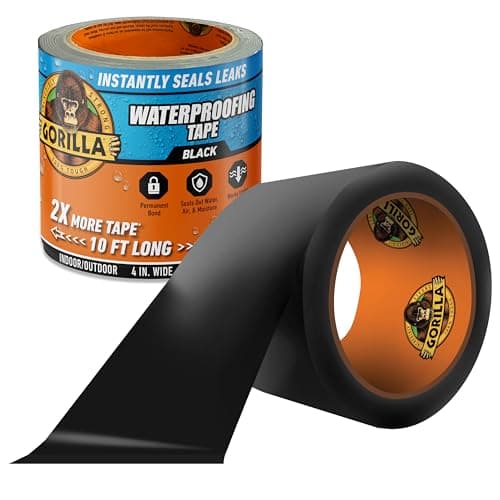
Gorilla Waterproof Patch & Seal Tape: a 4 in patch tape for roofs, liners and plastic, with no pressure rating, so not a pipe repair.
Key Specs
Type
Thick patch tape; adhesive chemistry not stated on the listing
Size
4 in wide x 10 ft
Bond (stated)
Permanent bond that seals out air, water and moisture
Wet use (stated)
Indoors and out, rain or shine, even under water
UV (stated)
Backing designed to withstand moisture and UV rays
Uses named
Roofs, rubber, plastic and vinyl pool liners; holes, cracks, gaps and tears
Pros
Cons
Suited to
Patching a crack, hole or seam on a gutter, roof edge, pool liner, plastic container or plastic drain line
Our take
This is the tape to keep in the drawer for leaks that are not under pressure: a split gutter seam, a crack in a plastic tub or downspout, a torn pool liner, a gap at a vent boot. The 4 in width matters, because a patch should overlap sound material by about 2 in on every side of a crack, and narrow tape cannot do that in one strip. Read the listing for what it covers. It names roofs, rubber, plastic and vinyl pool liners, says it bonds under water, and claims a permanent bond. It does not name pressurized water pipes or give a pressure rating. On a supply line, close the shutoff, dry the pipe, and treat any patch as a way to get through until a plumber replaces the section.
Affiliate link — commission at no extra cost to you
Compare elsewhere
These open a search for this model. We quote prices only where we can verify them — Amazon, Sylvane and eBay.
Check price
on Amazon ↗
Listing verified 13 Oct 2026
See it on Amazon ↗Best for Pipes and Hoses
Quick Verdict
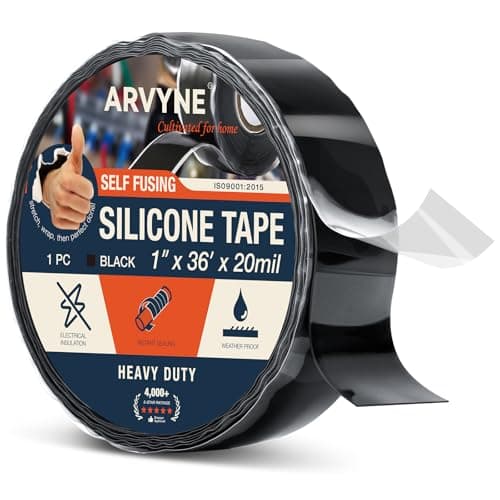
arvyne Self Fusing Silicone Tape: glue-free silicone that fuses into a sleeve around a pipe or hose, a stopgap until the pipe is repaired.
Key Specs
Type
Self-fusing silicone; bonds to itself, no adhesive
Size
1 in wide x 36 ft
Temperature (stated)
-76°F to 392°F, continuous use
Tensile strength (stated)
950 PSI or more
Standard (stated)
MIL-I-46852
Resistance (stated)
Oil, fuel, acids, saltwater, solvents and UV
Pros
Cons
Suited to
Wrapping a pinhole or weeping joint on a pipe or hose after the water is shut off
Our take
Self-fusing silicone tape works differently from every other tape here. It has no glue. You stretch it as you wrap, and the stretched layers fuse into one rubber sleeve, so it grips a round pipe or hose tightly and still comes off clean later. That is why it suits pipes. Read the 950 PSI figure carefully: it is the tape's tensile strength, how hard the material resists being pulled apart, not the water pressure a wrap will hold. A home supply line runs under constant pressure, and no listing on this page gives a pipe pressure rating. Close the shutoff, dry the pipe, wrap with each turn overlapping the last by half, then get the section replaced. On a weeping fitting it buys time, not a fix.
Affiliate link — commission at no extra cost to you
Compare elsewhere
Check price
on Amazon ↗
Listing verified 13 Oct 2026
See it on Amazon ↗Best Butyl Tape for Outdoor Seams
Quick Verdict
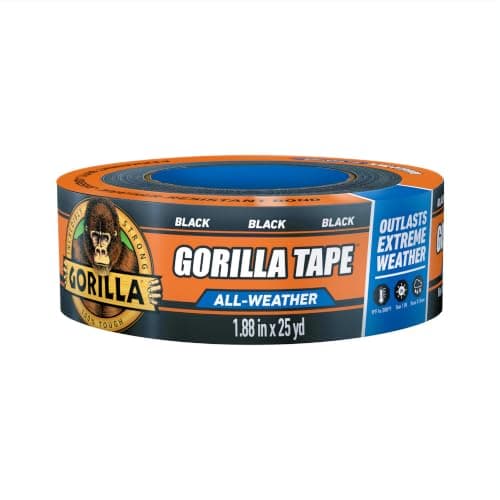
Gorilla All Weather Tape: butyl adhesive rated 0°F to 200°F for dry outdoor seams, not for pipes or wet patches.
Key Specs
Type
Permanent butyl adhesive on a reinforced, weather-resistant backing
Size
1.88 in wide x 25 yd (75 ft)
Temperature (stated)
0°F to 200°F
Weather (stated)
Sun, rain, snow and wind
Surfaces named
Wood, stone, stucco, brick, metal and vinyl
Handling (stated)
Tears by hand
Pros
Cons
Suited to
Sealing an exterior seam, a gap around a vent or a split in a metal or vinyl gutter, on a dry day
Our take
Butyl is the adhesive builders reach for when a seam has to stay sealed outdoors through every season, and this roll is the butyl option on the page. Gorilla states a working range of 0°F to 200°F and a shell built for sun, rain, snow and wind, which covers the heat and cold a gutter seam or metal roof edge goes through in a year. The listing names wood, stone, stucco, brick, metal and vinyl, the outside skin of a house. Two limits follow from what it leaves out. It makes no wet or underwater claim, so apply it to a clean, dry surface on a dry day. It also names no plumbing use. At 1.88 in wide, run it along a seam or edge rather than across a hole.
Affiliate link — commission at no extra cost to you
Compare elsewhere
Check price
on Amazon ↗
Listing verified 13 Oct 2026
See it on Amazon ↗Best Stretch Wrap for Fittings
Quick Verdict
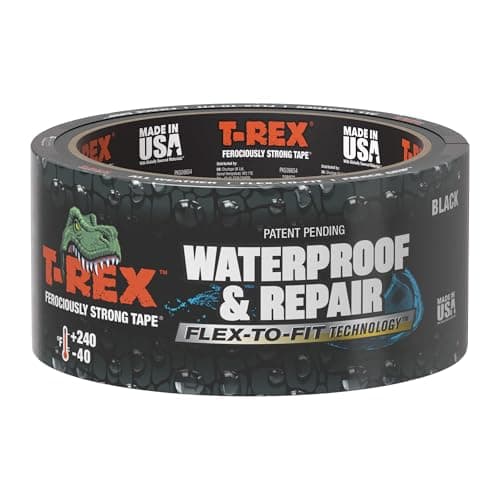
T-REX Waterproof and Repair Tape: a stretch-to-wrap tape with a stated 40°F to 130°F application range, best on pipes and hoses in a warm space.
Key Specs
Type
Stretchy multi-layer film with a solventless UV acrylic adhesive
Size
1.88 in wide x 30 ft
Application temperature (stated)
40°F to 130°F
Service temperature (stated)
-40°F to 240°F after install
Wet use (stated)
Seals out water, air and moisture; even works under water
Handling (stated)
Initially repositionable; no backing to remove
Pros
Cons
Suited to
Wrapping a pipe, hose or fitting in a heated space, or a quick repair on outdoor gear
Our take
T-REX publishes two temperature ranges, and the gap between them matters. The adhesive goes on between 40°F and 130°F, and once applied it holds from -40°F to 240°F. That first number is the one people miss. A pipe that leaked because it froze usually sits in a cold crawl space or garage, often below 40°F, and tape applied there may never bond properly. Shut the water off, then warm the pipe and the air around it with a hair dryer before you wrap. The tape stretches, is repositionable at first and has no liner, so wrapping a pipe one-handed is easier than with a stiff patch tape. Plumbing is on its list of uses, but a pressure rating is not, so treat it as a stopgap on a supply line.
Affiliate link — commission at no extra cost to you
Compare elsewhere
Check price
on Amazon ↗
Listing verified 13 Oct 2026
See it on Amazon ↗Best for Wet-Surface Patches
Quick Verdict
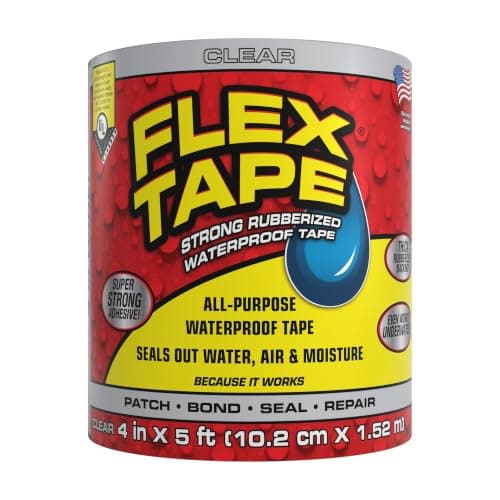
Flex Tape Rubberized Waterproof Tape: a 4 in rubberized patch the listing says goes on wet or underwater, for drains and containers, not supply lines.
Key Specs
Type
Rubberized waterproof tape with a thick, flexible backing
Size
4 in wide x 5 ft
Application (stated)
Hot or cold, wet or dry, even underwater
UV and VOCs (stated)
UV resistant; VOC-free
Temperature range
Described as wide; no figures on the listing
Pressure rating
None stated
Pros
Cons
Suited to
A patch that has to go on a wet surface right away, such as a cracked bucket, cooler, planter or dripping drain trap
Our take
Flex Tape's listing makes the broadest wet-surface claim on this page: apply it hot or cold, wet or dry, even underwater. That makes it the one to reach for when you cannot dry the surface first, such as a cracked drain trap, a split bucket or a leaking pool fitting. Wet application is a convenience, not a reason to skip prep when you have the chance; pressing a patch onto clean, dry material still gives any adhesive its best grip. The listing calls its temperature range wide but prints no figures, and it gives no pressure rating, so do not count on it over a hot supply line. At 4 in by 5 ft, one roll covers a few small patches, not a long seam.
Affiliate link — commission at no extra cost to you
Compare elsewhere
What to know before you buy.
Waterproof tape is three different products sold under one name. Patch tapes such as the Gorilla Waterproof Patch & Seal and Flex Tape put a thick adhesive on a flexible backing about 4 in wide, for flat or gently curved holes, cracks and tears. Butyl tape, such as Gorilla All Weather, uses a soft, sticky butyl adhesive; it belongs on outdoor seams, flashing and gutters, and it wants a dry surface. Self-fusing silicone tape, such as the arvyne roll, has no glue at all. Stretched and wrapped, it bonds only to itself, so it is for round things like pipes, hoses and fittings and will not stick to a flat crack. T-REX sits in between: a stretchy film with an acrylic adhesive. Choose by shape: a flat hole takes patch tape, a long seam takes butyl, and a pipe takes silicone or a stretch wrap.
Tape cannot win against water that is pushing out of a hole, so close the valve before you touch the pipe. Use the fixture shutoff if the leak is after one, or the main shutoff if not, then open a faucet below the leak to drain the pressure. EPA WaterSense's faucet-repair advice opens the same way: turn off the water line before you start. Dry the pipe and wipe away grime, then wrap from about 2 in on one side of the leak to 2 in past the other, overlapping each turn by half. Turn the water back on slowly and watch the patch for a few minutes. Then call a plumber, because none of the tapes on this page lists a pressure rating. Soak up the water quickly too; EPA advises drying water-damaged areas and items within 24 to 48 hours to prevent mold growth.
Most tape failures start before the tape goes on. Wipe the area clean of dirt, grease and loose paint, dry it as well as you can, and round off any sharp edge that could cut the backing. Cut patch tape with rounded corners, since square corners lift first, then press from the center outward to push out air. Temperature matters as much as dirt. T-REX states an application range of 40°F to 130°F, and its listing is the only one here to separate application temperature from service temperature. A frozen pipe in a crawl space is below that floor, so shut off the water and warm the pipe with a hair dryer before wrapping. The Red Cross lists a hair dryer among safe ways to warm a frozen pipe and warns against a blowtorch or any open flame. Wet-rated tapes still bond best to a clean surface.
Start with the distance around the pipe: multiply its outside diameter by 3.14. Copper and PEX sold as 1/2 in measure about 0.625 in across, so about 2 in around, and 3/4 in pipe measures about 0.875 in, so about 2.75 in around. A 1 in tape wrapped with half overlap moves along the pipe 0.5 in per turn. Covering 2 in on each side of a pinhole, 4 in in all, takes about 8 turns, which is about 22 in of tape per layer on 3/4 in pipe, or about 44 in for the two layers worth putting on. That makes the 36 ft arvyne roll good for about nine such repairs. Stretching self-fusing tape uses a little less length. A 1.88 in wide tape such as T-REX advances about 0.94 in per turn, so it needs about half as many turns for the same 4 in patch.
A tape on a roof edge or gutter sees summer sun and winter frost, so check what each listing actually states. Gorilla All Weather gives 0°F to 200°F and names sun, rain, snow and wind. T-REX states -40°F to 240°F once installed and calls itself UV-resistant. The arvyne silicone tape states -76°F to 392°F and UV resistance. Gorilla Patch & Seal says its backing withstands moisture and UV but gives no temperature figures, and Flex Tape says UV resistant and a wide temperature range, again with no numbers. Where a number is missing, assume less. On a roof, any tape is a short-term patch to keep rain out of the attic until a roofer can see it; shingles, flashing and the deck underneath are where the real repair happens, and a wet attic needs drying whatever the patch.
Some leaks are past what any tape can do. If a pipe has burst and water is spraying, go straight to the main shutoff and call a plumber; there is no time for a patch. Never tape a gas line; if you smell gas, leave the house and call the gas utility from outside. A leak on the main line before the shutoff, a water heater tank, or a fitting inside a wall cannot be reached or held by tape. A leaking shower is the same: a gap at the tub needs silicone caulk, and water showing on the ceiling below comes from the valve, drain or pan behind the tile. Renters should report any leak to the landlord before patching. In each of these cases you need a plumber, and the tape stays in the drawer.
YesAs a temporary patch on a small leak, once the water is shut off and the pipe is dry.
Self-fusing silicone or stretch tape wrapped tightly can stop a pinhole or a weeping joint for a while. None of the tapes on this page gives a pressure rating, and a household supply line stays under constant pressure, so a taped pipe should be cut out and replaced by a plumber.
Not reliably, so turn the water off first. Water forcing its way out of a hole lifts the tape's edge before the adhesive or the fused layers can take hold, and no listing here names a pressure rating.
Close the shutoff, open a faucet below the leak to drain the line, dry the pipe, then wrap. Turn the water back on slowly and watch the patch.
On a pressurized water pipe, no; on a gutter seam, liner or container, it can last a long time. Gorilla calls its Patch & Seal bond permanent, which describes the adhesive rather than the repair.
A supply line under constant pressure will keep working at the edges of any patch. Treat a taped pipe as a way to get to the plumber's visit, and treat a taped roof the same way until a roofer has looked.
Some tapes do, according to their listings. Flex Tape says it goes on wet or dry and even underwater, while Gorilla Patch & Seal and T-REX both say they work under water.
Gorilla All Weather, the butyl tape here, makes no such claim and needs a dry surface. Even with a wet-rated tape, wiping the area clean and as dry as you can gives the adhesive a better grip.
Usually none, because tape is the wrong fix for a shower. A gap where the tub meets the tile needs 100% silicone caulk, which cures into the joint.
A showerhead that drips at the pipe calls for pipe tape, the thin thread-seal kind; EPA WaterSense notes that pipe tape, also called teflon tape, can help control leaks there. Water on the ceiling below means a leak behind the tile that no tape can reach.
Neither is better overall; they do different jobs. Butyl tape carries a sticky adhesive and belongs on flat outdoor seams such as roof flashing, gutters and siding, applied to a dry surface.
Self-fusing silicone tape has no adhesive and bonds only to itself, so it is for wrapping round things such as pipes, hoses and fittings. Put butyl on a seam and silicone on a pipe.
Call (888) 840-6512. The line is answered 24 hours a day, seven days a week, and connects you with an IICRC-certified water damage restoration company that serves your area. A recorded menu picks up first: choose water damage or mold, key in your 5-digit ZIP code, and hold through the short silence while the call is passed to the company.
Describe what you can see — where the water is coming from, how long it has been there, and whether it smells — the more specific you are, the faster the right company is on the line. If the source is a pipe or an appliance, shut the main water valve first. Have four things ready and the call goes quickly: the address, when the water started, what is wet now, and whether you have filed an insurance claim.
Still not sure which of these is your situation? (888) 840-6512 · toll-free · answered 24/7
Methodology: How we source and verify data · Report an error
Free 2-day shipping
Amazon Prime members pay no shipping on restoration equipment
Dehumidifiers, air movers, and moisture meters qualify for free Prime delivery — bulk items that otherwise cost $15–$40 to ship.
Affiliate link — HearthDry earns a bounty if you sign up; costs you nothing extra.

A pipe repair clamp, a wrap of self-fusing tape or a lump of epoxy putty can stop a leaking pipe within the hour, but only after the main valve is off and only until the damaged section is properly replaced. These picks are matched to the kind of damage, the pipe material and the size, using each listing's own pressure and temperature figures and noting what it leaves unsaid.
Read the comparisonA can, tube or roll from this page can stop a small roof leak at a seam, a flashing edge or a vent boot. It cannot replace missing shingles or rotted decking, and the place water gets in is often several feet uphill from the stain on your ceiling.
Read the comparisonA smart water shutoff closes the supply when it detects a leak, so a burst pipe does not run for hours while nobody is home. The four systems here split into two designs: leak sensors that close the valve you already have, and valves on the main line that watch the flow itself.
Read the comparisonA heavy polyethylene tarp, boarded down and run over the ridge, is the standard emergency cover for missing shingles or a hole in the roof deck. It keeps the weather out for the days or weeks until the roof is fixed, and putting one up is real roof work, so this page starts with when to leave it to a roofer.
Read the comparison