
Quick answer
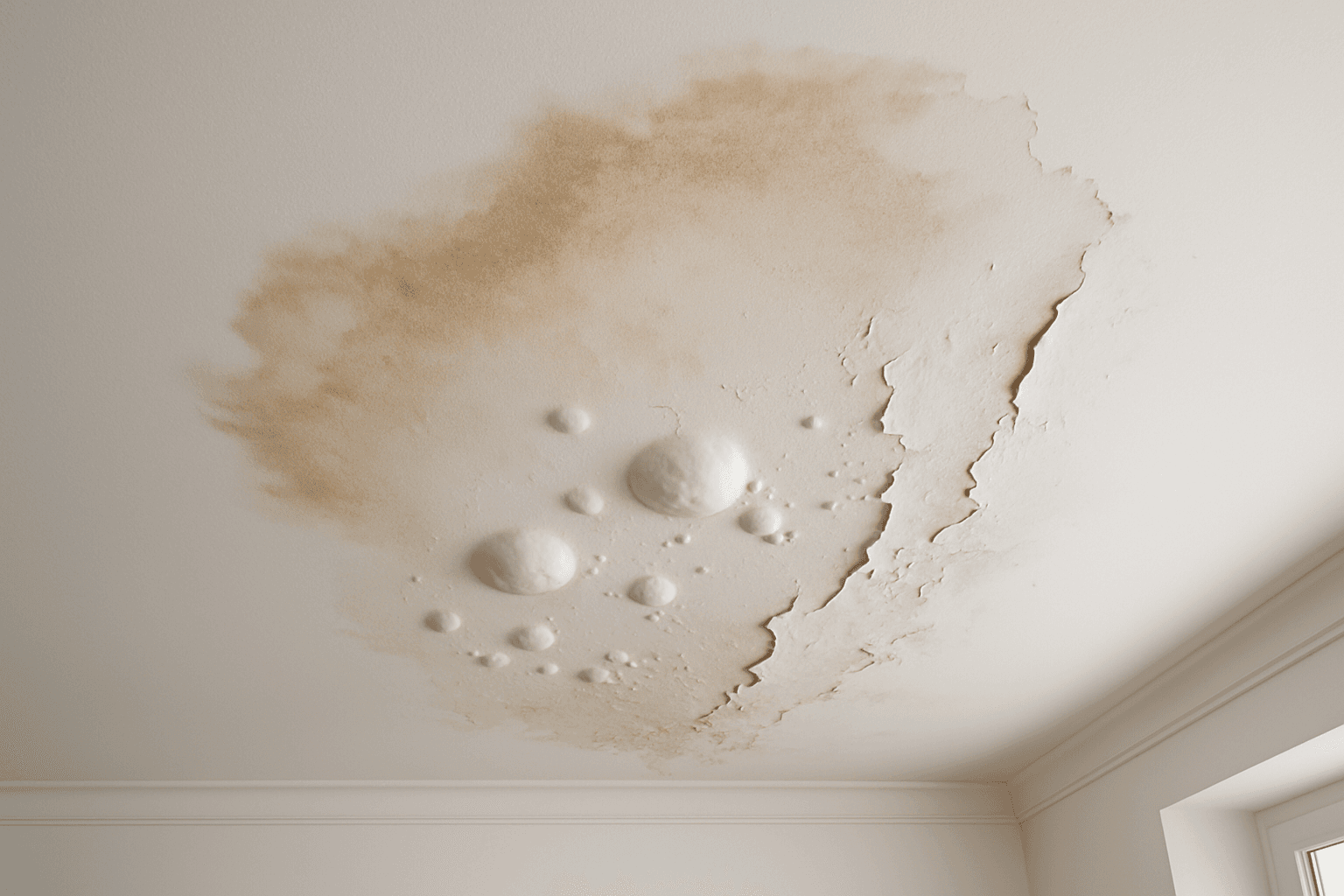
A roof leak reaching the ceiling means water has already crossed the attic, so the wet area is usually larger than the stain suggests. Tarp the roof opening, relieve a sagging ceiling with a small hole and a bucket, and check attic insulation — saturated insulation holds water against the ceiling for weeks. For insurance, the storm evidence matters more than the ceiling photo. Call (888) 840-6512 to reach a certified water damage restoration company in your area; the line is answered 24/7.
Written by Marcus Reed
Reviewed by David Chen, PEProfessional Engineer (PE)
Reviewed June 28, 2026· Next review Dec 2026
Roof Leak Water Damage: How to Assess, Dry, and Claim
Roof leak water damage is the most frequently denied homeowners insurance claim in the United States. The reason: most homeowners policies cover sudden and accidental damage — but most roof leaks are the result of gradual roof deterioration that insurers classify as a maintenance failure.
Understanding exactly how this distinction works — and what documentation protects your claim — is worth thousands of dollars.
How to Identify Active Roof Leak Damage
What you see:
- Water staining on ceiling (brown ring patterns)
- Sagging, bubbling, or soft ceiling drywall
- Water dripping from ceiling fixtures, recessed lights, or seams
- Damp or wet insulation in attic
- Water running down interior walls during rain
What's not visible without professional assessment:
- Saturated ceiling drywall with no visible surface staining yet
- Wet insulation batts (insulation holds water for weeks, growing mold throughout)
- Wet ceiling framing (joists and blocking above the drywall)
- Mold colonization in ceiling cavity — begins in 24–48 hours in humid conditions
The Three Types of Roof Leak Water Damage
Type 1 — Active storm damage (Covered): A previously intact roof is damaged by a covered peril: wind, hail, falling tree limb, ice dam. The damage is clearly storm-related, recent, and sudden. This is what insurance is designed for. Document the storm date, take photos of all damage including roof exterior, and call your insurer within 24–48 hours.
Type 2 — Failed maintenance leak (Disputed): Flashing around a chimney or skylight has been deteriorating for years. A heavy rain finally overwhelms the degraded seal and water enters the home. Insurers frequently deny this as gradual deterioration. Your defense: If the interior damage is sudden and significant (not just a small stain you didn't notice for months), many state insurance regulations require payment for the interior damage even if the exterior roofing repair is denied as maintenance. Consult a public adjuster if your insurer denies a Type 2 claim.
Type 3 — Gradual, undiscovered leak (Usually denied): A slow leak has been occurring for months. By the time it's discovered, the ceiling shows significant mold and structural deterioration. Insurers argue this is gradual damage that the homeowner failed to maintain and discover — the "your house, your responsibility to inspect" defense. This is the hardest type to collect on.
Immediate Steps: What to Do Right Now
- 1Put buckets under active drips. This documents the active leak and prevents additional floor damage.
- 2Do not cut or remove ceiling drywall yourself. Wet drywall with possible mold above requires professional assessment before disturbance. Disturbing moldy drywall without HEPA containment spreads spores throughout the home.
- 3Document the storm or event. Screenshot weather apps showing the exact rainfall event. This timestamped weather documentation is critical evidence.
- 4Photograph and video everything — water drips, ceiling staining, water marks on walls. Photograph the exterior roof damage if accessible from the ground.
- 5Call a restoration company for moisture assessment. Professional moisture meters map the full extent of saturation that is not visible to the eye — and this mapping becomes part of your insurance documentation.
- 6Open your insurance claim immediately. Do not wait to see "how bad it gets." Delayed reporting can be used against you.
Will the Roof Leak Damage Insurance Claim Be Approved?
Strong claim factors:
- Recent storm with documented high winds, hail, or heavy rain
- Roof is relatively new (under 10 years) or was in documented good condition
- Damage is sudden and extensive, not small stains from a slow drip
- You report promptly (within 24–48 hours of discovery)
Claim risk factors:
- Roof is over 15–20 years old
- No recent roof inspection documentation
- Adjacent ceiling areas show old staining from prior undisclosed events
- Adjuster finds deteriorated flashing, lifted shingles, or cracked caulking consistent with long-term maintenance neglect
Ceiling Drywall: Save or Replace?
This is the most common question after a roof leak. The honest answer depends on moisture content, not appearance:
- Drywall under 18% moisture content (measured by a professional moisture meter): Dry in place with equipment.
- Drywall over 18% moisture: Replace. Wet drywall cannot be effectively dried in place once saturation has reached the paper facing and core — it will dry dimensionally warped and support mold growth.
- Any drywall with visible mold: Replace with full containment and HEPA air scrubbing.
- Ceiling drywall that is sagging or soft: Replace — structural failure risk.
Never base the save-or-replace decision on how it looks after it appears to have dried. Measure with a moisture meter.
Mold in the Ceiling After a Roof Leak
If your roof leak has been occurring for more than 48–72 hours in warm conditions, mold growth in the ceiling cavity is likely even if you cannot see it on the drywall surface. Signs:
- Musty odor in the room below (mold odor penetrates drywall)
- Small dark spots appearing on ceiling surface
- Anyone in the household with new respiratory symptoms
Mold adds $4,000–$20,000 to the remediation scope and requires HEPA containment, air scrubbing, and professional disposal. It is not a DIY project.
How Much Does Roof Leak Ceiling Repair Cost?
- Single room, small stain, no mold, dry in place: $800–$2,500
- Single room, ceiling replacement, no mold: $2,500–$6,000
- Single room with mold remediation: $6,000–$15,000
- Multi-room, insulation replacement, mold: $15,000–$40,000+
Talk to a water damage pro now
Answered 24/7 · Toll-free · answered 24/7 · no obligation
(888) 840-6512- Describe the damage & give your ZIP
- You're routed to the on-call local crew
- They quote — you decide, no obligation
Reading to confirm what you already suspect?
Confirm it in two minutes instead — the pro on this line answers questions about YOUR situation all day: what it is, what it should cost, whether you even need service. If you want, they'll set the appointment on the same call.
Toll-free · no obligation · asking costs nothing
Frequently Asked Questions
- 1If water is bulging in the ceiling, poke a small hole with a screwdriver at the bulge's lowest point to drain it in a controlled way -- releasing the pressure prevents a larger collapse
- 2Place buckets and move valuables out from under the drip
- 3Cover electronics and furniture
- 4Document with video and photos before any cleanup
- 5Call a roofer for emergency tarping and a water damage company to assess ceiling and attic moisture. Do not enter the attic if electrical fixtures are involved.
- 1Brownish water stain rings on drywall or plaster
- 2Ceiling paint bubbling, peeling, or sagging
- 3Soft or spongy texture when pressing the ceiling
- 4Visible mold (black or green spots)
- 5Dripping during or after rain
- 6Musty odor in upper rooms or attic. A moisture meter pressed to ceiling drywall above 17% confirms active moisture. Thermal imaging cameras can detect water-cooled zones in the ceiling structure.
- 1Go into the attic during or immediately after rain — use a flashlight to trace wet areas backward (uphill from the drip point) along rafters and sheathing
- 2Look for water staining along rafter runs and at ridge, hip, and valley intersections — these are the highest-leak-rate locations
- 3Check roof penetrations closest to the stain: plumbing vents, chimney flashing, skylight curbs, and HVAC stack flashing are the most common leak sources and often leak only under specific wind-driven rain conditions
- 4If the attic is inaccessible or the stain location is below a finished ceiling, an IR thermal camera inspection ($200–$400) can identify active moisture in ceiling assemblies.
What should I do about a roof leak causing ceiling water damage?
Immediately:
Does homeowners insurance cover roof leak water damage to the ceiling?
Coverage depends on what caused the roof leak. If a sudden storm, fallen tree, or hail caused the roof damage: covered under HO-3 wind/hail coverage. If the roof was already in poor condition or the leak developed gradually: typically not covered (maintenance exclusion).
The interior water damage to drywall, insulation, and personal property is almost always covered as resulting damage from the roof event, even if the roof itself has a coverage dispute. Document the exterior roof damage alongside the interior damage.
How do I know if my ceiling has water damage inside the structure?
Signs of water damage inside ceiling structure:
How much does it cost to repair ceiling water damage from a roof leak?
Minor ceiling water damage (staining only, no structural compromise): $300-$800 for drywall patching and painting. Moderate damage (wet drywall requiring replacement, insulation replacement): $1,500-$3,500.
Severe damage with prolonged moisture (mold in attic, multiple ceiling bays, structural framing damage): $5,000-$20,000+. The roof repair itself is separate: emergency tarping is $300-$1,000, permanent roof repair $1,500-$8,000 depending on extent. Most roof leak damage claims are covered under homeowners insurance.
How do I find the source of a roof leak when the water stain on my ceiling is far from where the leak actually is?
Water rarely travels straight down from the entry point — it follows rafters, sheathing, insulation, and vapor barriers before dropping through a ceiling penetration. The distance between the visible stain and the actual roof entry point can be 5–15 feet or more. The correct search method:
Never have a roofer just apply sealant to every penetration near the stain — systematic leak tracing prevents expensive and ineffective shotgun repairs.
Who do I call for a roof leak — a roofer or a restoration company?
BothHave a job, in this order: if water is actively coming in, a restoration company first — they tarp the opening, extract the water and start drying the ceiling cavity the same day, which is the time-critical half.
The roofer then does the permanent repair, which can wait for daylight and dry weather. Calling only the roofer is the common mistake: the shingles get fixed while the soaked insulation and drywall above your ceiling quietly grow mold. If the leak is small and stopped (no active drip, no sag), you can reverse the order — roofer first, then have the wet materials evaluated.
Who do I call right now for water damage?
Call (888) 840-6512. The line is answered 24 hours a day, seven days a week, and connects you with an IICRC-certified water damage restoration company that serves your area. Describe what you can see — where the water is coming from, how long it has been there, and whether it smells — the more specific you are, the faster the right company is on the line.
If the source is a pipe or an appliance, shut the main water valve first. Have four things ready and the call goes quickly: the address, when the water started, what is wet now, and whether you have filed an insurance claim.
Need it handled now?
Roof Leak Water Damage — 24/7 Certified Crews
Stain spreading on the ceiling? Attic-to-ceiling drying, insulation replacement, and repairs.
Sources
- IICRC S500 — Water Damage Restoration(retrieved 2026-07-02)
- EPA — Mold and Water Cleanup Guidance(retrieved 2026-07-02)
Methodology: How we source and verify data · Report an error
Disclaimer: HearthDry is an independent educational resource. This article is for informational purposes only and does not constitute professional, legal, or insurance advice. Consult licensed professionals before making decisions about your property or insurance claims.
Professional Equipment
Ceiling and Wall Drying Systems — Skip the Demo
Dri-Eaz DriForce wall cavity drying systems can pull moisture from ceiling drywall through injection ports — avoiding full demo in many cases. This is the equipment restoration companies use to save drywall on roof leak jobs.
Affiliate link — HearthDry earns a commission from Sylvane via CJ at no extra cost to you
Watch
Source: Roof Doctors — YouTube
Free 2-day shipping
Amazon Prime members pay no shipping on restoration equipment
Dehumidifiers, air movers, and moisture meters qualify for free Prime delivery — bulk items that otherwise cost $15–$40 to ship.
Affiliate link — HearthDry earns a bounty if you sign up; costs you nothing extra.
Equipment
What each machine actually does
Removes the moisture the structure is still giving off — the machine that decides how long drying takes
See the picks →Moves air across wet surfaces so the dehumidifier has something to take out of the air
See the picks →Finds water behind walls and under floors, and tells you when a material is actually dry
See the picks →Alerts you the moment a leak starts — the cheapest thing on this list and the only preventive one
See the picks →Those pages carry affiliate links. As an Amazon Associate, HearthDry earns from qualifying purchases; it costs you nothing extra.
Our Amazon storefront →Advertisement
