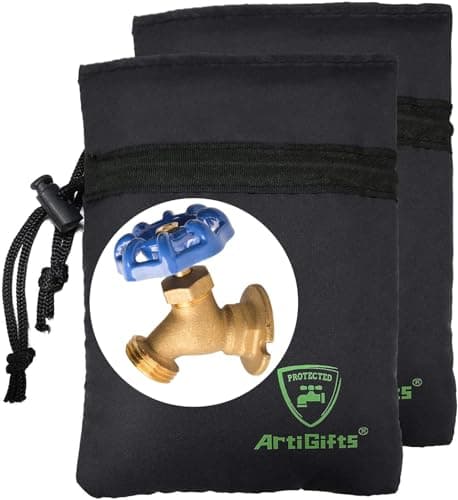
Best for: A standard wall hose bib on a house where the hose is off and the line is drained
- Type:
- Soft insulated sock with a string tie
- Size (stated):
- 5.9 in wide x 7.7 in tall, 1.4 in thick
Listing verified 13 Oct 2026

Insulated Socks, Hard Shells and What a Cover Cannot Do
5 picks compared · prices, ratings and stock checked October 11, 2026
Our Top Pick
For most wall spigots, the ArtiGifts Pro Outdoor Faucet Cover Socks (5.9 x 7.7 in, Set of 2): polyester pongee over PP insulated cotton, 1.4 in thick per the listing, with a string tie. For a long frost-free sillcock or a spigot with a vacuum breaker, the DEMEDO Enlarge Outdoor Faucet Cover (10 x 6.3 in Opening, 3M Thinsulate, 2 Pack), the only cover here whose size is given as the opening.
4.7 on Amazon · 11,361 ratings
Quick answer
The best outdoor faucet cover for most wall spigots is the ArtiGifts Pro Outdoor Faucet Cover Socks (5.9 x 7.7 in, Set of 2): if you have a standard hose bib, buy this insulated sock, and if the spigot is a long frost-free sillcock or carries a vacuum breaker, size up to the DEMEDO with its 10 x 6.3 in opening. The ArtiGifts is rated 4.7 stars across 11,361 Amazon ratings. A cover adds no heat, so fit it last: the American Red Cross says to remove the hose, close the inside valve and open the outside spigot to drain the line.
Every pick below is currently stocked — ratings and stock read from Amazon on 11 October 2026.
Best for: A standard wall hose bib on a house where the hose is off and the line is drained
Listing verified 13 Oct 2026
Best for: A short hose bib on flat siding, where the cover may get knocked or buried in drifting snow
Listing verified 13 Oct 2026
Best for: A hose bib with a wide wheel handle, or a short frost-free sillcock that crowds a smaller sock
Listing verified 13 Oct 2026
Best for: A frost-free sillcock, a spigot with a vacuum breaker, or any faucet too big for a standard sock
Listing verified 13 Oct 2026
Best for: A house with three or four plain hose bibs on flat siding that each need a basic cover
Listing verified 13 Oct 2026
How this page was made: we compare the current Amazon listings, the makers' published specs and what verified buyers report, then rank by fit for the job. Ratings, review counts and stock are read from Amazon and dated. We earn a commission on purchases through our links; it does not change the order. Reviewed by Marcus Reed, IICRC-certified Water Restoration Technician.
Full Reviews
Each pick in detail: what the listing states, what buyers report, and where it falls short.
Check price
on Amazon ↗
Listing verified 13 Oct 2026
See it on Amazon ↗Quick Verdict
The ArtiGifts Pro Outdoor Faucet Cover Socks (5.9 x 7.7 in, Set of 2) have the deepest buyer record here and the only stated thickness; measure first, since this is the smallest sock.
Key Specs
Type
Soft insulated sock with a string tie
Size (stated)
5.9 in wide x 7.7 in tall, 1.4 in thick
Outer fabric
Heavyweight polyester pongee, described as waterproof
Insulation
PP insulated cotton, per the listing
Wall fit
Designed to sit close against the wall, per the listing
In the pack
2 covers
Pros
Cons
Suited to
A standard wall hose bib on a house where the hose is off and the line is drained
Our take
Most outdoor spigots are a short hose bib or a frost-free sillcock standing a few inches off the siding, and a soft insulated sock suits both because its fabric edge settles against uneven siding better than a rigid shell does. This one pairs heavyweight polyester pongee outside with PP insulated cotton inside, and it is the only cover on this page that states its thickness, 1.4 in. The listing calls the design wall-hugging, and that is the detail to check once it is on: cold air that slips in at the wall edge undoes the insulation. At 5.9 x 7.7 in it is the smallest of the soft covers here, so measure the spigot, handle and any vacuum breaker included, before ordering. Fit it after the hose is off and the line is drained, then leave it until spring.
Affiliate link — commission at no extra cost to you
Compare elsewhere
These open a search for this model. We quote prices only where we can verify them — Amazon, Sylvane and eBay.
Check price
on Amazon ↗
Listing verified 13 Oct 2026
See it on Amazon ↗Best Hard-Shell Cover
Quick Verdict
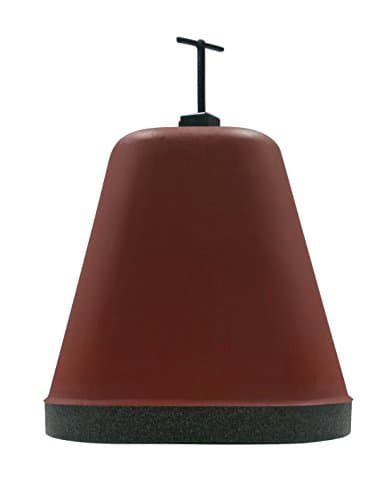
The Frost King FC2 Hard Plastic Faucet Cover (Rectangular, Single) is the one rigid shell here and suits flat siding; the listing gives no size, so check the fit before the first freeze.
Key Specs
Type
Hard plastic outer shell over a poly foam inner cover
Shape
Rectangular
Stated use
Regular and stand outdoor faucets (listing wording)
In the pack
1 cover
Dimensions
Not stated on the listing
Fastening method
Not described on the listing
Pros
Cons
Suited to
A short hose bib on flat siding, where the cover may get knocked or buried in drifting snow
Our take
A hard-shell cover does one thing a sock cannot: it keeps its shape. The FC2 puts a hard plastic outer shell over a poly foam inner cover, per the listing, so snow piled against the wall or a knock from a wheelbarrow does not flatten the insulation the way it can squash a fabric bag. The trade-off is fit. A rigid rim needs a fairly flat surface around the spigot to close the gap where cold air gets in, and the listing gives no dimensions at all, which makes the fit check harder than it should be. Measure how far the spigot and its handle stand off the wall and compare that with the cover when it arrives. On uneven siding, a strip of foam weatherstripping around the rim can close the gap.
Affiliate link — commission at no extra cost to you
Compare elsewhere
Check price
on Amazon ↗
Listing verified 13 Oct 2026
See it on Amazon ↗Quick Verdict
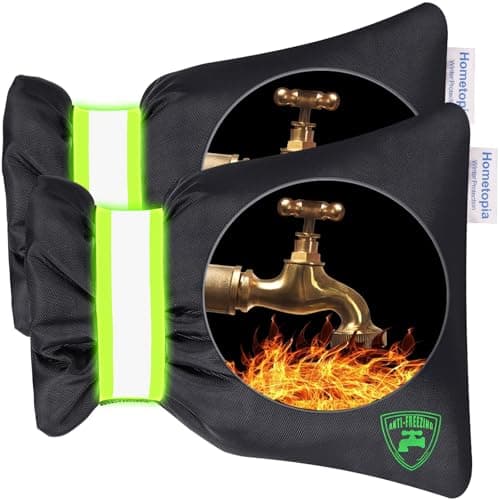
The Hometopia Pro Outdoor Faucet Covers (6.7 x 8.3 in, 2 Pack) are a size up from the ArtiGifts in a heavier 600D shell, for spigots that crowd a small sock.
Key Specs
Type
Soft insulated sock, three-layer design
Size (stated)
6.7 in wide x 8.3 in tall
Outer fabric
600D Oxford with a water coating, per the listing
Insulation
PP insulated cotton
Fastening
Hook-and-loop straps plus a cord
In the pack
2 covers
Pros
Cons
Suited to
A hose bib with a wide wheel handle, or a short frost-free sillcock that crowds a smaller sock
Our take
This is the same kind of cover as the ArtiGifts, a three-layer insulated sock, one size up: 6.7 x 8.3 in by the listing, about 0.8 in wider and 0.6 in taller. That margin matters on a spigot with a wide wheel handle or a short frost-free sillcock, where a tight sock gets pushed off the wall and leaves a gap. The outer fabric is 600D Oxford with a water coating, the heaviest fabric rating stated among these picks, over a middle layer of PP insulated cotton. It fastens with hook-and-loop straps and a cord, two ways to pull it snug against the siding. Like every cover here, it carries no R-value or temperature rating, so count on insulation and a windbreak, not on surviving any particular cold snap.
Affiliate link — commission at no extra cost to you
Compare elsewhere
Check price
on Amazon ↗
Listing verified 13 Oct 2026
See it on Amazon ↗Best for Frost-Free Sillcocks
Quick Verdict
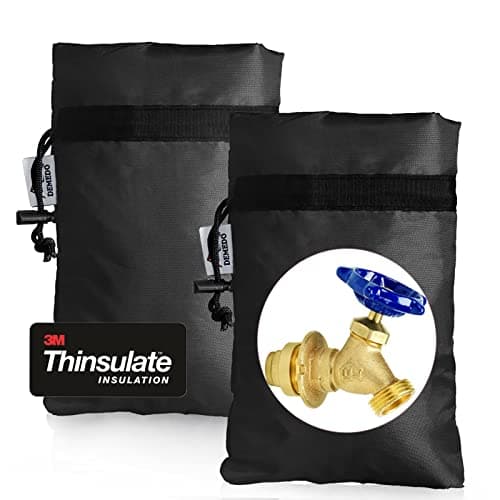
The DEMEDO Enlarge Outdoor Faucet Cover (10 x 6.3 in Opening, 3M Thinsulate, 2 Pack) is the large sock here, with a stated opening and Thinsulate fill, for sillcocks a small cover cannot reach around.
Key Specs
Type
Soft insulated sock with a drawstring
Opening (stated)
10 in tall x 6.3 in wide
Insulation
3M Thinsulate
Outer fabric
Double layer of 420D Oxford with a waterproof coating, per the listing
Fastening
Drawstring
In the pack
2 covers
Pros
Cons
Suited to
A frost-free sillcock, a spigot with a vacuum breaker, or any faucet too big for a standard sock
Our take
Frost-free sillcocks and spigots with an anti-siphon vacuum breaker on top stand taller than a plain hose bib, and that is where small socks fail: they ride up, lift off the wall and let cold air in. DEMEDO answers with size. Its listing gives a 10 x 6.3 in opening, the only figure on this page stated as the opening rather than the cover, and claims the bag is an inch or two larger than most. Inside is 3M Thinsulate under a double layer of 420D Oxford with a waterproof coating, closed with a drawstring. One line on the listing deserves attention: it warns against pulling the cover off to run water while temperatures are still low. That is the right habit for every covered spigot.
Affiliate link — commission at no extra cost to you
Compare elsewhere
Check price
on Amazon ↗
Listing verified 13 Oct 2026
See it on Amazon ↗Quick Verdict
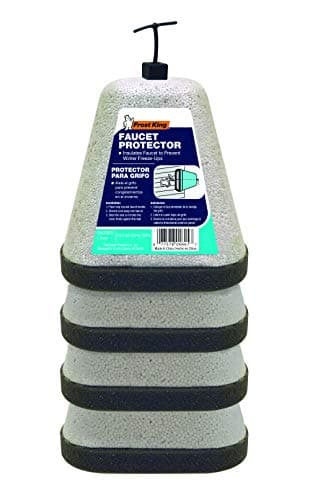
The Frost King FC1 Foam Faucet Cover (Oval, Pack of 4) covers several spigots in one order; its listing states no size, so check that each spigot fits under a dome.
Key Specs
Type
Foam dome cover
Shape
Oval
In the pack
4 covers
Water resistance
Water resistant, per the title
Made in
USA, per the listing
Dimensions
Not stated on the listing
Pros
Cons
Suited to
A house with three or four plain hose bibs on flat siding that each need a basic cover
Our take
This is the plain foam dome in a four-pack, and its listing is thin: it protects outdoor faucets from freezing, wind and chill, it is easy to install, it is water resistant per the title, and it is made in the USA. There are no dimensions, no material grade and no description of how it fastens. The value is in coverage. A house with spigots on three or four walls can cover all of them from one order, and the spigot left bare is the one most likely to freeze. Check that each spigot is short enough to sit under a dome, and replace any cover that cracks. As with every cover here, the hose, valve and drain steps come first and matter more than the cover chosen.
Affiliate link — commission at no extra cost to you
Compare elsewhere
What to know before you buy.
A faucet cover is insulation and a windbreak, nothing more. It adds no heat; it slows the loss of the little warmth that travels out along the pipe from the heated house, and it keeps wind off the metal. That helps a spigot ride out a cold night, but over days of hard freeze, water left in an undrained line can still freeze behind the cover. The American Red Cross lists outdoor hose bibs among the pipes that freeze most often, and the damage rarely shows at the spigot itself. Water expands as it freezes, and the split often opens in the pipe or valve body behind the siding or in the basement ceiling, where it leaks unseen until the ice melts or the spigot is next used. A cover is cheap insurance against that, worth having on every spigot, but the steps below do more of the work.
The American Red Cross sets out the order for outdoor faucets: remove, drain and store the hoses; close the inside valve that supplies each hose bib; then open the outside spigot to let the line drain, and keep it open so any water left in the pipe has room to expand without breaking it. The inside valve usually sits close to where the pipe passes through the wall, often in a basement ceiling, a utility room or behind an access panel. Some have a small bleeder cap on the side; open it over a bucket to let out water trapped between the valve and the spigot. Only then fit the cover. A short dribble from the open spigot is the line draining. A spigot that drips steadily with no inside valve to close has a worn washer, and that drip will freeze under any cover, so fix it before winter.
A frost-free sillcock puts its valve at the end of a long stem inside the heated part of the wall. When it is shut, the water left in the barrel drains out of the spout, provided the sillcock slopes slightly down toward the outside. A connected hose blocks that drain. Water stays trapped in the barrel, freezes and can split it inside the wall, and the split usually stays hidden until spring, when the first turn of the handle sends water into the wall cavity or the basement instead of out of the spout. That is why the hose comes off every fall even on a frost-free spigot. In a cold region a cover is still worth adding, because it keeps wind off the exposed head and slows the cold traveling into the barrel. Frost-free heads run long, which is where the taller DEMEDO fits better than a small sock.
Three designs cover nearly every listing. Insulated socks, such as the ArtiGifts, Hometopia and DEMEDO here, are fabric bags with a fill layer: polyester pongee or Oxford fabric outside, PP insulated cotton or 3M Thinsulate inside, per their listings. They fold flat for storage, and their soft edges settle against lap siding and brick. Hard-shell covers like the Frost King FC2 wrap foam in rigid plastic, so snow and knocks do not crush the insulation, but the rim needs a fairly flat wall to seal. Plain foam domes like the Frost King FC1 are the simplest and the easiest to dent or crack. None of the five listings on this page states an R-value or a temperature rating, so a cold-weather figure quoted for one of these covers elsewhere did not come from its listing. Choose by fit first, then by how exposed the spigot is.
Fit decides whether a cover works. With the hose off, measure three things: how far the spigot stands out from the wall, handle included; its height from the lowest point to the top of any vacuum breaker; and its width across the handle. Then compare with the listings. ArtiGifts says its cover measures 5.9 x 7.7 in and Hometopia 6.7 x 8.3 in, without saying whether that is the outside or the opening; DEMEDO describes its 10 x 6.3 in as the opening; the two Frost King covers give no size at all. Leave some room. A cover that is too tight pushes off the wall and leaves a gap for cold air, while one far too big bunches up and lets wind in under the edge. After fitting, run a hand around the rim and close any gap you feel.
Some spigots need a different fix. If the pipe to the spigot runs through an unheated garage or crawl space, a cover protects only the faucet body; the exposed pipe needs foam insulation or heat cable, compared on our pipe insulation page. If the spigot has no inside shutoff and has frozen before, a cover is a stopgap, so ask a plumber about adding a shutoff or a frost-free sillcock. If the house will sit empty through the winter, shut off the main and drain the system, or fit an automatic shutoff valve, because a split that runs for days is the worst case. The Red Cross advises leaving the heat set no lower than 55°F when you are away in cold weather. In places that see only the odd light frost, disconnecting the hose may be all a spigot needs.
YesAs insulation and a windbreak, but not on their own. A cover slows heat loss from the spigot and keeps wind off it, which helps it ride out a cold night.
It adds no heat, so in a long hard freeze a line still full of water can freeze behind it. Covers work best as the last of four steps: hose off, inside valve closed, spigot opened to drain, then the cover fitted snugly against the wall.
In a cold region it helps, but removing the hose matters more. A frost-free sillcock drains itself only when no hose is attached and it slopes slightly outward, so disconnect the hose every fall.
A cover then adds insulation and wind protection at the exposed head. Frost-free heads are often longer than plain hose bibs, so choose a taller cover, such as the DEMEDO with its stated 10 x 6.3 in opening.
YesOnce the inside valve that feeds it is closed.
The American Red Cross advises closing the inside valve, opening the outside hose bib to drain the line, and keeping it open so any water left in the pipe can expand without breaking it. If there is no inside valve, leave the spigot shut, since opening it would only run water, then cover it and ask a plumber about adding a shutoff.
Fit them in fall, before the first night forecast below freezing, and leave them on until the last frost in spring. For much of the northern US, that means October.
Do the hose, valve and drain steps first, then fit the cover. Check it after storms and high wind, and do not pull it off to use the spigot during a cold spell, which the DEMEDO listing also warns against.
NoA cover cannot seal over a connected hose, and the hose is the bigger problem anyway: it holds water against the spigot, and on a frost-free sillcock it stops the barrel from draining.
That trapped water freezes and can split the pipe inside the wall. Disconnect every hose, drain it, store it out of the cold if you can, and then fit the cover over the bare spigot.
Usually the first time you open it in spring. Signs include weak flow at the spout, water spraying or dripping behind the siding, and a wet basement ceiling, wall or floor near where the pipe comes through.
Close the inside valve at once, or the main if there is none, and call a plumber. EPA advises that wet materials dried within 24 to 48 hours will, in most cases, not grow mold, so start drying that day.
Call (888) 840-6512. The line is answered 24 hours a day, seven days a week, and connects you with an IICRC-certified water damage restoration company that serves your area. A recorded menu picks up first: choose water damage or mold, key in your 5-digit ZIP code, and hold through the short silence while the call is passed to the company.
Describe what you can see — where the water is coming from, how long it has been there, and whether it smells — the more specific you are, the faster the right company is on the line. If the source is a pipe or an appliance, shut the main water valve first. Have four things ready and the call goes quickly: the address, when the water started, what is wet now, and whether you have filed an insurance claim.
Still not sure which of these is your situation? (888) 840-6512 · toll-free · answered 24/7
Methodology: How we source and verify data · Report an error
Free 2-day shipping
Amazon Prime members pay no shipping on restoration equipment
Dehumidifiers, air movers, and moisture meters qualify for free Prime delivery — bulk items that otherwise cost $15–$40 to ship.
Affiliate link — HearthDry earns a bounty if you sign up; costs you nothing extra.

A burst frozen pipe is one of the most expensive kinds of winter water damage, and preventing it costs a small fraction of the repair. This guide pairs the two tools that stop it, foam insulation that slows heat loss and heat tape that adds heat, with the sealant that closes the drafts in between.
Read the comparisonA pipe repair clamp, a wrap of self-fusing tape or a lump of epoxy putty can stop a leaking pipe within the hour, but only after the main valve is off and only until the damaged section is properly replaced. These picks are matched to the kind of damage, the pipe material and the size, using each listing's own pressure and temperature figures and noting what it leaves unsaid.
Read the comparisonA smart water shutoff closes the supply when it detects a leak, so a burst pipe does not run for hours while nobody is home. The four systems here split into two designs: leak sensors that close the valve you already have, and valves on the main line that watch the flow itself.
Read the comparisonA water leak detector catches a leak while it is still a puddle rather than an insurance claim. These four flood sensors and water alarms range from a standalone 110 dB alarm with no Wi-Fi to a LoRa kit that sounds on the spot and texts your phone.
Read the comparisonA roof heat cable melts a channel through the ice at the eave and in the gutter so meltwater can drain, but it does not stop the attic heat loss that causes ice dams. These picks are compared on the wattage, cable type, roof types and certifications each listing states, with the sizing arithmetic, the running cost in kilowatt-hours and the electrical and ladder safety points most roundups skip.
Read the comparisonHeat tape is a plug-in cable that warms a water pipe in a crawl space, garage or unheated cabinet so the water inside cannot freeze. These picks are compared on cable type, thermostat settings, pipe materials and insulation as each listing states them, along with the draining and shutoff jobs that no cable replaces.
Read the comparisonA frost-free hose bib keeps its valve inside the heated house at the end of a long stem, so the part outdoors drains dry each time you shut it off. These picks are compared on stem length, inlet type and what each listing states, with the wall measurement, the downward slope and the connected hose that decide whether one actually lasts through winter.
Read the comparison