Best Roof Heat Cable in 2026 — De-Icing Cables That Keep Meltwater Draining, and the Attic Fix That Stops Ice Dams

Best Roof Heat Cable in 2026

De-Icing Cables That Keep Meltwater Draining, and the Attic Fix That Stops Ice Dams

5 picks compared · prices, ratings and stock checked October 11, 2026

Our Top Pick

For an asphalt-shingle roof with metal or plastic gutters, the HEATIT HIRD Roof & Gutter De-Icing Cable: ETL and CSA certified, 5 W per foot, and sold in lengths from 30 to 240 ft with clips and spacers. For a metal, flat or wood roof, or a layout where runs cross, the self-regulating Radiant Solutions HeatTapePro.

4.4 on Amazon · 2,035 ratings

Quick answer

If ice dams form along your shingled eaves, buy a certified plug-in cable long enough to zigzag the eave and run through the gutter and downspout, and for most homes that is the HEATIT HIRD Roof & Gutter De-Icing Cable, rated 4.4 stars across 2,035 Amazon ratings and sold in lengths from 30 to 240 ft at a stated 5 W per foot. A 100 ft run draws 500 W, so plan its GFCI outlet and running hours. The cable keeps a drain channel open through the ice; it does not stop dams forming. Air sealing and insulating the attic does that.

Our Picks at a Glance

Every pick below is currently stocked — ratings and stock read from Amazon on 11 October 2026.

How this page was made: we compare the current Amazon listings, the makers' published specs and what verified buyers report, then rank by fit for the job. Ratings, review counts and stock are read from Amazon and dated. We earn a commission on purchases through our links; it does not change the order. Reviewed by Marcus Reed, IICRC-certified Water Restoration Technician.

Full Reviews

Each pick in detail: what the listing states, what buyers report, and where it falls short.

#1
Best Overall

Check price

on Amazon ↗

Listing verified 13 Oct 2026

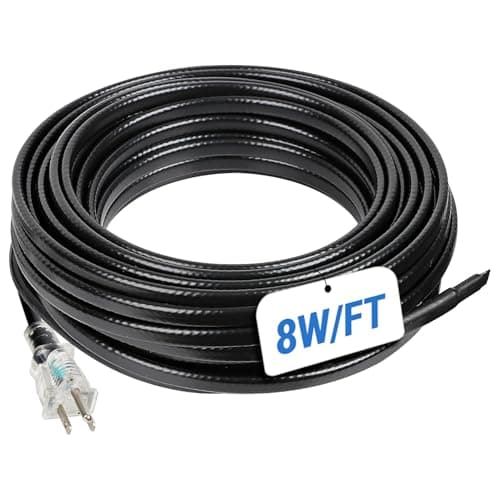
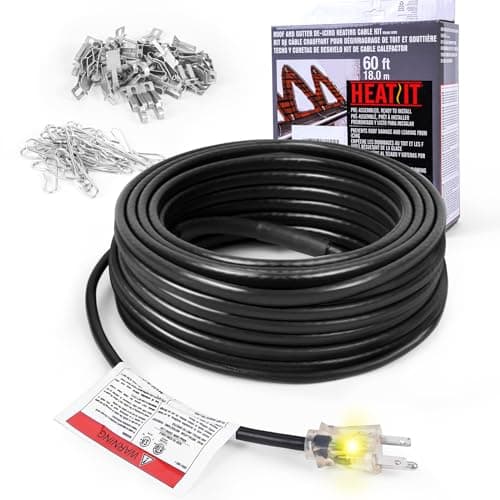
HEATIT HIRD Roof & Gutter De-Icing Cable, 100 ft (5 Watts Per Foot, Constant Wattage)See it on Amazon ↗

Quick Verdict

HEATIT HIRD Roof & Gutter De-Icing Cable: certified 5 W per foot constant-wattage cable in six lengths for shingle roofs; keep the runs apart.

Key Specs

Type

Constant wattage, per the listing

Output (stated)

5 W per foot

Length

100 ft; 30, 60, 80, 200 and 240 ft are listed separately

Total draw

500 W by arithmetic (100 ft × 5 W per foot); not printed on the listing

Certification (stated)

Cable ETL and CSA certified; plug UL certified

Power lead (stated)

6 ft 18/3 cold lead with plug

Pros

  • Certification covers the cable as well as the plug, per the listing, which is the detail to check on any plug-in roof cable
  • Six lengths from 30 to 240 ft, so the cable can be sized to the eave rather than the other way round
  • Clips and spacers come in the box, unlike the Radiant Solutions cable
  • The listing gives a pre-install check: uncoil it fully, plug it in, and it should feel slightly warm within about 5 minutes

Cons

  • Constant wattage means no part of the heated cable may touch, cross or overlap itself, which makes valleys and downspouts fiddly
  • Listed for noncombustible shingle roofs only; metal, flat and wood roofs are not named
  • Draws its full load whenever it is plugged in, and no thermostat is stated, so running hours are up to you

Suited to

Asphalt-shingle roofs with metal or plastic gutters where ice builds along a measured stretch of eave

Our take

One maker dominates this category on Amazon: HEATIT's HIRD cable is listed in six lengths, and TOPDURE sells a cable with the same stated specs. Constant wattage is the plainest design here. Every foot puts out 5 W whenever it is plugged in, so the 100 ft cable draws 500 W from the first minute to the last, which makes running cost easy to predict and easy to overspend. Power it from a GFCI outdoor outlet through a plug-in thermostat or a switched outlet, and run it through snow and the melt that follows rather than all season. The installation rule that matters is the listing's own: keep every heated run from touching or crossing another, because this cable cannot turn itself down where two runs meet.

Check today's price on Amazon →

Affiliate link — commission at no extra cost to you

Compare elsewhere

These open a search for this model. We quote prices only where we can verify them — Amazon, Sylvane and eBay.

#2
Best Self-Regulating Cable for Metal, Flat and Wood Roofs

Check price

on Amazon ↗

Listing verified 13 Oct 2026

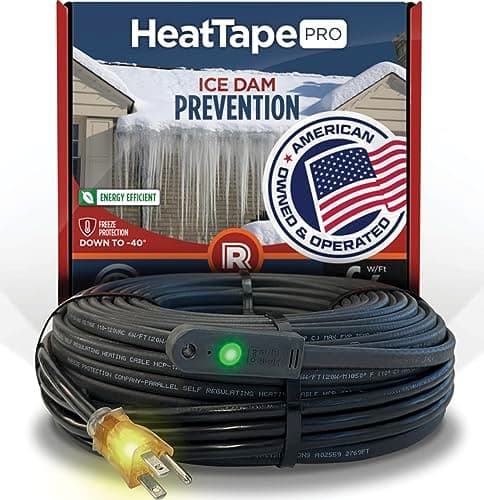
Radiant Solutions HeatTapePro Self-Regulating Heat Cable for Roof, 50 ft (UL Listed, GlowCap End)See it on Amazon ↗

Best Self-Regulating Cable for Metal, Flat and Wood Roofs

Radiant Solutions HeatTapePro Self-Regulating Heat Cable for Roof, 50 ft (UL Listed, GlowCap End)

4.4(576 reviews)

Quick Verdict

Radiant Solutions HeatTapePro: UL-listed self-regulating cable for metal, flat and wood roofs with a 10-year warranty; clips extra, watts per foot unstated.

Key Specs

Type

Self-regulating, per the listing

Length

50 ft; 37 and 62 ft are listed separately

Watts per foot

Not stated on the listing

Certification (stated)

UL Listed

Roofs (stated)

Flat, metal, asphalt, wood and rubber roofs, among others

Overlap (stated)

Will not short or burn out if overlapped

Pros

  • The only pick whose listing names metal, flat, wood and rubber roofs
  • A GlowCap end, which the listing says lets you confirm the cable is working all the way to its far end
  • Self-regulating with a stated tolerance for overlap, so a run that doubles back in a valley or downspout is not a failure point
  • A 10-year warranty, the only warranty term stated on this page

Cons

  • Watts per foot is not on the listing, so circuit load and running cost cannot be worked out from it
  • Clips are not included and have to be ordered separately
  • The longest length listed is 62 ft, so a long eave needs more than one cable and more than one outlet

Suited to

Metal, flat, wood or rubber roofs, or a layout where cable runs will cross

Our take

Self-regulating cable has a conductive core whose output drops as it warms and rises as it cools, which is why its makers allow runs to overlap, while a constant-wattage cable can overheat where it crosses itself. That property, plus the widest list of roof types on this page, is what this cable's premium buys. The gap is wattage: the listing gives no watts per foot, so ask the seller or read the spec sheet before choosing the outlet. Radiant Solutions points buyers to its own HeatCableCalculator for length and accessories, which beats estimating from a photo of the roof. On a metal roof in particular, use the clips the maker specifies rather than shingle clips.

Check today's price on Amazon →

Affiliate link — commission at no extra cost to you

#3
Best Higher-Output Self-Regulating Cable

Check price

on Amazon ↗

Listing verified 13 Oct 2026

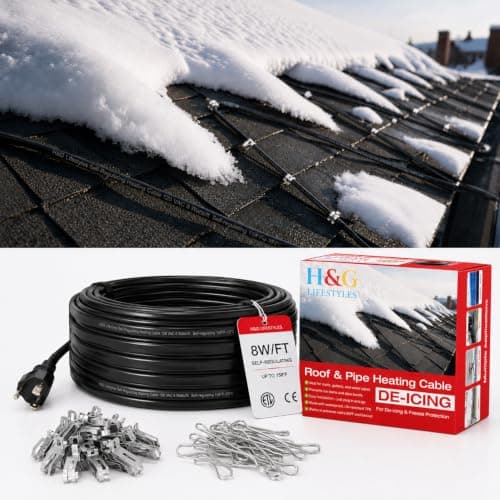
H&G lifestyles Self-Regulating Roof Heat Cable, 80 ft (8 Watts Per Foot, Clips Included)See it on Amazon ↗

Quick Verdict

H&G lifestyles 8 W per foot cable: self-regulating with clips in the box; check for a safety mark, since the listing names none.

Key Specs

Type

Self-regulating, per the listing

Output (stated)

8 W per foot; the temperature behind the rating is not stated

Length

80 ft; a 60 ft version is listed separately, and the listing mentions lengths to 140 ft

Maximum draw

640 W by arithmetic (80 ft × 8 W per foot)

Power cord (stated)

5.4 ft

Clips (stated)

15 to 35 clips on the 60–140 ft lengths, about one every 4 ft

Pros

  • A stated 8 W per foot, the highest stated output on this page, matched by the Eastrexon kit
  • Clips come with the 60–140 ft lengths, matched by the listing at about one every 4 ft
  • Self-regulating, so output falls on stretches that are already warm
  • The listing is upfront that there is no built-in thermostat and suggests adding a plug-in one

Cons

  • No safety certification is named on the listing, unlike HEATIT's ETL and CSA or Radiant Solutions' UL
  • Much of the listing copy is written about water pipes rather than roofs, so follow the roof layout in the instructions
  • A 5.4 ft power cord means the outlet has to sit close to where the cable leaves the roof

Suited to

A long eave in a cold climate where a self-regulating cable with clips in the box is wanted

Our take

An 8 W per foot rating on a self-regulating cable is a ceiling, not a constant: the listing says output adjusts to the surrounding temperature, and the figure is not tied to a stated temperature, so it cannot be compared watt for watt with HEATIT's 5 W per foot constant output. What it does give you is the maximum load. Eighty feet at 8 W per foot is 640 W, which leaves room on a 15 A outdoor circuit. The bigger gap is certification: HEATIT names ETL and CSA, Radiant Solutions names UL, and this listing names none, so look for a mark on the cable and plug when it arrives. Its suggestion of a plug-in thermostat outlet is worth taking.

Check today's price on Amazon →

Affiliate link — commission at no extra cost to you

#4
Best for a Long Eave on One Plug

Check price

on Amazon ↗

Listing verified 13 Oct 2026

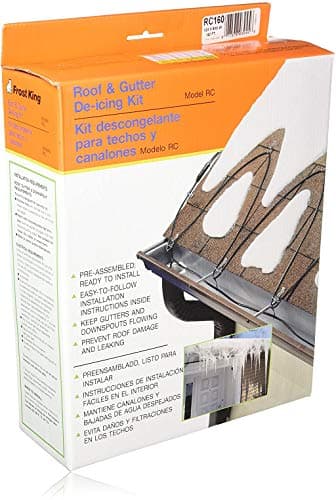
Frost King RC160 Electric Roof Cable Kit, 160 ft (120 V, 800 W)See it on Amazon ↗

Best for a Long Eave on One Plug

Frost King RC160 Electric Roof Cable Kit, 160 ft (120 V, 800 W)

4.5(185 reviews)

Quick Verdict

Frost King RC160: 160 ft and 800 W on one plug for a long eave; the listing is thin, so check the box for clips and certification.

Key Specs

Length (stated)

160 ft

Power (stated)

120 V, 800 W

Output

5 W per foot by arithmetic (800 W ÷ 160 ft); not printed on the listing

Current

About 6.7 A by arithmetic (800 W ÷ 120 V)

Assembly (stated)

Pre-assembled, ready to install, instructions included

Cable type, certification, clips

Not stated on the listing

Pros

  • States its total draw, 800 W at 120 V, so the circuit load is known before buying
  • 160 ft on one plug covers a long single-story eave without a second outlet
  • Frost King publishes an installation guide that spells out the zigzag layout and the downspout run
  • Pre-assembled, so there is no wiring to do at the plug end

Cons

  • The listing is thin: cable type, certification, roof types and clips are not stated
  • At 800 W it uses more than half of a 15 A circuit's 1,440 W continuous limit, so give it a circuit without other outdoor loads
  • No thermostat is mentioned, so it runs whenever it is plugged in

Suited to

A long single-story eave where one cable and one outlet should cover the job

Our take

Frost King's listing says almost nothing beyond length and power, yet those are the two numbers that size the job. Spread 800 W over 160 ft and the output works out to 5 W per foot, the same as the HEATIT cable, drawing about 6.7 A at 120 V. For layout, Frost King's own installation guide has the cable zigzag up the overhang toward the warm part of the roof, then run along the inside of the gutter and down the downspout, plugged into a GFCI outlet, with brackets wherever it bends. Before you climb, open the box and confirm the clips, the certification mark and the roof types the printed instructions allow, since the listing does not say.

Check today's price on Amazon →

Affiliate link — commission at no extra cost to you

#5
Best Short Kit for One Problem Spot

Check price

on Amazon ↗

Listing verified 13 Oct 2026

Eastrexon Self-Regulating Roof De-Icing Kit, 50 ft (8 Watts Per Foot, 20 Clips, LED Plug)See it on Amazon ↗

Quick Verdict

Eastrexon 50 ft kit: overlap-tolerant 8 W per foot cable with clips and a long cord for one problem spot; no certification named.

Key Specs

Type

Self-regulating, 120 V, per the listing

Output (stated)

8 W per foot

Maximum draw

400 W by arithmetic (50 ft × 8 W per foot)

Power cord (stated)

9.8 ft, with an LED plug

Included (stated)

20 clips and 20 spacers

Overlap (stated)

Will not short out or burn out if overlapped

Pros

  • A 9.8 ft power cord, the longest stated on this page, reaches an outlet farther from the eave
  • The LED plug shows at a glance that the cable has power
  • Overlap-tolerant, so it can loop down a downspout and back without careful spacing
  • Clips and spacers are in the box

Cons

  • No certification mark is named on the listing
  • 50 ft is short for a whole eave once the zigzag, gutter and downspout runs are counted
  • Like the H&G listing, it mixes roof and pipe-freeze uses, so rely on the roof instructions in the box

Suited to

One problem spot: a valley, a single downspout or the eave over an entry door

Our take

Most ice dams do not run the full length of a roof. They build where the attic below is warmest, over a poorly sealed hatch or a run of ceiling lights, and at valleys and downspouts where meltwater collects. A 50 ft kit fits that pattern. At 8 W per foot its maximum draw is 400 W, and because the listing says overlapping runs will not short or burn out, it can loop into a downspout and back without the spacing a constant-wattage cable needs. The 9.8 ft cord and LED plug make it easier to power from a porch outlet and see that it is on from the ground. It names no certification, so confirm one on the product itself.

Check today's price on Amazon →

Affiliate link — commission at no extra cost to you

Buyer's Guide

What to know before you buy.

What a Heat Cable Does About Ice Dams, and What It Cannot

An ice dam starts in the attic. Heat leaking up from the rooms below warms the roof deck, snow on that warm section melts, and the water runs down to the eave, the overhang beyond the exterior wall with no heated space under it, where it refreezes into a ridge. Meltwater then pools behind the ridge and works under the shingles, into the sheathing and through the ceiling. A heat cable does not stop any of that from starting. It melts a channel through the ridge and keeps the gutter and downspout open, so the pooled water has somewhere to go. The lasting fix is keeping heat out of the roof: air sealing ceiling penetrations such as light fixtures, the attic hatch and plumbing chases, adding attic insulation and keeping soffit-to-ridge ventilation clear. A thermal camera on a cold day shows where the heat is escaping.

Constant Wattage or Self-Regulating

Constant-wattage cable, such as the HEATIT and TOPDURE 5 W per foot cables, puts out the same heat per foot whenever it is powered. It is simpler and less costly to buy, but the TOPDURE listing spells out the rule for the type: the heated part of an operating cable must not touch, cross or overlap itself or another de-icing cable. Self-regulating cable has a core that turns its own output down as it warms and up as it cools, which is why the Radiant Solutions and Eastrexon listings say it will not short or burn out if overlapped. Two cautions when comparing them. A self-regulating cable's watts-per-foot figure depends on temperature, and neither 8 W per foot listing here says what temperature it was rated at. And only Radiant Solutions names metal, flat and wood roofs; the rest name shingle roofs.

How Much Cable to Buy

Measure three things: the length of eave where ice forms, the gutter below it, and each downspout. The cable runs up and down the overhang in a zigzag, with the top of each loop just past the line of the exterior wall; Frost King's installation guide describes triangles about 15 in wide. At that spacing, every foot of eave takes about 1.6 times the length of one zigzag leg. A 30 ft eave with legs reaching 2.5 ft up the slope uses about 120 ft of cable on the roof. Add about 30 ft for the run back along the inside of the gutter and 10 ft for one downspout, and the total is about 160 ft, the length of Frost King's RC160 kit. Constant-wattage cable cannot be cut to length, so choose the nearest listed length and take up any extra in the gutter or a second downspout.

Outlet, GFCI and Circuit Load

Every plug-in roof cable belongs in a GFCI-protected outdoor outlet with a weatherproof in-use cover. Makers' instructions call for one, the National Electrical Code requires ground-fault protection on outdoor outlets at homes, and a cable lying in a wet gutter is exactly the case it exists for. If the nearest outlet is far from the eave or lacks GFCI protection, have an electrician add one rather than stringing an extension cord up the wall. Then check the load. The electrical code sizes circuits for roof de-icing as a continuous load, which works out to 80% of the circuit's rating: 1,440 W on a 15 A, 120 V circuit, or 1,920 W on a 20 A circuit. A 240 ft cable at 5 W per foot draws 1,200 W, close to the 15 A limit on its own, and two cables on one circuit can trip it.

What It Costs to Run

Running cost is watts times hours, divided by 1,000, times your electricity rate. A 100 ft cable at 5 W per foot draws 500 W, so it uses 0.5 kWh every hour, 12 kWh a day, and about 360 kWh over a 30-day month if it is left on around the clock. Frost King's 160 ft kit, at a stated 800 W, uses 19.2 kWh a day. Multiply those figures by the rate per kWh printed on your utility bill to get a cost. A self-regulating cable draws less once it warms, but plan with its stated maximum, which is 640 W for the 80 ft H&G cable. The biggest saving is hours: a cable that runs only through snowfall and the melt afterward costs a fraction of one left on from December to March, and a plug-in thermostat outlet makes that automatic.

Who Should Not Buy One, and When to Hire It Out

Treat a cable as a stopgap, or skip it, if ice dams form along the whole roof every winter: that pattern means the attic is losing heat everywhere, and air sealing and insulation are the better spend. If water is already coming through a ceiling, a cable installed now will not stop it; rake snow off the lower few feet of roof from the ground, catch the drips, and dry wet materials within 24 to 48 hours, which the EPA says in most cases keeps mold from growing. Install only in dry weather before the first snow, from a ladder on firm ground set about 1 ft out for every 4 ft of height, and never on an icy or snow-covered roof. A two-story eave, a steep pitch or a metal roof is work for a roofer or electrician, and renters should leave roof work to the owner.

Frequently Asked Questions

Do roof heat cables work for ice dams?

YesAs a drain path, not as a cure. The warm cable holds open a route through the ice ridge, the gutter and the downspout, so meltwater leaves the roof instead of backing up under the shingles.

It does not stop the attic heat loss that melts the snow in the first place, so ice can still build between the loops. Air sealing and insulating the attic floor is the lasting fix, and the cable protects the roof while that work waits.

Should roof heat cables be left on all winter?

No; run them from the start of a snowfall until the roof and gutters have drained, then switch them off.

Frost King's guidance is to plug cables in before snow starts and unplug them once temperatures stay above freezing. A constant-wattage cable left on through a dry, mild week uses its full load and melts nothing. A plug-in thermostat outlet or a switched outdoor outlet saves climbing out to the plug every time the forecast changes.

How much does it cost to run a roof heat cable?

About 0.3 kWh an hour for a 60 ft cable at 5 W per foot, so multiply its hours of use by your electricity rate. Through a two-day storm and melt, that 300 W cable uses about 14.4 kWh; the same cable plugged in for a whole 30-day month uses 216 kWh.

Self-regulating cable draws less on mild stretches but is sized by its stated maximum. The hours it runs, not the brand, decide most of the cost.

Do heat cables need a GFCI outlet?

YesMakers of plug-in roof cables call for a ground-fault (GFCI) outlet, and outdoor outlets at a home need that protection under the electrical code anyway.

A GFCI cuts power when current leaks to ground, which matters for a cable lying in wet gutters and snowmelt. Use a weatherproof in-use cover, keep the plug off the ground, and have an electrician add an outlet if the nearest one is far from the eave or not protected.

How far up the roof should heat cable go?

Far enough that the top of each loop sits just past the line of the exterior wall, where the heated part of the roof begins.

Ice dams form on the overhang, the strip with no heated space beneath it, so the cable has to bridge that cold strip to give meltwater a path off the roof. A deeper overhang needs taller loops and more cable, which is why measuring the overhang comes before choosing a length.

Can you put heat cable on a metal roof?

Only a cable whose listing names metal roofs, such as the Radiant Solutions HeatTapePro, which per its listing is certified for flat, metal, asphalt, wood and rubber roofs.

The HEATIT and Eastrexon listings name noncombustible shingle roofs and metal or plastic gutters, not metal roof panels. Metal panels also need clips made for them rather than shingle clips, so use the maker's clips and layout, and consider a roofer for a steep metal pitch.

Who do I call right now for water damage?

Call (888) 840-6512. The line is answered 24 hours a day, seven days a week, and connects you with an IICRC-certified water damage restoration company that serves your area. A recorded menu picks up first: choose water damage or mold, key in your 5-digit ZIP code, and hold through the short silence while the call is passed to the company.

Describe what you can see — where the water is coming from, how long it has been there, and whether it smells — the more specific you are, the faster the right company is on the line. If the source is a pipe or an appliance, shut the main water valve first. Have four things ready and the call goes quickly: the address, when the water started, what is wet now, and whether you have filed an insurance claim.

Still not sure which of these is your situation? (888) 840-6512 · toll-free · answered 24/7

Sources

  1. EPA — A Brief Guide to Mold, Moisture, and Your Home

Methodology: How we source and verify data · Report an error

How we chose these picks

  • Every pick is a current listing. Stock, star ratings and rating counts are read from Amazon by script and carry the date they were read.
  • Nothing under 4.0 stars makes the list, and the top pick needs a large rating count, so one good week of reviews cannot put it there.
  • Specs are quoted from the listing or the maker, with the test condition behind the number where there is one, and sized against the job rather than the room on the box.
  • We do not run lab or field tests. Where a spec matters, we say what it is measured under and what it cannot tell you.

Free 2-day shipping

Amazon Prime members pay no shipping on restoration equipment

Dehumidifiers, air movers, and moisture meters qualify for free Prime delivery — bulk items that otherwise cost $15–$40 to ship.

Try Prime free →

Affiliate link — HearthDry earns a bounty if you sign up; costs you nothing extra.

Also Worth Comparing

Best Roof Leak Sealants, Patches and Tapes in 2026 — Temporary Repairs That Hold Until the Roofer Comes

A can, tube or roll from this page can stop a small roof leak at a seam, a flashing edge or a vent boot. It cannot replace missing shingles or rotted decking, and the place water gets in is often several feet uphill from the stain on your ceiling.

Read the comparison

Best Roof Tarps for Emergency Leaks in 2026 — Thickness, Size and Tie-Down Points Compared

A heavy polyethylene tarp, boarded down and run over the ridge, is the standard emergency cover for missing shingles or a hole in the roof deck. It keeps the weather out for the days or weeks until the roof is fixed, and putting one up is real roof work, so this page starts with when to leave it to a roofer.

Read the comparison

Best Pipe Insulation and Heat Tape for Water Pipes in 2026 — Stop Burst Pipes Before They Start

A burst frozen pipe is one of the most expensive kinds of winter water damage, and preventing it costs a small fraction of the repair. This guide pairs the two tools that stop it, foam insulation that slows heat loss and heat tape that adds heat, with the sealant that closes the drafts in between.

Read the comparison

Best Thermal Cameras for Water Leak Detection in 2026 — Find Hidden Moisture

Water damage behind walls is invisible until it's mold. A thermal camera reveals temperature differentials caused by moisture — identifying wet areas in walls, ceilings, and floors before they become a mold problem.

Read the comparison

Best Moisture Meters for Homeowners in 2026 — Water Damage Detection

A moisture meter tells you what your eyes can't see — wet drywall, soggy subfloor, and moisture in framing. These are the four best moisture meters for homeowners dealing with water damage.

Read the comparison

Best Outdoor Faucet Covers for Winter in 2026 — Insulated Socks, Hard Shells and What a Cover Cannot Do

An outdoor faucet cover insulates the spigot and blocks the wind, which lowers the odds of a frozen hose bib splitting the pipe inside the wall, where the real water damage happens. It cannot do that job alone, so every pick here comes with the steps that matter more: hose off, inside valve shut and the line drained.

Read the comparison

Best Attic Fan in 2026 — Gable, Solar and Humidistat Fans, and the Intake and Air Sealing That Decide Whether One Helps

A powered attic fan lowers attic heat only when the soffit vents can feed it and the ceiling below is sealed; otherwise it pulls cooled air and moisture up from the rooms and can upset gas appliance flues. These picks are compared on what each listing states about airflow, watts, thermostats and humidistats, with the sizing arithmetic for fan and intake and the moisture fixes that come first.

Read the comparison

Best Gutter Guards in 2026 — DIY Micro-Mesh and Aluminum Screens Sized for 5 in and 6 in Gutters, So Roof Water Reaches the Downspout

A clogged gutter spills roof water over its front edge and onto the soil right beside the foundation, which is where many basement leaks begin. These DIY guards are compared on the debris each type stops, the gutter width each listing states, how each one meets the roof edge, and the cleaning that no guard removes.

Read the comparison

Best Heat Tape for Pipes in 2026 — Self-Regulating vs Constant-Wattage Cable, How Much to Buy, and What a Heat Cable Cannot Protect

Heat tape is a plug-in cable that warms a water pipe in a crawl space, garage or unheated cabinet so the water inside cannot freeze. These picks are compared on cable type, thermostat settings, pipe materials and insulation as each listing states them, along with the draining and shutoff jobs that no cable replaces.

Read the comparison

Best Ice Melt for Roofs in 2026 — Calcium Chloride Pellets and Tablets That Open a Drain Channel Through an Ice Dam

Roof ice melt opens a drain channel through an ice dam so trapped water can run off; it does not stop the next dam forming. These calcium chloride picks are compared on what each listing states, alongside the stocking method, how much to buy for your eaves and why rock salt stays off the roof.

Read the comparison