Best Heat Tape for Pipes in 2026 — Self-Regulating vs Constant-Wattage Cable, How Much to Buy, and What a Heat Cable Cannot Protect

Best Heat Tape for Pipes in 2026

Self-Regulating vs Constant-Wattage Cable, How Much to Buy, and What a Heat Cable Cannot Protect

5 picks compared · prices, ratings and stock checked October 12, 2026

Our Top Pick

For one short exposed pipe, the Frost King HC6A 6 ft Automatic Electric Heat Cable Kit at 7 W/ft. For a longer run, or a pipe with valves to cover, the HEATIT 30 ft Self-Regulating Pipe Heating Cable with its built-in thermostat. Plug either one into a GFCI-protected outlet and insulate the pipe the way the instructions allow.

4.6 on Amazon · 6,444 ratings

Quick answer

The best heat tape for pipes is a cable sized to the exposed run and plugged into a GFCI outlet: if the cold section of pipe is about 6 ft long, buy the Frost King HC6A 6 ft Automatic Electric Heat Cable Kit, rated 4.6 stars across 6,444 Amazon ratings and listed at 7 W/ft down to -40°F. For a longer run or a pipe with valves, choose a self-regulating cable such as the HEATIT 30 ft, which switches on at 38°F per its listing. Never let a constant-wattage cable cross itself. Heat tape still needs insulation, and it does not replace draining outdoor lines.

Our Picks at a Glance

Every pick below is currently stocked — ratings and stock read from Amazon on 12 October 2026.

How this page was made: we compare the current Amazon listings, the makers' published specs and what verified buyers report, then rank by fit for the job. Ratings, review counts and stock are read from Amazon and dated. We earn a commission on purchases through our links; it does not change the order. Reviewed by Marcus Reed, IICRC-certified Water Restoration Technician.

Full Reviews

Each pick in detail: what the listing states, what buyers report, and where it falls short.

#1
Best Overall

Check price

on Amazon ↗

Listing verified 13 Oct 2026

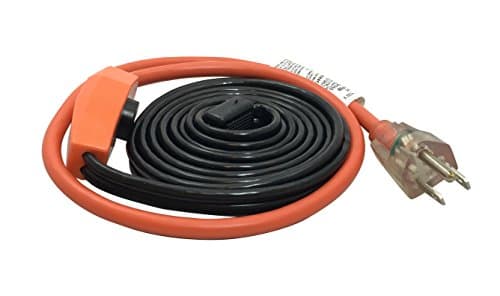
Frost King HC6A 6 ft Automatic Electric Heat Cable Kit (7 W/ft, 120 V)See it on Amazon ↗

Quick Verdict

Frost King HC6A 6 ft Automatic Electric Heat Cable Kit: the most heat per foot here for one short pipe, on a listing too brief to skip the instruction sheet.

Key Specs

Length

6 ft of heating cable

Output (stated)

7 W/ft at 120 V, about 42 W for the whole kit

Rated to (stated)

Keeps water flowing down to -40°F

Pipe types (stated)

Metal and plastic water pipes

Thermostat

The title says automatic; switch-on and switch-off temperatures are not stated in the listing bullets

Cable type

Not described as self-regulating, so treat it as constant wattage

Pros

  • 7 W/ft is the highest stated output per foot on this page
  • Listed for both metal and plastic water pipes
  • Rated to keep water flowing down to -40°F, per the listing
  • At 42 W for the full 6 ft, it is a light load on the outlet

Cons

  • The listing bullets are four short lines, with no thermostat temperatures, overlap rules or safety mark
  • A fixed 6 ft length, so measure the exposed run before ordering
  • Does not say whether insulation may go over it, so you need the instruction sheet before wrapping the pipe

Suited to

One short exposed water pipe, such as the line where it enters a crawl space or passes through a garage wall

Our take

Frost King's listing is four lines long, and each one matters. The cable is 6 ft, runs at 120 V and puts out 7 W/ft, the most heat per foot on this page, and it is listed for metal and plastic water pipes down to -40°F. That works out to 42 W for the whole kit. The title calls the kit automatic, which points to a built-in thermostat, but the bullets give no switch-on temperature. They also never say self-regulating, so treat it as a constant-wattage cable: lay or wrap it exactly as the instruction sheet shows, and never let it touch or cross itself. Read the same sheet before you add insulation over it.

Check today's price on Amazon →

Affiliate link — commission at no extra cost to you

Compare elsewhere

These open a search for this model. We quote prices only where we can verify them — Amazon, Sylvane and eBay.

#2
Best Self-Regulating Cable

Check price

on Amazon ↗

Listing verified 13 Oct 2026

HEATIT 30 ft Self-Regulating Pipe Heating Cable (3 W/ft, Built-In Thermostat, ETL Certified)See it on Amazon ↗

Quick Verdict

HEATIT 30 ft Self-Regulating Pipe Heating Cable: a thermostat-controlled, ETL-marked cable for long runs, with modest output per foot.

Key Specs

Length

30 ft; the listing offers 3 ft to 160 ft

Output (stated)

3 W/ft, so up to about 90 W at 30 ft

Cable type (stated)

Self-regulating

Thermostat (stated)

Built in; on at 38°F, off at 50°F

Rated to (stated)

Keeps water flowing down to -40°F

Pipe types (stated)

Metal and plastic, including copper, PVC and stainless steel

Pros

  • Self-regulating, so output drops along any stretch that is already warm
  • A thermostat window of 38°F on and 50°F off keeps it idle on mild winter days
  • The ETL mark covers the whole cable, not only the plug
  • Sold from 3 ft to 160 ft, so you can match the pipe run instead of stretching a short cable

Cons

  • 3 W/ft is less than half the Frost King's output, so insulation over it matters more in a very cold crawl space
  • The 2 ft power cord means the outlet has to sit close to where the cable starts
  • The bullets do not say whether it may overlap or what insulation can go over it

Suited to

A long exposed run, or a pipe with valves and fittings, in a crawl space, basement or garage

Our take

Self-regulating cable changes its own output along its length: where the pipe is cold it heats more, and where it is already warm it backs off. HEATIT pairs that with a thermostat that switches on at 38°F and off at 50°F, per the listing, so on a mild winter day the cable sits idle. At 3 W/ft, a 30 ft run tops out near 90 W. That is less heat per foot than Frost King's 7 W/ft, which makes insulation over the cable more important when a crawl space falls well below freezing. The listing names copper, PVC and stainless steel pipe and carries an ETL mark on the full cable. Note the 2 ft cord before you plan where it plugs in.

Check today's price on Amazon →

Affiliate link — commission at no extra cost to you

#3
Best Heavy-Duty Cable

Check price

on Amazon ↗

Listing verified 13 Oct 2026

HEATIT JHSF1-CT 50 ft Self-Regulating Heating Cable (120 V, No Thermostat, Fluoropolymer Jacket)See it on Amazon ↗

Quick Verdict

HEATIT JHSF1-CT 50 ft Self-Regulating Heating Cable: the most complete listing here, suited to large or drain pipes, but it has no thermostat.

Key Specs

Length

50 ft

Cable type (stated)

Industrial-grade self-regulating cable

Output (stated)

5 W/ft at 120 V for pipes; 6 W/ft at 32°F for roof de-icing

Thermostat (stated)

None built in

Pipe size (stated)

Pipes up to 2 1/2 in diameter

Pipe types (stated)

Plastic and metal, including inlet, drain and sewer pipes

Pros

  • The only cable here with a stated maximum pipe size, 2 1/2 in
  • Tells you how much insulation to put over it: at least 1/2 in, and 1 in below -20°F
  • Allows straight, spiral and overlapping runs, per the listing
  • Listed for drain and sewer pipes as well as supply lines

Cons

  • No built-in thermostat, so it stays live whenever it is plugged in unless you add a controller or unplug it
  • At 5 W/ft, 50 ft can draw up to about 250 W while it runs
  • The joint between the orange cold lead and the black heating cable is rated IP65 and must stay above water, per the listing

Suited to

Large-diameter or drain pipes, and long runs where you will control the power yourself

Our take

Read this listing twice before buying, because the cable behaves differently from the rest. It is an industrial-grade self-regulating cable with no built-in thermostat, so it stays live whenever it is plugged in; its output falls as the pipe warms, but it never switches itself off. In exchange, the listing answers questions the others skip. It names a maximum pipe size of 2 1/2 in, allows straight, spiral and overlapping runs, and recommends at least 1/2 in of insulation over the cable, or 1 in when it gets colder than -20°F. It is also listed for drain lines. Pair it with a plug-in thermostat controller, or make unplugging it each spring a habit.

Check today's price on Amazon →

Affiliate link — commission at no extra cost to you

#4
Best for Wrapping Valves

Check price

on Amazon ↗

Listing verified 13 Oct 2026

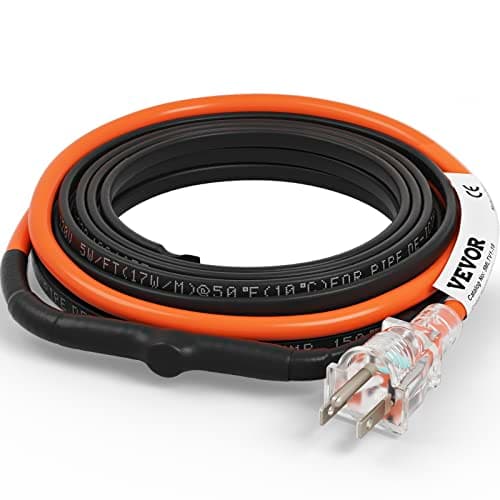
VEVOR 18 ft Self-Regulating Pipe Heating Cable (5 W/ft, Built-In Thermostat, 120 V)See it on Amazon ↗

Quick Verdict

VEVOR 18 ft Self-Regulating Pipe Heating Cable: easy to wrap around valves, but rated only to 0°F and with no US safety listing named.

Key Specs

Length

18 ft heating cable plus a 3 ft power cord

Output (stated)

5 W/ft, about 90 W at full output

Cable type (stated)

Self-regulating

Thermostat (stated)

On at 43°F, off at 55°F, read at the pipe

Rated to (stated)

Protects pipes at 0°F

Pipe types (stated)

Metal pipe, plastic pipe and PVC hose

Pros

  • The listing allows spiral, crossing and straight runs, which makes wrapping a valve or spigot simpler
  • Switches on at 43°F, a wider margin above freezing than HEATIT's 38°F
  • An indicator light on the grounded plug shows when it has power
  • Names outdoor hydrants, pipe valves and faucets among its uses

Cons

  • Names CE approval but no UL or ETL listing, while the Red Cross suggests UL-listed heat tape
  • Rated to 0°F, far milder than the -40°F on the other listings here
  • A fixed 18 ft length

Suited to

A run of up to 18 ft that includes a valve, meter or outdoor hydrant, in a region where winters rarely reach 0°F

Our take

VEVOR's listing answers the overlap question directly: the cable can be installed in a spiral, crossing or straight, which is the freedom a self-regulating cable is meant to give. That helps around a valve body, where a cable has to wrap tightly over a short distance. The thermostat reads the pipe, switching on at 43°F and off at 55°F, a little earlier than HEATIT's. Two gaps keep it from ranking higher. The safety mark it names is CE, a European conformity mark, and no UL or ETL listing is stated, while the Red Cross suggests UL-listed heat tape. Its rated low of 0°F is also far milder than the -40°F on the other cables, so look for a US listing mark on the box when it arrives.

Check today's price on Amazon →

Affiliate link — commission at no extra cost to you

#5
Best Listed for PEX Pipe

Check price

on Amazon ↗

Listing verified 13 Oct 2026

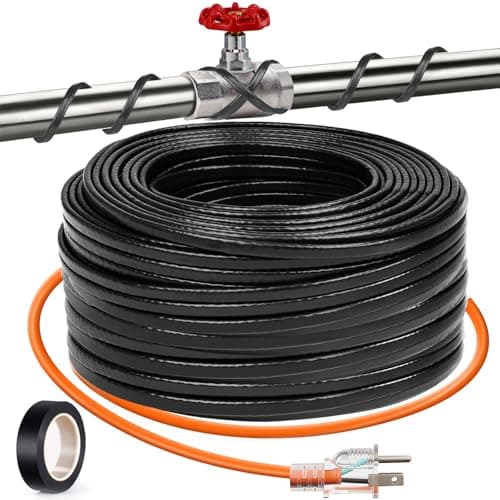
JDZKOMKE 50 ft Pipe Heating Cable (5 W/ft, Copper, PVC and PEX)See it on Amazon ↗

Quick Verdict

JDZKOMKE 50 ft Pipe Heating Cable: names PEX and warns about empty pipes, but states no thermostat or named safety listing.

Key Specs

Length

50 ft; the listing offers 3 ft to 200 ft

Output (stated)

5 W/ft

Rated to (stated)

Prevents ice at -40°F

Pipe types (stated)

Water-filled metal and plastic pipes, including copper, PVC and PEX

Installation (stated)

Straight, spiral or overlapping

Power cord (stated)

5 ft grounded plug with indicator light

Pros

  • The only listing on this page that names PEX
  • A 5 ft power cord, the longest stated here
  • Warns plainly against use on fuel lines or gutters, where a cable with no water around it overheats
  • Describes its aluminum shield and TPE outer jacket layer by layer

Cons

  • No thermostat or self-regulating claim in the bullets, which say it holds pipes 10 to 15°F above the surrounding air
  • It allows overlapping yet warns about overheating, so read the instruction sheet before crossing it
  • No named safety standard, such as UL or ETL

Suited to

A long PEX or PVC supply line that stays full of water all winter

Our take

If your supply line is PEX, this is the one listing on the page that names it, alongside copper and PVC. It also carries the clearest warning: use it only on water-filled pipe, never on fuel lines or gutters, because without water to carry the heat away the cable overheats. Let that shape how you use it. If you drain a line for the winter, unplug the cable first. The bullets never mention a thermostat and describe the cable holding pipes 10 to 15°F above the surrounding air, so expect it to run whenever it has power. The listing says the whole cable meets standards without naming any, so look for a UL or ETL mark on the cable itself.

Check today's price on Amazon →

Affiliate link — commission at no extra cost to you

Buyer's Guide

What to know before you buy.

Self-Regulating or Constant Wattage, and the Overlap Rule

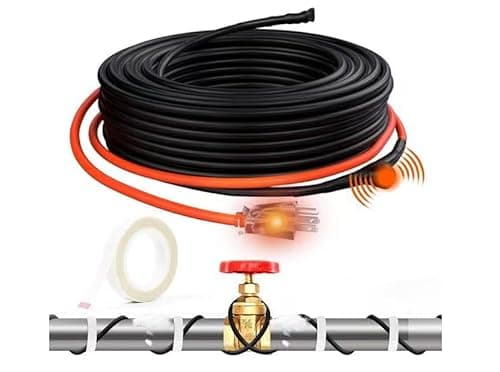
Heat tape comes in two kinds, and the difference decides how you install it. A constant-wattage cable puts out the same heat along every foot whenever it has power. Where it crosses or touches itself, that heat doubles in one spot, which can damage the cable, the pipe or the insulation, so a constant cable must never overlap. A self-regulating cable has a core whose output drops as it warms, so a crossed section backs off on its own. That is why the VEVOR and HEATIT JHSF1-CT listings permit crossing or overlapping. Frost King's bullets never say self-regulating, so treat that kit as constant wattage. Whichever you buy, the instruction sheet in the box overrides any general rule, including this one.

How Much Cable: Measure the Cold Section, Then Do the Arithmetic

Measure only the part of the pipe that sits in cold space: from where it leaves the heated house to where it enters the ground, a heated room or the spigot. Note any valve, meter or union on that stretch, because those bulky fittings lose heat fast and many instruction sheets call for extra cable around them. Laid straight, a cable covers its own length of pipe. Wrapped in a spiral, it covers less, so a 6 ft kit spiralled around a pipe protects only part of that distance. Buy the length that matches the run, never stretch a short cable, and do not cut one unless its listing says you can. Power follows from length: Frost King's 6 ft at 7 W/ft is 42 W, and HEATIT's 30 ft at 3 W/ft tops out at 90 W.

Plastic Pipe, Insulation and the Thermostat

Put heat tape on plastic pipe only when the listing names plastic. All five cables here do: Frost King says metal and plastic, HEATIT names PVC, and JDZKOMKE adds PEX. Insulation is the next question. A layer over the cable holds its heat against the pipe, and the HEATIT JHSF1-CT listing asks for at least 1/2 in, or 1 in below -20°F. The other listings do not say what may cover the cable, so read the sheet before wrapping foam around it, and use the insulation type it names. Then look at the thermostat. HEATIT's switches on at 38°F and VEVOR's at 43°F. Where the sensor is a separate bulb on the cable, the instruction sheet says where it must touch the pipe, and a sensor hanging in warmer air may never switch the cable on.

Power: A GFCI Outlet and No Extension Cord

A heat cable lies against a water pipe in a damp space, so it belongs on a GFCI-protected outlet, the kind with test and reset buttons, which cuts the power if current leaks to ground. The National Electrical Code already calls for GFCI protection on 120 V outlets in garages, crawl spaces, basements and outdoors, the places heat tape goes. Heat cable instructions also commonly rule out extension cords. If there is no outlet near the pipe, have an electrician add one rather than running a cord through the crawl space. Press the GFCI test button each fall, and after the first cold night check the cable's indicator light where it has one. Once a season, run your eye along the cable for cracks, scorch marks or a soft, discolored jacket, and replace it if you find any.

What Heat Tape Cannot Do

Heat tape keeps a pipe above freezing only while the power is on. If a winter storm cuts the electricity, the cable stops and the pipe is back to relying on its insulation. A cable also cannot protect lines that should simply be empty in winter. The Red Cross advises draining swimming pool and sprinkler supply lines as their maker or installer directs, removing and draining garden hoses, closing the inside valves that feed outdoor hose bibs, and opening the outside bibs so leftover water can expand without breaking the pipe. A cable on a spigot does none of that. Nor can it reach pipes inside a closed exterior wall. The protection there is heat in the house: the Red Cross advises the same thermostat setting day and night, and no lower than 55°F while you are away.

Who Should Not Buy Heat Tape, and When to Call a Pro

Skip heat tape if every pipe at risk is inside a finished wall or ceiling. You cannot reach those, and the fix is insulation, air sealing or rerouting the line, which is plumber work. Skip it for an outdoor line you can shut off and drain instead. A frost-free sillcock already closes its valve inside the heated wall, so once the hose is off a cable adds little. A cable sold only for water pipes does not belong on a roof or gutter either; JDZKOMKE's listing warns against exactly that, so buy a cable whose listing names roof use. Call a licensed plumber when a pipe has already frozen and you cannot find, reach or thaw the frozen section, as the Red Cross also advises. Call an electrician when no GFCI outlet sits within reach of the pipe.

Frequently Asked Questions

Can you put insulation over heat tape?

Usually yesBut only the type and thickness the cable's instructions allow.

Insulation holds the cable's heat against the pipe, which is why the HEATIT JHSF1-CT listing recommends at least 1/2 in over it, and 1 in when the air drops below -20°F. The Frost King, HEATIT thermostat cable, VEVOR and JDZKOMKE listings do not say, so check the sheet in the box before covering any of them.

Can heat tape be used on PVC or PEX pipe?

YesIf the cable's listing names plastic pipe, and all five cables on this page do.

Frost King lists metal and plastic water pipes, HEATIT names PVC, and JDZKOMKE is the one listing here that names PEX. Plastic softens with heat, so follow the cable's own rules on spacing and overlap, and keep any constant-wattage cable from crossing itself on a plastic line.

Does heat tape need a GFCI outlet?

YesA heat cable sits on a water pipe in a damp place, and a GFCI outlet shuts off the power if current leaks to ground.

The garage, crawl space, basement and outdoor outlets where heat tape gets used are the ones the electrical code already expects to be GFCI protected. Plug the cable straight into the outlet without an extension cord, and test the outlet every fall.

Do you leave heat tape plugged in all winter?

With a built-in thermostat, yes, you can leave it plugged in through the cold months, because the cable heats only when the pipe is cold. HEATIT's thermostat switches on at 38°F and off at 50°F, and VEVOR's at 43°F and 55°F.

A cable without one, like the HEATIT JHSF1-CT, runs whenever it has power, so add a plug-in controller or unplug it in mild spells. Unplug every cable in spring and inspect it.

Is self-regulating heat tape better than constant wattage?

For most homeowners, yes, because it is more forgiving to install. A self-regulating cable lowers its output where it is already warm, so the VEVOR and HEATIT JHSF1-CT listings allow crossing or overlapping, which makes wrapping a valve easier.

A constant-wattage cable puts out the same heat everywhere and must never overlap. On a short, straight pipe a constant cable still does the job, which is where the Frost King HC6A fits.

Does heat tape use a lot of electricity?

Not much on a short run, but it adds up on long cables with no thermostat. Multiply watts per foot by length: the Frost King HC6A is 6 ft at 7 W/ft, or 42 W, so a full day of heating uses about 1 kWh.

A 50 ft cable at 5 W/ft can draw up to 250 W, about 6 kWh a day if it never switches off. Multiply the kWh by the rate on your bill.

Who do I call right now for water damage?

Call (888) 840-6512. The line is answered 24 hours a day, seven days a week, and connects you with an IICRC-certified water damage restoration company that serves your area. A recorded menu picks up first: choose water damage or mold, key in your 5-digit ZIP code, and hold through the short silence while the call is passed to the company.

Describe what you can see — where the water is coming from, how long it has been there, and whether it smells — the more specific you are, the faster the right company is on the line. If the source is a pipe or an appliance, shut the main water valve first. Have four things ready and the call goes quickly: the address, when the water started, what is wet now, and whether you have filed an insurance claim.

Still not sure which of these is your situation? (888) 840-6512 · toll-free · answered 24/7

Sources

  1. American Red Cross — Frozen Pipes

Methodology: How we source and verify data · Report an error

How we chose these picks

  • Every pick is a current listing. Stock, star ratings and rating counts are read from Amazon by script and carry the date they were read.
  • Nothing under 4.0 stars makes the list, and the top pick needs a large rating count, so one good week of reviews cannot put it there.
  • Specs are quoted from the listing or the maker, with the test condition behind the number where there is one, and sized against the job rather than the room on the box.
  • We do not run lab or field tests. Where a spec matters, we say what it is measured under and what it cannot tell you.

Free 2-day shipping

Amazon Prime members pay no shipping on restoration equipment

Dehumidifiers, air movers, and moisture meters qualify for free Prime delivery — bulk items that otherwise cost $15–$40 to ship.

Try Prime free →

Affiliate link — HearthDry earns a bounty if you sign up; costs you nothing extra.

Also Worth Comparing

Best Pipe Insulation and Heat Tape for Water Pipes in 2026 — Stop Burst Pipes Before They Start

A burst frozen pipe is one of the most expensive kinds of winter water damage, and preventing it costs a small fraction of the repair. This guide pairs the two tools that stop it, foam insulation that slows heat loss and heat tape that adds heat, with the sealant that closes the drafts in between.

Read the comparison

Best Outdoor Faucet Covers for Winter in 2026 — Insulated Socks, Hard Shells and What a Cover Cannot Do

An outdoor faucet cover insulates the spigot and blocks the wind, which lowers the odds of a frozen hose bib splitting the pipe inside the wall, where the real water damage happens. It cannot do that job alone, so every pick here comes with the steps that matter more: hose off, inside valve shut and the line drained.

Read the comparison

Best Roof Heat Cable in 2026 — De-Icing Cables That Keep Meltwater Draining, and the Attic Fix That Stops Ice Dams

A roof heat cable melts a channel through the ice at the eave and in the gutter so meltwater can drain, but it does not stop the attic heat loss that causes ice dams. These picks are compared on the wattage, cable type, roof types and certifications each listing states, with the sizing arithmetic, the running cost in kilowatt-hours and the electrical and ladder safety points most roundups skip.

Read the comparison

Best Frost-Free Hose Bibs in 2026 — Sillcock Length, PEX or Copper Inlets, and the Connected Hose That Defeats Them

A frost-free hose bib keeps its valve inside the heated house at the end of a long stem, so the part outdoors drains dry each time you shut it off. These picks are compared on stem length, inlet type and what each listing states, with the wall measurement, the downward slope and the connected hose that decide whether one actually lasts through winter.

Read the comparison

SharkBite Fittings Review 2026 — Max Couplings, Elbows, a Ball Valve and an Adapter Compared From Their Listings, and the Burst-Pipe Repair They Are Bought For

SharkBite fittings push onto PEX, copper, CPVC, PE-RT or HDPE pipe and seal without solder, glue or a crimp tool, which is why one lives in so many basements next to the main shutoff. This comparison of the SharkBite Max coupling, elbow, ball valve and threaded adapter, plus one brass alternative, is built from the Amazon listings, SharkBite's published specs and buyer ratings, not from our own installs.

Read the comparison