Best for: 5 in K-style gutters under pines, firs or trees that drop seed pods and fine debris
- Type:
- Stainless steel micro-mesh
- Gutter width (stated):
- 5 in gutters and smaller
Listing verified 13 Oct 2026

DIY Micro-Mesh and Aluminum Screens Sized for 5 in and 6 in Gutters, So Roof Water Reaches the Downspout
5 picks compared · prices, ratings and stock checked October 12, 2026
Our Top Pick
For 5 in gutters under pines or trees that shed fine debris, the Raptor 5 in Stainless Steel Micro-Mesh Gutter Guard. Under broad leaves, the A-M 5 in Mill Finish Aluminum Gutter Guard covers 100 ft per box, and for 6 in gutters, the VEVOR 6 in Aluminum Gutter Guard.
4.6 on Amazon · 4,457 ratings
Quick answer
The best gutter guard for keeping roof water away from your basement is one sized to your gutter that stops what your trees drop: for 5 in gutters under pines or fine debris, buy the Raptor 5 in Stainless Steel Micro-Mesh Gutter Guard, rated 4.6 stars across 4,457 Amazon ratings. Per the listing, its panels are 5.625 in wide and each kit covers 48 ft. Under broad leaves, a perforated screen such as the A-M 5 in Mill Finish Aluminum Gutter Guard does the job. No guard ends cleaning, and a guard only protects the foundation if the downspout then carries the water several feet out.
Every pick below is currently stocked — ratings and stock read from Amazon on 12 October 2026.
Best for: 5 in K-style gutters under pines, firs or trees that drop seed pods and fine debris
Listing verified 13 Oct 2026
Best for: Long runs of 5 in gutter under maples, oaks and other trees with big, flat leaves
Listing verified 13 Oct 2026
Best for: 6 in gutters on a larger house with mostly broad leaves overhead
Listing verified 13 Oct 2026
Best for: A single-story roof with a clean shingle edge, where you want a screw-free install
Listing verified 13 Oct 2026
Best for: 4 or 5 in gutters under pines, for a buyer who wants a long written warranty
Listing verified 13 Oct 2026
How this page was made: we compare the current Amazon listings, the makers' published specs and what verified buyers report, then rank by fit for the job. Ratings, review counts and stock are read from Amazon and dated. We earn a commission on purchases through our links; it does not change the order. Reviewed by Marcus Reed, IICRC-certified Water Restoration Technician.
Full Reviews
Each pick in detail: what the listing states, what buyers report, and where it falls short.
Check price
on Amazon ↗
Listing verified 13 Oct 2026
See it on Amazon ↗Best Overall
Quick Verdict
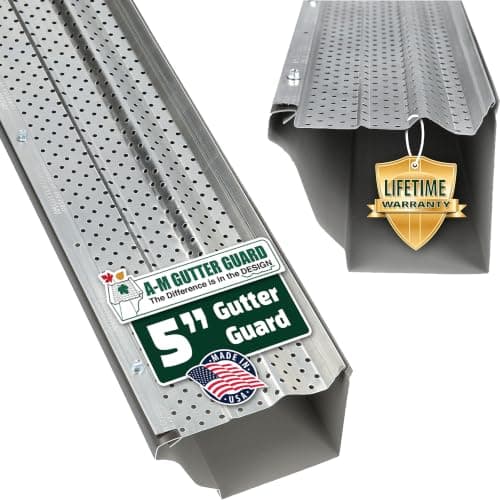
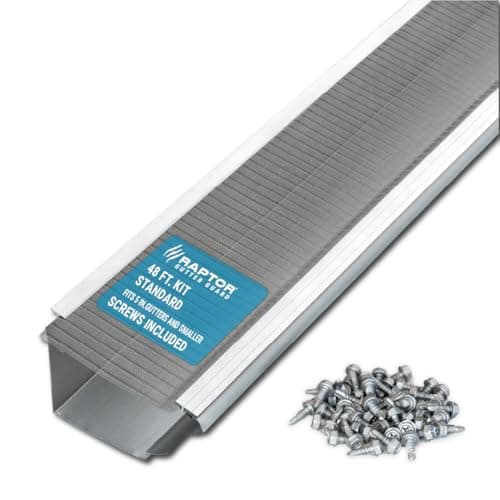
Raptor 5 in Stainless Steel Micro-Mesh Gutter Guard: fine stainless mesh with a stated panel width, for 5 in gutters under needle-dropping trees.
Key Specs
Type
Stainless steel micro-mesh
Gutter width (stated)
5 in gutters and smaller
Panel size (stated)
5.625 in x 47.625 in
Coverage (stated)
48 ft nominal per kit
Fixings (stated)
Self-tapping screws included
Other claims (stated)
WUI compliant; UL approved for rainwater collection to NSF P151 and NSF 372
Pros
Cons
Suited to
5 in K-style gutters under pines, firs or trees that drop seed pods and fine debris
Our take
Micro-mesh is the type to beat for fine debris, because its openings are small enough that pine needles, seed pods and shingle grit stay on top while water passes through. Raptor does not state the mesh opening, so you cannot compare it with other mesh by the number, but it does state the panel: 5.625 in wide, enough to span a 5 in gutter from the front lip to the roof edge. For 6 or 7 in gutters, Raptor lists a wider 7.187 in panel separately. Work out how many kits you need before ordering: a 140 ft run of gutter takes three 48 ft kits. Plan to brush grit and pollen off the mesh once or twice a year, since a matted top sends water over the edge.
Affiliate link — commission at no extra cost to you
Compare elsewhere
These open a search for this model. We quote prices only where we can verify them — Amazon, Sylvane and eBay.
Check price
on Amazon ↗
Listing verified 13 Oct 2026
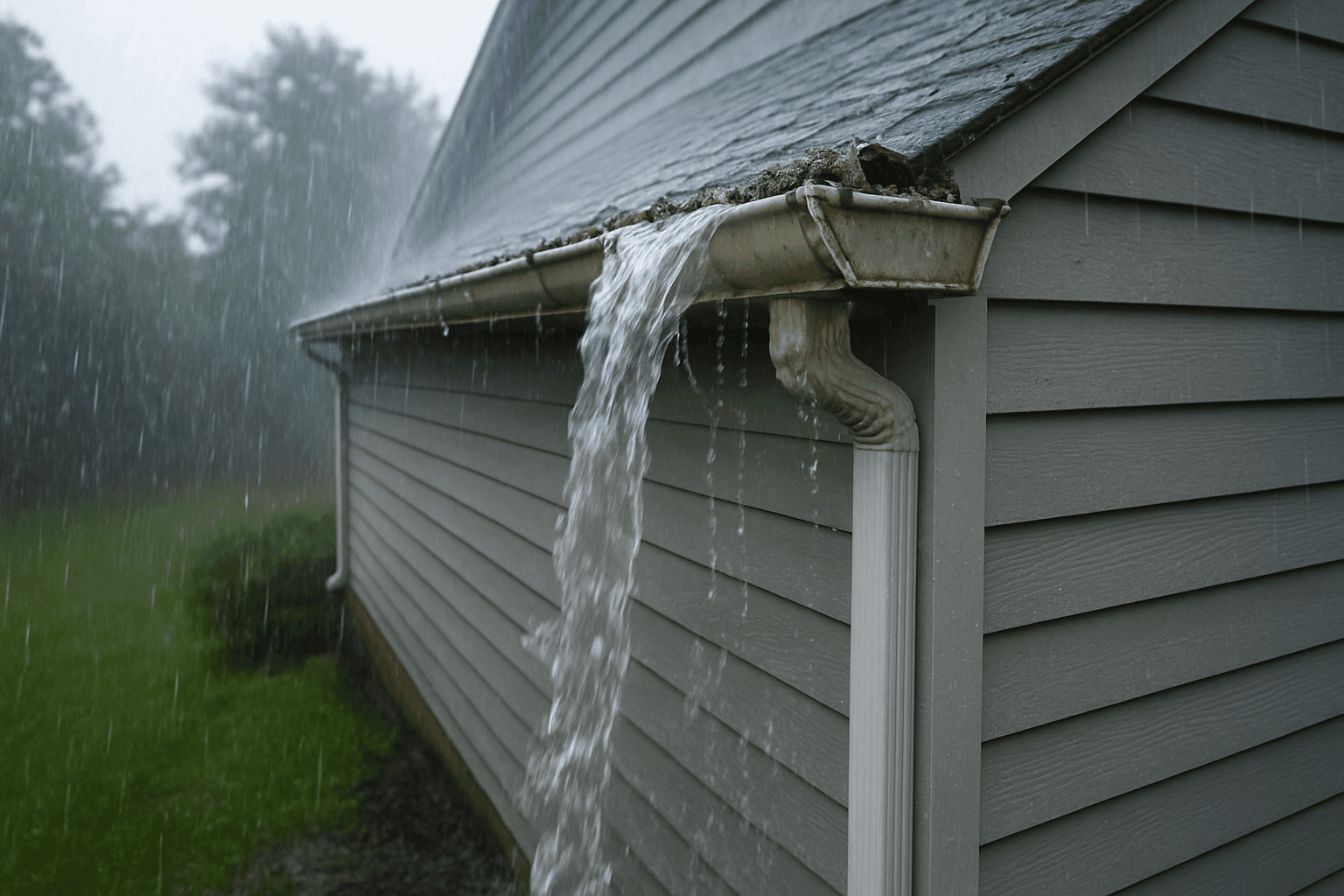
See it on Amazon ↗Quick Verdict
A-M 5 in Mill Finish Aluminum Gutter Guard: a well-specified aluminum screen for leaf-heavy yards, though coarser than micro-mesh against needles.
Key Specs
Type
Perforated aluminum screen with a raised, bubbled surface
Gutter width (stated)
5 in; A-M lists a 6 in version and a 200 ft box separately
Coverage (stated)
100 ft installed, with extra pieces to allow for overlap
Material (stated)
.018 gauge aluminum
Openings (stated)
380 holes per linear foot; hole size not stated
Hangers (stated)
Works with hidden, K-style and spike and ferrule hangers
Pros
Cons
Suited to
Long runs of 5 in gutter under maples, oaks and other trees with big, flat leaves
Our take
A-M's listing gives more numbers than most: .018 gauge aluminum, 380 holes per linear foot, and 100 ft of coverage with extra pieces included for the overlaps. The raised, bubbled surface is meant to let air under wet leaves so they dry and blow off. That suits yards under maples and oaks, where the debris is big and flat. The hole size itself is not stated, and a perforated sheet is coarser than micro-mesh, so needles and grit will reach the gutter over time. Two claims need a second look. The listing says the guard stays clear without maintenance, which no guard can do. It also says the guard will not void roof warranties; that is A-M speaking, so confirm with your shingle maker.
Affiliate link — commission at no extra cost to you
Compare elsewhere
Check price
on Amazon ↗
Listing verified 13 Oct 2026
See it on Amazon ↗Quick Verdict
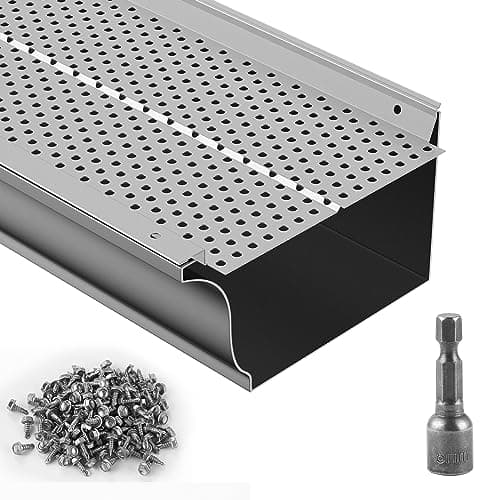
VEVOR 6 in Aluminum Gutter Guard: a fully dimensioned screen for 6 in gutters, best under broad leaves rather than pines.
Key Specs
Type
Perforated aluminum cover
Gutter width (stated)
Standard 6 in gutters
Pieces (stated)
52 pieces, each 48 in x 6 in, 208 ft total
Hole diameter (stated)
0.157 in (4 mm)
Thickness (stated)
0.02 in
Fixings (stated)
Pre-drilled holes on the front and back folds; screws included
Pros
Cons
Suited to
6 in gutters on a larger house with mostly broad leaves overhead
Our take
Six-inch gutters carry more water than 5 in gutters, so they turn up on houses with large or steep roofs, and a guard made for 5 in will not span one. VEVOR sizes this kit for 6 in gutters and states its numbers: 52 pieces of 48 in by 6 in, 0.157 in (4 mm) holes and 0.02 in thick aluminum. Those holes stop leaves well. The listing also says they stop pine needles, but a slim needle can slide through a 4 mm hole end-first, so under long-needle pines a micro-mesh guard is the safer buy. Screws go through pre-drilled holes in the front and back folds. Look at your roof edge before buying, because the listing does not say what the back fold fastens to.
Affiliate link — commission at no extra cost to you
Compare elsewhere
Check price
on Amazon ↗
Listing verified 13 Oct 2026
See it on Amazon ↗Best Screw-Free Install
Quick Verdict
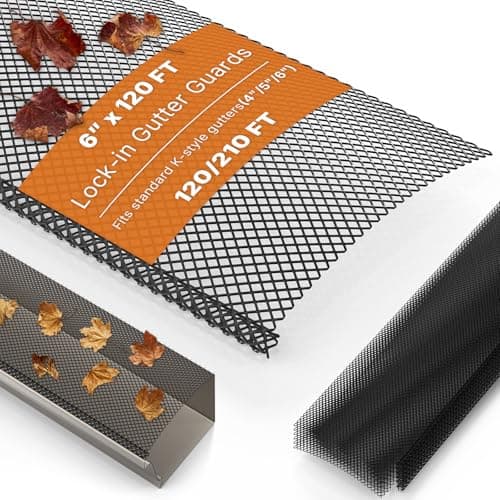
SDSNTE Lock-in Steel Gutter Guard: the quickest fit here, as long as your shingle warranty allows an under-shingle guard.
Key Specs
Type
Powder-coated steel screen, lock-in fit
Coverage (stated)
40 pieces, 6 in x 120 ft
Fits (stated)
4, 5 and 6 in steel or aluminum K-style gutters
Install (stated)
Slides under the first row of shingles and locks onto the gutter's front lip; no screws
Color
Black
Warranty (stated)
1 year
Pros
Cons
Suited to
A single-story roof with a clean shingle edge, where you want a screw-free install
Our take
This is the one pick here whose listing says plainly where it goes: the flat back edge slides under the first row of shingles and the bent front edge locks onto the gutter lip, with no screws. That makes it quick to fit, and it is also the catch. Lifting the first course of shingles can break the adhesive strip that keeps them down in wind, and some shingle warranties set conditions on later work at the roof edge. Read yours, or ask your roofer, before you buy. SDSNTE says the 6 in pieces fit 4, 5 and 6 in K-style gutters, so on a narrower gutter, check how far each piece will reach under the shingles. Powder-coated steel depends on its coating, so seal any edge you cut.
Affiliate link — commission at no extra cost to you
Compare elsewhere
Check price
on Amazon ↗
Listing verified 13 Oct 2026
See it on Amazon ↗Micro-Mesh Runner-Up
Quick Verdict
Sukhavati Home 5 in Stainless Steel Micro-Mesh Gutter Guard: a fully described micro-mesh kit with a 30-year written term, on a shorter buyer record.
Key Specs
Type
Stainless steel micro-mesh on an aluminum frame
Pieces (stated)
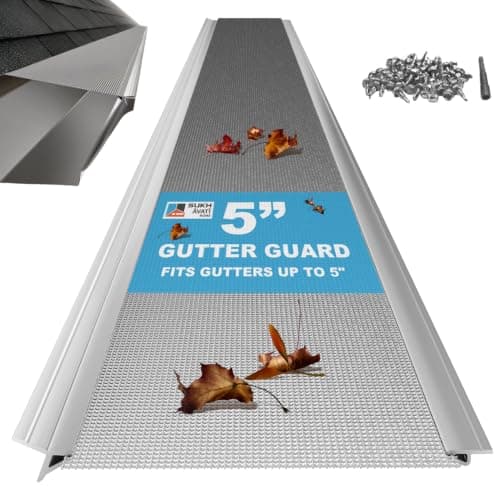
12 pieces, each 48 in x 5.6 in, 48 ft total
Gutter width (stated)
4 and 5 in gutters or smaller
Pitch (stated)
SmartPitch design angles the guard up to the roofline so the mesh sits level over the gutter
Install (stated)
Screw-in
Warranty (stated)
30 years
Pros
Cons
Suited to
4 or 5 in gutters under pines, for a buyer who wants a long written warranty
Our take
Sukhavati's kit is a second micro-mesh option for 4 and 5 in gutters, with a stated 30-year warranty. Its listing gives the parts: 12 pieces, each 48 in long and 5.6 in wide, with stainless mesh on an aluminum frame. Its SmartPitch claim is about geometry: the guard angles up toward the roofline so the mesh sits level over the gutter. No flow figure is given to show what that changes in a heavy rain. Read the warranty terms before you lean on them. A long warranty covers defects in the guard itself, not the cleaning it still needs or water damage from an overflow, and terms often ask for proof of purchase.
Affiliate link — commission at no extra cost to you
Compare elsewhere
What to know before you buy.
A gutter has one job: carry roof water to a downspout. When leaves and needles pack the trough or plug the downspout opening, the water spills over the front edge instead, along the whole run. It lands in a line right beside the foundation, in the loose backfill soil that drains toward the wall. One inch of rain on 1,000 sq ft of roof is about 623 gallons, so a blocked run can pour hundreds of gallons into that strip in a single storm. EPA's mold guidance tells homeowners to clean and repair roof gutters regularly and to make sure the ground slopes away from the foundation. Guards help with the first part. A downspout extension and sound grading finish the job by carrying the water out past the backfill.
Gutter guards come in four main DIY types, and the right one depends on what falls from your trees. Stainless micro-mesh, like the Raptor and Sukhavati kits, has openings fine enough to stop pine needles, seed pods and shingle grit. Perforated aluminum or steel screens, like the A-M, VEVOR and SDSNTE picks, have larger holes; they stop broad leaves well but let needles and grit through. Foam inserts fill the gutter and let water soak down through them, while debris settles on top and holds moisture. Brush guards are bristle cylinders that sit in the trough, and needles tangle in the bristles until you pull the brushes out to clean them. None of the picks here is foam or brush, because no listing of either type was among the candidates checked for this page.
Gutter size is measured across the top opening, from the front lip to the back edge against the fascia. On US houses, 5 in K-style gutters are the common size, while 6 in gutters show up on larger or steeper roofs. A guard made for 5 in will not span a 6 in gutter, and a 6 in piece can overhang a 5 in one. The listings here state their fit: Raptor's 5.625 in panel is for 5 in gutters and smaller, Sukhavati's 5.6 in pieces are for 4 and 5 in, VEVOR's pieces are 6 in wide, and SDSNTE says its 6 in pieces fit 4, 5 and 6 in K-style gutters. Next, add up the total length of gutter and divide by the kit length. A 140 ft run takes three 48 ft micro-mesh kits, or the 200 ft A-M box.
How a guard attaches matters as much as its mesh. Some slide their back edge under the first row of shingles, as the SDSNTE lock-in pieces do per the listing. Others screw to the gutter lip and to the fascia or roof edge, and some rest inside the gutter on the hangers. Lifting shingles can break the adhesive strip that holds them flat in wind, and many shingle warranties set conditions on work done to the roof after installation. Before you buy an under-shingle guard, read your shingle maker's warranty or ask the roofer who installed it. An assurance from the guard maker is not the same as one from your roof maker. Several listings here, Raptor's included, do not say where the back edge goes, so read the maker's install guide first.
A guard keeps the trough clear; it does not make the gutter maintenance-free, whatever a listing says. Pollen, shingle grit and small debris form a mat on top of fine mesh that slows water through, so brush or hose the top once or twice a year. In a hard downpour, water can run across the top of a guard and over the edge, worst below a roof valley where two slopes pour into one spot. In winter, snow and ice can freeze over the surface, and guards do not stop ice dams, which start with heat escaping the attic. Too few downspouts or a crushed elbow will overflow a guarded gutter too. And a guarded gutter still needs a downspout that empties several feet from the wall.
Skip the DIY kit if reaching the gutter means working from a ladder at second-story height or on a steep roof; ladder falls are a real risk at that height, and an installer has the staging for it. Gutters that sag, pull away from the fascia or hold standing water after rain need rehanging or re-pitching first, because a guard on a badly pitched gutter only hides the puddle. Rotted fascia needs repair before anything screws into it. If your basement leaks while the gutters run clear and nothing overflows, a guard will not help, since groundwater rising under the slab calls for drain tile and a sump pump. And if the gutters fill only once a year under a few small trees, a fall cleaning may be less work than a full install.
YesThey keep leaves and most debris out of the trough, but they cut cleaning rather than end it.
How well they work depends on matching the type to your trees: micro-mesh for pine needles and grit, a perforated screen for broad leaves. Debris and pollen still collect on top and need brushing off, and in very heavy rain some water can run across a guard and over the edge, especially below a roof valley.
They are worth it when trees overhang the roof and your gutters clog more than once a season, or when overflow is soaking the ground beside a basement wall. With few trees nearby, a yearly cleaning may be less work than an install.
Guards also cannot fix gutters that sag or pitch the wrong way. Weigh the ladder work as well, since a two-story install is often better left to an installer.
Stainless steel micro-mesh is the type to buy for pine needles, because its openings are too fine for needles to drop through.
Perforated screens have larger holes; VEVOR states 4 mm holes on its aluminum guard, and a slim needle can slip through one end-first. Needles will still pile up on top of any guard, so plan to brush them off after the heaviest drop each year.
They can, if the install lifts, bends or nails through shingles in a way your shingle warranty does not allow. Under-shingle guards, such as the SDSNTE lock-in pieces, slide beneath the first row of shingles, while guards that fasten to the gutter lip and fascia leave the shingles alone.
A guard maker's word that its product is safe for your roof is not your roof maker's, so read your shingle warranty or ask your roofer first.
NoIce dams form when heat escaping through the attic melts snow higher on the roof and the water refreezes at the cold eaves, guard or no guard.
A guard can freeze over, though, and then meltwater runs off the edge instead of into the gutter. The lasting fix for ice dams is attic air sealing and insulation, with heat cable along the eaves as the stopgap for problem spots.
Buy the guard made for your gutter's width, measured across the top opening from the front lip to the back edge. Raptor's 5.625 in panel is listed for 5 in gutters and smaller, while VEVOR makes its 6 in pieces for 6 in gutters.
Then divide your total gutter length by the kit length to get the number of kits, allowing a little extra for corners and cuts.
Call (888) 840-6512. The line is answered 24 hours a day, seven days a week, and connects you with an IICRC-certified water damage restoration company that serves your area. A recorded menu picks up first: choose water damage or mold, key in your 5-digit ZIP code, and hold through the short silence while the call is passed to the company.
Describe what you can see — where the water is coming from, how long it has been there, and whether it smells — the more specific you are, the faster the right company is on the line. If the source is a pipe or an appliance, shut the main water valve first. Have four things ready and the call goes quickly: the address, when the water started, what is wet now, and whether you have filed an insurance claim.
Still not sure which of these is your situation? (888) 840-6512 · toll-free · answered 24/7
Methodology: How we source and verify data · Report an error
Free 2-day shipping
Amazon Prime members pay no shipping on restoration equipment
Dehumidifiers, air movers, and moisture meters qualify for free Prime delivery — bulk items that otherwise cost $15–$40 to ship.
Affiliate link — HearthDry earns a bounty if you sign up; costs you nothing extra.

Roof water that lands at the foundation is one of the most common reasons a basement gets wet, and an extension is the low-cost way to carry it out to ground that drains away. These picks are measured against how far each one reaches by its own listing, and against the grading, ice and mowing problems that decide whether an extension keeps working.
Read the comparisonA roof heat cable melts a channel through the ice at the eave and in the gutter so meltwater can drain, but it does not stop the attic heat loss that causes ice dams. These picks are compared on the wattage, cable type, roof types and certifications each listing states, with the sizing arithmetic, the running cost in kilowatt-hours and the electrical and ladder safety points most roundups skip.
Read the comparisonA can, tube or roll from this page can stop a small roof leak at a seam, a flashing edge or a vent boot. It cannot replace missing shingles or rotted decking, and the place water gets in is often several feet uphill from the stain on your ceiling.
Read the comparisonA clear window well cover keeps rain, snow and leaves out of the well, which closes one of the usual routes for water to reach a basement window. It has to match the well's width, projection and shape, and over a bedroom egress well it must open from inside, so each pick here is checked against all three.
Read the comparisonA rain barrel saves roof water for the garden, but a barrel that overflows at the wall puts that water right where a wet basement starts. These barrels and one diverter kit are compared on stated gallons, lids and screens, spigots and overflow fittings, with the arithmetic on how fast a barrel fills and the winter routine it needs.
Read the comparisonRoof ice melt opens a drain channel through an ice dam so trapped water can run off; it does not stop the next dam forming. These calcium chloride picks are compared on what each listing states, alongside the stocking method, how much to buy for your eaves and why rock salt stays off the roof.
Read the comparisonA door threshold seal closes the gap between the door and the sill, which stops drafts and rain blown under the door; it cannot hold back water pooling against the house. These picks cover stick-on sweeps, a slide-on door bottom, a replacement threshold insert and a garage door threshold, compared on the gap each listing says it fills and how it attaches.
Read the comparisonA clogged gutter spills roof water along the whole length of the house, right where the basement wall meets the soil. These picks are telescoping wands you use from the ground, compared on pole length, the reach each listing claims, and what a jet of water can and cannot clear.
Read the comparison