
Best Door Threshold Seals in 2026 — Sweeps, Threshold Inserts and Garage Seals for Rain Blowing Under the Door

Best Door Threshold Seals in 2026

Sweeps, Threshold Inserts and Garage Seals for Rain Blowing Under the Door

5 picks compared · prices, ratings and stock checked October 12, 2026

Our Top Pick

For an exterior door with a gap under it, the Grotheory Door Draft Stopper 2-Pack: two 39 in silicone stick-on sweeps you cut to width. For a garage door where rain blows in, the Jin&Bao Universal Garage Door Threshold Seal glues a 20 ft rubber ridge to the floor.

4.3 on Amazon · 39,730 ratings

Quick answer

If you can see daylight or feel a draft under an exterior door, a stick-on silicone sweep is the simplest seal, and the Grotheory Door Draft Stopper 2-Pack is the pick, rated 4.3 stars across 39,730 Amazon ratings: two 2 x 39 in strips you trim to the door. Its listing gives no gap range, so for a gap up to 1.5 in choose the Ormein sweep, which states one. If your aluminum threshold has a worn vinyl insert, replace the insert instead. A seal stops drafts and rain blown under the door; water pooling against the step needs drainage.

Our Picks at a Glance

Every pick below is currently stocked — ratings and stock read from Amazon on 12 October 2026.

How this page was made: we compare the current Amazon listings, the makers' published specs and what verified buyers report, then rank by fit for the job. Ratings, review counts and stock are read from Amazon and dated. We earn a commission on purchases through our links; it does not change the order. Reviewed by Marcus Reed, IICRC-certified Water Restoration Technician.

Full Reviews

Each pick in detail: what the listing states, what buyers report, and where it falls short.

#1
Best Overall

Check price

on Amazon ↗

Listing verified 13 Oct 2026

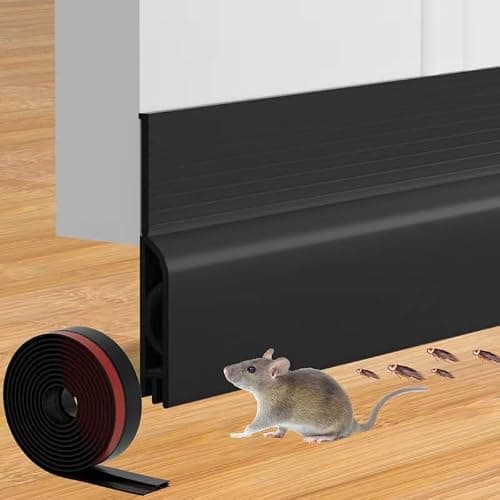
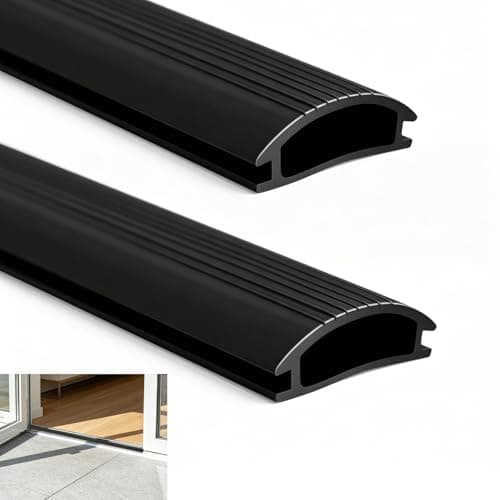
Grotheory Door Draft Stopper 2-Pack (Silicone Stick-On Sweep, 2 x 39 in)See it on Amazon ↗

Quick Verdict

Grotheory Door Draft Stopper 2-Pack: two 39 in silicone stick-on sweeps for the common gap under a door.

Key Specs

Type

Self-adhesive door sweep

Material (stated)

Silicone

Size (stated)

2 in wide x 39 in long, two strips

Attachment (stated)

Peel-and-stick adhesive; cut to length

Doors named (stated)

Exterior and interior, including glass, sliding, wood, storm and screen doors

Gap range

Not stated on the listing

Pros

  • Two 39 in strips cover a standard 36 in door with a second strip for another door or a redo
  • Silicone flexes over an uneven floor or threshold without marking it, per the listing
  • Cut with scissors and peel-and-stick, so there is no drilling into a door you may not own

Cons

  • No gap range on the listing, so a large gap under the door may be beyond what the lip reaches
  • The adhesive needs a clean, dry and reasonably warm door face; a cold exterior door in winter makes it harder to stick
  • The lip can catch on a thick doormat or rug inside the door

Suited to

An exterior or interior door with a visible gap at the bottom, in a home where drilling into the door is not an option

Our take

A sweep like this works by pressing a flexible lip against the threshold when the door closes, which blocks the moving air that carries rain under the door. The listing gives the strip as 2 in wide but not the gap it is meant to close, so measure before you buy: close the door and slide a ruler or a stack of coins into the gap at the hinge side, the middle and the latch side. If the gap tapers, set the strip so the lip just touches the sill at the narrowest point. On an inward-swinging door, stick it to the room side so the lip sweeps the threshold as the door shuts. Wipe the door with rubbing alcohol first and install on a dry day above freezing, since peel-and-stick adhesive grabs poorly on cold or dusty paint.

Check today's price on Amazon →

Affiliate link — commission at no extra cost to you

Compare elsewhere

These open a search for this model. We quote prices only where we can verify them — Amazon, Sylvane and eBay.

#2
Best for Larger Gaps

Check price

on Amazon ↗

Listing verified 13 Oct 2026

Ormein Door Draft Stopper (Silicone Stick-On Sweep, 1.96 x 39 in, Seals Gaps 0 to 1.5 in)See it on Amazon ↗

Quick Verdict

Ormein Door Draft Stopper: a silicone stick-on sweep with a stated 0 to 1.5 in gap range and a wide adhesive backing.

Key Specs

Type

Self-adhesive door sweep

Material (stated)

Silicone

Size (stated)

1.96 in wide x 39 in long

Gap range (stated)

0 to 1.5 in

Adhesive (stated)

Widened 1.5 in waterproof backing with a 1 mm groove

Cold-weather step (stated)

Warm the adhesive with a hair dryer for 2 minutes before installing

Pros

  • The only stick-on sweep here that states a gap range, 0 to 1.5 in, so you can match it to your measurement
  • A 1.5 in wide adhesive backing, per the listing, gives the glue more area to hold against floor drag
  • Prints a cold-weather install step, which matters for an exterior door fitted in winter

Cons

  • The listing suggests tape or thumbtacks as a backup hold, a hint that the adhesive has limits on some surfaces
  • A lip stretched across a 1.5 in gap is doing a lot of work; a gap that size often means the threshold needs adjusting

Suited to

An exterior door with a gap you have measured at up to 1.5 in, especially one fitted in cold weather

Our take

Gap range is the reason this sweep is on the list. Ormein states 0 to 1.5 in, and once you have measured your gap at the hinge, middle and latch side, that number tells you whether the lip will reach. The wide adhesive backing matters on an exterior door, because each time the door closes the lip drags across the threshold and pulls on the glue. Follow the listing's cold-weather step and warm the strip with a hair dryer for 2 minutes before pressing it on. If your measured gap sits near the top of that range, look at the threshold before blaming the door. An adjustable aluminum threshold can often be raised with its screws, which closes most of the gap before any sweep goes on.

Check today's price on Amazon →

Affiliate link — commission at no extra cost to you

#3
Best No-Adhesive Door Bottom

Check price

on Amazon ↗

Listing verified 12 Oct 2026

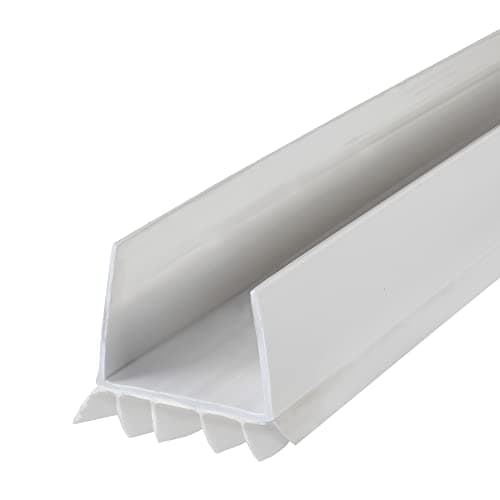
M-D Building Products Cinch U-Shape Slide-On Under Door Seal (Vinyl, 36 in, White)See it on Amazon ↗

Quick Verdict

M-D Cinch Slide-On Under Door Seal: a 36 in vinyl sleeve for doors where adhesive sweeps keep peeling.

Key Specs

Type

U-shaped door bottom that slides onto the door edge

Material (stated)

Vinyl

Length (stated)

36 in

Attachment (stated)

Slides on; no special tools

Door thickness

Not stated on the listing, which says it fits standard doors

Color

White

Pros

  • No adhesive to fail: the U-shape wraps the bottom of the door and holds by fit
  • A 36 in length matches a standard exterior door width
  • Blocks drafts, dust and some noise, per the listing

Cons

  • Door thickness fit is not stated on this listing, so check that your door matches before ordering
  • A 36 in length leaves nothing spare for a wider door
  • It adds material under the door, so a door that already rubs the threshold may bind

Suited to

A standard-width exterior or interior door where stick-on sweeps have peeled off

Our take

This is a different kind of seal from the two sweeps above. Instead of sticking to the door face, it slides over the bottom edge of the door like a sleeve, so there is no adhesive bond to give way when the door drags across the threshold all winter. The trade is fit. The listing says it fits standard doors but gives no thickness, and a sleeve that is too loose will slide off while one that is too tight will not go on, so measure the door's thickness before ordering. Check the clearance too: with the door closed, there needs to be room under it for the sleeve plus a little compression. If the door already scuffs the threshold, a sleeve will make it bind.

Check today's price on Amazon →

Affiliate link — commission at no extra cost to you

#4
Best for Garage Doors

Check price

on Amazon ↗

Listing verified 13 Oct 2026

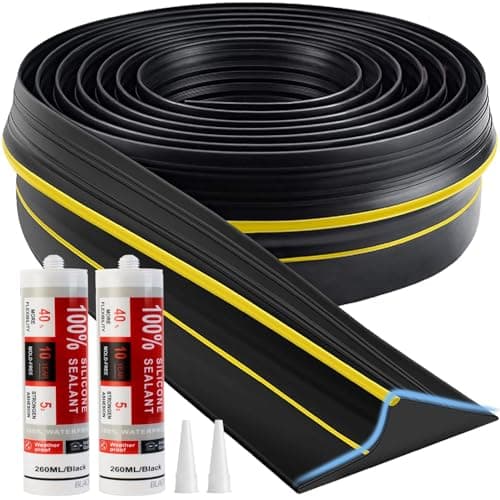
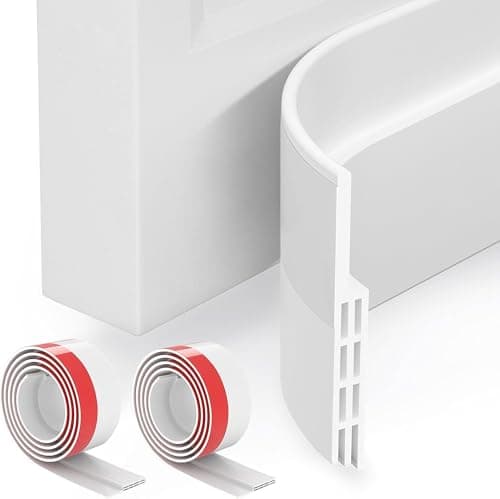
Jin&Bao Universal Garage Door Threshold Seal (20 ft Rubber Strip, 3.7 in Wide, 0.6 in High, Adhesive Included)See it on Amazon ↗

Quick Verdict

Jin&Bao Universal Garage Door Threshold Seal: a 20 ft, 0.6 in rubber ridge for rain blowing under a garage door.

Key Specs

Type

Floor-mounted garage door threshold

Length (stated)

20 ft, cut to fit

Profile (stated)

3.7 in wide, 0.6 in high

Temperature range (stated)

-40°F to 284°F

Attachment (stated)

Glued to the floor; two adhesives included

Floors named (stated)

Concrete, asphalt, painted or treated surfaces

Pros

  • Names wind-driven rain, snow and leaves under a garage door as the job it is built for
  • 20 ft covers a 16 ft double garage door with length to spare
  • Rated from -40°F to 284°F, so it should stay flexible in an unheated garage
  • A yellow edge strip makes the ridge easy to see when walking in

Cons

  • A 0.6 in ridge holds back only shallow water; it is not a flood barrier
  • Mowers, carts and bikes have to roll over the ridge
  • Needs a clean, dry floor for the glue, and a glued strip is hard to move later

Suited to

A garage door where rain and snow blow in along the floor, or where the slab is uneven under the door's rubber seal

Our take

A garage threshold works differently from a door sweep. It is a rubber ridge glued to the floor where the door comes down, so water running along the slab has to climb 0.6 in to get past it. That is enough for wind-driven rain and snowmelt dripping off a car. It is not enough when the driveway slopes toward the garage and water sheets down it in a storm; that needs regrading or a trench drain. Before gluing, close the door and mark where its bottom rubber lands, then set the strip so the ridge sits just inside that line. The listing names concrete, asphalt and painted floors, but scrape off any loose paint first, since the glue only holds as well as the surface under it.

Check today's price on Amazon →

Affiliate link — commission at no extra cost to you

#5
Best Replacement Insert for Aluminum Thresholds

Check price

on Amazon ↗

Listing verified 12 Oct 2026

Thrseely Vinyl Replacement Insert for Adjustable Aluminum Thresholds 2-Pack (36 in, 1-5/16 x 3/8 in)See it on Amazon ↗

Quick Verdict

Thrseely Vinyl Replacement Insert: a 1-5/16 x 3/8 in insert that restores the seal in an adjustable aluminum threshold.

Key Specs

Type

Replacement vinyl insert for an adjustable-height aluminum threshold

Profile (stated)

1-5/16 x 3/8 in

Length (stated)

36 in, two pieces

Fits (stated)

Most standard adjustable-height aluminum thresholds that use a vinyl sealing system

Install (stated)

Trim to length with household scissors; no special tools

Blocks (stated)

Drafts, moisture, dust and insects

Pros

  • Fixes the seal where it actually failed, in the worn vinyl strip of the threshold itself
  • Two 36 in pieces: one for the door and one spare or for a second door
  • Profile given in numbers, 1-5/16 x 3/8 in, so you can measure the old insert against it

Cons

  • Fits only adjustable aluminum thresholds that take this insert size; a wood sill or a different profile will not accept it
  • A newer listing with a short buyer history so far, so read recent reviews before ordering
  • Does nothing for gaps at the sides of the door, where the jamb weatherstripping is a separate part

Suited to

An exterior door whose adjustable aluminum threshold has a cracked, flattened or missing vinyl insert

Our take

Many exterior doors already have a threshold seal: a vinyl insert down the middle of an adjustable aluminum threshold. When it flattens or cracks, a sweep on the door is a workaround, and this is the actual repair. The listing gives the insert's profile as 1-5/16 x 3/8 in. Pull the old insert out, which usually lifts from its channel by hand or with pliers, and measure it and the slot before ordering, because similar inserts come in other sizes. Trim the new one to the opening with scissors and press it into the channel. Then adjust the threshold height with its screws until the door closes against the insert with light contact: a dollar bill shut in the door should pull out with some drag.

Check today's price on Amazon →

Affiliate link — commission at no extra cost to you

Buyer's Guide

What to know before you buy.

Sweep, Door Bottom, Threshold Insert or Garage Threshold: Which One You Need

Start by looking at what is under the door now. If the door closes onto an aluminum threshold with a rubbery strip down the middle, and that strip is flat, cracked or missing, replace the insert; that is the seal the door was built around. If there is no insert, or the gap is between the door bottom and a wood or stone sill, add a sweep to the door. Stick-on silicone sweeps need no tools. Screw-on metal sweeps with a vinyl or brush lip are sturdier on a busy exterior door, though none of the picks here is a screw-on model. A slide-on door bottom wraps the door edge and suits a door where adhesive keeps failing. Garage doors are their own case: the door's bottom rubber lands on the slab, so the fix is a raised threshold glued to the floor.

Measure the Width and the Gap Before You Buy

Two measurements decide the fit. Width comes first: measure the door itself, not the frame, and buy a strip at least that long; every entry-door pick here is 36 or 39 in long, which covers a standard 36 in exterior door. For the gap, close the door and check the space under it at the hinge side, the middle and the latch side, since older doors often sag toward the latch. A stack of coins or a set of drill bits makes a handy gauge. The Ormein listing states it seals gaps of 0 to 1.5 in; the others give a size but not a range. If the gap is wide at one end and tight at the other, tighten the hinge screws or adjust the threshold before fitting any seal, or the seal will only touch at one end.

Adhesive, Slide-On or Screw-On: How It Attaches

Peel-and-stick sweeps such as the Grotheory and Ormein go on in minutes and leave no holes, which suits renters. Their weak point is the glue. Each time the door closes, the lip drags across the threshold and pulls on the bond, and on an exterior door that bond goes through cold nights and wet days. Give it the best start: clean the door face with rubbing alcohol, fit it above freezing or warm the strip first as the Ormein listing advises, and press hard along the full length. A slide-on bottom such as the M-D Cinch has no glue to fail but depends on matching your door's thickness. Screw-on sweeps hold best and can be moved up or down as the floor wears, though they take a drill and some care to keep the line level. The garage threshold glues to the slab, so the concrete has to be clean and dry.

Rain Under the Door vs Water Coming From Outside

A threshold seal handles two problems: drafts, and rain driven sideways by wind into the gap at the bottom of the door. It does not hold back water that pools against the house. If the step, patio or driveway outside slopes toward the door, rain runs to the threshold and seeps under it however good the seal is. Watch the door in a hard rain, or run a garden hose at it from outside, starting low and working up, to see where the water gets in. Water at the sill line points to the seal or the threshold. Water that shows at the corners, the trim or under the floor points to flashing, a missing sill pan or grading. EPA's advice is that the ground should slope away from the foundation so water does not collect around it, and gutters that dump next to the door make every one of these worse.

Who Should Not Rely on a Threshold Seal

If water reaches the door from outside, a seal is the last line of defense, not the fix. A door below grade, such as a basement walkout at the bottom of a stairwell, needs a working drain at the foot of the stairs, and a seal there only stops spray. A patio or stoop that slopes toward the house needs releveling, a new slab or a channel drain. Downspouts that empty within a few feet of the door need extensions that carry water at least 4 to 6 ft away. And if you see lifted flooring, a soft spot or a swollen baseboard just inside the door, water has already been getting under the floor. EPA advises drying water-damaged areas within 24 to 48 hours to prevent mold growth, so check the subfloor with a moisture meter before covering it up. Rising water needs a flood barrier, not a seal.

Frequently Asked Questions

What is the best way to seal the bottom of an exterior door?

Fix the seal that is already there first, then add a sweep if a gap remains. Most exterior doors close onto a threshold with a vinyl insert, and if that insert is flat or cracked, a replacement such as the Thrseely insert restores the seal.

Where there is no insert, or the gap is between the door and a solid sill, a silicone sweep like the Grotheory, fixed to the room side of the door, closes it. If the threshold is adjustable, raise it before adding anything.

What is the difference between a door sweep and a threshold seal?

A sweep is fixed to the door and moves with it, while a threshold seal is fixed to the floor or sill under the door. On most exterior doors the two work as a pair: the door bottom or sweep closes onto the threshold's insert.

Replace whichever part is worn. If both are, do the threshold first, because the sweep has to land on it, and a new sweep on a crushed insert still leaves a gap.

How do I stop water coming under my door when it rains?

First find out whether the water is blowing in or running in. Rain blown into the gap under the door is a seal problem, and a sweep or a new threshold insert fixes it.

Water that runs across the step or patio to the threshold is a drainage problem that no seal will solve; it needs the slope outside corrected, nearby downspouts extended and any drain cleared. A garden hose test from outside shows which one you have.

How big should the gap be under an exterior door?

With the seal in place, there should be no gap at all: the door bottom or sweep should touch the threshold insert lightly along its whole width. Without a seal, the clearance depends on the threshold height, and an adjustable threshold can be raised to meet the door.

Test with a dollar bill shut in the door at several points; it should pull out with slight drag. Daylight or a draft anywhere along the bottom means the seal is not touching.

Do adhesive door sweeps work on exterior doors?

YesIf the door face is clean and the strip goes on in mild, dry weather. The Grotheory and Ormein listings both name exterior doors.

The bond is the weak point, because dirt, cold paint and the drag of the lip each time the door shuts all work against it. Prepare the surface, warm the strip in cold weather and press it on firmly. If it keeps peeling, switch to a slide-on door bottom or a screw-on sweep.

How do I keep rain out of my garage door?

Glue a raised threshold across the floor where the door closes, and replace the door's bottom rubber if it is cracked. The Jin&Bao threshold puts a 0.6 in rubber ridge under the door, which stops rain and snowmelt blown along the floor.

If the driveway slopes toward the garage and water sheets in during storms, the threshold will be overtopped, and the fix is a trench drain across the driveway or regrading.

Who do I call right now for water damage?

Call (888) 840-6512. The line is answered 24 hours a day, seven days a week, and connects you with an IICRC-certified water damage restoration company that serves your area. A recorded menu picks up first: choose water damage or mold, key in your 5-digit ZIP code, and hold through the short silence while the call is passed to the company.

Describe what you can see — where the water is coming from, how long it has been there, and whether it smells — the more specific you are, the faster the right company is on the line. If the source is a pipe or an appliance, shut the main water valve first. Have four things ready and the call goes quickly: the address, when the water started, what is wet now, and whether you have filed an insurance claim.

Still not sure which of these is your situation? (888) 840-6512 · toll-free · answered 24/7

Sources

  1. EPA — A Brief Guide to Mold, Moisture, and Your Home

Methodology: How we source and verify data · Report an error

How we chose these picks

  • Every pick is a current listing. Stock, star ratings and rating counts are read from Amazon by script and carry the date they were read.
  • Nothing under 4.0 stars makes the list, and the top pick needs a large rating count, so one good week of reviews cannot put it there.
  • Specs are quoted from the listing or the maker, with the test condition behind the number where there is one, and sized against the job rather than the room on the box.
  • We do not run lab or field tests. Where a spec matters, we say what it is measured under and what it cannot tell you.

Free 2-day shipping

Amazon Prime members pay no shipping on restoration equipment

Dehumidifiers, air movers, and moisture meters qualify for free Prime delivery — bulk items that otherwise cost $15–$40 to ship.

Try Prime free →

Affiliate link — HearthDry earns a bounty if you sign up; costs you nothing extra.

Also Worth Comparing

Best Downspout Extensions in 2026 — Flexible Pipes Measured Against the 4 to 10 ft Rule, for a Drier Basement

Roof water that lands at the foundation is one of the most common reasons a basement gets wet, and an extension is the low-cost way to carry it out to ground that drains away. These picks are measured against how far each one reaches by its own listing, and against the grading, ice and mowing problems that decide whether an extension keeps working.

Read the comparison

Best Window Well Covers in 2026 — Clear Covers, Egress Wells and Grates Compared on Fit, Load and Water

A clear window well cover keeps rain, snow and leaves out of the well, which closes one of the usual routes for water to reach a basement window. It has to match the well's width, projection and shape, and over a bedroom egress well it must open from inside, so each pick here is checked against all three.

Read the comparison

Best Moisture Meters for Homeowners in 2026 — Water Damage Detection

A moisture meter tells you what your eyes can't see — wet drywall, soggy subfloor, and moisture in framing. These are the four best moisture meters for homeowners dealing with water damage.

Read the comparison

Best Concrete Crack Sealer in 2026 — Injection Kits for Basement Walls, Fillers for Floors, and the Cracks That Need an Engineer Instead

A concrete crack sealer can stop water seeping through a crack in a basement wall or slab, but it does nothing about the groundwater pushing on that wall, and some cracks are signs of movement that no sealer should cover. These picks are matched to the crack in front of you, with the width limits and cure times each listing states and the warning signs that call for a structural engineer.

Read the comparison

Best Water Barriers in 2026 — Garage Door Seals, Water-Activated Sandless Bags, and What They Cannot Hold Back

A water barrier keeps rain runoff from running under a garage door or doorway, but only up to its own height and only if it is in place before the water arrives. These picks are compared on the height, length and limits each listing states, with the deployment steps and the water a barrier cannot stop.

Read the comparison

Best Window Caulk in 2026 — Exterior Silicone, Paintable and Hybrid Sealants, and the Leaks Caulk Cannot Stop

Window caulk seals the joint where the frame meets siding or trim, and the right type depends on whether that joint will be painted, how wide it is and how much it moves. These picks are compared on what each listing states about joint width, movement, rain-ready and paint-ready times, alongside where caulk belongs on a window, where it must never go, and the leaks it cannot stop.

Read the comparison