
Best for: A single garage door or a wide doorway where heavy rain sends a few inches of runoff toward the house
- Length:
- 10 ft, one barrier
- Height when wet (stated):
- Grows to 3.5 in high in minutes
Listing verified 13 Oct 2026

Garage Door Seals, Water-Activated Sandless Bags, and What They Cannot Hold Back
5 picks compared · prices, ratings and stock checked October 12, 2026
Our Top Pick
For a garage door or doorway before a storm, the Quick Dam Water Activated 10 ft Flood Barrier, which grows to 3.5 in high once wet. For water that creeps under a closed garage door in every rain, glue down the Jin&Bao Universal Garage Door Threshold Seal 20 ft.
4.5 on Amazon · 5,096 ratings
Quick answer
The best water barrier for a garage door or doorway is one taller than the water you expect, laid before the rain starts; for most homes, that is the Quick Dam Water Activated 10 ft Flood Barrier, rated 4.5 stars across 5,096 Amazon ratings. Its listing says it grows to 3.5 in high in minutes once wet, and 10 ft spans a single garage door. If water creeps under a closed garage door in every storm, glue down a permanent threshold seal such as the 0.6 in high Jin&Bao strip. No barrier stops groundwater rising through the slab.
Every pick below is currently stocked — ratings and stock read from Amazon on 12 October 2026.
Best for: A single garage door or a wide doorway where heavy rain sends a few inches of runoff toward the house
Listing verified 13 Oct 2026
Best for: A garage where a little water runs under the closed door in most storms
Listing verified 13 Oct 2026
Best for: Sealing doorways, door corners and short gaps that a long single barrier will not fit
Listing verified 13 Oct 2026
Best for: A doorway where past storms left water a little deeper than a 3.5 in bag can hold
Listing verified 13 Oct 2026
Best for: A low garage or doorway where water has stood deeper than a few inches, with a hose bib nearby
Listing verified 13 Oct 2026
How this page was made: we compare the current Amazon listings, the makers' published specs and what verified buyers report, then rank by fit for the job. Ratings, review counts and stock are read from Amazon and dated. We earn a commission on purchases through our links; it does not change the order. Reviewed by Marcus Reed, IICRC-certified Water Restoration Technician.
Full Reviews
Each pick in detail: what the listing states, what buyers report, and where it falls short.
Check price
on Amazon ↗
Listing verified 13 Oct 2026
See it on Amazon ↗Best Overall
Quick Verdict
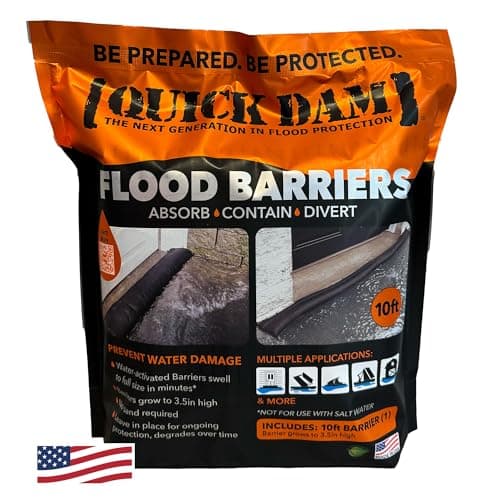
Quick Dam Water Activated 10 ft Flood Barrier: one 10 ft piece with no joints across a single garage door, good for runoff up to its stated 3.5 in.
Key Specs
Length
10 ft, one barrier
Height when wet (stated)
Grows to 3.5 in high in minutes
Activation (stated)
Get it wet; no sand needed
Design (stated)
Long and flexible, with a dual chamber design meant to stop it rolling out of place
Uses (stated)
Doorways, garages, leaking water heaters and erosion control, indoors or out
Salt water (stated)
Do not use; the listing says a chemical reaction makes it deflate
Pros
Cons
Suited to
A single garage door or a wide doorway where heavy rain sends a few inches of runoff toward the house
Our take
The case for a 10 ft barrier is joints. Every place two short bags meet is a seam water can push through, and a single piece laid across a single garage door has none in the middle. Quick Dam states the height the barrier reaches once wet, 3.5 in, and that number is the limit of what it can hold back; water deeper than that goes over the top. The listing also warns against salt water, which makes it deflate, so it is a tool for rain runoff, not coastal surge. Lay it before the storm, tight against the closed door, and let it swell where it sits.
Affiliate link — commission at no extra cost to you
Compare elsewhere
These open a search for this model. We quote prices only where we can verify them — Amazon, Sylvane and eBay.
Check price
on Amazon ↗
Listing verified 13 Oct 2026
See it on Amazon ↗Best Permanent Garage Seal
Quick Verdict
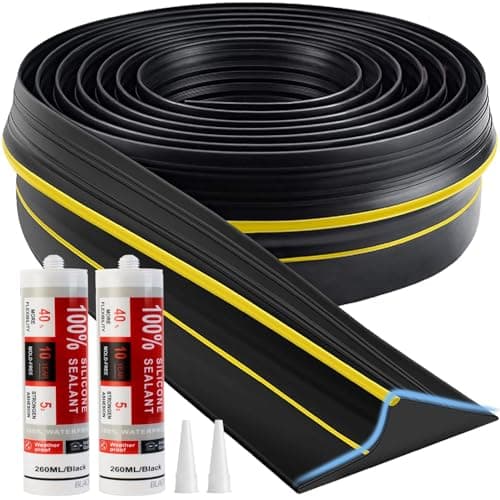
Jin&Bao Universal Garage Door Threshold Seal 20 ft: a glue-down lip that stops everyday runoff under a closed garage door.
Key Specs
Length
20 ft, cut to fit
Size (stated)
3.7 in wide, 0.6 in high
Material (stated)
Rubber strip with anti-slip ridges, a yellow safety strip and a serrated base for the adhesive
Adhesive
Included, per the listing title
Temperature range (stated)
-40°F to 284°F
Surfaces (stated)
Concrete, asphalt, painted or treated surfaces
Pros
Cons
Suited to
A garage where a little water runs under the closed door in most storms
Our take
A threshold seal is the barrier you never have to remember. It is glued to the slab where the garage door closes, and the door's own bottom seal presses down onto it, so runoff that used to slide under the door meets a raised lip. At 0.6 in high, per the listing, it handles the thin sheet of water that runs down a driveway in heavy rain, not a pool standing against the door. It also does nothing while the door is open. Clean and dry the concrete before gluing, and check that the door still closes fully onto the strip.
Affiliate link — commission at no extra cost to you
Compare elsewhere
Check price
on Amazon ↗
Listing verified 13 Oct 2026
See it on Amazon ↗Best Sandless Sandbags
Quick Verdict
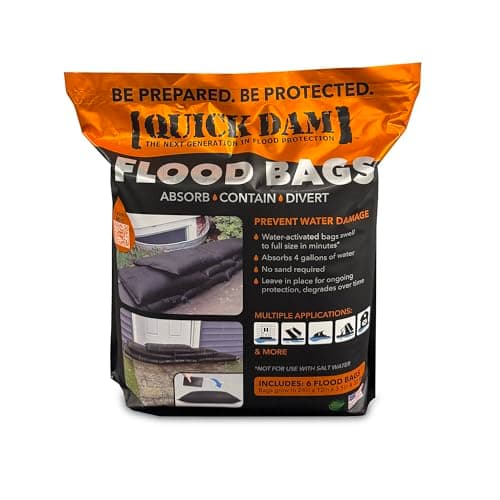
Quick Dam 12 x 24 in Water Activated Flood Bags 6-Pack: flexible sandless bags for doorways and corners, as long as you close the seams.
Key Specs
Size when wet (stated)
12 in wide x 24 in long x 3.5 in tall
Count
6 bags
Activation (stated)
Grows in minutes once wet; no sand needed
Uses (stated)
Doorways, garages and erosion control, indoors or out
Salt water (stated)
Do not use; a chemical reaction makes them deflate
Stacking and reuse
Not stated on the listing
Pros
Cons
Suited to
Sealing doorways, door corners and short gaps that a long single barrier will not fit
Our take
Bags do a job a long barrier cannot: they fit. A 10 ft barrier will not tuck into the corner where a door frame meets the step, but a 12 x 24 in bag will, and six of them can close a basement door, a sliding door or the gap beside a garage door. The trade-off is seams. Butt the ends tight and overlap where you can, because water finds the joint. Each bag grows to the size the listing states, 12 x 24 x 3.5 in, which is roughly 4 gallons of water by volume, so a swollen bag is heavy to lift. Plan its spot before you soak it.
Affiliate link — commission at no extra cost to you
Compare elsewhere
Check price
on Amazon ↗
Listing verified 13 Oct 2026
See it on Amazon ↗Tallest Water-Activated Bag
Quick Verdict
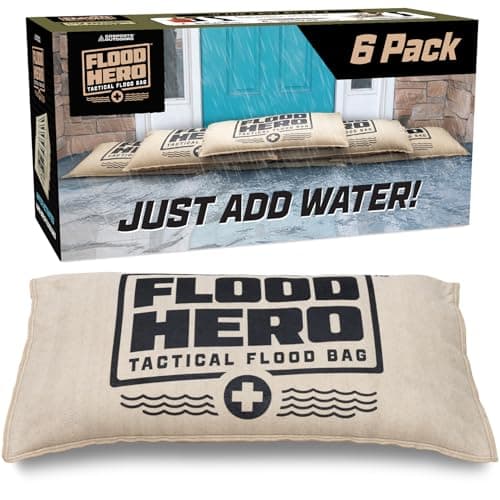
Flood Hero 2 x 1 ft Water Activated Sandbags 6-Pack: the tallest stated water-activated bag here, up to 5 in, with clear activation steps.
Key Specs
Size (stated)
28 in long x 14.5 in wide; grow up to 5 in high
Count
6 bags
Activation (stated)
5 to 10 minutes; lay in slow water or pre-soak in a bucket for fast water
Filler (stated)
Sand Gel filler that solidifies once set
Fabric (stated)
Thick, puncture-resistant
Avoid (stated)
Chlorine and salt water, which can stop activation or deactivate the gel
Pros
Cons
Suited to
A doorway where past storms left water a little deeper than a 3.5 in bag can hold
Our take
Height is the spec that matters most on a water barrier, and Flood Hero states the most for a water-activated bag on this page: up to 5 in. That extra inch and a half can be the difference at a low doorway. The listing is also clear on how to use it: lay the bags in slow-moving water to activate them in place, or soak them in a bucket first when water is coming fast. It warns that chlorinated or salt water can stop the gel working, so do not soak them with pool water. Treat the 5 in as a ceiling, and line them up with ends pressed tight.
Affiliate link — commission at no extra cost to you
Compare elsewhere
Check price
on Amazon ↗
Listing verified 13 Oct 2026
See it on Amazon ↗Tallest Barrier, Reusable
Quick Verdict
VEVOR Flood Barrier Hydro Bag 12 ft: a reusable, hose-filled dam 12 in high, for doorways that see deeper water.
Key Specs
Size (stated)
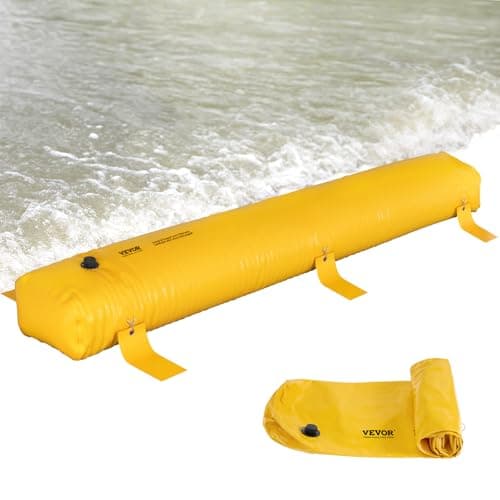
12 ft long x 20 in wide x 12 in high
Fill (stated)
Filled through a valve with a hose; holds up to 132 gallons, about 1,113 lb filled
Material (stated)
Industrial-strength PVC tarpaulin
Empty weight (stated)
11 lb
Reuse (stated)
Reusable season after season; drain before storing
Anchoring (stated)
A fixed mechanism meant to stop it moving in stronger currents
Pros
Cons
Suited to
A low garage or doorway where water has stood deeper than a few inches, with a hose bib nearby
Our take
This is a different kind of barrier. Instead of a gel that swells, it is a PVC tube you fill with a hose, and the listing states 12 in of height, 12 ft of length and up to 132 gallons inside. That weight is what holds it down. It is the only pick here that can hold back water deeper than about 5 in, and it can be drained and reused. The cost is time: you need a working hose and a while to fill it before the storm. Lay it on swept concrete, since grit under the tube leaves gaps for water to run through.
Affiliate link — commission at no extra cost to you
Compare elsewhere
What to know before you buy.
Water barriers for homes come in three forms. A threshold seal is a rubber strip glued to the slab where a garage door closes; it works every time it rains, with nothing to set out, but it is low. Water-activated barriers and sandless sandbags are dry, flat fabric packs filled with a super-absorbent gel; soak them and they swell to the size the listing states, usually 3 to 5 in high, in minutes. Fill-with-water dams are PVC tubes you fill from a hose, taller and reusable but slow to set up. Pick by the water you get. A thin sheet of runoff under a closed door every storm calls for a threshold seal. A few inches of water against a door in heavy storms calls for a deployable barrier set out beforehand.
A barrier holds back water only up to its own height, minus whatever seeps underneath, so start with how deep the water has stood at your door. Look for a dirt line on the door or the wall from past storms. The Jin&Bao threshold seal stands 0.6 in high; the Quick Dam barrier and bags grow to 3.5 in; Flood Hero states up to 5 in; the VEVOR hydro bag reaches 12 in. Then measure the width. Single garage doors are commonly 8 or 9 ft wide and doubles about 16 ft, so a 10 ft barrier covers a single door with some overlap onto the frame, and a double door needs two pieces with a tight overlap. Buy enough to carry the barrier a foot or so past each side of the opening.
A barrier set out once water is already pooling at the door is late. When a storm is forecast, sweep the concrete in front of the door, because grit and gravel under a barrier leave channels for water. For water-activated bags, follow the listing: Flood Hero says to lay them in slow-moving water to activate them in place, or pre-soak them in a bucket when water will arrive fast. Place the barrier tight against the closed door or the outside of the step, and carry the ends past the frame. Where two pieces meet, butt them hard together or overlap them. Set out the barrier before dark, while you can still see where water usually comes in. Then keep a wet/dry vac ready for whatever still gets through.
A barrier stops surface water moving across the ground toward a door. It cannot stop water that comes from below or through the structure. Groundwater pushed up through cracks in a slab or basement floor rises behind the barrier no matter how tall it is. Water seeping through block walls, or backing up through a floor drain from a full sewer, needs drainage, a sump pump or a backwater valve instead. Water deeper than the barrier goes over it, and some always seeps under on rough or sloped concrete. Quick Dam and Flood Hero both warn against salt water, which deactivates the gel, so water-activated barriers are the wrong tool for coastal surge. A barrier also does nothing for a garage door left open.
Do not treat a water barrier as protection if you live where a river or storm surge can put a foot or more of water against the house; follow evacuation orders, move valuables up and look into flood insurance, which a standard homeowners policy does not include. Skip it as a fix if your basement floods from below, which is a job for a sump pump and drainage, or if your driveway slopes straight into the garage and sends water at the door in every rain; a trench drain or regrading solves that for good. Barriers are a stopgap for runoff. The long-term fixes sit upstream: EPA's mold guide advises making sure the ground slopes away from the foundation and keeping roof gutters clean and repaired, and downspouts should discharge well away from the walls.
Once the storm passes, a swollen bag is heavy and full of gel, and most listings here do not say whether it can be reused, so plan on water-activated bags as single-use and follow the maker's directions for disposal. Do not leave wet bags leaning against drywall, wood trim or stored boxes, because they keep that material damp. The VEVOR hydro bag is the exception: drain it, let it dry and store it away from sharp objects, as its listing says. If water did get in, dry the floor and anything it touched quickly. EPA advises drying water-damaged areas and items within 24 to 48 hours to prevent mold growth. Wet carpet pad, insulation or drywall that stays wet past that window may need to be cut out and replaced.
YesFor surface runoff no deeper than the barrier is tall.
A glue-down threshold seal such as the 0.6 in Jin&Bao strip stops the thin sheet of rain that runs under a closed door, and a water-activated barrier that grows to 3.5 in holds back a few inches of water if it is laid before the storm. Neither stops water rising through the slab, and both do nothing when the door is open.
YesAgainst shallow fresh water, when they are swollen and laid with tight seams.
The gel inside absorbs water and swells to the height each listing states, 3.5 in for Quick Dam bags and up to 5 in for Flood Hero. They are weaker than sand at joints and on rough ground, where water seeps underneath. Both makers warn against salt water, so they are not for storm surge.
Minutes, per the listings: Quick Dam says its bags grow in minutes once wet, and Flood Hero states 5 to 10 minutes.
For water moving fast, soak the bags in a bucket or tub first and set them out already swollen, which Flood Hero's listing recommends. Laying them dry and waiting for the storm to wet them leaves them flat while the first water passes.
YesA garage threshold seal sits where the car crosses, so it has to be driven over, but the Jin&Bao listing states no vehicle load rating.
Cross it slowly and straight rather than turning the wheels on it. Let the adhesive cure fully before driving on it. If you park heavy vehicles or the strip starts peeling at the ends, re-glue it before the next rain.
Usually notSo plan on them as single-use.
None of the water-activated listings on this page say the bags can be reused once swollen, and Flood Hero describes its gel as solidifying once set. A fill-with-water dam such as the VEVOR hydro bag is the reusable option: drain it, dry it and store it for the next storm, as its listing describes.
NoA barrier stops water moving across the ground toward a door, but groundwater pushed up through cracks or the joint where the slab meets the wall rises behind it.
That water calls for drainage work, sealing cracks or a sump pump, depending on where it enters. Mark where the water appears during the next storm before deciding on a fix.
Call (888) 840-6512. The line is answered 24 hours a day, seven days a week, and connects you with an IICRC-certified water damage restoration company that serves your area. A recorded menu picks up first: choose water damage or mold, key in your 5-digit ZIP code, and hold through the short silence while the call is passed to the company.
Describe what you can see — where the water is coming from, how long it has been there, and whether it smells — the more specific you are, the faster the right company is on the line. If the source is a pipe or an appliance, shut the main water valve first. Have four things ready and the call goes quickly: the address, when the water started, what is wet now, and whether you have filed an insurance claim.
Still not sure which of these is your situation? (888) 840-6512 · toll-free · answered 24/7
Methodology: How we source and verify data · Report an error
Free 2-day shipping
Amazon Prime members pay no shipping on restoration equipment
Dehumidifiers, air movers, and moisture meters qualify for free Prime delivery — bulk items that otherwise cost $15–$40 to ship.
Affiliate link — HearthDry earns a bounty if you sign up; costs you nothing extra.
A door threshold seal closes the gap between the door and the sill, which stops drafts and rain blown under the door; it cannot hold back water pooling against the house. These picks cover stick-on sweeps, a slide-on door bottom, a replacement threshold insert and a garage door threshold, compared on the gap each listing says it fills and how it attaches.
Read the comparisonRoof water that lands at the foundation is one of the most common reasons a basement gets wet, and an extension is the low-cost way to carry it out to ground that drains away. These picks are measured against how far each one reaches by its own listing, and against the grading, ice and mowing problems that decide whether an extension keeps working.
Read the comparisonA backwater valve is a one-way flap in your drain line that swings shut when the city sewer backs up toward your house. These picks are in-line valves and a floor-drain float compared on pipe size, access and what each listing actually states, with the plumbing-code test, the install, and the rule for the hours the valve is closed.
Read the comparisonA water leak detector catches a leak while it is still a puddle rather than an insurance claim. These four flood sensors and water alarms range from a standalone 110 dB alarm with no Wi-Fi to a LoRa kit that sounds on the spot and texts your phone.
Read the comparisonA wet/dry vac is sized by what you can lift, not by what the label promises: water weighs about 8.3 lb a gallon, so a full 6-gallon drum is a 50 lb load. These five picks run from a cordless 2-gallon vac for the car to a 16-gallon drum with a drain port for the garage.
Read the comparison