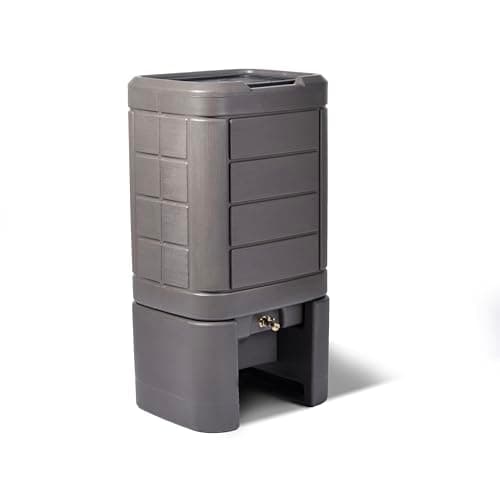
Best for: One downspout feeding a garden bed, with room to add a second barrel later
- Capacity (stated):
- 50 gallons
- Shape (stated):
- Flat back, to sit against a wall or fence
Listing verified 13 Oct 2026

Barrels and a Diverter Kit Compared on Gallons, Screens and Overflow, So the Water Stays Off Your Foundation
5 picks compared · prices, ratings and stock checked October 12, 2026
Our Top Pick
For one downspout, the RTS Home Accents 50-Gallon Rain Barrel with Brass Spigot. For more water and a raised spigot, the Step2 Lakewood 60-Gallon Rain Barrel with Stand, and to feed a barrel without cutting the downspout down to an open top, the Prestantious Downspout Rainwater Diverter.
4.4 on Amazon · 2,051 ratings
Quick answer
The best rain barrel for most homes holds 50 to 60 gallons and has an overflow outlet you can pipe away from the house: for one downspout, buy the RTS Home Accents 50-Gallon Rain Barrel with Brass Spigot, rated 4.4 stars across 2,051 Amazon ratings. A downspout draining 500 sq ft of roof sends about 310 gallons per inch of rain, so a 50-gallon barrel is full after roughly a sixth of an inch. In a storm, the overflow hose does most of the work. Screen every opening against mosquitoes, and drain the barrel before the first hard freeze.
Every pick below is currently stocked — ratings and stock read from Amazon on 12 October 2026.
Best for: One downspout feeding a garden bed, with room to add a second barrel later
Listing verified 13 Oct 2026
Best for: Gardeners who fill watering cans and want more storage from one downspout
Listing verified 13 Oct 2026
Best for: A buyer who wants to clean the barrel out each season and choose which side the overflow leaves from
Listing verified 13 Oct 2026
Best for: Cold-climate yards, renters, or anyone without space to store a rigid barrel over winter
Listing verified 13 Oct 2026
Best for: Feeding a closed-top barrel from a downspout you still want draining to its extension
Listing verified 13 Oct 2026
How this page was made: we compare the current Amazon listings, the makers' published specs and what verified buyers report, then rank by fit for the job. Ratings, review counts and stock are read from Amazon and dated. We earn a commission on purchases through our links; it does not change the order. Reviewed by Marcus Reed, IICRC-certified Water Restoration Technician.
Full Reviews
Each pick in detail: what the listing states, what buyers report, and where it falls short.
Check price
on Amazon ↗
Listing verified 13 Oct 2026
See it on Amazon ↗Best Overall
Quick Verdict
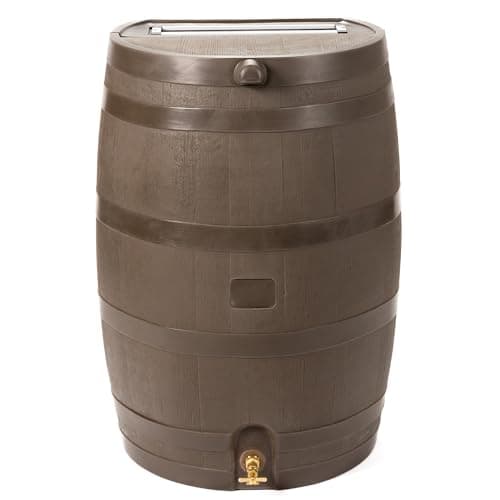
RTS Home Accents 50-Gallon Rain Barrel with Brass Spigot: a flat-back 50-gallon barrel with a brass tap, as long as you pipe the overflow away from the wall.
Key Specs
Capacity (stated)
50 gallons
Shape (stated)
Flat back, to sit against a wall or fence
Material (stated)
UV-resistant polyethylene
Spigot (stated)
Brass
Overflow (stated)
Built-in overflow valve; barrels can be linked
Stand
Sold separately, per the listing
Pros
Cons
Suited to
One downspout feeding a garden bed, with room to add a second barrel later
Our take
A full 50-gallon barrel holds about 417 lb of water, so set it on level, compacted ground or pavers before the first storm; a barrel that settles and leans on soft soil can tip. The flat back lets it sit tight to the wall under a downspout, which puts its overflow right at the foundation, the one place you do not want extra water. Run a hose from the overflow valve out to ground that slopes away, or link a second barrel to it, as the listing allows. The stand is sold separately. Raising the barrel makes it easier to fill a watering can, since each foot of height adds a little pressure at the spigot. No top screen is described, so check the inlet when it arrives.
Affiliate link — commission at no extra cost to you
Compare elsewhere
These open a search for this model. We quote prices only where we can verify them — Amazon, Sylvane and eBay.
Check price
on Amazon ↗
Listing verified 13 Oct 2026
See it on Amazon ↗Quick Verdict
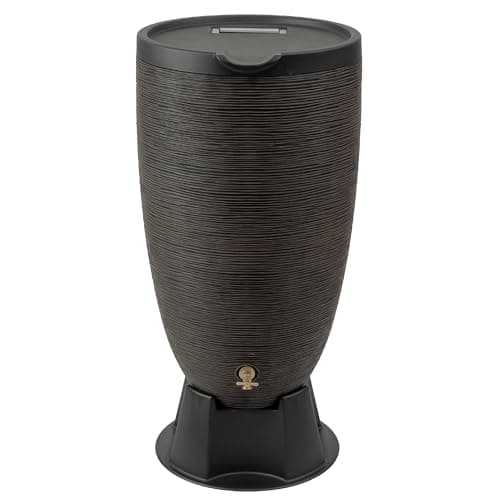
Step2 Lakewood 60-Gallon Rain Barrel with Stand: more storage, a steel screen and a raised brass spigot, with the overflow fitting left undescribed.
Key Specs
Capacity (stated)
60 gallons
Size (stated)
46 in H x 24 in W x 20 in D, assembled
Inlet screen (stated)
Stainless steel mesh screen
Spigot (stated)
3/4 in brass
Stand (stated)
Raised design, stand included
Construction (stated)
Double-walled plastic
Pros
Cons
Suited to
Gardeners who fill watering cans and want more storage from one downspout
Our take
Step2 gives the dimensions most barrel listings leave out: 46 in tall, 24 in wide and 20 in deep once assembled, holding 60 gallons. That height sets where you cut the downspout, so measure the wall before ordering. Full, the barrel carries about 500 lb of water, which makes a level, firm base essential. It comes with a stand, so a watering can fits under the 3/4 in brass spigot. The stainless steel screen is described as filtering very fine particulate, but no mesh size is given, so check for gaps around its edge where mosquitoes could get in. Linking barrels for overflow management is mentioned, yet the overflow fitting itself is not described, so look for it when you unpack.
Affiliate link — commission at no extra cost to you
Compare elsewhere
Check price
on Amazon ↗
Listing verified 13 Oct 2026
See it on Amazon ↗Easiest to Clean
Quick Verdict
RTS Home Accents 50-Gallon Newport Rain Barrel: a lift-off lid for cleaning and an overflow you can put on the side away from the wall.
Key Specs
Capacity (stated)
50 gallons
Lid (stated)
Removable, for cleaning
Screen (stated)
Screen kit on top
Overflow (stated)
Overflow nozzle fits on either side; optional link kit
Stand (stated)
Included
Spigot (stated)
Brass
Pros
Cons
Suited to
A buyer who wants to clean the barrel out each season and choose which side the overflow leaves from
Our take
A lid that comes off is the practical feature here. Roof grit, pollen and leaf bits settle at the bottom of every barrel, and with the Newport you can lift the lid and rinse the sediment out at the end of the season instead of working through a small opening. RTS says the overflow nozzle can be fitted on either side, so you can choose the side that points away from the house and run a hose from there. A screen kit sits on top, and the stand and brass spigot come in the box; a link kit for a second barrel is optional. Fasten the lid back down after cleaning, because an open barrel is a drowning risk for small children.
Affiliate link — commission at no extra cost to you
Compare elsewhere
Check price
on Amazon ↗
Listing verified 13 Oct 2026
See it on Amazon ↗Best for Winter Storage
Quick Verdict
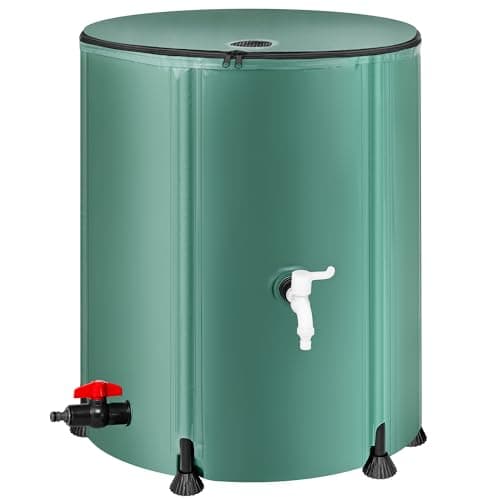
Laspeiraux 53 Gallon Collapsible Rain Barrel: folds away for winter, but plan its overflow and screening yourself.
Key Specs
Capacity (stated)
53 gallons
Material (stated)
Three-layer PVC
Storage (stated)
Folds flat for storage and transport
Top (stated)
Mesh top to keep out leaves and debris
Spigot (stated)
Screw-in faucet built into the body
Base (stated)
Circular footpads
Pros
Cons
Suited to
Cold-climate yards, renters, or anyone without space to store a rigid barrel over winter
Our take
A rigid barrel left full outside can crack when the water in it freezes, and storing a hard 50-gallon drum for the winter takes real space. This barrel's answer is that it folds. Per the listing, it is made of three-layer PVC, holds 53 gallons, stands on circular footpads and has a screw-in faucet built into the body. Water enters through a mesh top, which makes it an open-top barrel: the downspout has to end over it. The listing says the mesh prevents overflow, which a mesh cannot do once the barrel is full, and it mentions an overflow kit without describing it. Plan where the excess goes, and fit fine screen if the mesh looks coarse.
Affiliate link — commission at no extra cost to you
Compare elsewhere
Check price
on Amazon ↗
Listing verified 13 Oct 2026
See it on Amazon ↗Best Diverter Kit
Quick Verdict
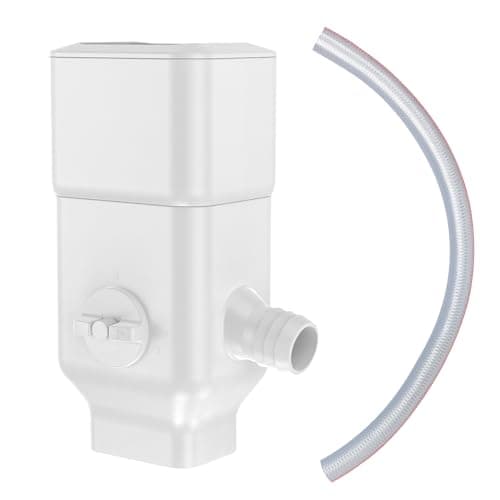
Prestantious Downspout Rainwater Diverter: keeps the downspout in service and switches off for winter, but the full-barrel behavior is unstated.
Key Specs
Fits (stated)
3 x 4 in downspouts; also 2 x 3 in
Valve (stated)
OFF, Medium and High settings
Collection (stated)
More than 85% of the water to the barrel, per the maker; no rain rate given
Hose (stated)
4 ft, 1-1/4 in flexible hose
Install (stated)
Cut out a section of downspout and fit the diverter in the gap
Cleaning (stated)
Top cap comes off to clear leaves
Pros
Cons
Suited to
Feeding a closed-top barrel from a downspout you still want draining to its extension
Our take
A diverter changes how the barrel fills. Instead of cutting the downspout to end over an open top, you cut out a short section, fit the diverter in the gap, and run its 4 ft, 1-1/4 in hose to the barrel; the downspout below keeps carrying whatever the diverter does not send over. The valve has OFF, Medium and High settings, and OFF is the one for winter or a full barrel. The maker says the diverter sends more than 85% of the water to the barrel, with no rain rate given. Nothing on the listing says what happens once the barrel fills, so either switch to OFF or make sure the barrel's own overflow is piped away. Your barrel also needs an inlet that fits the hose.
Affiliate link — commission at no extra cost to you
Compare elsewhere
What to know before you buy.
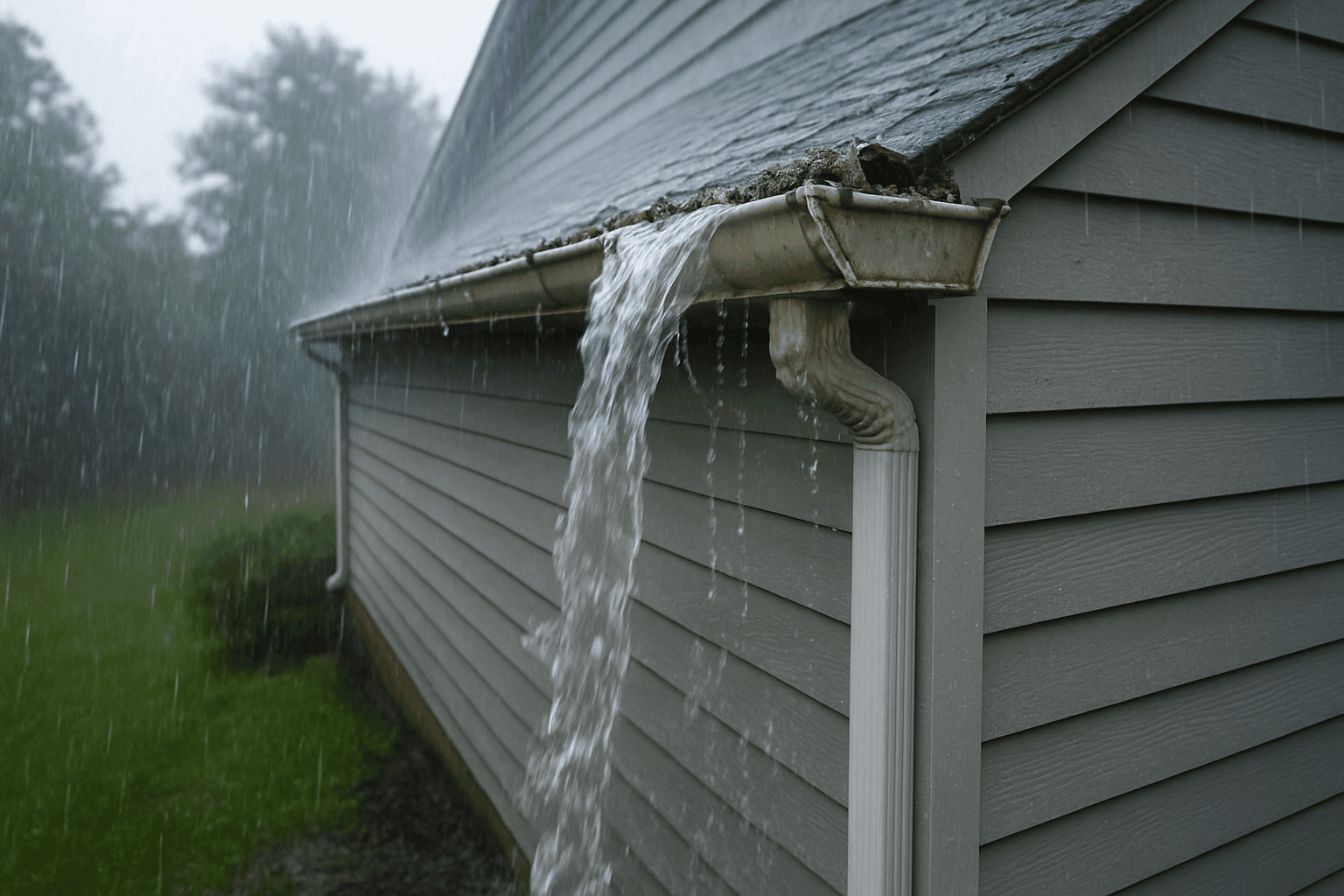
EPA describes a rain barrel simply: it captures water from a roof and holds it for later use on lawns, gardens or indoor plants, and collecting that runoff reduces the water flowing off your property. That is the whole job. A barrel saves tap water for the garden and takes a little load off storm drains. It is not a basement fix. Fifty or sixty gallons is a small slice of what a roof sheds in a real storm, and the barrel sits at the foot of the downspout, right beside the foundation. Set up well, with its overflow carried away, it does no harm there. Set up badly, overflowing at the wall or leaking from a cracked spigot, it adds water exactly where a wet basement starts.
An inch of rain on 1,000 sq ft of roof comes to about 623 gallons: one twelfth of a foot of water over that area is 83 cubic feet, at roughly 7.5 gallons per cubic foot. Most downspouts drain only part of the roof. Say yours drains a 25 by 20 ft section, 500 sq ft. That sends about 310 gallons down the downspout for every inch of rain, so a 50-gallon barrel is full after roughly a sixth of an inch, and a 60-gallon barrel only a little later. In a one-inch storm, around 260 gallons still have to go somewhere once a 50-gallon barrel fills. Linking two barrels doubles storage and still leaves most of a big storm for the overflow to handle.
There are two common ways to fill a barrel. With an open-top setup, you cut the downspout so it ends over the barrel's screened top, and all of its flow goes in until the barrel is full; after that, the water leaves through the overflow fitting or spills over the rim. With a diverter kit, most of the downspout stays in place. A fitting cut into it sends part of the flow through a hose to the barrel, and the rest carries on down the downspout to its extension. Some diverters send water back down the downspout on their own once the barrel fills; others, including the Prestantious kit on this page, need you to switch them off or rely on the barrel's overflow. When a good downspout extension is already in place, the diverter is the tidier choice.
Every barrel overflows, so plan the overflow before you set the barrel down. Attach a hose or a length of downspout extension to the overflow fitting and carry it out at least as far as you would carry a downspout, commonly 4 to 6 ft or more, onto ground that falls away from the house. EPA's mold guidance says to make sure the ground slopes away from the foundation so water does not enter or collect around it, and an overflow that dribbles down the barrel's side defeats that. Where you have a choice of overflow side, as on the RTS Newport, pick the side facing away from the wall. Watch the setup during the first heavy rain: water should leave the hose end, not pool at the barrel's base.
Water weighs about 8.3 lb per gallon, so a full 50-gallon barrel is over 400 lb. Set it on level, compacted ground, pavers or a solid stand, never on soft soil that can settle and tip it. Standing water that mosquitoes can reach becomes breeding water within days, so cover every opening with fine mesh, including the overflow port, and check the screens for gaps after storms. Using the water often keeps the barrel from sitting full for weeks. A lid also protects children and pets: an open barrel is a drowning hazard, so keep lids fastened and screens fixed in place. Some towns have health rules on mosquito breeding in standing water, one more reason to keep every opening covered.
Drain the barrel before the first hard freeze, since freezing water can split a rigid barrel or its spigot, then store it indoors or upside down and reconnect the downspout and its extension for the winter. Rain barrel water is not drinking water. EPA notes that roof runoff can pick up bacteria from birds and other animals and chemicals from roof materials, which matters if you plan to water edible plants. Rules vary: a few states limit how much rain you may store, and some homeowner associations restrict barrels, so check before buying. Skip the barrel for now if your basement already leaks in rain. Fix the gutters, downspout extensions and grading first, then add a barrel once the water around the house goes where it should.
They can if mosquitoes reach the water, but a barrel with every opening screened does not breed them. Fine mesh has to cover the inlet, the overflow port and any gap around the lid, since an uncovered overflow fitting is an easy way in.
Check the screens after storms, keep lids fastened, and use the water regularly so the barrel does not sit full and still for weeks at a time.
A diverter is a fitting cut into the downspout that sends part of the falling water through a hose into the barrel, while the rest keeps flowing down the downspout.
Some designs send water back down the downspout on their own once the barrel fills. Others, such as the Prestantious diverter with its OFF, Medium and High valve, rely on you switching them off or on the barrel's own overflow.
Overflow should go onto ground that slopes away from the house, carried out at least as far as a downspout extension would take it.
Fit a hose or an extension to the overflow fitting rather than letting water spill down the barrel's side and soak the soil by the wall. You can link a second barrel to the overflow instead, but that second barrel then needs its own overflow route.
Drain it before the first hard freeze and store it indoors or upside down, because ice can crack the barrel or its spigot. Reconnect the downspout to its extension so winter rain and snowmelt still drain away from the foundation.
If you use a diverter with an OFF setting, it can stay in the downspout switched off, and a collapsible barrel like the Laspeiraux folds flat for storage.
YesIn most places, though a few states limit how much you can store. Colorado, for example, allows a household up to two barrels holding 110 gallons in total.
Some homeowner associations restrict barrels too. Many cities and towns distribute rain barrels to residents through annual sales, EPA notes, so your town may already have guidance. Check your state water agency and your town before setting up several barrels.
NoNot without proper treatment, and a garden rain barrel is not set up for that.
Water running over a roof can pick up bacteria from birds and other animals and chemicals from roof materials, according to EPA. Use it on lawns, flower beds and for rinsing tools. For vegetable gardens, water the soil rather than the leaves, and look into testing harvested water before relying on it.
Call (888) 840-6512. The line is answered 24 hours a day, seven days a week, and connects you with an IICRC-certified water damage restoration company that serves your area. A recorded menu picks up first: choose water damage or mold, key in your 5-digit ZIP code, and hold through the short silence while the call is passed to the company.
Describe what you can see — where the water is coming from, how long it has been there, and whether it smells — the more specific you are, the faster the right company is on the line. If the source is a pipe or an appliance, shut the main water valve first. Have four things ready and the call goes quickly: the address, when the water started, what is wet now, and whether you have filed an insurance claim.
Still not sure which of these is your situation? (888) 840-6512 · toll-free · answered 24/7
Methodology: How we source and verify data · Report an error
Free 2-day shipping
Amazon Prime members pay no shipping on restoration equipment
Dehumidifiers, air movers, and moisture meters qualify for free Prime delivery — bulk items that otherwise cost $15–$40 to ship.
Affiliate link — HearthDry earns a bounty if you sign up; costs you nothing extra.

Roof water that lands at the foundation is one of the most common reasons a basement gets wet, and an extension is the low-cost way to carry it out to ground that drains away. These picks are measured against how far each one reaches by its own listing, and against the grading, ice and mowing problems that decide whether an extension keeps working.
Read the comparisonAn outdoor faucet cover insulates the spigot and blocks the wind, which lowers the odds of a frozen hose bib splitting the pipe inside the wall, where the real water damage happens. It cannot do that job alone, so every pick here comes with the steps that matter more: hose off, inside valve shut and the line drained.
Read the comparisonThe right sump pump prevents basement flooding before it starts — and handles it fast when it happens. These are the 3 best sump pumps for basement flooding in 2026, tested and ranked by an IICRC-certified water damage restoration technician.
Read the comparisonA clear window well cover keeps rain, snow and leaves out of the well, which closes one of the usual routes for water to reach a basement window. It has to match the well's width, projection and shape, and over a bedroom egress well it must open from inside, so each pick here is checked against all three.
Read the comparisonA clogged gutter spills roof water over its front edge and onto the soil right beside the foundation, which is where many basement leaks begin. These DIY guards are compared on the debris each type stops, the gutter width each listing states, how each one meets the roof edge, and the cleaning that no guard removes.
Read the comparison