Best for: An electric tank water heater up to 26 in across, in a closet, upstairs utility room or finished basement
- Inside / outside diameter:
- 30 in ID / 32 in OD
- Depth:
- 2.5 in
Listing verified 13 Oct 2026

Sized to the Tank, Matched to Gas or Electric, Paired With a Leak Alarm
5 picks compared · prices, ratings and stock checked October 11, 2026
Our Top Pick
For an electric water heater up to 26 in across, the Camco 30 in ID Plastic Water Heater Drain Pan with its PVC drain fitting. For a gas heater, the Oatey 34084 26 in Aluminum Water Heater Pan, whose listing names gas and electric heaters. Set a Flood Buzz Water Heater Leak Detector in whichever pan you buy.
4.5 on Amazon · 367 ratings
Quick answer
The best water heater drain pan is one at least 2 in wider than the tank, plumbed to a drain, and made of metal if the heater burns gas; for an electric tank up to 26 in across, that is the Camco 30 in ID Plastic Water Heater Drain Pan, rated 4.5 stars across 367 Amazon ratings. For a gas heater, choose a metal pan such as the Oatey 34084 26 in Aluminum Water Heater Pan. A 2.5 in deep pan catches drips, not a burst tank, so pair it with a leak alarm or an automatic shutoff valve.
Every pick below is currently stocked — ratings and stock read from Amazon on 11 October 2026.
Best for: An electric tank water heater up to 26 in across, in a closet, upstairs utility room or finished basement
Listing verified 13 Oct 2026
Best for: A gas-fired tank heater narrow enough for a 26 in pan, or any heater where metal is preferred
Listing verified 13 Oct 2026
Best for: Anyone with a pan under the tank who wants to hear about a leak while it is still a drip
Listing verified 13 Oct 2026
Best for: A water heater in an attic, above a finished room or in a home that sits empty for days
Listing verified 13 Oct 2026
Best for: A wide tank up to 26 in across where a metal pan is wanted and the floor has room for a 30 in rim
Listing verified 13 Oct 2026
How this page was made: we compare the current Amazon listings, the makers' published specs and what verified buyers report, then rank by fit for the job. Ratings, review counts and stock are read from Amazon and dated. We earn a commission on purchases through our links; it does not change the order. Reviewed by Marcus Reed, IICRC-certified Water Restoration Technician.
Full Reviews
Each pick in detail: what the listing states, what buyers report, and where it falls short.
Check price
on Amazon ↗
Listing verified 13 Oct 2026
See it on Amazon ↗Best for Electric Water Heaters
Quick Verdict
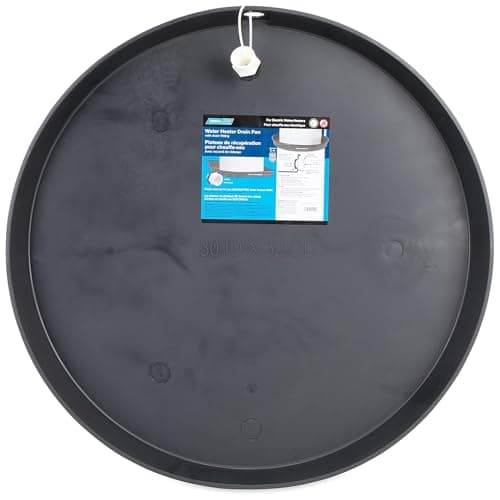
Camco 30 in ID Plastic Water Heater Drain Pan: states the tank size it fits and ships with the drain fitting, for electric heaters only.
Key Specs
Inside / outside diameter
30 in ID / 32 in OD
Depth
2.5 in
Heater fit (stated)
Electric water heaters up to a recommended 26 in diameter
Drain fitting
1 in / 1-1/2 in PVC fitting with gasket; pre-cut side opening
Material
Durable plastic, black
Code (stated)
Meets the size and construction requirements of IRC 2801.6 and state building codes for electric water heaters, per the listing
Pros
Cons
Suited to
An electric tank water heater up to 26 in across, in a closet, upstairs utility room or finished basement
Our take
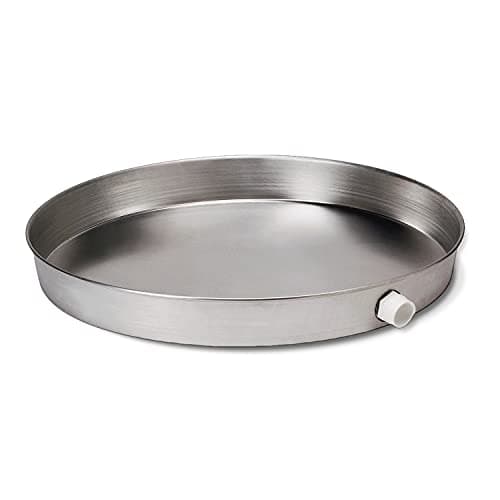
This is the pan that does the sizing arithmetic for you. Camco states the largest heater it suits, 26 in in diameter, which leaves 2 in on every side inside its 30 in floor, more than the common rule of a pan at least 2 in wider than the tank. It is 2.5 in deep, deeper than the 1.5 in minimum in model plumbing codes, and comes with a 1 to 1-1/2 in PVC fitting and gasket for the drain line. Being plastic and sold for electric heaters only is the right pairing, given the code limits on plastic under gas burners. Measure the space for the 32 in rim before buying.
Affiliate link — commission at no extra cost to you
Compare elsewhere
These open a search for this model. We quote prices only where we can verify them — Amazon, Sylvane and eBay.
Check price
on Amazon ↗
Listing verified 13 Oct 2026
See it on Amazon ↗Best for Gas Water Heaters
Quick Verdict
Oatey 34084 26 in Aluminum Water Heater Pan: a metal pan whose listing names gas heaters, though depth is not stated.
Key Specs
Size
26 in; the listing does not say whether that is the inside or outside diameter
Material (stated)
0.032 in prime aluminum
Heater type (stated)
Gas or electric water heaters
Drain fitting
Integrated 1 to 1-1/2 in PVC adapter
Depth
Not stated on this listing; Oatey's 28 in pan (34103) lists a 2.5 in minimum
Other uses (stated)
Washing machines, refrigerators and AC units
Pros
Cons
Suited to
A gas-fired tank heater narrow enough for a 26 in pan, or any heater where metal is preferred
Our take
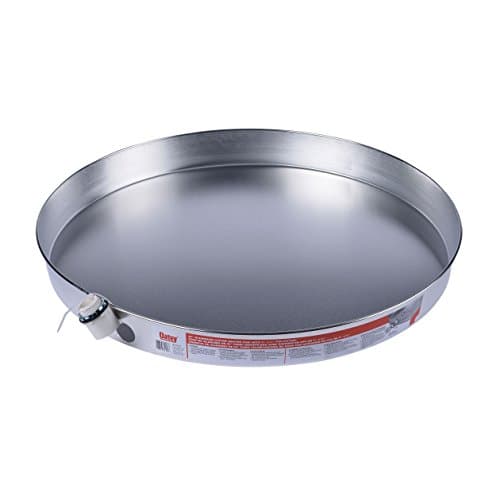
Under a gas-fired tank, a metal pan is the simple answer to the code limits on plastic described in the buyer's guide below. Oatey's listing names gas and electric heaters and gives the aluminum's thickness, 0.032 in, which clears the 0.0236 in minimum that model codes set for metal pans. What it leaves out is depth and whether the 26 in is measured inside or outside, so hold a tape across the pan's floor when it arrives and confirm it is at least 2 in wider than the tank. Slide the tank on carefully rather than dragging it, since thin aluminum creases. For a wider gas tank, the 28 in Oatey 34103 is the next size.
Affiliate link — commission at no extra cost to you
Compare elsewhere
Check price
on Amazon ↗
Listing verified 13 Oct 2026
See it on Amazon ↗Best Leak Alarm for the Pan
Quick Verdict
Flood Buzz Water Heater Leak Detector: made to sit in the pan, loud, and nothing to maintain until its replace-by date.
Key Specs
Alarm (stated)
Up to 110 dB
Sensor
Two metal prongs on the base; sounds when water bridges them
Power
Factory-sealed 12 V battery; not user-replaceable
Battery life (stated)
Replace-by date stamped on the unit, typically 2 or more years from receipt
Placement (stated)
Flat in the water heater drain pan
Connectivity
None: no app, no Wi-Fi, no phone alerts
Pros
Cons
Suited to
Anyone with a pan under the tank who wants to hear about a leak while it is still a drip
Our take
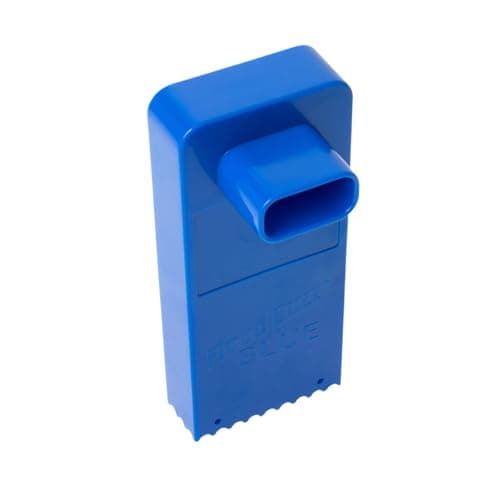
A pan with no alarm can fill and overflow, or quietly send a leak down the floor drain, without anyone knowing the tank has started to fail. This alarm closes that gap. It sits flat in the pan, and once water bridges its two prongs it sounds at up to 110 dB, per the listing. The sealed 12 V battery removes a common weak point of battery alarms, a battery no one remembers to check, and replaces it with a date stamped on the housing. The trade-off is that it only makes noise. For a heater in an attic, above a finished room or in a home left empty for days, add an automatic shutoff such as the FloodStop kit.
Affiliate link — commission at no extra cost to you
Compare elsewhere
Check price
on Amazon ↗
Listing verified 13 Oct 2026
See it on Amazon ↗Best Automatic Shutoff
Quick Verdict
FloodStop Water Heater Leak Detector Kit: closes the heater's supply when the sensor gets wet, on a thin listing.
Key Specs
Valve
Automatic shutoff valve, 3/4 in NPT male x female (MIP x FIP)
Trigger (stated)
Water on the sensor closes the valve and sounds an alarm
Normal state (stated)
Valve stays open until water is detected
Sensor placement (stated)
At the base of the water heater
Power source
Not stated on this listing
Alarm volume and cable length
Not stated on this listing
Pros
Cons
Suited to
A water heater in an attic, above a finished room or in a home that sits empty for days
Our take
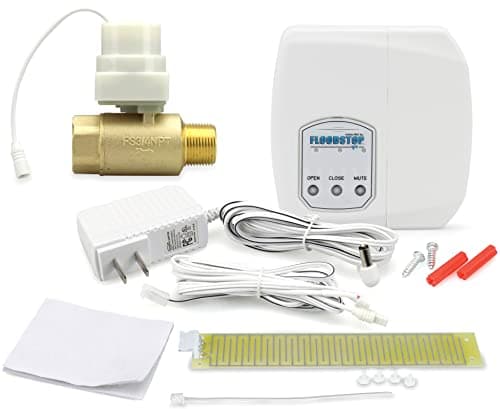
A pan catches drips; this kit deals with the failure a pan cannot hold. The valve goes on the water heater's 3/4 in supply, the sensor sits at the base of the tank, and when the sensor gets wet the valve closes and an alarm sounds, per the listing. Closing the supply matters because a failed tank keeps refilling from the mains for as long as its inlet is open. What the kit cannot do is hold back the water already inside the tank, so the pan and its drain still have a job. The listing is thin on detail, with no power source, alarm volume or cable length given, so read the maker's manual before buying.
Affiliate link — commission at no extra cost to you
Compare elsewhere
Check price
on Amazon ↗
Listing verified 13 Oct 2026
See it on Amazon ↗Best for Wide Tanks
Quick Verdict
Everflow AWHP28 Aluminum Water Heater Drain Pan: clear dimensions for a wide tank, with no fuel type or thickness stated.
Key Specs
Dimensions (stated)
28 in base diameter, 30 in top diameter, 2.5 in deep
Material
Aluminum
Drain fitting
PVC male adapter for a 1 to 1-1/2 in drain pipe; pre-cut side opening
Heater type
Not stated on this listing
Metal thickness
Not stated on this listing
Brand
Everflow, sold by Supply Giant
Pros
Cons
Suited to
A wide tank up to 26 in across where a metal pan is wanted and the floor has room for a 30 in rim
Our take
Large tanks are where pan sizing goes wrong, because a pan that looks big enough can leave the edge of the tank sitting on the rim. Everflow states all three dimensions: a 28 in base, a 30 in top and 2.5 in of depth. By the common 2 in rule, that suits a tank up to 26 in across, and the depth comfortably clears the code minimum. Aluminum also avoids the restrictions on plastic under gas heaters, although this listing names neither fuel and gives no metal thickness, so ask the seller if your inspector is likely to check. The included PVC adapter takes a 1 to 1-1/2 in drain line.
Affiliate link — commission at no extra cost to you
Compare elsewhere
What to know before you buy.
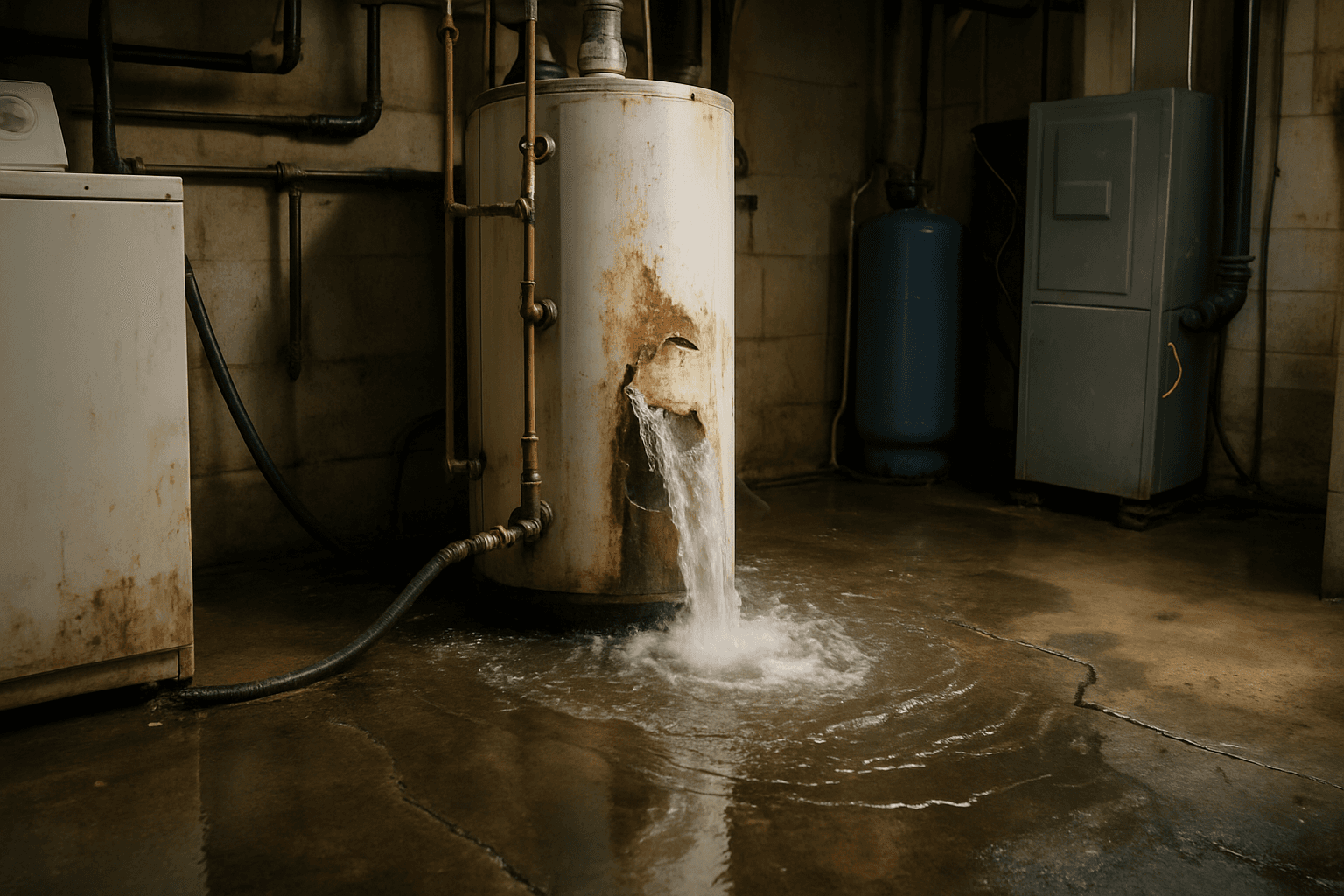
A drain pan is a shallow tray under the tank that catches water from a dripping drain valve, a weeping fitting or a tank that has begun to seep, and sends it down a drain line instead of across the floor. EPA WaterSense advises looking for water on the outside of pipes and around fittings when hunting for leaks, and a pan makes that check easy, because any water collects where you can see it. What a pan does not cover is a split tank. That releases everything the tank holds and keeps refilling from the supply, far more than a 2.5 in deep tray can hold or a 1 to 1-1/2 in drain line can carry. The pan protects the floor from drips and buys warning time; the alarm and shutoff valve on this page are what limit a burst. Treat the three as one system.
Measure the tank's diameter with a tape, then choose a pan whose inside diameter is at least 2 in larger. That margin is a common rule of thumb rather than a fixed code figure, and some inspectors look for more. Model plumbing codes also set a minimum depth of 1.5 in, and the Camco and Everflow pans here state 2.5 in. Check the outside diameter against the floor too: the Camco's 30 in floor sits inside a 32 in rim, which needs a clear circle that wide in the closet or alcove. Then think about the install itself. The tank has to be drained and lifted over the rim, so the water lines, the drain valve and, on gas heaters, the gas line and vent must all still reach once it sits in the pan.
Electric heaters can sit in a plastic pan, and plastic does not corrode. Gas-fired heaters are different, because the burner sits under the tank. Model plumbing codes have long restricted plastic pans beneath gas-fired heaters, and newer editions accept plastic there only when it carries a low flame-spread rating under the ASTM E84 test. None of the plastic pans reviewed here state that rating, and Camco's is sold for electric heaters only. Some plastic pans on Amazon are marketed for gas heaters anyway, so read the rating rather than the title. For gas, an aluminum or galvanized steel pan is the straightforward choice, and the Oatey 34084 names gas heaters on its listing. When in doubt, your local building department can say which pans its inspectors accept.
A pan with no drain only delays the overflow. Model plumbing codes call for a pan drain line at least 3/4 in in diameter, ending at a floor drain, an indirect waste receptor or outdoors, and every pan here comes with a PVC fitting for a 1 to 1-1/2 in pipe. Run the line downhill the whole way, with no trap and no dip that can hold water. Where no drain is within reach, as in many basements and closets, the rules vary: some codes do not require a pan drain when a replacement heater never had one, and some cities accept or require a leak alarm or an automatic shutoff valve instead. Local code may require a pan wherever a leak would damage the building, so check before you buy and before you plan the drain route.
A leak into a pan usually starts when nobody is looking at the heater, so the pan needs a voice. The simplest step is a battery alarm placed flat in the pan, such as the Flood Buzz Water Heater Leak Detector, which sounds when water bridges its two prongs. A Wi-Fi leak sensor does the same job and also sends a phone alert, which matters for a heater in a garage, an attic or a rental. An automatic shutoff valve such as the FloodStop kit goes further by closing the water supply to the heater when its sensor gets wet, which limits a burst to the water already in the tank. The EPA's mold guidance says to dry water-damaged areas within 24 to 48 hours, and an early alarm is what keeps a leak inside that window.
A round tank pan is the wrong product for a tankless heater, which hangs on the wall and uses a small pan made for wall-hung units; Camco sells one of those separately. A heater already leaking from the tank body does not need a pan so much as a replacement, since a pan only manages the water. A heater on a garage slab or a basement floor beside a floor drain, with nothing nearby to damage, may not need a pan under local code, though an alarm is still worth having. And if fitting the pan means disconnecting a gas line or a flue, have a licensed plumber do it. The tank must be drained, disconnected, lifted and reconnected, and gas connections are not a DIY job.
Often, yes: local code may require one wherever a leak would damage the building, such as a heater in an attic, an upstairs closet or above a finished room.
Model codes tie the requirement to the risk of damage, so a heater on a garage slab may not need one. Even where it is optional, a pan with a drain line and an alarm turns a slow leak into a warning rather than a stained ceiling or a soaked subfloor.
Choose a pan whose inside diameter is at least 2 in larger than the tank, a common sizing rule rather than a fixed code number. Measure the tank, add 2 in, and compare the result with the pan's inside measurement, not its rim.
Camco states its 30 in ID pan suits electric heaters up to 26 in, and Everflow's AWHP28 has a 28 in base. Then confirm the outside diameter fits the floor space you have.
Only if the pan carries a fire rating your local code accepts; otherwise use metal. Current model codes allow plastic under a gas-fired heater only when it has a low flame-spread rating under ASTM E84, and older editions ban it outright.
Camco's plastic pans are sold for electric heaters only. An aluminum pan such as the Oatey 34084, whose listing names gas heaters, avoids the question altogether.
It should be wherever a drain can be reached, because an undrained pan only holds a couple of inches of water before it overflows. Model codes call for a drain line of at least 3/4 in to a floor drain, an indirect waste receptor or the outdoors.
When no drain is practical, some jurisdictions accept a pan paired with a leak alarm or an automatic shutoff instead, so ask your building department.
YesBut it is real work: the tank has to be drained, disconnected, lifted into the pan and reconnected, and a full tank is far too heavy to lift.
On a gas heater the gas line and vent are involved too, which makes it a job for a licensed plumber. Many homeowners add the pan when the heater is replaced instead. Until then, a leak alarm on the floor beside the tank gives some of the same warning.
For most homes, a pan alarm such as the Flood Buzz Water Heater Leak Detector, and for a heater above finished space, an automatic shutoff such as the FloodStop Water Heater Leak Detector Kit.
Flood Buzz says its Blue model is built to sit in a water heater drain pan and sounds at up to 110 dB on a sealed battery. FloodStop closes a 3/4 in valve on the supply when its sensor gets wet, which also stops the water.
Call (888) 840-6512. The line is answered 24 hours a day, seven days a week, and connects you with an IICRC-certified water damage restoration company that serves your area. A recorded menu picks up first: choose water damage or mold, key in your 5-digit ZIP code, and hold through the short silence while the call is passed to the company.
Describe what you can see — where the water is coming from, how long it has been there, and whether it smells — the more specific you are, the faster the right company is on the line. If the source is a pipe or an appliance, shut the main water valve first. Have four things ready and the call goes quickly: the address, when the water started, what is wet now, and whether you have filed an insurance claim.
Still not sure which of these is your situation? (888) 840-6512 · toll-free · answered 24/7
Methodology: How we source and verify data · Report an error
Free 2-day shipping
Amazon Prime members pay no shipping on restoration equipment
Dehumidifiers, air movers, and moisture meters qualify for free Prime delivery — bulk items that otherwise cost $15–$40 to ship.
Affiliate link — HearthDry earns a bounty if you sign up; costs you nothing extra.

A water leak detector catches a leak while it is still a puddle rather than an insurance claim. These four flood sensors and water alarms range from a standalone 110 dB alarm with no Wi-Fi to a LoRa kit that sounds on the spot and texts your phone.
Read the comparisonMost homeowners do not discover a leak until it has soaked into subfloor and drywall. A Wi-Fi water leak detector sends the alert to your phone while the water is still on the floor, whether or not anyone is home to hear a siren.
Read the comparisonA smart water shutoff closes the supply when it detects a leak, so a burst pipe does not run for hours while nobody is home. The four systems here split into two designs: leak sensors that close the valve you already have, and valves on the main line that watch the flow itself.
Read the comparisonBefore you run a dehumidifier, you need to remove standing water. These are the best wet/dry vacuums for water damage — compared on capacity, suction, and filtration.
Read the comparisonA washing machine's two fill hoses sit under full house pressure whenever the valves are open, and an old rubber hose that splits keeps releasing water until someone closes the valve. These picks are braided stainless hoses compared on fittings, length, elbows and what each listing actually states, with the replacement habit and the shutoff valve that a better hose does not replace.
Read the comparisonA washing machine drain pan catches drips and small overflows under the washer, and only a pan with a drain port can send that water away instead of holding it. These picks are compared on inside size, wall height, drain port and material, with the gallons-per-inch math and the burst-hose risk that no pan covers.
Read the comparisonA tank water heater stores 40 or 50 gallons that end up on the floor when the tank rusts through, and a tankless unit takes that stored water away. These picks are electric and gas models compared on flow at your winter temperature rise, the breakers or venting each listing asks for, and the flushing that hard water adds.
Read the comparisonHard water leaves scale inside water heaters, valves and appliances, and a whole-house softener is the fix that actually removes the minerals behind it. These picks compare salt-based softeners on grain capacity, certification and controls, plus one salt-free conditioner whose own listing says it does not soften, with the sizing arithmetic and the drain and brine connections that need careful installation.
Read the comparisonWhen a check valve or pressure-reducing valve closes your plumbing, the water a heater expands has nowhere to go, and house pressure spikes after every heating cycle. These expansion tanks are compared on size, stated pre-charge, pressure and temperature ratings and mounting, with the air-charge step most installs skip.
Read the comparisonA secondary condensate drain pan sits under an air handler or furnace coil and catches the water when the unit's own drain clogs, which is how an attic AC ends up staining the ceiling below. These picks are judged on size against the model-code rule, depth, drain fitting and material, with a separate floor tray for portable air conditioners.
Read the comparisonA water heater's anode rod corrodes so the steel tank does not, and once the rod is gone the tank rusts from the inside until it weeps or splits. These picks are a powered rod, flexible magnesium and aluminum-zinc rods and a hot-water-outlet model compared from their listings and buyer ratings, with the clearance arithmetic, the smell question and the jobs that belong to a licensed plumber.
Read the comparisonA tank water heater holds 40 to 80 gallons and stands on a floor that was never meant to get wet, and the manual valve on its cold inlet only helps if someone is home to turn it. These picks are automatic shutoff valves that close that inlet when a sensor in the drain pan gets wet, compared from their listings and buyer ratings on valve size, power source, alarm and what each cannot do, with the gas or breaker step a valve leaves to you and the jobs that belong to a licensed plumber.
Read the comparison