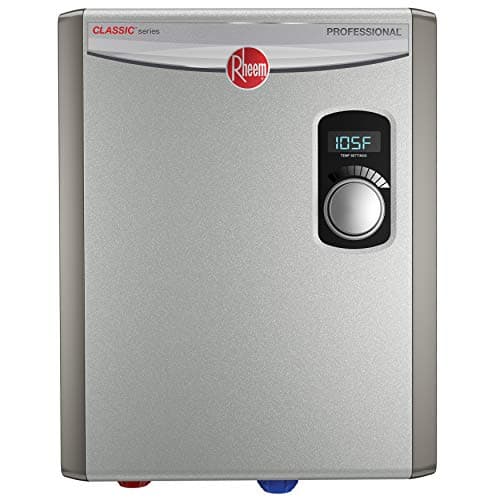
Best for: An all-electric home with a 200-amp panel, in a warm climate or with modest winter hot-water use
- Power:
- 24 kW at 240V single-phase
- Flow (stated):
- Up to 5.9 GPM; no temperature rise is given with that figure
Listing verified 13 Oct 2026

Electric and Gas Units Judged by Flow at Your Winter Temperature Rise, the Wiring or Venting They Need, and the Leaks They Can Still Have
5 picks compared · prices, ratings and stock checked October 12, 2026
Our Top Pick
For a home with no gas line and a 200-amp panel, the Rheem RTEX-24 24kW 240V Electric Tankless Water Heater. For a home on natural gas or propane, the Rinnai RX199iN Condensing Smart Sense Tankless Water Heater, fitted by a licensed installer.
4.3 on Amazon · 895 ratings
Quick answer
The best tankless water heater for a home without gas is a whole-house electric unit sized to your winter temperature rise, and with a 200-amp panel that is the Rheem RTEX-24 24kW 240V Electric Tankless Water Heater, rated 4.3 stars across 895 Amazon ratings. Its listing gives up to 5.9 GPM and calls for three 40-amp double-pole breakers. Heating 45°F winter water to 105°F, standard heat math puts it nearer 2.7 GPM, about one shower and a sink. On natural gas or propane, the Rinnai RX199iN lists up to 11.1 GPM. Have a licensed installer size and fit either one.
Every pick below is currently stocked — ratings and stock read from Amazon on 12 October 2026.
Best for: An all-electric home with a 200-amp panel, in a warm climate or with modest winter hot-water use
Listing verified 13 Oct 2026
Best for: A home on natural gas or propane with two or more bathrooms, installed by a licensed pro
Listing verified 13 Oct 2026
Best for: A smaller all-electric home, or a warm-climate house where the incoming water is rarely cold
Listing verified 13 Oct 2026
Best for: A single bathroom or bar sink far from the main water heater
Listing verified 13 Oct 2026
Best for: A natural gas home in a mild climate that wants whole-house flow without a vent run through the walls
Listing verified 13 Oct 2026
How this page was made: we compare the current Amazon listings, the makers' published specs and what verified buyers report, then rank by fit for the job. Ratings, review counts and stock are read from Amazon and dated. We earn a commission on purchases through our links; it does not change the order. Reviewed by Marcus Reed, IICRC-certified Water Restoration Technician.
Full Reviews
Each pick in detail: what the listing states, what buyers report, and where it falls short.
Check price
on Amazon ↗
Listing verified 13 Oct 2026
See it on Amazon ↗Best Electric for a Whole House
Quick Verdict
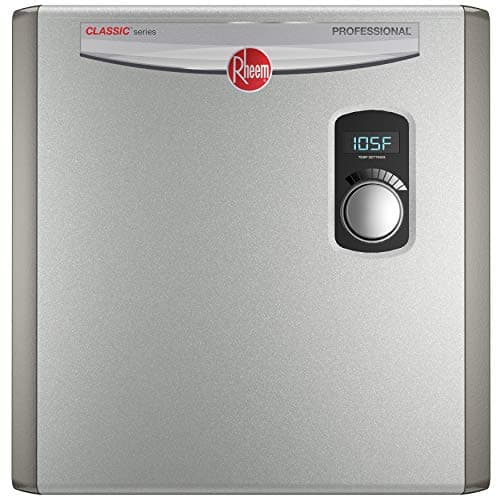
Rheem RTEX-24 24kW 240V Electric Tankless Water Heater: clearly stated wiring and no venting, with real winter flow nearer 2.7 GPM than 5.9.
Key Specs
Power
24 kW at 240V single-phase
Flow (stated)
Up to 5.9 GPM; no temperature rise is given with that figure
Wiring (stated)
Three 40-amp double-pole breakers and three sets of #8 AWG copper conductors with ground
Panel (stated)
200-amp household service recommended as a minimum
Temperature setting (stated)
80°F to 140°F in 1-degree steps
Venting (stated)
None required
Pros
Cons
Suited to
An all-electric home with a 200-amp panel, in a warm climate or with modest winter hot-water use
Our take
The 5.9 GPM headline needs context. An electric heater adds a fixed amount of heat, so its flow falls as the rise grows. By standard heat arithmetic, 24 kW lifts about 5.9 GPM by roughly 28°F, which only happens with warm inlet water. Bring in 45°F winter water and set 105°F, a 60°F rise, and the same unit gives about 2.7 GPM. That covers one shower plus a sink, not two showers at once. The listing is plain about the wiring: three 40-amp double-pole breakers, three runs of #8 copper and a 200-amp service. Have an electrician check your panel's spare capacity before ordering, and ask about the water connection size, which the listing leaves out.
Affiliate link — commission at no extra cost to you
Compare elsewhere
These open a search for this model. We quote prices only where we can verify them — Amazon, Sylvane and eBay.
Check price
on Amazon ↗
Listing verified 13 Oct 2026
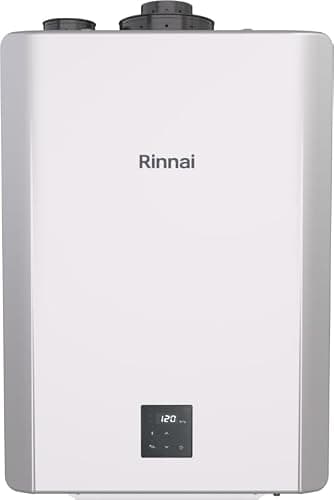
See it on Amazon ↗Best Gas for a Whole House
Quick Verdict
Rinnai RX199iN Condensing Smart Sense Tankless Water Heater: the most flow and fuel flexibility here, for a pro-installed gas home.
Key Specs
Fuel (stated)
Natural gas or propane, through the Smart Sense gas control
Flow (stated)
Up to 11.1 GPM, described as 7 fixtures at once; no temperature rise given
Efficiency (stated)
UEF 0.98, condensing
Venting (stated)
Indoor or outdoor with Versa Vent; RX-OVC vent cap required outdoors
Flushing (stated)
Quick Flush feature
Wi-Fi
Needs the Controlr module named on the listing, sold separately
Pros
Cons
Suited to
A home on natural gas or propane with two or more bathrooms, installed by a licensed pro
Our take
Rinnai gives 11.1 GPM without a temperature rise, so read it as a ceiling rather than a winter figure. Even so, a gas burner in this class has far more heat to give than any electric unit here, and that is what lets it keep two winter showers hot at once. The 0.98 UEF comes from condensing: the unit pulls extra heat out of its own exhaust, which leaves a mildly acidic condensate that must drain away. Fuel flexibility is the other point. The listing says the one model runs on natural gas or propane and vents indoors or out, with an RX-OVC cap for outdoor installs. Register it within 90 days, or labor coverage drops from 5 years to 1.
Affiliate link — commission at no extra cost to you
Compare elsewhere
Check price
on Amazon ↗
Listing verified 13 Oct 2026
See it on Amazon ↗Best Mid-Size Electric
Quick Verdict
Rheem 18kW 240V Tankless Electric Water Heater: serviceable elements and a big buyer record, but get the wiring requirements before you buy.
Key Specs
Power
18 kW at 240V
Flow (stated)
Up to 4.4 GPM; no temperature rise given
Heating elements (stated)
Two copper immersion elements, field serviceable and threaded for replacement
Control (stated)
External digital thermostat with LED display; self-modulating power
Water connections (stated)
3/4 in NPT, on the bottom
Breakers and panel
Not stated on this listing
Pros
Cons
Suited to
A smaller all-electric home, or a warm-climate house where the incoming water is rarely cold
Our take
This heater has the largest buyer record on the page, and its best feature is easy to miss: the two copper elements are threaded, so a burned-out element is a part, not a new heater. The 4.4 GPM figure has no temperature rise attached. On the same heat arithmetic, 18 kW lifts about 4.4 GPM by only 28°F, and at a 60°F winter rise it falls to roughly 2 GPM, which is one shower with a low-flow head. The listing also skips the electrical requirements, and on an electric unit those matter more than anything else. An 18 kW heater at 240V draws about 75 amps, so get the installation manual and have an electrician confirm the breakers and panel before you buy.
Affiliate link — commission at no extra cost to you
Compare elsewhere
Check price
on Amazon ↗
Listing verified 13 Oct 2026
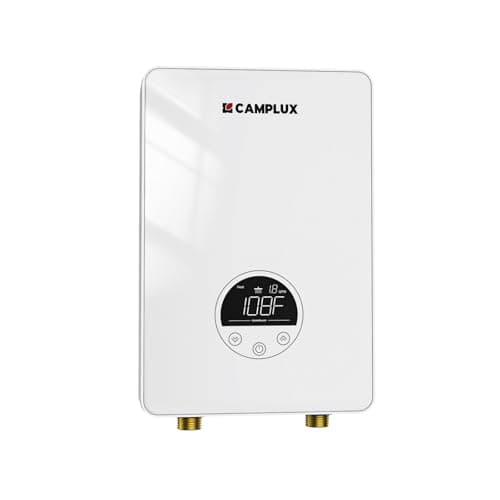
See it on Amazon ↗Best Point-of-Use (One Sink)
Quick Verdict
Camplux 4.5kW 120V Electric Point-of-Use Tankless Water Heater: a tidy under-sink fix for one tap, with a flow claim to read carefully.
Key Specs
Power (stated)
4.5 kW at 120V, hardwired with no plug
Circuit (stated)
40-amp breaker and 10 AWG wire
Flow (stated)
1.0 GPM at a 50°F rise; switches on at 0.26 GPM
Water connection (stated)
1/2 in NPT
Size (stated)
10.95 x 2.52 x 7.4 in
Use (stated)
One sink only
Pros
Cons
Suited to
A single bathroom or bar sink far from the main water heater
Our take
A point-of-use heater solves a different problem from a whole-house unit. It sits under one sink and heats water there, so you skip the long wait while cold water clears from a distant heater. Camplux states its electrical needs clearly: 120V, a 40-amp breaker and 10 AWG wire, hardwired. Its flow claim needs care. The listing says 1.0 GPM at a 50°F rise, but 4.5 kW adds roughly 15,400 BTU an hour, which lifts 1.0 GPM by about 31°F. Expect warm water at a full stream and hotter water at a gentler flow. For handwashing that is often enough; for a kitchen sink fed by cold winter water, it may fall short.
Affiliate link — commission at no extra cost to you
Compare elsewhere
Check price
on Amazon ↗
Listing verified 13 Oct 2026
See it on Amazon ↗Best Outdoor Gas (No Vent Pipe)
Quick Verdict
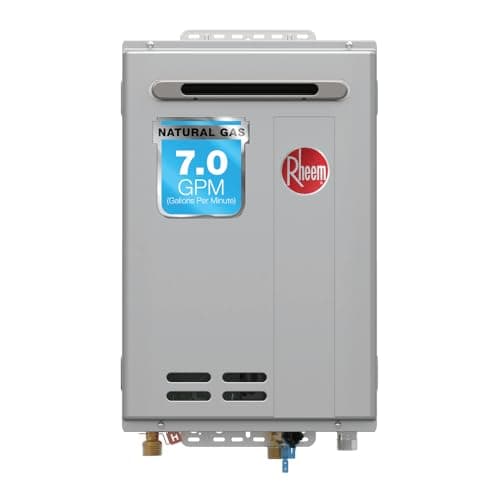
Rheem RTG Series 7.0 GPM Natural Gas Tankless Water Heater Outdoor: an honest flow-at-rise rating and no indoor vent, for mild-climate gas homes.
Key Specs
Flow (stated)
7.0 GPM at a 35°F temperature rise
Input (stated)
160,000 BTU per hour
Fuel
Natural gas
Efficiency (stated)
UEF 0.82, non-condensing
Venting (stated)
Outdoor installation, so no vent pipe
Protection (stated)
Freeze protection and flame failure protection
Pros
Cons
Suited to
A natural gas home in a mild climate that wants whole-house flow without a vent run through the walls
Our take
Rheem does what most tankless listings skip and gives its flow with the temperature rise: 7.0 GPM at a 35°F rise. That lets you do the sizing yourself. With the heat output fixed, flow shrinks in proportion as the rise grows, so a 60°F winter rise leaves about 4.1 GPM, enough for one shower and a sink or two low-flow showers. Mounting it outdoors removes the vent pipe, often the hardest and costliest part of a gas install. The trade-off is exposure to weather. The listing names freeze protection, but that kind of protection typically depends on power, so plan for a hard freeze during an outage. One bullet on this outdoor listing also mentions indoor installation, so confirm the model with your installer.
Affiliate link — commission at no extra cost to you
Compare elsewhere
What to know before you buy.
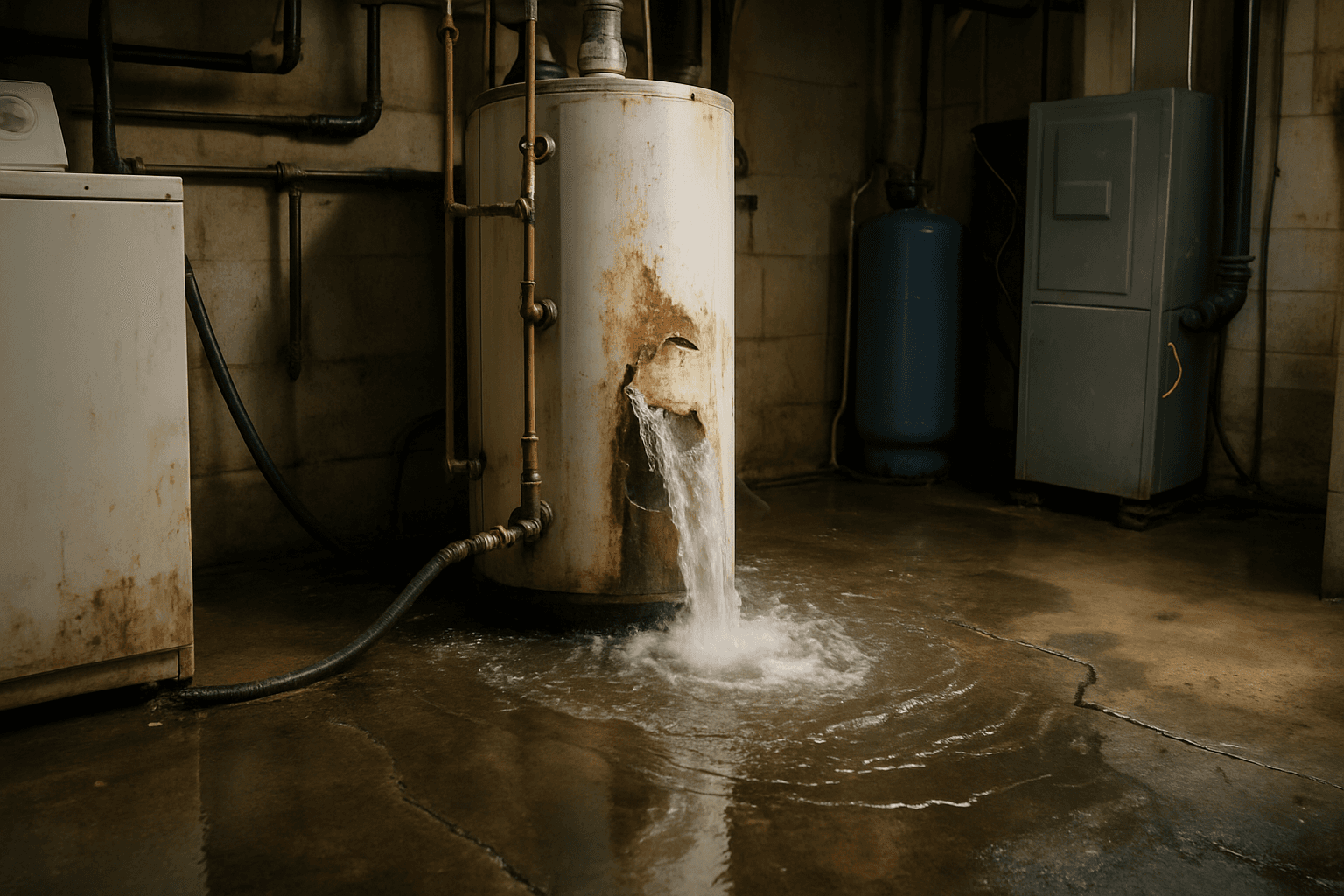
A tank water heater keeps 40 or 50 gallons of hot water under house pressure. When the steel tank finally rusts through, that water lands on the floor, and the cold supply keeps refilling the tank until someone closes the valve. A tankless unit removes the stored water, which is the main reason it belongs on a water-damage site. It does not remove every leak. The water fittings, the pressure relief valve and its discharge line, and the heat exchanger inside can all drip, and scale is a common cause of exchanger trouble. Condensing gas models also send a steady trickle of condensate to a drain. Set a leak alarm on the floor under the unit, and if you keep a tank, stand it in a drain pan. EPA advises drying water-damaged areas within 24 to 48 hours to prevent mold growth.
A tankless heater is sized by flow, in gallons per minute, at a given temperature rise. The rise is your set temperature minus the temperature of the water coming in, and that changes with the season and the region. Southern winter water may arrive near 60°F, while northern water can be closer to 40°F, so a 105°F shower needs a rise of anywhere from 45°F to 65°F. Rinnai's listing points buyers to a groundwater temperature map for this reason. Next, add up what runs at once. A US showerhead flows at most 2.5 GPM, WaterSense models 2.0 GPM or less, and a kitchen faucet often 1.5 to 2.2 GPM. For an electric unit, a quick estimate is kW × 6.8 ÷ rise. For gas, start from a rating given at a stated rise, such as Rheem's 7.0 GPM at 35°F, and scale it down for a larger rise.
An electric tankless heater draws heavy current while the water runs. Divide the watts by the voltage: a 24 kW unit at 240V pulls 100 amps, and an 18 kW unit pulls 75. That is why Rheem's 24 kW listing asks for three 40-amp double-pole breakers, three runs of #8 copper and a 200-amp service, while its 11 kW sibling, on one 50-amp breaker, is listed for a 100-amp panel. Many older homes have 100-amp service with little to spare, and a panel upgrade can add a large cost to the job. Before you buy, have an electrician do a load calculation. In return, electric units need no vent and no gas line, which keeps the install simpler, and they send no heat up a flue. Their limit is cold water: in a northern winter, even the largest electric pick here manages about one full-flow shower at a time.
A gas tankless heater burns far more fuel per minute than a tank heater does, so most of the work is in the hookup. The gas line has to carry the unit's full input, and a 160,000 BTU burner can need a larger line than the old tank used. Indoor units need a sealed vent to the outside, sized and routed to the maker's manual; Rinnai's Versa Vent takes an RX-OVC cap when the unit goes outdoors. Outdoor models such as the Rheem RTG skip the vent pipe entirely. Condensing units like the Rinnai RX199iN reach a higher UEF but produce acidic condensate that needs a drain, and sometimes a neutralizer. A badly vented gas appliance can put carbon monoxide into the house, so this is a job for a licensed installer, usually under a permit, with a CO alarm nearby.
Scale is the usual enemy of a tankless heater. Calcium and magnesium in hard water drop out when the water is heated, and they coat the narrow passages of the heat exchanger. Flow falls, the unit may show an error code, and a badly scaled exchanger can fail. Most makers call for periodic flushing with a descaling solution pumped through the unit, more often where water is hard, and your manual sets the interval. Ask the installer to fit isolation valves with service ports, because flushing without them means cutting into the pipes. Rinnai's listing names a Quick Flush feature meant to make the job simpler. Clean the small inlet filter screen at the same time. A water softener slows scale down, but it does not replace the flush.
Tankless is the wrong buy for some homes. If you are all-electric with a 100-amp panel, live where winter water is cold, and run two showers at once, a whole-house electric unit will disappoint, and a heat pump or standard tank heater may serve you better. If your only complaint is the wait for hot water at one far sink, a point-of-use unit like the Camplux is the smaller fix. Renters usually cannot change the heater at all. And if your current tank is leaking now, do not start shopping first. Close the cold supply valve above the heater, switch off its breaker or turn its gas control to off, and call a plumber. Water left under a heater wicks into drywall, baseboards and subfloor, and that is when a leak becomes a mold problem.
They are worth it when your fuel, wiring and hot-water habits fit one. A tankless unit removes the stored tank that can flood a basement, heats water only when a tap runs, and frees floor space.
The costs are a bigger install, periodic descaling, and a flow limit that cold winter water cuts further. A gas home with two or more bathrooms usually gains the most, and an all-electric home with a small panel and cold groundwater the least.
Size it by the flow you use at once at your winter temperature rise. Add up your fixtures, such as a 2.0 GPM shower plus a 1.5 GPM faucet for 3.5 GPM, then find the rise: 105°F minus your incoming water, often 45°F to 65°F.
For an electric unit, kW × 6.8 ÷ rise gives the flow, so 18 kW at a 45°F rise yields about 2.7 GPM. Gas units need a rating given at a stated rise.
Gas is better for a whole house with more than one bathroom, and electric is better for smaller loads or homes with no gas line. A gas burner supplies far more heat, so it holds more flow at a large winter rise; the Rinnai RX199iN lists up to 11.1 GPM.
Electric units need no vent or gas line, but a 24 kW model draws 100 amps. Your existing fuel and panel usually settle the question.
YesMinerals in the water build scale inside the heat exchanger, which cuts flow and can lead to a failure, so makers call for periodic flushing with a descaling solution.
Hard water needs it more often, and the manual gives the interval. Isolation valves with service ports turn it into a short job with a small pump, two hoses and a bucket. Clean the inlet filter screen while you are there.
YesAlthough it has no stored tank to empty, so the worst case is smaller. A failed fitting still leaks until the supply is shut off.
Leaks usually show up at the water connections, the pressure relief valve's discharge line, the condensate line on condensing models, or a scaled heat exchanger. Look under the unit for drips or white crust a few times a year, and keep a battery leak alarm on the floor below it.
Most do not. Electric units stop outright, and gas units also need household power for their controls, igniter and exhaust fan.
In a freezing outage the freeze protection stops as well, so ask the installer how to drain the unit if the power is out for long. A tank heater with a standing pilot light is the type that can keep giving hot water without electricity.
Call (888) 840-6512. The line is answered 24 hours a day, seven days a week, and connects you with an IICRC-certified water damage restoration company that serves your area. A recorded menu picks up first: choose water damage or mold, key in your 5-digit ZIP code, and hold through the short silence while the call is passed to the company.
Describe what you can see — where the water is coming from, how long it has been there, and whether it smells — the more specific you are, the faster the right company is on the line. If the source is a pipe or an appliance, shut the main water valve first. Have four things ready and the call goes quickly: the address, when the water started, what is wet now, and whether you have filed an insurance claim.
Still not sure which of these is your situation? (888) 840-6512 · toll-free · answered 24/7
Methodology: How we source and verify data · Report an error
Free 2-day shipping
Amazon Prime members pay no shipping on restoration equipment
Dehumidifiers, air movers, and moisture meters qualify for free Prime delivery — bulk items that otherwise cost $15–$40 to ship.
Affiliate link — HearthDry earns a bounty if you sign up; costs you nothing extra.

A drain pan sits under a tank water heater and catches drips from valves, fittings and a seeping tank, carrying them to a drain instead of across the floor. These picks are sized against the tank, matched to gas or electric heaters by what each listing states, and paired with an alarm and an automatic shutoff for the leak a pan cannot hold.
Read the comparisonA water pressure regulator comes in two very different kinds: a whole-house pressure reducing valve (PRV) that a plumber fits on the main line, and a small hose-thread regulator for an RV, a camper or a garden hose. These picks say plainly which kind each one is, compared on connection, stated adjustment range and what each listing leaves out, with the gauge test to run first and the expansion tank a PRV can make necessary.
Read the comparisonMost homeowners do not discover a leak until it has soaked into subfloor and drywall. A Wi-Fi water leak detector sends the alert to your phone while the water is still on the floor, whether or not anyone is home to hear a siren.
Read the comparisonA water leak detector catches a leak while it is still a puddle rather than an insurance claim. These four flood sensors and water alarms range from a standalone 110 dB alarm with no Wi-Fi to a LoRa kit that sounds on the spot and texts your phone.
Read the comparisonA smart water shutoff closes the supply when it detects a leak, so a burst pipe does not run for hours while nobody is home. The four systems here split into two designs: leak sensors that close the valve you already have, and valves on the main line that watch the flow itself.
Read the comparisonWhen a check valve or pressure-reducing valve closes your plumbing, the water a heater expands has nowhere to go, and house pressure spikes after every heating cycle. These expansion tanks are compared on size, stated pre-charge, pressure and temperature ratings and mounting, with the air-charge step most installs skip.
Read the comparisonA water heater's anode rod corrodes so the steel tank does not, and once the rod is gone the tank rusts from the inside until it weeps or splits. These picks are a powered rod, flexible magnesium and aluminum-zinc rods and a hot-water-outlet model compared from their listings and buyer ratings, with the clearance arithmetic, the smell question and the jobs that belong to a licensed plumber.
Read the comparison