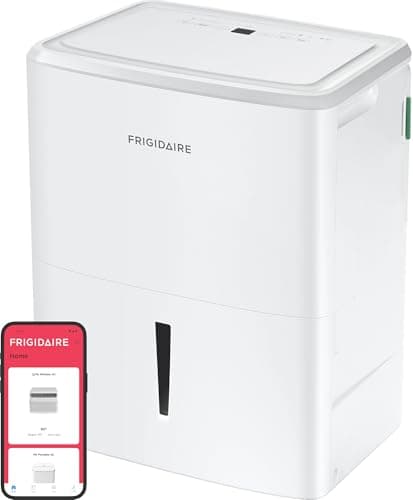
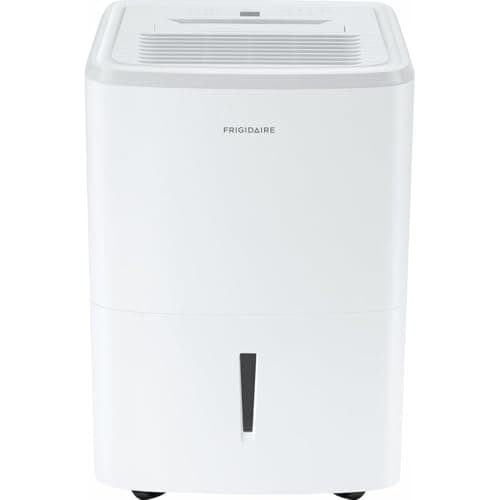
Best for: A damp basement or large living area where you want app control
- Capacity (stated):
- 50 pints per day; test conditions not stated on the listing
- Controls (stated):
- Wi-Fi; custom humidity control
Listing verified 13 Oct 2026

The 22, 35 and 50 Pint Models Compared From Their Listings, and What Those Listings Leave Out
5 picks compared · prices, ratings and stock checked October 12, 2026
Our Top Pick
For a damp basement or large room, the Frigidaire 50 Pint Dehumidifier with Wi-Fi. For a bedroom or bathroom, the Frigidaire 22-Pint Wi-Fi Dehumidifier, which is ENERGY STAR certified and lists operation down to 41°F.
4.3 on Amazon · 292 ratings
Quick answer
For most damp basements and large rooms, the Frigidaire to buy is the Frigidaire 50 Pint Dehumidifier with Wi-Fi, rated 4.3 stars across 292 Amazon ratings, the most-rated Frigidaire listing we found. For a bedroom or bathroom, choose the Frigidaire 22-Pint Wi-Fi Dehumidifier, which is ENERGY STAR certified and lists operation down to 41°F. This comparison is built from the listings, published specs and buyer ratings. Frigidaire's listings leave out test conditions and tank sizes, so check the product details before ordering. For a large, wet basement, look at an 80 pint unit instead.
Every pick below is currently stocked — ratings and stock read from Amazon on 12 October 2026.
Best for: A damp basement or large living area where you want app control
Listing verified 13 Oct 2026
Best for: A bedroom, bathroom or small room with a musty smell, including cool rooms
Listing verified 13 Oct 2026
Best for: A very damp medium room where 22 pints is too little and 50 is more than you need
Listing verified 13 Oct 2026
Best for: A smart-home user who wants schedules, fan control and finer filtration in a medium room
Listing verified 13 Oct 2026
Best for: A large or wet basement that needs more than Frigidaire's 50 pint listing offers
Listing verified 13 Oct 2026
How this page was made: we compare the current Amazon listings, the makers' published specs and what verified buyers report, then rank by fit for the job. Ratings, review counts and stock are read from Amazon and dated. We earn a commission on purchases through our links; it does not change the order. Reviewed by Marcus Reed, IICRC-certified Water Restoration Technician.
Full Reviews
Each pick in detail: what the listing states, what buyers report, and where it falls short.
Check price
on Amazon ↗
Listing verified 13 Oct 2026
See it on Amazon ↗Best Overall Frigidaire
Quick Verdict
Frigidaire 50 Pint Dehumidifier with Wi-Fi: Frigidaire's most-rated size for basements and large rooms, on a listing that leaves out drainage and test details.
Key Specs
Capacity (stated)
50 pints per day; test conditions not stated on the listing
Controls (stated)
Wi-Fi; custom humidity control
Filter (stated)
Washable filter
Drainage and tank size
Not stated on this listing
ENERGY STAR
Not stated on this listing
Noise and low-temperature rating
Not stated on this listing
Pros
Cons
Suited to
A damp basement or large living area where you want app control
Our take
This is the Frigidaire to start with, mainly because buyers have rated it more than any other Frigidaire listing we found. The listing itself says very little: 50 pints a day, Wi-Fi, custom humidity control and a washable filter. It does not say at what temperature and humidity the 50 pints was measured, whether there is a hose port, how big the bucket is or whether it carries the ENERGY STAR mark. Those details decide how it works in a basement. Before ordering, look in the product details or the manual for a continuous drain port and the ENERGY STAR label. If no floor drain sits lower than the unit, you will empty the bucket by hand, so its size matters.
Affiliate link — commission at no extra cost to you
Compare elsewhere
These open a search for this model. We quote prices only where we can verify them — Amazon, Sylvane and eBay.
Check price
on Amazon ↗
Listing verified 13 Oct 2026
See it on Amazon ↗Best Frigidaire for Small Rooms
Quick Verdict
Frigidaire 22-Pint Wi-Fi Dehumidifier: ENERGY STAR, a continuous drain option and a 41°F rating for bedrooms and bathrooms.
Key Specs
Capacity (stated)
22 pints per day; test conditions not stated
Room size (stated)
Small to medium rooms, bedrooms and bathrooms
Efficiency (stated)
ENERGY STAR certified
Low-temperature operation (stated)
Down to 41°F
Drainage (stated)
Removable bucket or continuous drain; auto shut-off when the bucket is full
Controls (stated)
Wi-Fi through the Frigidaire app; works with Amazon Alexa and Google Home; custom humidity setting
Pros
Cons
Suited to
A bedroom, bathroom or small room with a musty smell, including cool rooms
Our take
This is the most fully described Frigidaire listing, and the one to buy for a single room. It states ENERGY STAR certification, a continuous drain option, auto shut-off when the bucket is full, Wi-Fi with Alexa and Google Home, and operation down to 41°F. That last point matters in a cool bathroom or a spare room kept cold in winter. ENERGY STAR notes that frost can form on the coils below 65°F, so a stated low-temperature rating is worth having. Its sizing chart puts a slightly to moderately damp room under 2,000 sq ft at 20 to 30 pints a day, so 22 pints suits a bedroom or bathroom with a musty smell, not a room with sweating walls.
Affiliate link — commission at no extra cost to you
Compare elsewhere
Check price
on Amazon ↗
Listing verified 13 Oct 2026
See it on Amazon ↗Best Mid-Size Frigidaire
Quick Verdict
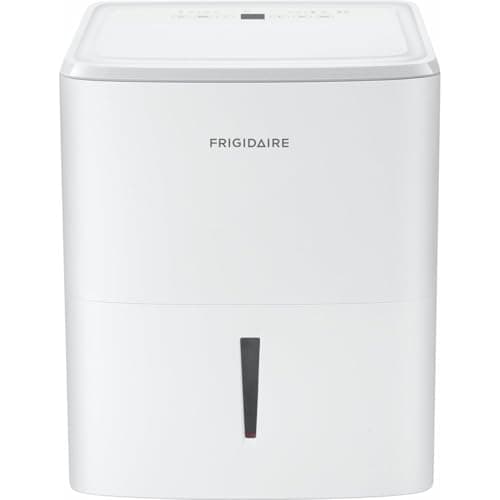
Frigidaire 35 Pint Dehumidifier: the in-between size for a very damp medium room, on a thin listing with a short buyer record.
Key Specs
Capacity (stated)
35 pints per day; test conditions not stated
Room size (stated)
Home, bedroom and medium rooms
Controls (stated)
Custom humidity control
Filter (stated)
Washable filter
Wi-Fi
Not stated on this listing
Drainage, tank size and ENERGY STAR
Not stated on this listing
Pros
Cons
Suited to
A very damp medium room where 22 pints is too little and 50 is more than you need
Our take
The 35 pint size fills the gap between a bedroom unit and a basement unit. On ENERGY STAR's chart, a very damp room under 2,000 sq ft, one that smells damp all the time and shows damp spots on walls or floors, calls for 25 to 40 pints a day, and this model sits in that range. The listing is short: capacity, custom humidity control and a washable filter. It does not mention Wi-Fi, drainage, tank size or ENERGY STAR, and its buyer record is still small. If you need this size, check the box or the manual for a continuous drain port before relying on it in a room you do not visit every day.
Affiliate link — commission at no extra cost to you
Compare elsewhere
Check price
on Amazon ↗
Listing verified 13 Oct 2026
See it on Amazon ↗Best Frigidaire for App Control and Filtration
Quick Verdict
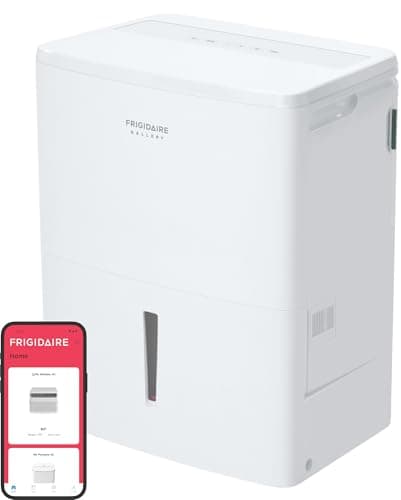
Frigidaire Gallery 35 Pint Smart Dehumidifier: a MERV 14 filter and full app control, with an ionizer to ask about and few ratings so far.
Key Specs
Capacity (stated)
35 pints per day; test conditions not stated
Filtration (stated)
MERV 14 air filter and a washable filter
Ionizer (stated)
Built-in clean air ionizer
App control (stated)
Frigidaire app: on/off, humidity level, modes, schedules and fan speeds
Voice control (stated)
Works with Amazon Alexa and the Google Assistant
Drainage, tank size and ENERGY STAR
Not stated on this listing
Pros
Cons
Suited to
A smart-home user who wants schedules, fan control and finer filtration in a medium room
Our take
Gallery is Frigidaire's step-up line, and this listing adds two features the plain 35 pint model does not mention: a MERV 14 air filter and a built-in ionizer, plus full app control with schedules and fan speeds. The filter is a real upgrade over a basic dust screen; EPA says filters rated MERV 13 and above must show at least 50% removal of the smallest particles tested. Still, a dehumidifier is not sized or rated as an air purifier, so treat the filter as a bonus. EPA also notes that air cleaners with ionizers may emit ozone in some cases, and this listing does not say whether the ionizer can be switched off. The buyer record is thin so far.
Affiliate link — commission at no extra cost to you
Compare elsewhere
Check price
on Amazon ↗
Listing verified 13 Oct 2026
See it on Amazon ↗If Not Frigidaire: Big, Wet Basements
Quick Verdict
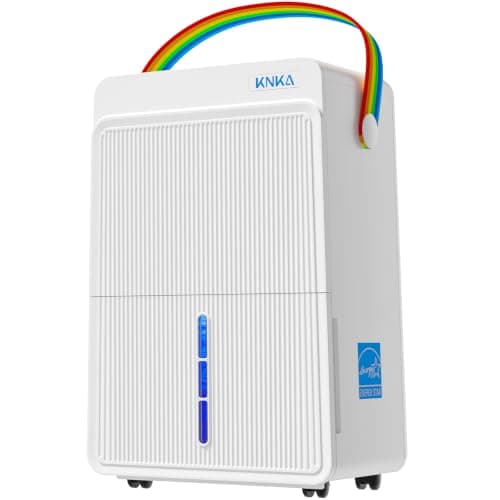
KNKA 80 Pint ENERGY STAR Dehumidifier: stated test conditions, a drain hose in the box and more capacity than any Frigidaire listing compared here.
Key Specs
Capacity (stated)
80 pints per day at 95°F and 95% RH; 56 pints per day at 86°F and 80% RH
Coverage (stated)
Up to 5,500 sq ft
Efficiency (stated)
ENERGY STAR certified
Drainage (stated)
1.45 gal tank; 6.56 ft hose for continuous drainage; optional 2.64 gal external tank sold separately
Humidity settings (stated)
30% to 80% RH; AUTO mode defaults to 50% RH
Noise (stated)
40 to 45 dB
Pros
Cons
Suited to
A large or wet basement that needs more than Frigidaire's 50 pint listing offers
Our take
This is the if-not-Frigidaire pick, included because the Frigidaire listings here stop at 50 pints and say little about drainage. KNKA states what Frigidaire does not. Its listing gives 80 pints a day at 95°F and 95% RH, and 56 pints at 86°F and 80% RH, which shows how fast capacity falls as air cools and dries; a 65°F basement will see less still. It comes with a 6.56 ft drain hose for continuous drainage, a 1.45 gal tank, ENERGY STAR certification and a 30% to 80% RH setting range. ENERGY STAR's chart puts a wet space over 2,000 sq ft at 50 pints a day or more, which is where this unit earns its size.
Affiliate link — commission at no extra cost to you
Compare elsewhere
What to know before you buy.
This page compares Frigidaire's current dehumidifier listings on Amazon using what each listing states and the buyer ratings shown when we read them on 12 October 2026. Frigidaire's listings are short. Most state the pint size, a washable filter and custom humidity control, and stop there. The 22-Pint Wi-Fi model is the exception, listing ENERGY STAR certification, a continuous drain option, auto shut-off and operation down to 41°F. None of the Frigidaire listings state the temperature and humidity behind their pint figure, the bucket size, a noise level or a pump. A gap on a listing does not prove a feature is missing; it means you should read the product details, the manual or the box before ordering. Look for three things: a continuous drain port, the ENERGY STAR mark and the lowest operating temperature.
A pint rating means little without the temperature and humidity it was measured at. The US Department of Energy test used for efficiency ratings since 2019 runs at 65°F and 60% relative humidity, roughly a cool, damp basement. Many makers also quote a far higher figure measured in hot, saturated air. KNKA's listing shows the gap plainly: 80 pints a day at 95°F and 95% RH, but 56 pints at 86°F and 80% RH. Frigidaire's listings give a single number with no conditions, so you cannot tell which test produced it. Compare models on the same basis, and expect any unit to remove less water in a cool basement than its headline suggests. ENERGY STAR adds that frost can form on the coils when the air drops below 65°F, which is why a stated low-temperature rating such as the 22-Pint's 41°F is useful.
ENERGY STAR sizes dehumidifiers by how damp a space is and whether it is under or over 2,000 sq ft. A slightly to moderately damp space, with a musty odor that comes and goes and 50% to 75% relative humidity, calls for 20 to 30 pints a day in the smaller size and 30 or more in the larger. A very damp space, which smells damp all the time and shows damp spots on walls and floors, calls for 25 to 40 pints, or 40 or more. A wet space, where walls or floors sweat or seepage is present, calls for 30 to 50 pints, or 50 or more. In Frigidaire terms, the 22 pint covers the first row in a bedroom or bathroom, the 35 pint the middle row, and the 50 pint the wet row. ENERGY STAR's own rule of thumb is that it is better to oversize than undersize.
A dehumidifier pulls water out of the air, and that water has to go somewhere. With the bucket, you empty it by hand, and a full bucket stops the unit until you do, so a humid basement goes undried while you are away. Continuous drainage runs a hose from a port on the unit to a floor drain, sump or utility sink that sits lower than the port, because gravity does the work. The Frigidaire 22-Pint lists a continuous drain option; the other Frigidaire listings here do not mention one, so check before ordering. None of the Frigidaire models compared here list a pump. If your only drain is a sink higher than the unit, or the water must travel up and out of a basement, look at a dehumidifier with a built-in pump. Keep drain hoses away from electrical cords and connections, as ENERGY STAR advises.
A portable dehumidifier holds a room at a healthy humidity; it does not dry out a house after a leak. If a pipe has burst or the basement has taken on water, wet drywall, carpet pad and framing need extraction, air movers and drying equipment sized for the job, and often a restoration company. EPA advises drying water-damaged areas and items within 24 to 48 hours to prevent mold growth, which a 22 or 50 pint unit cannot manage alone. A dehumidifier also does not remove mold that is already growing; EPA says a moldy patch under about 10 square feet is usually a job you can handle yourself, and beyond that, get help. A crawl space needs a unit built for crawl spaces, and a house with damp air in every room is better served by a ducted whole-house system.
Set the humidity control, then leave it alone. EPA advises keeping indoor humidity below 60 percent, ideally between 30 and 50 percent, and ENERGY STAR suggests 30% to 40% in colder seasons to prevent window condensation. Close the doors and windows to the room while the unit runs, as ENERGY STAR advises, or it spends its effort drying the outdoors. Leave space around the unit so air reaches the intake and exhaust, and keep it away from dust sources that clog coils and grilles. Rinse the washable filter on a schedule; on the 22-Pint, the filter alert does the reminding. Check the reading against a separate hygrometer now and then, since the built-in sensor sits in the unit's own airflow. Warm air coming off the unit is normal.
YesFor everyday room and basement humidity, judging by buyer ratings, though the current Amazon listings say little about performance.
The 50 pint Wi-Fi model has the strongest buyer record of the Frigidaire listings we found, and the 22-Pint Wi-Fi listing is the most fully described. Look up what the listings leave out, such as test conditions, tank size and drainage, in the product details or manual before buying.
YesYears ago. Frigidaire-branded dehumidifiers made by Gree were among the brands in a recall announced by the US Consumer Product Safety Commission in 2013 and expanded in 2014, over overheating and fire risk.
It covered older units. If you own an older or second-hand Frigidaire, read the model number on its label and look it up on the CPSC recall site before running it.
Pick by dampness and room size. ENERGY STAR's chart calls for 20 to 30 pints a day in a slightly damp room under 2,000 sq ft, 25 to 40 in a very damp one and 30 to 50 in a wet one, with more for larger spaces.
That points to the 22 pint for a bedroom or bathroom, the 35 pint for a very damp medium room and the 50 pint for a wet basement. When in doubt, go bigger.
Use the continuous drain port, if your model has one, and run a hose downhill to a floor drain or sump. The Frigidaire 22-Pint listing states a continuous drain option; the other Frigidaire listings compared here do not mention one, so check the manual for the port and the hose size it takes.
Gravity drainage works only when the drain sits lower than the port. If it does not, you need a model with a built-in pump.
Somewhere between 30% and 50% for most homes, and never above 60%. EPA advises keeping indoor humidity below 60 percent, ideally 30 to 50 percent, to prevent mold growth.
In cold weather, ENERGY STAR suggests 30% to 40% so windows do not run with condensation. Many people hold a basement near 50%. Confirm the room's level with a separate hygrometer rather than trusting the unit's display alone.
Some models do, down to a point. The Frigidaire 22-Pint Wi-Fi listing states operation down to 41°F; the other Frigidaire listings here give no low-temperature figure.
ENERGY STAR notes that frost can form on the coils below 65°F and suggests a unit rated for lower temperatures in a space that usually runs cooler than that. Expect less water removed per day in a cool basement than the pint rating suggests.
Call (888) 840-6512. The line is answered 24 hours a day, seven days a week, and connects you with an IICRC-certified water damage restoration company that serves your area. A recorded menu picks up first: choose water damage or mold, key in your 5-digit ZIP code, and hold through the short silence while the call is passed to the company.
Describe what you can see — where the water is coming from, how long it has been there, and whether it smells — the more specific you are, the faster the right company is on the line. If the source is a pipe or an appliance, shut the main water valve first. Have four things ready and the call goes quickly: the address, when the water started, what is wet now, and whether you have filed an insurance claim.
Still not sure which of these is your situation? (888) 840-6512 · toll-free · answered 24/7
Methodology: How we source and verify data · Report an error
Free 2-day shipping
Amazon Prime members pay no shipping on restoration equipment
Dehumidifiers, air movers, and moisture meters qualify for free Prime delivery — bulk items that otherwise cost $15–$40 to ship.
Affiliate link — HearthDry earns a bounty if you sign up; costs you nothing extra.

The right dehumidifier for a home depends on the size of the space and how damp it is, and the pint number on the box depends on which test produced it. These five picks run from a 22-pint single-room unit to an 80-pint machine for a whole basement, compared on the figures their listings actually state.
Read the comparisonMost basement dehumidifier disappointment comes from two numbers nobody reads properly: the pint rating, measured at warm test conditions a 60°F basement never reaches, and the drainage method. Five units are compared here on those two points first, from a garden-hose drain to a built-in pump with a stated 15 ft lift.
Read the comparisonA built-in pump is the answer when the only drain is above the dehumidifier: a laundry sink, a standpipe or a window. It is only an answer if it can lift water that high, and two of the four listings here state a lift height while two do not.
Read the comparisonA bedroom dehumidifier has to be quiet enough to sleep beside, and five of the six picks here are thermoelectric units that remove ounces of water a day rather than pints. That is enough for a stuffy bedroom, closet or studio apartment; for a room with wet windows every morning, the sixth pick is a small compressor unit rated in pints.
Read the comparisonA hygrometer is the small, inexpensive instrument that tells you whether a room needs a dehumidifier, a humidifier or nothing at all. These picks are judged on the accuracy each listing states, how easily you can read them, and whether they can warn you about a damp basement before you smell it.
Read the comparison